
Homework Answers

Add Answer to:
7) In lecture we proved one of the following using the definitions of unions intersections, and...
no need to answer part a. (1) In week 4, Lecture 1 we saw 7 remarks...
 no
need to answer part a.
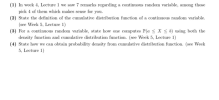
(1) In week 4, Lecture 1 we saw 7 remarks regarding a continuous random variable, among those pick 4 of them which makes sense for you. (2) State the definition of the cumulative distribution function of a continuous random variable. (see Week 5, Lecture 1) (3) For a continuous random variable, state how one computes P(a < X < b) using both the density function and cumulative distribution function. (see Week 5, Lecture 1)...
no
need to answer part a.
(1) In week 4, Lecture 1 we saw 7 remarks regarding a continuous random variable, among those pick 4 of them which makes sense for you. (2) State the definition of the cumulative distribution function of a continuous random variable. (see Week 5, Lecture 1) (3) For a continuous random variable, state how one computes P(a < X < b) using both the density function and cumulative distribution function. (see Week 5, Lecture 1)...
(Discrete Math) Read the following combinatorial proof, and write a theorem that we proved. Explain it...
(Discrete Math) Read the following combinatorial proof, and write a theorem that we proved. Explain it in details. We count the number of k+1 element subsets of [n+1]. On one hand, it is clearly C(n+1,k+1). On the other hand, we can count these subsets in two steps. First we count the subsets that contain the number n+1. Since have to choose another k elements from {1,2,...,n} for it to make a k+1-element set, the number of these is C(n,k). Then...
5. Derive the equation of motion for Example 3 in Lecture 7 using the conservation of...
 5. Derive the equation of motion for Example 3 in Lecture 7 using the conservation of energy approach. We were unable to transcribe this image
Problem 5 of 7 Consider the standard definitions of sum of squared deviations in the two types of one factor ANOVA discussed in this unit. Prove the following. 1. SST = SSA +SSE (completely randomize...
 Problem 5 of 7 Consider the standard definitions of sum of squared deviations in the two types of one factor ANOVA discussed in this unit. Prove the following. 1. SST = SSA +SSE (completely randomized ANOVA) 2. SST SSA +SSB SSE (randomized complete block ANOVA) 3. Prove the two alternative formulas for calculating the SSA,SSE,SST in the completely randomized ANOVA. Provide a justification of why someone may prefer to use these formulas against the others that calculate the sum of...
When 1) Using a set of values from 0 to 10, perform the following unions using...
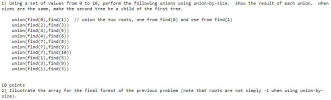 When 1) Using a set of values from 0 to 10, perform the following unions using union-by-size. Show the result of each union. sizes are the same, make the second tree be a child of the first tree. union(find(), find(1)) // union the two roots, one from find(e) and one from find(1) union(find(2), find (3) union(find(4), find(5)) union(find(4), find (6) union(find(7), find (8) union(find(7), find (9)) union(find(7), find (10) union(find(1), find(5)) union(find(3), find (9)) union(find(1), find (3) 10 points 2)...
Problem 5 of 7 Consider the standard definitions of sum of squared deviations in the two types of one factor ANOVA discussed in this unit. Prove the following. 1. SST SSA+SSE (completely randomized A...
 Problem 5 of 7 Consider the standard definitions of sum of squared deviations in the two types of one factor ANOVA discussed in this unit. Prove the following. 1. SST SSA+SSE (completely randomized ANOVA) 2. SST-SSA+SS SSE (randomized complete block ANOVA) 3. Prove the two alternative formulas for calculating the SSA, SSE, SSr in the completely randomized ANOVA. Provide a justification of why someone may prefer to use these formulas against the others others that calculate the sum of squared...
Balance the following equation using the 7 steps discussed in the lecture and book. _Cu(s) +...
 Balance the following equation using the 7 steps discussed in the lecture and book. _Cu(s) + _H*(aq) + _NO3 (aq) --> _NO(g) + _H2O(l) + - Cu2+(aq) The coefficients for the balanced reaction are:
7. Prove the following assertions by using the definitions of the notations in- volved, or dispro...
 7. Prove the following assertions by using the definitions of the notations in- volved, or disprove them by giving a specific counterexample. a. If t(n) e (g(n)), then g(n) E S2(t(n I. Θ(gg(n))-e(g(n)), where α > 0. c. Θ(g(n))-: 0(g(n))n Ω (g(n)). d. For any two nonnegative functions t (n) and g(n) defined on the set of nonnegative integers, either t (n) e 0(g(n)), or t (n) e Ω(g(n)), or both
7. Prove the following assertions by using the definitions...
7. Prove the following assertions by using the definitions of the notations in- volved, or disprove them by giving a specific counterexample. a. If t(n) e (g(n)), then g(n) E S2(t(n I. Θ(gg(n))-e(g(n)), where α > 0. c. Θ(g(n))-: 0(g(n))n Ω (g(n)). d. For any two nonnegative functions t (n) and g(n) defined on the set of nonnegative integers, either t (n) e 0(g(n)), or t (n) e Ω(g(n)), or both
7. Prove the following assertions by using the definitions...
1. Consider the pendulum model that we discussed in class. It's also on page 71 of the lecture notes 4. Again, for simplicity, we assume m-1-1-1 Suppose in addition we consider a damping force of...
 1. Consider the pendulum model that we discussed in class. It's also on page 71 of the lecture notes 4. Again, for simplicity, we assume m-1-1-1 Suppose in addition we consider a damping force of this model as follows. The magnitude of the damping force is proptional to angular velocity while its direction is opposite to the one of the angular velocity. For simplicity, we may assume the damping force to be -' Then the net external torque become τ...
7. (5pts) of the reducing agents that we discussed during lecture, what would you use to...
 7. (5pts) of the reducing agents that we discussed during lecture, what would you use to reduce an amide? 8.(12 pts) Draw a detailed stepwise mechanism for the following reaction. Must include ALL steps. 1) Br, hv 2) Mg(s) 3) OH 요 4) H30+
 no
need to answer part a.
(1) In week 4, Lecture 1 we saw 7 remarks regarding a continuous random variable, among those pick 4 of them which makes sense for you. (2) State the definition of the cumulative distribution function of a continuous random variable. (see Week 5, Lecture 1) (3) For a continuous random variable, state how one computes P(a < X < b) using both the density function and cumulative distribution function. (see Week 5, Lecture 1)...
no
need to answer part a.
(1) In week 4, Lecture 1 we saw 7 remarks regarding a continuous random variable, among those pick 4 of them which makes sense for you. (2) State the definition of the cumulative distribution function of a continuous random variable. (see Week 5, Lecture 1) (3) For a continuous random variable, state how one computes P(a < X < b) using both the density function and cumulative distribution function. (see Week 5, Lecture 1)...
 5. Derive the equation of motion for Example 3 in Lecture 7 using the conservation of energy approach. We were unable to transcribe this image
 Problem 5 of 7 Consider the standard definitions of sum of squared deviations in the two types of one factor ANOVA discussed in this unit. Prove the following. 1. SST = SSA +SSE (completely randomized ANOVA) 2. SST SSA +SSB SSE (randomized complete block ANOVA) 3. Prove the two alternative formulas for calculating the SSA,SSE,SST in the completely randomized ANOVA. Provide a justification of why someone may prefer to use these formulas against the others that calculate the sum of...
 When 1) Using a set of values from 0 to 10, perform the following unions using union-by-size. Show the result of each union. sizes are the same, make the second tree be a child of the first tree. union(find(), find(1)) // union the two roots, one from find(e) and one from find(1) union(find(2), find (3) union(find(4), find(5)) union(find(4), find (6) union(find(7), find (8) union(find(7), find (9)) union(find(7), find (10) union(find(1), find(5)) union(find(3), find (9)) union(find(1), find (3) 10 points 2)...
 Problem 5 of 7 Consider the standard definitions of sum of squared deviations in the two types of one factor ANOVA discussed in this unit. Prove the following. 1. SST SSA+SSE (completely randomized ANOVA) 2. SST-SSA+SS SSE (randomized complete block ANOVA) 3. Prove the two alternative formulas for calculating the SSA, SSE, SSr in the completely randomized ANOVA. Provide a justification of why someone may prefer to use these formulas against the others others that calculate the sum of squared...
 Balance the following equation using the 7 steps discussed in the lecture and book. _Cu(s) + _H*(aq) + _NO3 (aq) --> _NO(g) + _H2O(l) + - Cu2+(aq) The coefficients for the balanced reaction are:
 7. Prove the following assertions by using the definitions of the notations in- volved, or disprove them by giving a specific counterexample. a. If t(n) e (g(n)), then g(n) E S2(t(n I. Θ(gg(n))-e(g(n)), where α > 0. c. Θ(g(n))-: 0(g(n))n Ω (g(n)). d. For any two nonnegative functions t (n) and g(n) defined on the set of nonnegative integers, either t (n) e 0(g(n)), or t (n) e Ω(g(n)), or both
7. Prove the following assertions by using the definitions...
7. Prove the following assertions by using the definitions of the notations in- volved, or disprove them by giving a specific counterexample. a. If t(n) e (g(n)), then g(n) E S2(t(n I. Θ(gg(n))-e(g(n)), where α > 0. c. Θ(g(n))-: 0(g(n))n Ω (g(n)). d. For any two nonnegative functions t (n) and g(n) defined on the set of nonnegative integers, either t (n) e 0(g(n)), or t (n) e Ω(g(n)), or both
7. Prove the following assertions by using the definitions...
 1. Consider the pendulum model that we discussed in class. It's also on page 71 of the lecture notes 4. Again, for simplicity, we assume m-1-1-1 Suppose in addition we consider a damping force of this model as follows. The magnitude of the damping force is proptional to angular velocity while its direction is opposite to the one of the angular velocity. For simplicity, we may assume the damping force to be -' Then the net external torque become τ...
 7. (5pts) of the reducing agents that we discussed during lecture, what would you use to reduce an amide? 8.(12 pts) Draw a detailed stepwise mechanism for the following reaction. Must include ALL steps. 1) Br, hv 2) Mg(s) 3) OH 요 4) H30+
Most questions answered within 3 hours.
-
Where is the error in this code sequence?
String s1 = "Hello";
String s2 = "ello";...
asked 11 months ago -
Financial data for Joel de Paris, Inc., for last year
follow:
Joel de Paris, Inc.
Balance...
asked 11 months ago -
Consider this reaction:
Al2(SO4)3 (aq)+ BaCl3
(aq) Al2Cl6 (aq)- +
3BaSO4(s) . What is the...
asked 11 months ago -
Suppose that Savneet is considering increasing her
recent random sample from 20 car rentals to 40...
asked 11 months ago -
Trucks arrive at an unloading terminal at an average rate of 120
per hour.
Trucks arrive...
asked 11 months ago -
Why are methanol and ethanol completely soluble in water while
octanol is not very little soluble....
asked 11 months ago -
A facilities manager at a university reads in a research report
that the mean amount of...
asked 11 months ago -
When the CuSO4 is rehydrated by adding water to the anhydrous
compound, is this an endothermic...
asked 11 months ago -
A ray of sunlight is passing from diamond into crown glass; the
angle of incidence is...
asked 11 months ago -
A block of mass 0.249 kg is placed on top of a light, vertical
spring of...
asked 11 months ago -
how do the kidneys compensate in the presences of acidosis
a) trigger hyperventilate
b) reserve acid...
asked 11 months ago -
Question 501 pts
The rental rate of capital to the firm increases. Which of the
following...
asked 11 months ago