The drawing shows a lower leg being exercised. It has a 52-N weight attached to the...
The drawing shows a lower leg being exercised. It has a 52-N weight attached to the foot and is extended at an angle θ with respect to the vertical. Consider a rotational axis at the knee. (a) When θ = 90.0°, find the magnitude of the torque that the weight creates. N · m (b) At what angle θ does the magnitude of the torque equal 12 N · m? °
Homework Answers

Add Answer to:
The drawing shows a lower leg being exercised. It has a 52-N
weight attached to the...
The figure shows a lower leg being exercised. It has a 49-N weight attached to the...
The figure shows a lower leg being exercised. It has a 49-N weight attached to the foot and is extended at an angle with respect to the vertical. Consider a rotational axis at the knee, as indicated. (a) When = 52°, find the magnitude of the torque that the weight creates. (b) At what angle does the magnitude of the torque have a value of 13 N·m?
The ngure shows a lower leg being exercised. It has 47-N weight attached to the root...
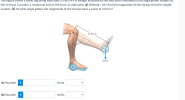 The ngure shows a lower leg being exercised. It has 47-N weight attached to the root and is extended at an angled with respect to the vertical. Consider a rotational axis at the knee, as indicated. (a) When 4 = 46°, find the magnitude of the torque that the weight creates. (b) At what angle does the magnitude of the torque have a value of 14 N.m? Axis 0.55 m 49 N (a) Number i Units (b) Number i Units
KIN 3112 Homework #3 Perform a dynamic analysis for a knee extension movement. The knee extensors...
 KIN 3112 Homework #3 Perform a dynamic analysis for a knee extension movement. The knee extensors insert on the tibia at an angle 0-30° and at a distance d-5.2 cm from the axis of rotation of the knee. The combined weight of lower leg and foot is F 48 N and its center of mass is r 0.27 m away from the knee joint axis. The joint angle with respect to the left horizontal is A-70 (Note: this is not...
A person is sitting with one leg outstretched and stationary, so that it makes an angle...
 A person is sitting with one leg outstretched and stationary, so that it makes an angle of 30.0° with the horizontal, as the drawing indicates. The weight of the leg below the knee is 45.0 N, with the center of gravity located below the knee joint. The leg is being held in this position because of the force M applied by the quadriceps muscle, which is attached 0.100 m below the knee joint (see the drawing). Obtain the magnitude of...
An ACL patient is doing leg extensions to strengthen his quadriceps muscles. With no additional weight...
 An ACL patient is doing leg extensions to strengthen his quadriceps muscles. With no additional weight added, the patient's lower leg (shank+foot) has a mass of 6.25 kg. The center of mass of the lower leg segment is located 32 cm from the axis of rotation of the knee joint. The leg is flexed 25 degree down from horizontal. The quadriceps muscle acts through the patellar tendon, which inserts 5 cm from the axis of rotation of the knee joint...
PROBLEM 2 Knee Extension - The angular motion of the lower leg about the knee joint,...
 PROBLEM 2 Knee Extension - The angular motion of the lower leg about the knee joint, and the forces and torques produced by the muscles crossing the knee joint during knee flexions and extensions have been investigated by a number of researchers utilizing different experimental techniques. One of these techniques is discussed here. Consider the person illustrated in Fig. 10.12. The test subject is sitting on a table, with the back placed against a back rest and the lower legs...
The drawing shows a uniform horizontal beam attached to a vertical wall by a frictionless hinge...
The drawing shows a uniform horizontal beam attached to a vertical wall by a frictionless hinge and supported from below at an angle ? = 44o by a brace that is attached to a pin. The beam has a weight of 338 N. Three additional forces keep the beam in equilibrium. The brace applies a force P ¯ to the right end of the beam that is directed upward at the angle ? with respect to the horizontal. The hinge...
Stuggling on this physis question! The drawing shows a uniform horizontal beam attached to a vertical...
 Stuggling on this physis question!
The drawing shows a uniform horizontal beam attached to a vertical wall by a frictionless hinge and supported from below at an angle theta = 35degree by a brace that is attached to a pin. The beam has a weight of 342 N. Three additional forces keep the beam in equilibrium. The brace applies a force P to the right end of the beam that is directed upward at the angle theta with respect to...
Stuggling on this physis question!
The drawing shows a uniform horizontal beam attached to a vertical wall by a frictionless hinge and supported from below at an angle theta = 35degree by a brace that is attached to a pin. The beam has a weight of 342 N. Three additional forces keep the beam in equilibrium. The brace applies a force P to the right end of the beam that is directed upward at the angle theta with respect to...
13 Figure 12-31 shows the anatomical structures in the lower leg and foot that are involved...
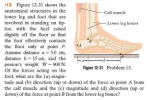 13 Figure 12-31 shows the anatomical structures in the lower leg and foot that are involved in standing on tip- toe, with the heel raisecd slightly off the loor so that the foot effectively contacts the floor only at point P. Assume distance a- 50 cm, distance b 15 cm, and the Calf muscle Lower leg hones person's weight W 900 N. Of the forces acting on the foot, what are the (a) magni tude and (b) direction (up or...
The figure shows a jet engine suspended beneath the wing of an airplane. The weight W...
 The figure shows a jet engine suspended beneath the wing of an airplane. The weight W of the engine is 13600 N and acts as shown in the figure. In flight the engine produces a thrust 7 of 61000 N that is parallel to the ground. The rotational axis in the figure is perpendicular to the plane of the paper. With respect to this axis, find the magnitude of the torque due to (a) the weight and (b) the thrust....
 The ngure shows a lower leg being exercised. It has 47-N weight attached to the root and is extended at an angled with respect to the vertical. Consider a rotational axis at the knee, as indicated. (a) When 4 = 46°, find the magnitude of the torque that the weight creates. (b) At what angle does the magnitude of the torque have a value of 14 N.m? Axis 0.55 m 49 N (a) Number i Units (b) Number i Units
 KIN 3112 Homework #3 Perform a dynamic analysis for a knee extension movement. The knee extensors insert on the tibia at an angle 0-30° and at a distance d-5.2 cm from the axis of rotation of the knee. The combined weight of lower leg and foot is F 48 N and its center of mass is r 0.27 m away from the knee joint axis. The joint angle with respect to the left horizontal is A-70 (Note: this is not...
 A person is sitting with one leg outstretched and stationary, so that it makes an angle of 30.0° with the horizontal, as the drawing indicates. The weight of the leg below the knee is 45.0 N, with the center of gravity located below the knee joint. The leg is being held in this position because of the force M applied by the quadriceps muscle, which is attached 0.100 m below the knee joint (see the drawing). Obtain the magnitude of...
 An ACL patient is doing leg extensions to strengthen his quadriceps muscles. With no additional weight added, the patient's lower leg (shank+foot) has a mass of 6.25 kg. The center of mass of the lower leg segment is located 32 cm from the axis of rotation of the knee joint. The leg is flexed 25 degree down from horizontal. The quadriceps muscle acts through the patellar tendon, which inserts 5 cm from the axis of rotation of the knee joint...
 PROBLEM 2 Knee Extension - The angular motion of the lower leg about the knee joint, and the forces and torques produced by the muscles crossing the knee joint during knee flexions and extensions have been investigated by a number of researchers utilizing different experimental techniques. One of these techniques is discussed here. Consider the person illustrated in Fig. 10.12. The test subject is sitting on a table, with the back placed against a back rest and the lower legs...
 Stuggling on this physis question!
The drawing shows a uniform horizontal beam attached to a vertical wall by a frictionless hinge and supported from below at an angle theta = 35degree by a brace that is attached to a pin. The beam has a weight of 342 N. Three additional forces keep the beam in equilibrium. The brace applies a force P to the right end of the beam that is directed upward at the angle theta with respect to...
Stuggling on this physis question!
The drawing shows a uniform horizontal beam attached to a vertical wall by a frictionless hinge and supported from below at an angle theta = 35degree by a brace that is attached to a pin. The beam has a weight of 342 N. Three additional forces keep the beam in equilibrium. The brace applies a force P to the right end of the beam that is directed upward at the angle theta with respect to...
 13 Figure 12-31 shows the anatomical structures in the lower leg and foot that are involved in standing on tip- toe, with the heel raisecd slightly off the loor so that the foot effectively contacts the floor only at point P. Assume distance a- 50 cm, distance b 15 cm, and the Calf muscle Lower leg hones person's weight W 900 N. Of the forces acting on the foot, what are the (a) magni tude and (b) direction (up or...
 The figure shows a jet engine suspended beneath the wing of an airplane. The weight W of the engine is 13600 N and acts as shown in the figure. In flight the engine produces a thrust 7 of 61000 N that is parallel to the ground. The rotational axis in the figure is perpendicular to the plane of the paper. With respect to this axis, find the magnitude of the torque due to (a) the weight and (b) the thrust....
Most questions answered within 3 hours.
-
Where is the error in this code sequence?
String s1 = "Hello";
String s2 = "ello";...
asked 10 months ago -
Financial data for Joel de Paris, Inc., for last year
follow:
Joel de Paris, Inc.
Balance...
asked 10 months ago -
Consider this reaction:
Al2(SO4)3 (aq)+ BaCl3
(aq) Al2Cl6 (aq)- +
3BaSO4(s) . What is the...
asked 10 months ago -
Suppose that Savneet is considering increasing her
recent random sample from 20 car rentals to 40...
asked 10 months ago -
Trucks arrive at an unloading terminal at an average rate of 120
per hour.
Trucks arrive...
asked 10 months ago -
Why are methanol and ethanol completely soluble in water while
octanol is not very little soluble....
asked 10 months ago -
A facilities manager at a university reads in a research report
that the mean amount of...
asked 10 months ago -
When the CuSO4 is rehydrated by adding water to the anhydrous
compound, is this an endothermic...
asked 10 months ago -
A ray of sunlight is passing from diamond into crown glass; the
angle of incidence is...
asked 10 months ago -
A block of mass 0.249 kg is placed on top of a light, vertical
spring of...
asked 10 months ago -
how do the kidneys compensate in the presences of acidosis
a) trigger hyperventilate
b) reserve acid...
asked 10 months ago -
Question 501 pts
The rental rate of capital to the firm increases. Which of the
following...
asked 10 months ago