

Homework Answers



Add Answer to:
4. Consider the potential step shown below with a beam of particles incident from the left....
A beam of particles of energy E is incident from the left on a downward step...
A beam of particles of energy E is incident from the left on a downward step potential of depth -2E. What is the reflection coefficient of this beam?
Consider a particle incident from the left on the potential step. Where E = 2 eV...
 Consider a particle incident from the left on the potential step. Where E = 2 eV V(x) {5 eV lo x < 0 x > 0 1) Find the wave function of the particle in two regions 2) Find reflection and transmission coefficients R and T
toward a Problem 4 (30 points): Consider a current of particles of energy E moving from...
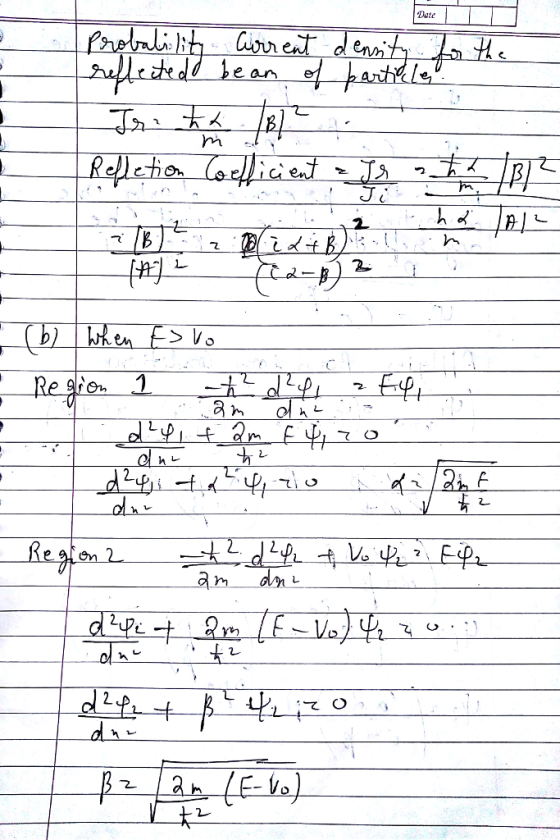
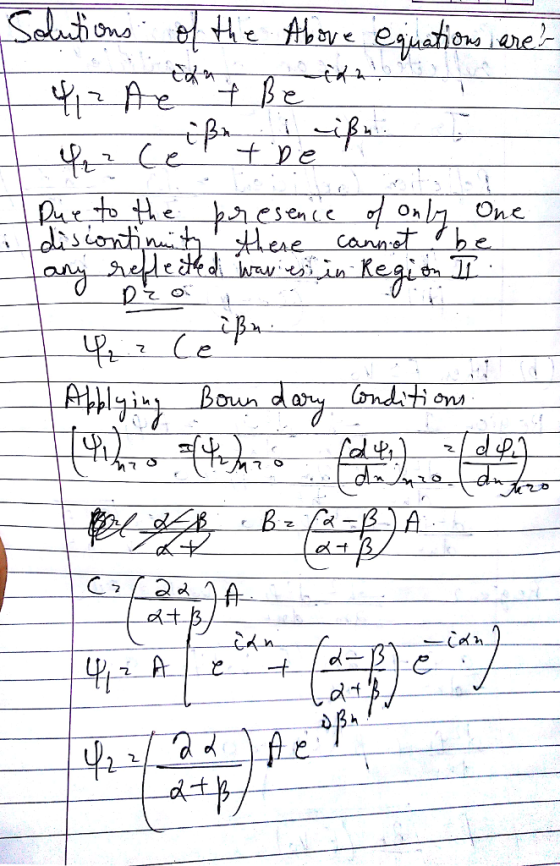
 toward a Problem 4 (30 points): Consider a current of particles of energy E moving from x = - potential step as shown in the figure. x > 0 V(x) = {v. x<0 TE Where E > V a) (8 points) Derive the general solution of Schrödinger equation for x < 0 and for x > 0 b) (14 points) Apply the boundary conditions and calculate the transmission and the reflection coefficients. c) (8 points) What is the value of...
A beam of particles, each of the same mass and the same energy, travels in the positive r-direction. The beam is incide...
 A beam of particles, each of the same mass and the same energy, travels in the positive r-direction. The beam is incident on an abrupt potential energy step at 0 and some of the beam is transmitted into the region r > 0 and the rest reflected. The energy eigenfunction describing the beam is Aeik,Be-i for r< 0 )Cekfor T > 0, where the coefficients A, B and C are constants and ki and k are real constants (a) Write...
In class we looked at the example of the potential energy step seen below (where E...
 In class we looked at the example of the potential energy step seen below (where E > U_0). We wrote down the wave functions in complex exponential form as seen below: psi _0 (x) = A' e^i K_0 x + B' e^-i K_0 x x < 0 psi _1 (x) = C' e^i K_1 x + D' e^-i K_1 x x > 0 a) Assume the particles are incident on the barrier from the left, which coefficient can be set...
6. (20pts) Consider a particle of mass m and energy E approaching the step potential V(x)...
 6. (20pts) Consider a particle of mass m and energy E approaching the step potential V(x) = { 0x< V.>0 x > 0 from negative values of x. Consider the case E> Vo. a) Classically, what is the probability of reflection? b) Quantum mechanically, what is the probability of reflection? Express your result in terms of the ratio VIE. What is the probability of reflection if E= 2Vo?
Scattering #1 Consider the "downstep" potential shown. A particle of mass m and energy E, inciden...
 Scattering #1 Consider the "downstep" potential shown. A particle of mass m and energy E, incident from the left, strikes a potential energy drop-off of depth Vo 0 (2 pts) Using classical physics, consider a particle incident with speed vo. Use conservation of energy to find the speed on the right vf. ALSO, what is the probability that a given particle will "transmit" from the left side to the right side (again, classically)? A. B. (4 pts) This problem is...
5. Consider a square potential barrier in figure below: V(x) 0 x <0 a) Assume that...
 5. Consider a square potential barrier in figure below: V(x) 0 x <0 a) Assume that incident particles of energy E> v are coming from-X. Find the stationary states (the equations for region . 2 and 3 and the main equation for the all regions). Apply the matching limit conditions in the figure. Explain and find all the constants used in the equations in terms of the parameters provided and Planck's constant -(6) Find the transmission and reflection coefficients. -(4)
Hello, please help with this problem. Thanks in advance. 3. Consider a step potential shown in...
 Hello, please help with this problem. Thanks in
advance.
3. Consider a step potential shown in Figure B. Which of the following statement is correct for a particle with E<0. (a) The form of the wave function to the left is elk, where k2 = 2mE/h?. (b) The form of the wave function to the left is eiex where g?=2m(V.-E)/h. (d) All of the above. (e) None of the above. 4- If the particle energy E was 0<E<V. for the...
Hello, please help with this problem. Thanks in
advance.
3. Consider a step potential shown in Figure B. Which of the following statement is correct for a particle with E<0. (a) The form of the wave function to the left is elk, where k2 = 2mE/h?. (b) The form of the wave function to the left is eiex where g?=2m(V.-E)/h. (d) All of the above. (e) None of the above. 4- If the particle energy E was 0<E<V. for the...
Consider the case of light incident from air (or vacuum) on a planar interface with diamond....
 Consider the case of light incident from air (or vacuum) on a planar interface with diamond. Calculate, (a) the reflection and transmission coefficients at normal incidence. (b) the reflection and transmission coefficients at the Brewster angle. (c) the “crossover” angle where the transmission and reflection coefficients are equal. Referring back to part (b), we might have imagined that, as the reflection coefficient is zero at Brewster's angle, that the transmission coefficient would equal one. But as your answer should have...
 Consider a particle incident from the left on the potential step. Where E = 2 eV V(x) {5 eV lo x < 0 x > 0 1) Find the wave function of the particle in two regions 2) Find reflection and transmission coefficients R and T
 toward a Problem 4 (30 points): Consider a current of particles of energy E moving from x = - potential step as shown in the figure. x > 0 V(x) = {v. x<0 TE Where E > V a) (8 points) Derive the general solution of Schrödinger equation for x < 0 and for x > 0 b) (14 points) Apply the boundary conditions and calculate the transmission and the reflection coefficients. c) (8 points) What is the value of...
 A beam of particles, each of the same mass and the same energy, travels in the positive r-direction. The beam is incident on an abrupt potential energy step at 0 and some of the beam is transmitted into the region r > 0 and the rest reflected. The energy eigenfunction describing the beam is Aeik,Be-i for r< 0 )Cekfor T > 0, where the coefficients A, B and C are constants and ki and k are real constants (a) Write...
 In class we looked at the example of the potential energy step seen below (where E > U_0). We wrote down the wave functions in complex exponential form as seen below: psi _0 (x) = A' e^i K_0 x + B' e^-i K_0 x x < 0 psi _1 (x) = C' e^i K_1 x + D' e^-i K_1 x x > 0 a) Assume the particles are incident on the barrier from the left, which coefficient can be set...
 6. (20pts) Consider a particle of mass m and energy E approaching the step potential V(x) = { 0x< V.>0 x > 0 from negative values of x. Consider the case E> Vo. a) Classically, what is the probability of reflection? b) Quantum mechanically, what is the probability of reflection? Express your result in terms of the ratio VIE. What is the probability of reflection if E= 2Vo?
 Scattering #1 Consider the "downstep" potential shown. A particle of mass m and energy E, incident from the left, strikes a potential energy drop-off of depth Vo 0 (2 pts) Using classical physics, consider a particle incident with speed vo. Use conservation of energy to find the speed on the right vf. ALSO, what is the probability that a given particle will "transmit" from the left side to the right side (again, classically)? A. B. (4 pts) This problem is...
 5. Consider a square potential barrier in figure below: V(x) 0 x <0 a) Assume that incident particles of energy E> v are coming from-X. Find the stationary states (the equations for region . 2 and 3 and the main equation for the all regions). Apply the matching limit conditions in the figure. Explain and find all the constants used in the equations in terms of the parameters provided and Planck's constant -(6) Find the transmission and reflection coefficients. -(4)
 Hello, please help with this problem. Thanks in
advance.
3. Consider a step potential shown in Figure B. Which of the following statement is correct for a particle with E<0. (a) The form of the wave function to the left is elk, where k2 = 2mE/h?. (b) The form of the wave function to the left is eiex where g?=2m(V.-E)/h. (d) All of the above. (e) None of the above. 4- If the particle energy E was 0<E<V. for the...
Hello, please help with this problem. Thanks in
advance.
3. Consider a step potential shown in Figure B. Which of the following statement is correct for a particle with E<0. (a) The form of the wave function to the left is elk, where k2 = 2mE/h?. (b) The form of the wave function to the left is eiex where g?=2m(V.-E)/h. (d) All of the above. (e) None of the above. 4- If the particle energy E was 0<E<V. for the...
 Consider the case of light incident from air (or vacuum) on a planar interface with diamond. Calculate, (a) the reflection and transmission coefficients at normal incidence. (b) the reflection and transmission coefficients at the Brewster angle. (c) the “crossover” angle where the transmission and reflection coefficients are equal. Referring back to part (b), we might have imagined that, as the reflection coefficient is zero at Brewster's angle, that the transmission coefficient would equal one. But as your answer should have...
Most questions answered within 3 hours.
-
Where is the error in this code sequence?
String s1 = "Hello";
String s2 = "ello";...
asked 1 year ago -
Financial data for Joel de Paris, Inc., for last year
follow:
Joel de Paris, Inc.
Balance...
asked 1 year ago -
Consider this reaction:
Al2(SO4)3 (aq)+ BaCl3
(aq) Al2Cl6 (aq)- +
3BaSO4(s) . What is the...
asked 1 year ago -
Suppose that Savneet is considering increasing her
recent random sample from 20 car rentals to 40...
asked 1 year ago -
Trucks arrive at an unloading terminal at an average rate of 120
per hour.
Trucks arrive...
asked 1 year ago -
Why are methanol and ethanol completely soluble in water while
octanol is not very little soluble....
asked 1 year ago -
A facilities manager at a university reads in a research report
that the mean amount of...
asked 1 year ago -
When the CuSO4 is rehydrated by adding water to the anhydrous
compound, is this an endothermic...
asked 1 year ago -
A ray of sunlight is passing from diamond into crown glass; the
angle of incidence is...
asked 1 year ago -
A block of mass 0.249 kg is placed on top of a light, vertical
spring of...
asked 1 year ago -
how do the kidneys compensate in the presences of acidosis
a) trigger hyperventilate
b) reserve acid...
asked 1 year ago -
Question 501 pts
The rental rate of capital to the firm increases. Which of the
following...
asked 1 year ago