![ҳL+) 0-1 3 Consider the XLt) signal, Draw the following signals in detalle N 1 G o 1 a) X(t-1) 3 2 b b) [xlt) + x(-1)] Ult) c](http://img.homeworklib.com/questions/cb0959f0-2abb-11eb-94fe-03d63ec93dec.png?x-oss-process=image/resize,w_560)
Homework Answers
Using time shifting, time reversal and time scaling properties, we can solve above questions.
![टा Given segnal is 1 x1) 3 2 - 2 3 f a) x(4-1) X(t-1) 3 2 >t 0 2 3 4 At as a time-shifting siqnal by is = [X(t)+ x(t)]u[t) ha](http://img.homeworklib.com/questions/cbfbebf0-2abb-11eb-b83a-afc512d3db09.png?x-oss-process=image/resize,w_560)
![2 S Le pud xet) (8 [++2)-8(+-2)] We already have xH), fo. find [s[++ 3)-6(t+)] Slt) 181++372) AS(+-3/2) and Hi 0 ( 3222, 0 -2](http://img.homeworklib.com/questions/cd3a4180-2abb-11eb-9a97-61aa80d6deaa.png?x-oss-process=image/resize,w_560)
Add Answer to:
Signals and Systems
ҳL+) 0-1 3 Consider the XLt) signal, Draw the following signals in detalle...
2. For the signal shown in figure, draw the following signals x(t) 2 1 -1 0...
 2. For the signal shown in figure, draw the following signals x(t) 2 1 -1 0 1 2 a. x(t-5) b. x(2t+1) C. x(6-t) d. x(-t-2) e. [x(t)+x(-t)Ju(t) 3. Given x[n]=(6-1)[[n] -u[n-6]], draw the following signals a. X[n+3] b. X[3n+1] c. X[6-n) d. x 4. Draw the following signals a. X(t)=u(sin st) b. X(t)=u(t+1)-2u(t)+u(t-1) c. X(t)=r(++4)-r(1+2)+u(t)-3r(1-4)+3r(1-5) d. x(t)=2u(t)-u(1-2)+1(1-3)-2r(1-4)+2r(1-5)
signal and systems 9. Consider the convolution of two of the following signals : | att)...
 signal and systems
9. Consider the convolution of two of the following signals : | att) ht) le(n) 力。 2.5 1015年9 L. -3-2-10 2-1012 (5 points cach). a. Determine the convolution of act) and (t) : x(t)= a(t) * b(t). b. Determine the convolution of c(n) and dén): y(n)= e(n) * dín). c. Give the MATLAB code for the convolution of e(n) and dín).
signal and systems
9. Consider the convolution of two of the following signals : | att) ht) le(n) 力。 2.5 1015年9 L. -3-2-10 2-1012 (5 points cach). a. Determine the convolution of act) and (t) : x(t)= a(t) * b(t). b. Determine the convolution of c(n) and dén): y(n)= e(n) * dín). c. Give the MATLAB code for the convolution of e(n) and dín).
4tlt) Signa! 1 x(t) Signal 4 xlt) Signal 5 - 48 1 2 4 0.5 5) (Gibbs Effect) Identify whether or not Gibbs Effect will be present in the Fourier Series reproduction of the same 3 signals (1, 4, 5) abo...
 4tlt) Signa! 1 x(t) Signal 4 xlt) Signal 5 - 48 1 2 4 0.5 5) (Gibbs Effect) Identify whether or not Gibbs Effect will be present in the Fourier Series reproduction of the same 3 signals (1, 4, 5) above, and the one below: Heavily Cipped Sine wave Signal 6-Clipped sine wave
4tlt) Signa! 1 x(t) Signal 4 xlt) Signal 5 - 48 1 2 4 0.5
5) (Gibbs Effect) Identify whether or not Gibbs Effect will be present...
4tlt) Signa! 1 x(t) Signal 4 xlt) Signal 5 - 48 1 2 4 0.5 5) (Gibbs Effect) Identify whether or not Gibbs Effect will be present in the Fourier Series reproduction of the same 3 signals (1, 4, 5) above, and the one below: Heavily Cipped Sine wave Signal 6-Clipped sine wave
4tlt) Signa! 1 x(t) Signal 4 xlt) Signal 5 - 48 1 2 4 0.5
5) (Gibbs Effect) Identify whether or not Gibbs Effect will be present...
Signal system question. EEGR 221 Signals and Systems Homework 3 Determine whether the following systems are...
 Signal system question.
EEGR 221 Signals and Systems Homework 3 Determine whether the following systems are (i) Memoryless (ii) Invertible (ii) Casual (iv) Stable (v) Time invariant (vi) Linear (a) y(t)-5x(2t +4) (b) y(t)-7 x(2t 1) +3 (c) y(t)e4x(c) (d) y(t)-sin (x(t + 1)) (e) y(t) x(t)l (1) y() log(x(t)) Your answer must have 3 components for each property 1) Definition of the property 2) Yes or NO 3) Justification and the test that you have done to give the...
Signal system question.
EEGR 221 Signals and Systems Homework 3 Determine whether the following systems are (i) Memoryless (ii) Invertible (ii) Casual (iv) Stable (v) Time invariant (vi) Linear (a) y(t)-5x(2t +4) (b) y(t)-7 x(2t 1) +3 (c) y(t)e4x(c) (d) y(t)-sin (x(t + 1)) (e) y(t) x(t)l (1) y() log(x(t)) Your answer must have 3 components for each property 1) Definition of the property 2) Yes or NO 3) Justification and the test that you have done to give the...
HW 1_Chi 1) Find the energies of the following signals below. 2) Find the power and...
 HW 1_Chi 1) Find the energies of the following signals below. 2) Find the power and the rms value of the signal belo a) x(-4) b)x(-t) c) x(2-4) 3) for the signal x(t) shown below, sketch the signals b) (-4)[u(t-2)-(-4)] 4) sketch the following signals a) uſt-5) - ult-7) 5) Simplify the following expressions: (a) (2+2) (1) (+3)sw) (c) le='cos (31 – 60°)80) () (sin ka ) s() 6) Evaluate the following integrals: (a) , 8(7)x(1 – t)dt (b) *()8(1-1)dt...
3. (45 pts) On signal energy and power. From the following signals, identify energy signals and...
 3. (45 pts) On signal energy and power. From the following signals, identify energy signals and power signals. For energy signals, calculate their energy. For power signals, calculate their average signal power. (g) x(t)= rect(t)) (h) x(t) =Loo rect(A) (i) 2(t)=e(-1-j80%(t) (k) x(t) = e-M/2 (l) x[n] = e-jm/2
1. Use combinations of STEP FUNCTIONS to describe each continuous-time signal shown below. f(t) 0 2...
 1. Use combinations of STEP FUNCTIONS to describe each continuous-time signal shown below. f(t) 0 2 4 6 0 1 2 3 0 1 2 3 4 2. Sketch the following signals: (a) x (t)=1 [u(t+2)-u(t-1)] (c) X(t)=\fety (b) X(t)=t.e (d) x (t) = u(t) u(t-1).ult-2).u(t-3) 3. Determine whether the systems below are linear and time invariant. Justify your answer! (a) y(t) = x(31) (b) y(t)= 2x(1-t) y(t)=cos(x(t)] 4. Simplify the expressions: (a) y(t)=1.8(t+2)+(t +1) 8(1-1)+(t+3). 8(t) (b) y(t) =...
0 Piot the graph of the following signals: a) fit) = sgnlt) + p (t) utt)...
 0 Piot the graph of the following signals: a) fit) = sgnlt) + p (t) utt) - 2 Alt) 6) f(t) = ult-3) -88-t+). c) Elt) = ult+1) + ult-1)-8 (t-1)+r(t-3)
3. Sketch stuff (by hand or by computer) 3.1 Systems signals The signal x()-sin^t), for 0stsl;...
 3. Sketch stuff (by hand or by computer) 3.1 Systems signals The signal x()-sin^t), for 0stsl; is applied to a circuit with an impulse response given by h(t)-2, for Osts1. Sketch these signals and the output of the circuit If the input signal is now set to x()-6(t-3), sketch the input and output signals. (3.2)
4. Consider the following discrete-time signal: x[n 2 1 2 n → 1 -1 Carefully draw...
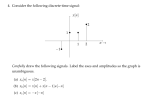 4. Consider the following discrete-time signal: x[n 2 1 2 n → 1 -1 Carefully draw the following signals. Label the axes and amplitudes so the graph is unambiguous. (a) xa[n] = x[2n – 2]. (b) xh[n] = x[n] + x[n 1]u[-n] (c) x[n] = -x[-n]
 2. For the signal shown in figure, draw the following signals x(t) 2 1 -1 0 1 2 a. x(t-5) b. x(2t+1) C. x(6-t) d. x(-t-2) e. [x(t)+x(-t)Ju(t) 3. Given x[n]=(6-1)[[n] -u[n-6]], draw the following signals a. X[n+3] b. X[3n+1] c. X[6-n) d. x 4. Draw the following signals a. X(t)=u(sin st) b. X(t)=u(t+1)-2u(t)+u(t-1) c. X(t)=r(++4)-r(1+2)+u(t)-3r(1-4)+3r(1-5) d. x(t)=2u(t)-u(1-2)+1(1-3)-2r(1-4)+2r(1-5)
 signal and systems
9. Consider the convolution of two of the following signals : | att) ht) le(n) 力。 2.5 1015年9 L. -3-2-10 2-1012 (5 points cach). a. Determine the convolution of act) and (t) : x(t)= a(t) * b(t). b. Determine the convolution of c(n) and dén): y(n)= e(n) * dín). c. Give the MATLAB code for the convolution of e(n) and dín).
signal and systems
9. Consider the convolution of two of the following signals : | att) ht) le(n) 力。 2.5 1015年9 L. -3-2-10 2-1012 (5 points cach). a. Determine the convolution of act) and (t) : x(t)= a(t) * b(t). b. Determine the convolution of c(n) and dén): y(n)= e(n) * dín). c. Give the MATLAB code for the convolution of e(n) and dín).
 4tlt) Signa! 1 x(t) Signal 4 xlt) Signal 5 - 48 1 2 4 0.5 5) (Gibbs Effect) Identify whether or not Gibbs Effect will be present in the Fourier Series reproduction of the same 3 signals (1, 4, 5) above, and the one below: Heavily Cipped Sine wave Signal 6-Clipped sine wave
4tlt) Signa! 1 x(t) Signal 4 xlt) Signal 5 - 48 1 2 4 0.5
5) (Gibbs Effect) Identify whether or not Gibbs Effect will be present...
4tlt) Signa! 1 x(t) Signal 4 xlt) Signal 5 - 48 1 2 4 0.5 5) (Gibbs Effect) Identify whether or not Gibbs Effect will be present in the Fourier Series reproduction of the same 3 signals (1, 4, 5) above, and the one below: Heavily Cipped Sine wave Signal 6-Clipped sine wave
4tlt) Signa! 1 x(t) Signal 4 xlt) Signal 5 - 48 1 2 4 0.5
5) (Gibbs Effect) Identify whether or not Gibbs Effect will be present...
 Signal system question.
EEGR 221 Signals and Systems Homework 3 Determine whether the following systems are (i) Memoryless (ii) Invertible (ii) Casual (iv) Stable (v) Time invariant (vi) Linear (a) y(t)-5x(2t +4) (b) y(t)-7 x(2t 1) +3 (c) y(t)e4x(c) (d) y(t)-sin (x(t + 1)) (e) y(t) x(t)l (1) y() log(x(t)) Your answer must have 3 components for each property 1) Definition of the property 2) Yes or NO 3) Justification and the test that you have done to give the...
Signal system question.
EEGR 221 Signals and Systems Homework 3 Determine whether the following systems are (i) Memoryless (ii) Invertible (ii) Casual (iv) Stable (v) Time invariant (vi) Linear (a) y(t)-5x(2t +4) (b) y(t)-7 x(2t 1) +3 (c) y(t)e4x(c) (d) y(t)-sin (x(t + 1)) (e) y(t) x(t)l (1) y() log(x(t)) Your answer must have 3 components for each property 1) Definition of the property 2) Yes or NO 3) Justification and the test that you have done to give the...
 HW 1_Chi 1) Find the energies of the following signals below. 2) Find the power and the rms value of the signal belo a) x(-4) b)x(-t) c) x(2-4) 3) for the signal x(t) shown below, sketch the signals b) (-4)[u(t-2)-(-4)] 4) sketch the following signals a) uſt-5) - ult-7) 5) Simplify the following expressions: (a) (2+2) (1) (+3)sw) (c) le='cos (31 – 60°)80) () (sin ka ) s() 6) Evaluate the following integrals: (a) , 8(7)x(1 – t)dt (b) *()8(1-1)dt...
 3. (45 pts) On signal energy and power. From the following signals, identify energy signals and power signals. For energy signals, calculate their energy. For power signals, calculate their average signal power. (g) x(t)= rect(t)) (h) x(t) =Loo rect(A) (i) 2(t)=e(-1-j80%(t) (k) x(t) = e-M/2 (l) x[n] = e-jm/2
 1. Use combinations of STEP FUNCTIONS to describe each continuous-time signal shown below. f(t) 0 2 4 6 0 1 2 3 0 1 2 3 4 2. Sketch the following signals: (a) x (t)=1 [u(t+2)-u(t-1)] (c) X(t)=\fety (b) X(t)=t.e (d) x (t) = u(t) u(t-1).ult-2).u(t-3) 3. Determine whether the systems below are linear and time invariant. Justify your answer! (a) y(t) = x(31) (b) y(t)= 2x(1-t) y(t)=cos(x(t)] 4. Simplify the expressions: (a) y(t)=1.8(t+2)+(t +1) 8(1-1)+(t+3). 8(t) (b) y(t) =...
 0 Piot the graph of the following signals: a) fit) = sgnlt) + p (t) utt) - 2 Alt) 6) f(t) = ult-3) -88-t+). c) Elt) = ult+1) + ult-1)-8 (t-1)+r(t-3)
 3. Sketch stuff (by hand or by computer) 3.1 Systems signals The signal x()-sin^t), for 0stsl; is applied to a circuit with an impulse response given by h(t)-2, for Osts1. Sketch these signals and the output of the circuit If the input signal is now set to x()-6(t-3), sketch the input and output signals. (3.2)
 4. Consider the following discrete-time signal: x[n 2 1 2 n → 1 -1 Carefully draw the following signals. Label the axes and amplitudes so the graph is unambiguous. (a) xa[n] = x[2n – 2]. (b) xh[n] = x[n] + x[n 1]u[-n] (c) x[n] = -x[-n]
Most questions answered within 3 hours.
-
Where is the error in this code sequence?
String s1 = "Hello";
String s2 = "ello";...
asked 10 months ago -
Financial data for Joel de Paris, Inc., for last year
follow:
Joel de Paris, Inc.
Balance...
asked 10 months ago -
Consider this reaction:
Al2(SO4)3 (aq)+ BaCl3
(aq) Al2Cl6 (aq)- +
3BaSO4(s) . What is the...
asked 10 months ago -
Suppose that Savneet is considering increasing her
recent random sample from 20 car rentals to 40...
asked 10 months ago -
Trucks arrive at an unloading terminal at an average rate of 120
per hour.
Trucks arrive...
asked 10 months ago -
Why are methanol and ethanol completely soluble in water while
octanol is not very little soluble....
asked 10 months ago -
A facilities manager at a university reads in a research report
that the mean amount of...
asked 10 months ago -
When the CuSO4 is rehydrated by adding water to the anhydrous
compound, is this an endothermic...
asked 10 months ago -
A ray of sunlight is passing from diamond into crown glass; the
angle of incidence is...
asked 10 months ago -
A block of mass 0.249 kg is placed on top of a light, vertical
spring of...
asked 10 months ago -
how do the kidneys compensate in the presences of acidosis
a) trigger hyperventilate
b) reserve acid...
asked 10 months ago -
Question 501 pts
The rental rate of capital to the firm increases. Which of the
following...
asked 10 months ago