A form of endocytosis that involves the uptake of large solid particles such as bacteria or...
Homework Answers
Answer=(a) Phagocytosis
Explanation-
During phagocytosis, cell engulf the large particles/bacteria via phagosome(More than 250 nm diameter endocytic vesicles).
It is performed by specialized cells only for example macrophages.
Now consider other option-
b)Receptor mediated endocytosis-
In this process minor components of ECF are concentrated in clathrin coated pits by the presence of receptors and taken up selectively in large amount in to the cell so incorrect option.
c)Pinocytosis-
Enjection of fluid/solute via smaller pinocytic Molecule vesicle (approximately 100 nm diameter) so incorrect option.
d) Exocytosis-
It refers to the fusion of secretary vesicles with plasma membrane and subsequent discharge of its content so incorrect option.
Add Answer to:
A form of endocytosis that involves the uptake of large solid
particles such as bacteria or...
Which of the following processes only moves substances into a cell? exocytosis active transport endocytosis facilitated...
 Which of the following processes only moves substances into a cell? exocytosis active transport endocytosis facilitated diffusion What process do white blood cells use to engulf bacteria? pinocytosis phagocytosis receptor-mediated endocytosis exocytosis
A select the key choices that characterize each of the following statements. Insert the appropriate letter(s)...
 A select the key choices that characterize each of the following statements. Insert the appropriate letter(s) or corresponding term(s) in the answer blanks. Diffusion, simple Diffusion, osmosis Endocytosis Exocytosis Filtration Solute pumping _____ 1. Require ATP (cellular energy) _____ 2. Driven by kinetic energy of the molecules _____ 3. Driven by hydrostatic (fluid) pressure _____ 4. Follow a concentration gradient _____ 5. Proceeds against a concentration gradient; require(s) a carrier _____ 6. A means of secreting cell products _____ 7....
You can recognize the process of pinocytosis when O the cell is engulfing extracellular fluid the...
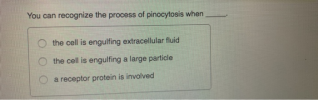 You can recognize the process of pinocytosis when O the cell is engulfing extracellular fluid the cell is engulfing a large particle O a receptor protein is involved A white blood cell engulfing a bacterium is an example of receptor-mediated endocytosis pinocytosis exocytosis phagocytosis facilitated diffusion
The export of large molecules from the cell is often accomplished by: a. endocytosis b. exocytosis...
The export of large molecules from the cell is often accomplished by: a. endocytosis b. exocytosis c. phagocytosis d. Pinocytosis e. all of these
In order for low density lipoproteins in (LDL) to enter to a cell, they must bind...
 In order for low density lipoproteins in (LDL) to enter to a cell, they must bind to receptors on the plasma membrane. This is an example of A. Receptor-mediated endocytosis B. Exocytosis C. Phagocytosis D. Pinocytosis I E. None of the above Chemical energy is a type of A. Thermal B. Kinetic C. Potential D. Light E. All of the above Flagella on bacteria help them to "swim" from one location to another. Flagella is made of A. Microtubules B....
Receptor-mediated endocytosis depends on functional cell surface receptor proteins True O False Question 29 1.5 pts...
 Receptor-mediated endocytosis depends on functional cell surface receptor proteins True O False Question 29 1.5 pts A certain cell needs to move a molecule of sucrose out of the cell. The concentration of sucrose in the extracellular space is greater than that in the cell's cytoplasm. What type of transport mechanism would the cell use? O passive transport exocytosis active transport osmosis In the lipid bilayer the phospholipid tails are hydrophobic hydrophilic Question 31 1.5 p A human white blood...
ements. 3 Select the key choices that chancerize each of the followving sta Insert the appropriate...
 ements. 3 Select the key choices that chancerize each of the followving sta Insert the appropriate answers in the answer blanks. Key Choices A Active transport B. Diffusion, C. Diffusion, osmosis F.Filtration G. Phagocytosis D. Exocytosis H. Pinocytosis simple E. Facilitated diffusion 1. Receptor-mediated endocytosis 1. Engulfment processes that require ATP 2. Driven by molecular enecgy 3. Driven by hydrostatic (lui) pressure (typically blood pressure in the body) 4. Moves dowh a concentration gradient 5. Moves up (agains) a concentration...
is the movement of solutes from an area of higher concentration to an area of lower...
 is the movement of solutes from an area of higher concentration to an area of lower concentration in solution a. Osmosis b. Facilitated diffusion Filtration d. Diffusion - Is the diffusion of water (solvent) across a selectively permeable membrane such as the plasma membrane. a. Osmosis b. Facilitated diffusion Fitration d. Diffusion means cell-drinking (pinching and is distinguished from phagocytosis in that smaller vesicles are formed and they contain molecules dissolved in liquids rather than partides a Endocytosis b. Exocytosis...
The process(es) of a. osmosis b. diffusion c. facilitated diffusion d. active transport e. two of the above 7. do...
 The process(es) of a. osmosis b. diffusion c. facilitated diffusion d. active transport e. two of the above 7. do NOT proceed to equilibriunm 8. The process of br a. Phagocytosis b. Pinocytosis c. Receptor mediated endocytosis d. None of the above ringing large particles into the cell using vesicles is called 9. Water is capable of forming hydrogen bonds because a. the hydrogen atoms carry partial positive charges. b. the oxygen atom carries a partial negative charge. c. it...
Toxicology 1) The toxicants pass through the cell membranes by what is known as, "passive diffusion"...
 Toxicology
1) The toxicants pass through the cell membranes by what is known as, "passive diffusion" which depends on (a) pore size (b) concentration gradients across the membrane (c) lipid solubility (d) the diastolic and systolic blood pressure in the individual 2) In toxicokinetics the rate of elimination of administered substances is measured from the area plots of concentrations versus time. Among the following substances which one would you expect to be excreted out at the slowest rate? (a) glucose...
Toxicology
1) The toxicants pass through the cell membranes by what is known as, "passive diffusion" which depends on (a) pore size (b) concentration gradients across the membrane (c) lipid solubility (d) the diastolic and systolic blood pressure in the individual 2) In toxicokinetics the rate of elimination of administered substances is measured from the area plots of concentrations versus time. Among the following substances which one would you expect to be excreted out at the slowest rate? (a) glucose...
 Which of the following processes only moves substances into a cell? exocytosis active transport endocytosis facilitated diffusion What process do white blood cells use to engulf bacteria? pinocytosis phagocytosis receptor-mediated endocytosis exocytosis
 A select the key choices that characterize each of the following statements. Insert the appropriate letter(s) or corresponding term(s) in the answer blanks. Diffusion, simple Diffusion, osmosis Endocytosis Exocytosis Filtration Solute pumping _____ 1. Require ATP (cellular energy) _____ 2. Driven by kinetic energy of the molecules _____ 3. Driven by hydrostatic (fluid) pressure _____ 4. Follow a concentration gradient _____ 5. Proceeds against a concentration gradient; require(s) a carrier _____ 6. A means of secreting cell products _____ 7....
 You can recognize the process of pinocytosis when O the cell is engulfing extracellular fluid the cell is engulfing a large particle O a receptor protein is involved A white blood cell engulfing a bacterium is an example of receptor-mediated endocytosis pinocytosis exocytosis phagocytosis facilitated diffusion
 In order for low density lipoproteins in (LDL) to enter to a cell, they must bind to receptors on the plasma membrane. This is an example of A. Receptor-mediated endocytosis B. Exocytosis C. Phagocytosis D. Pinocytosis I E. None of the above Chemical energy is a type of A. Thermal B. Kinetic C. Potential D. Light E. All of the above Flagella on bacteria help them to "swim" from one location to another. Flagella is made of A. Microtubules B....
 Receptor-mediated endocytosis depends on functional cell surface receptor proteins True O False Question 29 1.5 pts A certain cell needs to move a molecule of sucrose out of the cell. The concentration of sucrose in the extracellular space is greater than that in the cell's cytoplasm. What type of transport mechanism would the cell use? O passive transport exocytosis active transport osmosis In the lipid bilayer the phospholipid tails are hydrophobic hydrophilic Question 31 1.5 p A human white blood...
 ements. 3 Select the key choices that chancerize each of the followving sta Insert the appropriate answers in the answer blanks. Key Choices A Active transport B. Diffusion, C. Diffusion, osmosis F.Filtration G. Phagocytosis D. Exocytosis H. Pinocytosis simple E. Facilitated diffusion 1. Receptor-mediated endocytosis 1. Engulfment processes that require ATP 2. Driven by molecular enecgy 3. Driven by hydrostatic (lui) pressure (typically blood pressure in the body) 4. Moves dowh a concentration gradient 5. Moves up (agains) a concentration...
 is the movement of solutes from an area of higher concentration to an area of lower concentration in solution a. Osmosis b. Facilitated diffusion Filtration d. Diffusion - Is the diffusion of water (solvent) across a selectively permeable membrane such as the plasma membrane. a. Osmosis b. Facilitated diffusion Fitration d. Diffusion means cell-drinking (pinching and is distinguished from phagocytosis in that smaller vesicles are formed and they contain molecules dissolved in liquids rather than partides a Endocytosis b. Exocytosis...
 The process(es) of a. osmosis b. diffusion c. facilitated diffusion d. active transport e. two of the above 7. do NOT proceed to equilibriunm 8. The process of br a. Phagocytosis b. Pinocytosis c. Receptor mediated endocytosis d. None of the above ringing large particles into the cell using vesicles is called 9. Water is capable of forming hydrogen bonds because a. the hydrogen atoms carry partial positive charges. b. the oxygen atom carries a partial negative charge. c. it...
 Toxicology
1) The toxicants pass through the cell membranes by what is known as, "passive diffusion" which depends on (a) pore size (b) concentration gradients across the membrane (c) lipid solubility (d) the diastolic and systolic blood pressure in the individual 2) In toxicokinetics the rate of elimination of administered substances is measured from the area plots of concentrations versus time. Among the following substances which one would you expect to be excreted out at the slowest rate? (a) glucose...
Toxicology
1) The toxicants pass through the cell membranes by what is known as, "passive diffusion" which depends on (a) pore size (b) concentration gradients across the membrane (c) lipid solubility (d) the diastolic and systolic blood pressure in the individual 2) In toxicokinetics the rate of elimination of administered substances is measured from the area plots of concentrations versus time. Among the following substances which one would you expect to be excreted out at the slowest rate? (a) glucose...
Most questions answered within 3 hours.
-
Where is the error in this code sequence?
String s1 = "Hello";
String s2 = "ello";...
asked 11 months ago -
Financial data for Joel de Paris, Inc., for last year
follow:
Joel de Paris, Inc.
Balance...
asked 11 months ago -
Consider this reaction:
Al2(SO4)3 (aq)+ BaCl3
(aq) Al2Cl6 (aq)- +
3BaSO4(s) . What is the...
asked 11 months ago -
Suppose that Savneet is considering increasing her
recent random sample from 20 car rentals to 40...
asked 11 months ago -
Trucks arrive at an unloading terminal at an average rate of 120
per hour.
Trucks arrive...
asked 11 months ago -
Why are methanol and ethanol completely soluble in water while
octanol is not very little soluble....
asked 11 months ago -
A facilities manager at a university reads in a research report
that the mean amount of...
asked 11 months ago -
When the CuSO4 is rehydrated by adding water to the anhydrous
compound, is this an endothermic...
asked 11 months ago -
A ray of sunlight is passing from diamond into crown glass; the
angle of incidence is...
asked 11 months ago -
A block of mass 0.249 kg is placed on top of a light, vertical
spring of...
asked 11 months ago -
how do the kidneys compensate in the presences of acidosis
a) trigger hyperventilate
b) reserve acid...
asked 11 months ago -
Question 501 pts
The rental rate of capital to the firm increases. Which of the
following...
asked 11 months ago