

Homework Answers
Lewis structure for Bicarbonate anion:
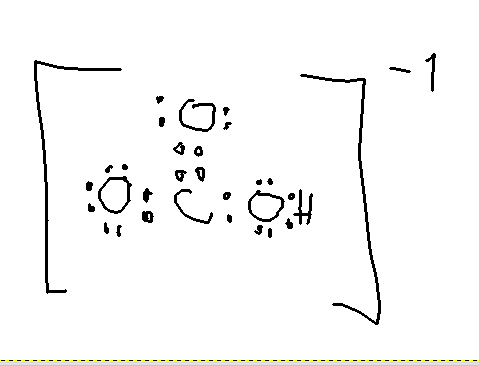
Note that you just missed the braket stating the -1 charge of the ion
electrons count is correct and perfectly placed
Q2
for
Nitrogen dioxide + water = nitric acid + nitrous acid
NO2 + H2O = HNO3 + HNO2
balance
2 NO2(g) + H2O(l) = HNO3(aq) + HNO2(aq)
Q3
Nitrogen dioxide gas into O2 and N2:
NO2(g) = N2(g) + O2(g)
balance
2NO2(g) = N2(g) + 2O2(g)
Add Answer to:
Carbon dioxide (CO2) is an abundant greenhouse gas that is present in high atmospheric concentration primarily...
Carbon dioxide dissolves in water to form carbonic acid, which is primarily dissolved CO2. Dissolved CO2...
 Carbon dioxide dissolves in water to form carbonic acid, which
is primarily dissolved CO2. Dissolved CO2 satisfies the equilibrium
equation The acid dissociation constants listed in most standard
reference texts for carbonic acid actually apply to dissolved CO2.
For a CO2 partial pressure of 1.8×10⁻⁴ bar in the atmosphere, what
is the pH of water in equilibrium with the atmosphere? (For
carbonic acid Ka1 = 4.46× 10⁻⁷ and Ka2 = 4.69× 10⁻¹¹).
Carbon dioxide dissolves in water to form carbonic...
Carbon dioxide dissolves in water to form carbonic acid, which
is primarily dissolved CO2. Dissolved CO2 satisfies the equilibrium
equation The acid dissociation constants listed in most standard
reference texts for carbonic acid actually apply to dissolved CO2.
For a CO2 partial pressure of 1.8×10⁻⁴ bar in the atmosphere, what
is the pH of water in equilibrium with the atmosphere? (For
carbonic acid Ka1 = 4.46× 10⁻⁷ and Ka2 = 4.69× 10⁻¹¹).
Carbon dioxide dissolves in water to form carbonic...
Carbonic acid present in the blood comes mainly from dissolved carbon dioxide (CO2). Dissolved carbon dioxide,...
Carbonic acid present in the blood comes mainly from dissolved carbon dioxide (CO2). Dissolved carbon dioxide, CO2(aq), reacts with water to produce H2CO3. a) Write the equilibrium expression for this process. b) The equilibrium constant for this reaction is the hydration constant for CO2, Kh = [H2CO3]/[CO2(aq)] = 3.0 x 10⁻³ . Combine this equation with the expression you derived in 1.a) for the equilibrium expressions for the first ionization (controlled by Ka1) and rearrange to obtain the apparent equilibrium...
2. Blood is buffered using a bicarbonate system primarily to accommodate the formation of CO2 in...
2. Blood is buffered using a bicarbonate system primarily to accommodate the formation of CO2 in the tissues. The overall pK for the reaction below is 6.35: CO2 + H2O H2CO3 H+ + HCO3 During acidosis, treatment can consist of IV administration of NaHC03. If the pH of blood is typically 7.4, and the total concentration of carbonic acid/ bicarb is 0.05M, what is the concentration of conjugate base and acid in blood?
Carbon dioxide dissolves in water to form carbonic acid, which is primarily dissolved CO2 . Dissolved...
Carbon dioxide dissolves in water to form carbonic acid, which is primarily dissolved CO2 . Dissolved CO2 satisfies the equilibrium equation CO2(g)↽−−⇀CO2(aq)?=0.032 CO 2 ( g ) ↽ − − ⇀ CO 2 ( aq ) K = 0.032 The acid dissociation constants listed in most standard reference texts for carbonic acid actually apply to dissolved CO2 CO 2 . For a CO2 CO 2 partial pressure of 2.6×10⁻⁴ bar 2.6 × 10 − 4 bar in the atmosphere, what...
Carbon dioxide dissolves in water to form carbonic acid, which is primarily dissolved CO2. Dissolved CO2...
Carbon dioxide dissolves in water to form carbonic acid, which is primarily dissolved CO2. Dissolved CO2 satisfies the equilibrium equation CO2(gas)<------>CO2(aq) K=0.032 M*atm-1 The acid dissociation constants listed in most standard reference texts for carbonic acid actually apply to dissolved CO2. For a CO2 partial pressure of 3.1×10⁻⁴ atm in the atmosphere, what is the pH of water in equilibrium with the atmosphere?
Carbon dioxide dissolves in water to form carbonic acid, which is primarily dissolved CO2. Dissol...
Carbon dioxide dissolves in water to form carbonic acid, which is primarily dissolved CO2. Dissolved CO2 satisfies the equilibrium equation. CO2 (g) <--> CO2 (aq) K= 0.032 M atm-1 The acid dissociation constants listed in most standard reference texts for carbonic acid actually apply to dissolved CO2. For a CO2 partial pressure of 8.8×10⁻⁴ atm in the atmosphere, what is the pH of water in equilibrium with the atmosphere?
21. What are the characteristics of the carbonic acid-bicarbonate buffer system (select all that apply? a...
 21. What are the characteristics of the carbonic acid-bicarbonate buffer system (select all that apply? a CO2 is eliminated by the lungs b. Neutralizes HCl acid to yield carbonic acid and salt c. H2CO3 formed by neutralization dissociates into H2O and CO2 d. Shifts H+ in and out of cell in exchange for other cations such as potassium and sodium e. Free basic radicals dissociate into ammonia and OH-, which combines with Ho to form water 22. What are characteristics...
(8 pts) Carbon dioxide in the atmosphere dissolves in water to establish an equilibrium that can...
 (8 pts) Carbon dioxide in the atmosphere dissolves in water to establish an equilibrium that can increase the acidity of aqueous solutions in the environment. This equilibrium is CO2(g) = CO2 (aq), Kn= 3.1 x 10⁻² at 25°C. Kh is called the Henry's law constant, which relates the solubility of the gas CO2 in the aqueous solution, [CO2), to the partial pressure of CO2 over the solution, p(CO2): [CO2] (M)= Kn · p(CO2) (atm) During the preceding decades, the atmospheric...
(8 pts) Carbon dioxide in the atmosphere dissolves in water to establish an equilibrium that can...
(8 pts) Carbon dioxide in the atmosphere dissolves in water to establish an equilibrium that can increase the acidity of aqueous solutions in the environment. This equilibrium is CO2 (g) ⇌ CO2 (aq), Kh = 3.1 * 10^2 at 25°C. Kh is called the Henry’s law constant, which relates the solubility of the gas CO2 in the aqueous solution, [CO2], to the partial pressure of CO2 over the solution, p(CO2): [CO2] (M) = Kh * p(CO2) (atm) During the preceding...
Arterial Blood Gas Interpretation Posttest Directions: Complete this test using the answer sheet provided The solution...
 Arterial Blood Gas Interpretation Posttest Directions: Complete this test using the answer sheet provided The solution that would be most alkalotic would be the one with a pH of: A. Four Seven C. Nine Fourteen D. A. The normal pH range for blood is: 7.0 - 7.25 B. 7.30 - 7.40 C. 7.35 -7.45 D. 7.45 - 7.55 The respiratory system compensates for changes in the pH level by responding to changes in the levels of: A. CO2 B. H0...
 Carbon dioxide dissolves in water to form carbonic acid, which
is primarily dissolved CO2. Dissolved CO2 satisfies the equilibrium
equation The acid dissociation constants listed in most standard
reference texts for carbonic acid actually apply to dissolved CO2.
For a CO2 partial pressure of 1.8×10⁻⁴ bar in the atmosphere, what
is the pH of water in equilibrium with the atmosphere? (For
carbonic acid Ka1 = 4.46× 10⁻⁷ and Ka2 = 4.69× 10⁻¹¹).
Carbon dioxide dissolves in water to form carbonic...
Carbon dioxide dissolves in water to form carbonic acid, which
is primarily dissolved CO2. Dissolved CO2 satisfies the equilibrium
equation The acid dissociation constants listed in most standard
reference texts for carbonic acid actually apply to dissolved CO2.
For a CO2 partial pressure of 1.8×10⁻⁴ bar in the atmosphere, what
is the pH of water in equilibrium with the atmosphere? (For
carbonic acid Ka1 = 4.46× 10⁻⁷ and Ka2 = 4.69× 10⁻¹¹).
Carbon dioxide dissolves in water to form carbonic...
 21. What are the characteristics of the carbonic acid-bicarbonate buffer system (select all that apply? a CO2 is eliminated by the lungs b. Neutralizes HCl acid to yield carbonic acid and salt c. H2CO3 formed by neutralization dissociates into H2O and CO2 d. Shifts H+ in and out of cell in exchange for other cations such as potassium and sodium e. Free basic radicals dissociate into ammonia and OH-, which combines with Ho to form water 22. What are characteristics...
 (8 pts) Carbon dioxide in the atmosphere dissolves in water to establish an equilibrium that can increase the acidity of aqueous solutions in the environment. This equilibrium is CO2(g) = CO2 (aq), Kn= 3.1 x 10⁻² at 25°C. Kh is called the Henry's law constant, which relates the solubility of the gas CO2 in the aqueous solution, [CO2), to the partial pressure of CO2 over the solution, p(CO2): [CO2] (M)= Kn · p(CO2) (atm) During the preceding decades, the atmospheric...
 Arterial Blood Gas Interpretation Posttest Directions: Complete this test using the answer sheet provided The solution that would be most alkalotic would be the one with a pH of: A. Four Seven C. Nine Fourteen D. A. The normal pH range for blood is: 7.0 - 7.25 B. 7.30 - 7.40 C. 7.35 -7.45 D. 7.45 - 7.55 The respiratory system compensates for changes in the pH level by responding to changes in the levels of: A. CO2 B. H0...
Most questions answered within 3 hours.
-
Where is the error in this code sequence?
String s1 = "Hello";
String s2 = "ello";...
asked 11 months ago -
Financial data for Joel de Paris, Inc., for last year
follow:
Joel de Paris, Inc.
Balance...
asked 11 months ago -
Consider this reaction:
Al2(SO4)3 (aq)+ BaCl3
(aq) Al2Cl6 (aq)- +
3BaSO4(s) . What is the...
asked 11 months ago -
Suppose that Savneet is considering increasing her
recent random sample from 20 car rentals to 40...
asked 11 months ago -
Trucks arrive at an unloading terminal at an average rate of 120
per hour.
Trucks arrive...
asked 11 months ago -
Why are methanol and ethanol completely soluble in water while
octanol is not very little soluble....
asked 11 months ago -
A facilities manager at a university reads in a research report
that the mean amount of...
asked 11 months ago -
When the CuSO4 is rehydrated by adding water to the anhydrous
compound, is this an endothermic...
asked 11 months ago -
A ray of sunlight is passing from diamond into crown glass; the
angle of incidence is...
asked 11 months ago -
A block of mass 0.249 kg is placed on top of a light, vertical
spring of...
asked 11 months ago -
how do the kidneys compensate in the presences of acidosis
a) trigger hyperventilate
b) reserve acid...
asked 11 months ago -
Question 501 pts
The rental rate of capital to the firm increases. Which of the
following...
asked 11 months ago