![M[kg] CN) ( 1. Derive the differential equations of motion for the system (two degrees of freedom). Let the angle 9 be small.](http://img.homeworklib.com/questions/e54e6330-3727-11eb-8d5f-35d35b7de36c.png?x-oss-process=image/resize,w_560)
Homework Answers
![20 Сая [on] C.cz Citc2 Cega beq= bb2 M I NS m beq m Kinetic Energy (T) Tab mit? +4 m (ie +L• Koso)2 + (LÒRing)] + Mz+52 Pote](http://img.homeworklib.com/questions/d24b1110-372a-11eb-b934-c59cbe5685fd.png?x-oss-process=image/resize,w_560)
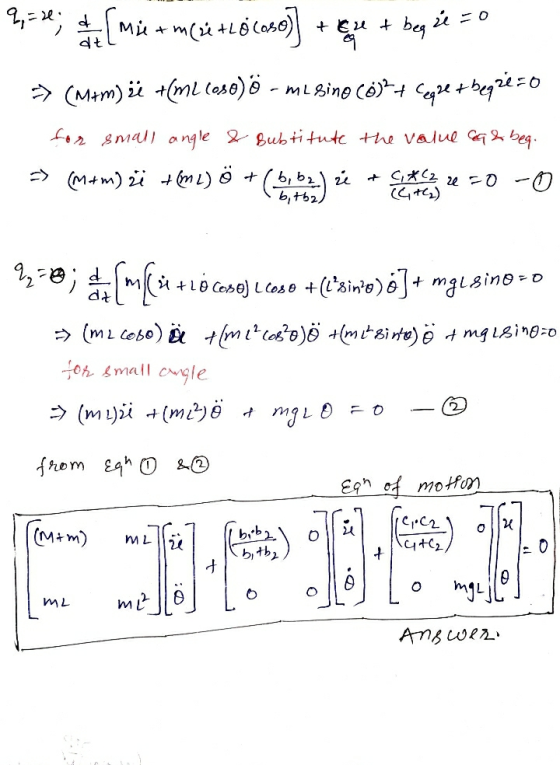
Please RATE my Answer
Thank you
Add Answer to:
M[kg] CN) ( 1. Derive the differential equations of motion for the system (two degrees of...
4. Derive the equations of motion for the shown two degrees system in terms of x...
 4. Derive the equations of motion for the shown two degrees system in terms of x and ?. Bonus 12.5 Pts: Derive and solve the characteristic equation for l = 4 m, m = 3 kg, ki-1 N/m, and k2 = 2 N/m. .
- Derive the equations of motion of the system in terms of variables m and K...
 - Derive the equations of motion of the system in terms of variables m and K and express them in matrix notation. Finally, express the equations of motion numerically in matrix notations if the stiffness and mass coefficients are k = 1 kip/in and m = 0.15 kip-sec? / in. Use X1, X2, and X: as degrees of freedom. (20 pts) X2 X 3m
Problem 5: For the system shown below, write the differential equations for small motions of the ...
 Problem 5: For the system shown below, write the differential equations for small motions of the system, in terms of the degrees of freedom (x(t),() Mass of the bar is m, and mass of the block is also m. System is set into motion through suitable initial conditions. Once you find the equations of motion in terms of the respective degrees of freedom, write out the natural frequency and the damping ratio for each sub-system, respectively.
Problem 5: For the...
Problem 5: For the system shown below, write the differential equations for small motions of the system, in terms of the degrees of freedom (x(t),() Mass of the bar is m, and mass of the block is also m. System is set into motion through suitable initial conditions. Once you find the equations of motion in terms of the respective degrees of freedom, write out the natural frequency and the damping ratio for each sub-system, respectively.
Problem 5: For the...
Assuming small oscillations, derive the differential equations of motion of the system shown in F...
 Assuming small oscillations, derive the differential equations
of motion of the system shown in Fig. P3.10.
F(t) = Fo sin ω,t 3 2 a4 m3 1 2 a1 +a2 + аз + а,-1 FIG. P3.10
F(t) = Fo sin ω,t 3 2 a4 m3 1 2 a1 +a2 + аз + а,-1 FIG. P3.10
Assuming small oscillations, derive the differential equations
of motion of the system shown in Fig. P3.10.
F(t) = Fo sin ω,t 3 2 a4 m3 1 2 a1 +a2 + аз + а,-1 FIG. P3.10
F(t) = Fo sin ω,t 3 2 a4 m3 1 2 a1 +a2 + аз + а,-1 FIG. P3.10
1. For the system shown in Figure 1. in determine the equations of motion taking degrees...
 1. For the system shown in Figure 1. in determine the equations of motion taking degrees of freedom 01,02, X3, moment of inertia of slender rod about the center is 1G = m (10 points). 3 to m ki . > K2 Figure 1 Figure 1
1. Derive the equations of motion of the system shown in Fig 1 by using Lagrange's...
 1. Derive the equations of motion of the system shown in Fig 1 by using Lagrange's equations. Find the natural frequencies and mode shapes of the dynamical system for k 1 N/m, k-2 N/m, k I N/m, and mi 2 kg, m l kg, m -2 kg. scale the eigenvectors matrix Ф in order to achieve a mass normalized eigenvectors matrix Φ such that: F40 Fan Fig. 1
The equations of motion for a certain mechanical system with two degrees of freedom, can be...
 The equations of motion for a certain mechanical system with two degrees of freedom, can be written as a pair of coupled, second-order, differential equations: (M + m)x - 1/2 mL theta^2 sin(theta) + 1/2 mL theta cos(theta) + k(x - L_0) = 0 1/3 mL^2 theta + 1/2 mLx cos(theta) + 1/2 mgLsin(theta) = 0 We can rewrite them in matrix form, A*qdd - b, to be solved simultaneously: [M + m 1/2 mL cos theta 1/2 mL cos...
09. For the two degrees of freedom system shown in Figure 4, determine the steady state response ...
 09. For the two degrees of freedom system shown in Figure 4, determine the steady state response of the system due to a sinusoidal force Fi() 10sin10r applied to the mass block whose displacement isn. Given m = 10 kg, k = 1000N rn and the equations of motion of the system are -지 3m
09. For the two degrees of freedom system shown in Figure 4, determine the steady state response of the system due to a sinusoidal force...
09. For the two degrees of freedom system shown in Figure 4, determine the steady state response of the system due to a sinusoidal force Fi() 10sin10r applied to the mass block whose displacement isn. Given m = 10 kg, k = 1000N rn and the equations of motion of the system are -지 3m
09. For the two degrees of freedom system shown in Figure 4, determine the steady state response of the system due to a sinusoidal force...
04: Derive the differential equation governing the motion of the one degree-of-freedom system by using Newton's...
 04: Derive the differential equation governing the motion of the one degree-of-freedom system by using Newton's method. Use the generalized coordinates shown in figure (5) (bar moment of inertia, 1-2 ml) Slender bar of mass m Figure (5)
3(a). Find the equations of motion for the system shown below. The system is two degree...
 3(a). Find the equations of motion for the system shown below. The system is two degree of freedom system with degrees of freedom X, and X2. Please find two equations of motion for this dynamical system by both Newtons method and Euler Lagrange. The point with which the spring is attached with the wall has zero displacement indeed) x X2 m2 ki kr Frictionless surfaces on which masses are resting Springs can be assumed to be massless Formulas: Formula to...
 4. Derive the equations of motion for the shown two degrees system in terms of x and ?. Bonus 12.5 Pts: Derive and solve the characteristic equation for l = 4 m, m = 3 kg, ki-1 N/m, and k2 = 2 N/m. .
 - Derive the equations of motion of the system in terms of variables m and K and express them in matrix notation. Finally, express the equations of motion numerically in matrix notations if the stiffness and mass coefficients are k = 1 kip/in and m = 0.15 kip-sec? / in. Use X1, X2, and X: as degrees of freedom. (20 pts) X2 X 3m
 Problem 5: For the system shown below, write the differential equations for small motions of the system, in terms of the degrees of freedom (x(t),() Mass of the bar is m, and mass of the block is also m. System is set into motion through suitable initial conditions. Once you find the equations of motion in terms of the respective degrees of freedom, write out the natural frequency and the damping ratio for each sub-system, respectively.
Problem 5: For the...
Problem 5: For the system shown below, write the differential equations for small motions of the system, in terms of the degrees of freedom (x(t),() Mass of the bar is m, and mass of the block is also m. System is set into motion through suitable initial conditions. Once you find the equations of motion in terms of the respective degrees of freedom, write out the natural frequency and the damping ratio for each sub-system, respectively.
Problem 5: For the...
 Assuming small oscillations, derive the differential equations
of motion of the system shown in Fig. P3.10.
F(t) = Fo sin ω,t 3 2 a4 m3 1 2 a1 +a2 + аз + а,-1 FIG. P3.10
F(t) = Fo sin ω,t 3 2 a4 m3 1 2 a1 +a2 + аз + а,-1 FIG. P3.10
Assuming small oscillations, derive the differential equations
of motion of the system shown in Fig. P3.10.
F(t) = Fo sin ω,t 3 2 a4 m3 1 2 a1 +a2 + аз + а,-1 FIG. P3.10
F(t) = Fo sin ω,t 3 2 a4 m3 1 2 a1 +a2 + аз + а,-1 FIG. P3.10
 1. For the system shown in Figure 1. in determine the equations of motion taking degrees of freedom 01,02, X3, moment of inertia of slender rod about the center is 1G = m (10 points). 3 to m ki . > K2 Figure 1 Figure 1
 1. Derive the equations of motion of the system shown in Fig 1 by using Lagrange's equations. Find the natural frequencies and mode shapes of the dynamical system for k 1 N/m, k-2 N/m, k I N/m, and mi 2 kg, m l kg, m -2 kg. scale the eigenvectors matrix Ф in order to achieve a mass normalized eigenvectors matrix Φ such that: F40 Fan Fig. 1
 The equations of motion for a certain mechanical system with two degrees of freedom, can be written as a pair of coupled, second-order, differential equations: (M + m)x - 1/2 mL theta^2 sin(theta) + 1/2 mL theta cos(theta) + k(x - L_0) = 0 1/3 mL^2 theta + 1/2 mLx cos(theta) + 1/2 mgLsin(theta) = 0 We can rewrite them in matrix form, A*qdd - b, to be solved simultaneously: [M + m 1/2 mL cos theta 1/2 mL cos...
 09. For the two degrees of freedom system shown in Figure 4, determine the steady state response of the system due to a sinusoidal force Fi() 10sin10r applied to the mass block whose displacement isn. Given m = 10 kg, k = 1000N rn and the equations of motion of the system are -지 3m
09. For the two degrees of freedom system shown in Figure 4, determine the steady state response of the system due to a sinusoidal force...
09. For the two degrees of freedom system shown in Figure 4, determine the steady state response of the system due to a sinusoidal force Fi() 10sin10r applied to the mass block whose displacement isn. Given m = 10 kg, k = 1000N rn and the equations of motion of the system are -지 3m
09. For the two degrees of freedom system shown in Figure 4, determine the steady state response of the system due to a sinusoidal force...
 04: Derive the differential equation governing the motion of the one degree-of-freedom system by using Newton's method. Use the generalized coordinates shown in figure (5) (bar moment of inertia, 1-2 ml) Slender bar of mass m Figure (5)
 3(a). Find the equations of motion for the system shown below. The system is two degree of freedom system with degrees of freedom X, and X2. Please find two equations of motion for this dynamical system by both Newtons method and Euler Lagrange. The point with which the spring is attached with the wall has zero displacement indeed) x X2 m2 ki kr Frictionless surfaces on which masses are resting Springs can be assumed to be massless Formulas: Formula to...
Most questions answered within 3 hours.
-
Where is the error in this code sequence?
String s1 = "Hello";
String s2 = "ello";...
asked 11 months ago -
Financial data for Joel de Paris, Inc., for last year
follow:
Joel de Paris, Inc.
Balance...
asked 11 months ago -
Consider this reaction:
Al2(SO4)3 (aq)+ BaCl3
(aq) Al2Cl6 (aq)- +
3BaSO4(s) . What is the...
asked 11 months ago -
Suppose that Savneet is considering increasing her
recent random sample from 20 car rentals to 40...
asked 11 months ago -
Trucks arrive at an unloading terminal at an average rate of 120
per hour.
Trucks arrive...
asked 11 months ago -
Why are methanol and ethanol completely soluble in water while
octanol is not very little soluble....
asked 11 months ago -
A facilities manager at a university reads in a research report
that the mean amount of...
asked 11 months ago -
When the CuSO4 is rehydrated by adding water to the anhydrous
compound, is this an endothermic...
asked 11 months ago -
A ray of sunlight is passing from diamond into crown glass; the
angle of incidence is...
asked 11 months ago -
A block of mass 0.249 kg is placed on top of a light, vertical
spring of...
asked 11 months ago -
how do the kidneys compensate in the presences of acidosis
a) trigger hyperventilate
b) reserve acid...
asked 11 months ago -
Question 501 pts
The rental rate of capital to the firm increases. Which of the
following...
asked 11 months ago