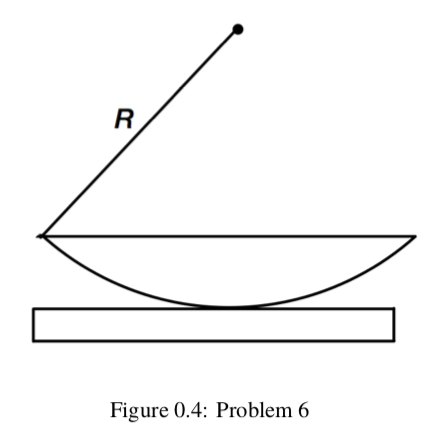
A lens rest on a flat surface as shown in figure (0.4).
Determine the radius of the nth bright spot.
Homework Answers
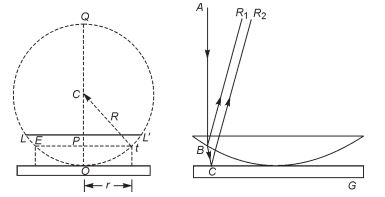
AB is a monochromatic ray of light, which falls on the system. A part is reflected at B (glass-air boundary) which goes out in the form of ray R1 without any phase reversal. The other part is refracted along BC. At point C it is again reflected and goes out in the form of ray R2 with a phase reversal of . The reflected rays R1 and R2 are in a position to produce interference fringes as they have been derived from the same ray AB and hence fulfill the condition of interference. As the rings are observed in the reflected light, the path difference between them is (2µt cos r + lambda/2). For air film µ = 1 and for normal incidence r = 0. Hence in this case, path difference is (2 t + lambda/2). At the point of contact t = 0, and the path difference is lambda/2, which is the condition of minimum intensity. Thus the central spot is dark. For nth maximum, we have
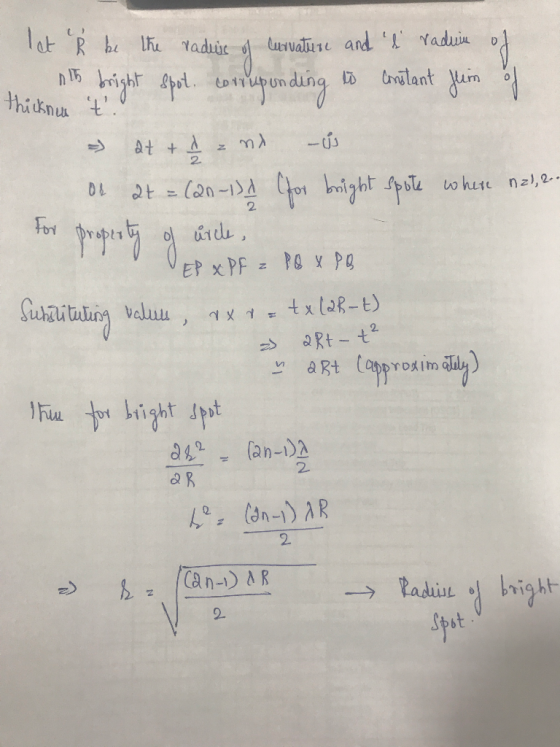
2 t + lambda/2 = n * lambda
This expression shows that a maximum of a particular order will occur for a constant value of t. In this system, ‘t’ remains constant along a circle Thus the maximum is in the form of a circle. For different value of ‘t’, different maxima will occur. Hence we get a number of concentric bright circular rings. In a similar way, this can be shown that minima are also in the circular form.
Theory :
Add Answer to:
A lens rest on a flat surface as shown in figure (0.4).
Determine the radius of...
For a diverging lens with one flat surface, the radius of curvature for the curved surface...
For a diverging lens with one flat surface, the radius of curvature for the curved surface is 20.0 cm. What must the index of refraction be so that the focal length is -30.0 cm?
Chapter 35, Problem 37. The radius of curvature of the convex surface of a planoconvex lens...
Chapter 35, Problem 37. The radius of curvature of the convex surface of a planoconvex lens is 68.4 cm. The lens is placed convex side down on a perfectly flat glass plate that is illuminated from above with red light having a wavelength of 580 nm. Find the diameter of the second bright ring in the interference pattern. Can you also please explain why you used the formulas in each step.
A plano-convex lens is one with a convex surface on one side and a flat surface...
A plano-convex lens is one with a convex surface on one side and a flat surface on the other. Suppose a thin lens is made of glass with index of refraction 1.5. If the radius of curvature of the curved surface is 1.2 meters, what is the focal length of the lens? Give your answer in meters.
A plano-convex glass lens of radius of curvature 3 m rests on an optically flat glass...
A plano-convex glass lens of radius of curvature 3 m rests on an optically flat glass plate. The arrangement is illuminated from above with monochromatic light of 569-nm wavelength. The indexes of refraction of the lens and plate are 1.6. Determine the radii of the first and second bright fringes in the reflected light. First bright fringe: m [5 points] 2 attempt(s) made (maximum allowed for credit = 5) [after that, multiply credit by 0.5 up to 10 attempts]...
A convex lens is placedon a flat glass plate and illuminated from above with monochromaticred light....
A convex lens is placedon a flat glass plate and illuminated from above with monochromaticred light. When viewed fromabove, concentric bands of red and dark are observed. What doesone observe at the exactcenter of the lens where the lens and the glass plate are in directcontact? A) a darkspot B) a bright spot thatis some color other than red C) a bright redspot D) a rainbow of color
A planoconvex contact lens from plastic (refraction index n-1.43) has one surface flat and the other...
A planoconvex contact lens from plastic (refraction index n-1.43) has one surface flat and the other has a radius R =-26.2 cm. What is the optical power of the lens (in diopters)?
2. Water flows over a flat surface at 8 m/s, as shown in figure. A pump...
 2. Water flows over a flat surface at 8 m/s, as shown in figure. A pump draws off water through a narrow slit at a volume rate of 0.2 m2/s per meter length of the slit. Assume that the fluid is incompressible and inviscid and can be represented by the combination of a uniform flow and a sink. a) Based on method of superposition, propose a general expression for stream function ψ velocity potential ф, and velocity components of v,...
The figure (a) shows a lens with radius of curvature 90 cm lying on a plate...
 The figure (a) shows a lens with radius of curvature 90 cm lying on a plate glass plate and illuminated from above by light with wavelength lambda = 550 nm. Figure (b) (a photograph taken from above the lens) snows that circular interference fringes (called Newton's rings) appear, associated with the variable thickness d of the a r Mm between the lens and the plate. Find the radii r of the interference maxima assuming r/R is much less than 1....
The figure (a) shows a lens with radius of curvature 94 cm lying on a plate...
 The figure (a) shows a lens with radius of curvature 94 cm lying
on a plate glass plate and illuminated from above by light with
wavelength ? = 600 nm. Figure (b) (a photograph taken from above
the lens) shows that circular interference fringes (called Newton's
rings) appear, associated with the variable thickness d of the air
film between the lens and the plate. Find the radii r of the
interference maxima assuming r/R is much less than 1. What...
The figure (a) shows a lens with radius of curvature 94 cm lying
on a plate glass plate and illuminated from above by light with
wavelength ? = 600 nm. Figure (b) (a photograph taken from above
the lens) shows that circular interference fringes (called Newton's
rings) appear, associated with the variable thickness d of the air
film between the lens and the plate. Find the radii r of the
interference maxima assuming r/R is much less than 1. What...
A surface density exists on the hemispherical surface of the radius b shown in the figure....
 A surface density exists on the hemispherical surface of the radius b shown in the figure. Given that js = Josintê, A/m where ), is constant. i) Find the total current flowing on the surface ii) find the magnetic flux density B at the origin 0. y Đ
 2. Water flows over a flat surface at 8 m/s, as shown in figure. A pump draws off water through a narrow slit at a volume rate of 0.2 m2/s per meter length of the slit. Assume that the fluid is incompressible and inviscid and can be represented by the combination of a uniform flow and a sink. a) Based on method of superposition, propose a general expression for stream function ψ velocity potential ф, and velocity components of v,...
 The figure (a) shows a lens with radius of curvature 90 cm lying on a plate glass plate and illuminated from above by light with wavelength lambda = 550 nm. Figure (b) (a photograph taken from above the lens) snows that circular interference fringes (called Newton's rings) appear, associated with the variable thickness d of the a r Mm between the lens and the plate. Find the radii r of the interference maxima assuming r/R is much less than 1....
 The figure (a) shows a lens with radius of curvature 94 cm lying
on a plate glass plate and illuminated from above by light with
wavelength ? = 600 nm. Figure (b) (a photograph taken from above
the lens) shows that circular interference fringes (called Newton's
rings) appear, associated with the variable thickness d of the air
film between the lens and the plate. Find the radii r of the
interference maxima assuming r/R is much less than 1. What...
The figure (a) shows a lens with radius of curvature 94 cm lying
on a plate glass plate and illuminated from above by light with
wavelength ? = 600 nm. Figure (b) (a photograph taken from above
the lens) shows that circular interference fringes (called Newton's
rings) appear, associated with the variable thickness d of the air
film between the lens and the plate. Find the radii r of the
interference maxima assuming r/R is much less than 1. What...
 A surface density exists on the hemispherical surface of the radius b shown in the figure. Given that js = Josintê, A/m where ), is constant. i) Find the total current flowing on the surface ii) find the magnetic flux density B at the origin 0. y Đ
Most questions answered within 3 hours.
-
Where is the error in this code sequence?
String s1 = "Hello";
String s2 = "ello";...
asked 10 months ago -
Financial data for Joel de Paris, Inc., for last year
follow:
Joel de Paris, Inc.
Balance...
asked 10 months ago -
Consider this reaction:
Al2(SO4)3 (aq)+ BaCl3
(aq) Al2Cl6 (aq)- +
3BaSO4(s) . What is the...
asked 10 months ago -
Suppose that Savneet is considering increasing her
recent random sample from 20 car rentals to 40...
asked 10 months ago -
Trucks arrive at an unloading terminal at an average rate of 120
per hour.
Trucks arrive...
asked 10 months ago -
Why are methanol and ethanol completely soluble in water while
octanol is not very little soluble....
asked 10 months ago -
A facilities manager at a university reads in a research report
that the mean amount of...
asked 10 months ago -
When the CuSO4 is rehydrated by adding water to the anhydrous
compound, is this an endothermic...
asked 10 months ago -
A ray of sunlight is passing from diamond into crown glass; the
angle of incidence is...
asked 10 months ago -
A block of mass 0.249 kg is placed on top of a light, vertical
spring of...
asked 10 months ago -
how do the kidneys compensate in the presences of acidosis
a) trigger hyperventilate
b) reserve acid...
asked 10 months ago -
Question 501 pts
The rental rate of capital to the firm increases. Which of the
following...
asked 10 months ago