4.18.3 A parallel flow heat exchange is such that one fluid stream enters at 200 C...
4.18.3 A parallel flow heat exchange is such that one fluid stream enters at 200 C and leaves at 150 C, the other stream enters at 100 C and leaves at 140 C. For the heat flow equation for the exchange what will you use for the delta T?
Ans: 39 C
Homework Answers

Add Answer to:
4.18.3 A parallel flow heat exchange is such that one fluid
stream enters at 200 C...
this problem in heat exchanger, please solve. . In a parallel flow heat exchanger, hot liquid...
 this problem in heat exchanger, please solve.
. In a parallel flow heat exchanger, hot liquid enters at 400°C and leaves at 250°C. Cold fluid enters at 50°C and leaves at 110°C. The inside and outside heat transfer coefficients are 120W/m2 K and 190 W/m2 K respectively. The inside and outside diameters of tube are 0.06 m and 0.08 m respectively. If the heat transferred per hour is 1.6x 10⁵ kJ. Determine the length of tube required. Ans:12.5 m
this problem in heat exchanger, please solve.
. In a parallel flow heat exchanger, hot liquid enters at 400°C and leaves at 250°C. Cold fluid enters at 50°C and leaves at 110°C. The inside and outside heat transfer coefficients are 120W/m2 K and 190 W/m2 K respectively. The inside and outside diameters of tube are 0.06 m and 0.08 m respectively. If the heat transferred per hour is 1.6x 10⁵ kJ. Determine the length of tube required. Ans:12.5 m
Could someone help with the following problem??? Helium enters a constant flow heat exchanger at 100...
Could someone help with the following problem??? Helium enters a constant flow heat exchanger at 100 kPa, 100 C, and 90 m / s, and receives heat in the amount of 120 kJ / kg as it flows through it. Helium leaves the heat exchanger at 80 kPa with a speed of 150 0 m / s. Determine the pressure and temperature of nitrogen stagnation in the input and output states. Helium enters a constant flow heat exchanger at 100...
5-30 Air enters an adiabatic nozzle steadily at 300 kPa, 200°C, and 30 m/s and leaves...
 5-30 Air enters an adiabatic nozzle steadily at 300 kPa, 200°C, and 30 m/s and leaves at 100 kPa and 180 m/s. The inlet area of the nozzle is 80 cm². Determine (a) the mass flow rate through the nozzle, (b) the exit temperature of the air, and (c) the exit area of the nozzle. Answers: (a) 0.5304 kg/s, (b) 184.6°C, (c) 38.7 cm P = 300 kPa T, = 200°C Vi = 30 m/s A = 80 cm AIR...
1: A hot-water stream at 95°C enters a mixing chamber where it is mixed with a...
 1: A hot-water stream at 95°C enters a mixing chamber where it is mixed with a stream of cold water at 25°C. Assume all the streams are at a pressure of 350 kPa. It is desired that the mixture with a mass flow rate of 0.7 kg/s leaves the chamber at 39°C. Each enthalpy is given by hi hf@95°c = 350 kJ/kg h2 z hr@25°C = 83 kJ/kg h = hf@ 39°C = 175 kJ/kg a. Write down the mass...
3. A stream of nitrogen (use the tables to find the necessary gas data) enters a diffuser at 200 m /s with a pressure of 80 kPa and -20 C. The speed at the outlet is 15 m/s at a pressure of 95 kP...
 3. A stream of nitrogen (use the tables to find the necessary gas data) enters a diffuser at 200 m /s with a pressure of 80 kPa and -20 C. The speed at the outlet is 15 m/s at a pressure of 95 kPa. If the diameter at the entrance is 100 mm, calculate: a) The mass flow b) The temperature at the outlet of the diffuser c) The temperature at the outlet of the diffuser if heat escapes at...
2 -Qg © 500°C 10 MPa 100m/s LOMPa, 120°C We 200 olyls 168°C) X = 0.922...
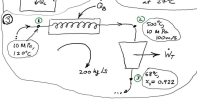 2 -Qg © 500°C 10 MPa 100m/s LOMPa, 120°C We 200 olyls 168°C) X = 0.922 (50 points). Combined boiler and turbine assembly: Water (H2O) flowing a the rate m = 200 kg is the working fluid for the boiler + turbine assembly shown in the figure. This flow enters the boiler at Pa = 10 MPa, T, = 120 °C. It leaves the boiler and enters the turbine at P2 = 10 MPa, T, = 500 °C with a...
17.2 To exchange heat between four streams: Stream C (kW/°C) Ts (°C) T' (°C) С1 2.5...
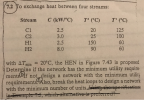 17.2 To exchange heat between four streams: Stream C (kW/°C) Ts (°C) T' (°C) С1 2.5 125 C2 3.0 20 25 150 HI 100 60 H2 2.5 8.0 90 60 with AT min = 20°C, the HEN in Figure 7.43 is proposed Determine if the network has the minimum utility require mentsOf not, design a network with the minimum utility requirements. Selso, break the heat loops to design a network with the minimum number of units in the specifications Exatrpie...
Oil enters a counterflow heat exchanger at 600 K with a mass flow rate of 10...
Oil enters a counterflow heat exchanger at 600 K with a mass flow rate of 10 kg/s and exits at 275 K. A separate stream of liquid water enters at 20°C, 5 bar. Each stream experiences no significant change in pressure. Stray heat transfer with the surroundings of the heat exchanger and kinetic and potential energy effects can be ignored. The specific heat of the oil is constant, c = 2 kJ/kg · K. If the designer wants to ensure...
A heat pump with refrigerant-134a as the working fluid is used to keep a space at 25°C by |absorbing heat from geotherm...
 A heat pump with refrigerant-134a as the working fluid is used to keep a space at 25°C by |absorbing heat from geothermal water that enters the evaporator at 50°C at a rate of 0.046 kg/s and leaves at 40°C. The refrigerant enters the evaporator at 20°C with a quality 23 percent and leaves at the inlet pressure as saturated vapor. The refrigerant loses305 W o heat to the surroundings as it flows through the compressor and the refrigerant leaves the...
2.Air enters an adiabatic nozzle in steady flow at 300 kPa, 200 C and 45 m/sec,...
 2.Air enters an adiabatic nozzle in steady flow at 300 kPa, 200 C and 45 m/sec, and leaves at 100 kPa and 180 m/sec. The inlet area of the nozzle is 110 cm 2. Determine: (a) the mass flow rate through the nozzle, and mdot = _ kg/sec (b) the exit temperature T2 = OC
 this problem in heat exchanger, please solve.
. In a parallel flow heat exchanger, hot liquid enters at 400°C and leaves at 250°C. Cold fluid enters at 50°C and leaves at 110°C. The inside and outside heat transfer coefficients are 120W/m2 K and 190 W/m2 K respectively. The inside and outside diameters of tube are 0.06 m and 0.08 m respectively. If the heat transferred per hour is 1.6x 10⁵ kJ. Determine the length of tube required. Ans:12.5 m
this problem in heat exchanger, please solve.
. In a parallel flow heat exchanger, hot liquid enters at 400°C and leaves at 250°C. Cold fluid enters at 50°C and leaves at 110°C. The inside and outside heat transfer coefficients are 120W/m2 K and 190 W/m2 K respectively. The inside and outside diameters of tube are 0.06 m and 0.08 m respectively. If the heat transferred per hour is 1.6x 10⁵ kJ. Determine the length of tube required. Ans:12.5 m
 5-30 Air enters an adiabatic nozzle steadily at 300 kPa, 200°C, and 30 m/s and leaves at 100 kPa and 180 m/s. The inlet area of the nozzle is 80 cm². Determine (a) the mass flow rate through the nozzle, (b) the exit temperature of the air, and (c) the exit area of the nozzle. Answers: (a) 0.5304 kg/s, (b) 184.6°C, (c) 38.7 cm P = 300 kPa T, = 200°C Vi = 30 m/s A = 80 cm AIR...
 1: A hot-water stream at 95°C enters a mixing chamber where it is mixed with a stream of cold water at 25°C. Assume all the streams are at a pressure of 350 kPa. It is desired that the mixture with a mass flow rate of 0.7 kg/s leaves the chamber at 39°C. Each enthalpy is given by hi hf@95°c = 350 kJ/kg h2 z hr@25°C = 83 kJ/kg h = hf@ 39°C = 175 kJ/kg a. Write down the mass...
 3. A stream of nitrogen (use the tables to find the necessary gas data) enters a diffuser at 200 m /s with a pressure of 80 kPa and -20 C. The speed at the outlet is 15 m/s at a pressure of 95 kPa. If the diameter at the entrance is 100 mm, calculate: a) The mass flow b) The temperature at the outlet of the diffuser c) The temperature at the outlet of the diffuser if heat escapes at...
 2 -Qg © 500°C 10 MPa 100m/s LOMPa, 120°C We 200 olyls 168°C) X = 0.922 (50 points). Combined boiler and turbine assembly: Water (H2O) flowing a the rate m = 200 kg is the working fluid for the boiler + turbine assembly shown in the figure. This flow enters the boiler at Pa = 10 MPa, T, = 120 °C. It leaves the boiler and enters the turbine at P2 = 10 MPa, T, = 500 °C with a...
 17.2 To exchange heat between four streams: Stream C (kW/°C) Ts (°C) T' (°C) С1 2.5 125 C2 3.0 20 25 150 HI 100 60 H2 2.5 8.0 90 60 with AT min = 20°C, the HEN in Figure 7.43 is proposed Determine if the network has the minimum utility require mentsOf not, design a network with the minimum utility requirements. Selso, break the heat loops to design a network with the minimum number of units in the specifications Exatrpie...
 2.Air enters an adiabatic nozzle in steady flow at 300 kPa, 200 C and 45 m/sec, and leaves at 100 kPa and 180 m/sec. The inlet area of the nozzle is 110 cm 2. Determine: (a) the mass flow rate through the nozzle, and mdot = _ kg/sec (b) the exit temperature T2 = OC
Most questions answered within 3 hours.
-
Where is the error in this code sequence?
String s1 = "Hello";
String s2 = "ello";...
asked 10 months ago -
Financial data for Joel de Paris, Inc., for last year
follow:
Joel de Paris, Inc.
Balance...
asked 10 months ago -
Consider this reaction:
Al2(SO4)3 (aq)+ BaCl3
(aq) Al2Cl6 (aq)- +
3BaSO4(s) . What is the...
asked 10 months ago -
Suppose that Savneet is considering increasing her
recent random sample from 20 car rentals to 40...
asked 10 months ago -
Trucks arrive at an unloading terminal at an average rate of 120
per hour.
Trucks arrive...
asked 10 months ago -
Why are methanol and ethanol completely soluble in water while
octanol is not very little soluble....
asked 10 months ago -
A facilities manager at a university reads in a research report
that the mean amount of...
asked 10 months ago -
When the CuSO4 is rehydrated by adding water to the anhydrous
compound, is this an endothermic...
asked 10 months ago -
A ray of sunlight is passing from diamond into crown glass; the
angle of incidence is...
asked 10 months ago -
A block of mass 0.249 kg is placed on top of a light, vertical
spring of...
asked 10 months ago -
how do the kidneys compensate in the presences of acidosis
a) trigger hyperventilate
b) reserve acid...
asked 10 months ago -
Question 501 pts
The rental rate of capital to the firm increases. Which of the
following...
asked 10 months ago