If the result of a second messenger activation is to increase K channel opening in the...
If the result of a second messenger activation is to increase K channel opening in the postsynaptic neuron, how will the excitability of the postsynaptic neuron change? Explain your answer.
Homework Answers
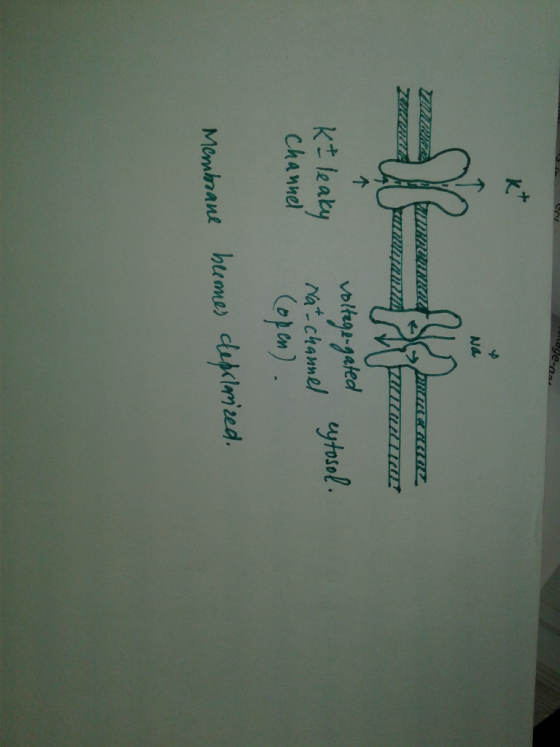
Ans:- In that case the postsynaptic neuron will become depolarized.
Explanation:- Opening of the K channels allows the leakage of the K out of the cell and hence the Na channels are opened allowing the Na ions to move into the neuron and thus become depolarized.
Add Answer to:
If the result of a second messenger activation is to
increase K channel opening in the...
The right answer is (D) Please explain. I don't understand how K+ could be effluxing rather...
 The right answer is (D)
Please explain. I don't understand how K+ could be effluxing rather
than influxing
Passage IV (Questions 114-117) Electrical impubses are transferred from one neuron to another via a synapse. Synapses can be electrical or chemical. In response to an electrical stimalus such as an action potential the presynaptic neuron in a chemical synapse releases a neuro- transmitner across a small space between the two neurons known as a symaptic cief. Neurotransmitiers may have excita- ory...
The right answer is (D)
Please explain. I don't understand how K+ could be effluxing rather
than influxing
Passage IV (Questions 114-117) Electrical impubses are transferred from one neuron to another via a synapse. Synapses can be electrical or chemical. In response to an electrical stimalus such as an action potential the presynaptic neuron in a chemical synapse releases a neuro- transmitner across a small space between the two neurons known as a symaptic cief. Neurotransmitiers may have excita- ory...
explain how the opening of the AChR found in skeletal muscle is able to lead to depolarization when the ion channel allo...
explain how the opening of the AChR found in skeletal muscle is able to lead to depolarization when the ion channel allows both na+ and k+ to flow through the ion channel
1. What triggers the opening of each of the different channels: ligand-gated K+ channels, ligand-gated Na+...
1. What triggers the opening of each of the different channels: ligand-gated K+ channels, ligand-gated Na+ channels, ligand-gated Cl- channels, voltage-gated Na+ channels, voltage-gated K+ channels, voltage-gated Ca2+ channels. 2. What happens to membrane potential in the immediate area where the channel is located when the channel opens and ions flow through? 3. Since graded and action potentials happen in different locations on the neuron, explain what has to happen to link these different events together.
4. There are a variety of receptors and second messenger systems in cells that in many...
4. There are a variety of receptors and second messenger systems in cells that in many cases exhibit cross-talk with each other (the activation of one can influence the behavior of another). Given this fact understanding how ligand activated receptors works is not as easy as presented in your book or in class. a. There are a number of different ligands that interact with their respective receptors. How do receptors for testosterone, ferro transferrin and Fibroblast Growth Factor differ from...
1. Calcium plays several roles in cells that are critical for second messenger signaling and overall...
1. Calcium plays several roles in cells that are critical for second messenger signaling and overall cell function. Yet loss of calcium homeostasis can result in cell death. a. List three cellular responses to a rise in cytosolic calcium b. Calcium ionophores such as A23187 and Ionomycin can demonstrate that a loss of intracellular calcium can lead to cell death through necrosis. Explain this statement. c. How is calcium important to the IP3/DAG pathway and why is this a two...
MEK is second messenger. Second messengers transmit and amplify the signal received by receptor –ligand interactions...
MEK is second messenger. Second messengers transmit and amplify the signal received by receptor –ligand interactions on the outside of the cell. Assume that the cancer cell has a mutation causing a constitutively active MEK (on all the time). Design a drug that acts as either a competitive inhibitor, allosteric inhibitor, or antagonist that would specifically inhibit this phenotype. Explain the Kd/Km of your drug for your chosen target. Explain the type of inhibition you will use. Explain how your...
You are studying a ligand-gated ion channel. The ligand is a neurotransmitter. Upon binding the neurotransmitter,...
You are studying a ligand-gated ion channel. The ligand is a neurotransmitter. Upon binding the neurotransmitter, the ion channel opens and Na+ flows into the cell. The receptor is found on the dendrites of frog neurons. You are going to use one of the patch-clamp variations to study the effect of (1) the neurotransmitter and (2) second (and separately) the effect of an antagonist. Explain the patch-clamp technique variation you would use and why. Explain how you will study the...
PES How do nonsteroid hormones differ from steroid hormones? Nonsteroid hormones act via a second messenger...
 PES How do nonsteroid hormones differ from steroid hormones? Nonsteroid hormones act via a second messenger system steroid hormones do not use a second messenger system Nonsteroid hormones bind to cytoplasmic receptors, steroid hormones bind to plasma membrane receptors. The action of nonsteroid hormones never affects gene expression, the action of steroid hormones always affects gene expression Nonsteroid hormones are fat-soluble; steroid hormones are water-soluble. Nonsteroid hormones bind to acell's DNA:sterold hormones do not bind DNA U Question 5 1...
ln(k) = -E_a/R 1/T + ln(A) A plot of ln (k)versus 1/T result in a straight...
 ln(k) = -E_a/R 1/T + ln(A) A plot of ln (k)versus 1/T result in a straight line with a slope = -E_a/R. The value of E_a can then be calculated using the value of R and to the slope of the line. This experiment uses the Arrhenius equation, which relates the temperature and specific reaction rate constant to determine the activation energy for the crystal violet reaction. The reaction will be performed at different temperatures. Once the order of reaction...
INFORMATION ABOUT IMAGE G FOR QUESTIONS 12-15: GABAB receptors (GABABRs) are G-protein-coupled receptors that can be...
 INFORMATION ABOUT IMAGE G FOR QUESTIONS 12-15:
GABAB receptors (GABABRs) are
G-protein-coupled receptors that can be found on both pre- and
postsynaptic neurons. When they are activated by GABA, they can
have a range of effects. For the synapse you are studying in the
following questions, the effects of GABABRs are
indicated in IMAGE G.
You are doing a series of experiments in which you are recording
from the pre- and postsynaptic cell at a synapse. The experiments
described below...
INFORMATION ABOUT IMAGE G FOR QUESTIONS 12-15:
GABAB receptors (GABABRs) are
G-protein-coupled receptors that can be found on both pre- and
postsynaptic neurons. When they are activated by GABA, they can
have a range of effects. For the synapse you are studying in the
following questions, the effects of GABABRs are
indicated in IMAGE G.
You are doing a series of experiments in which you are recording
from the pre- and postsynaptic cell at a synapse. The experiments
described below...
 The right answer is (D)
Please explain. I don't understand how K+ could be effluxing rather
than influxing
Passage IV (Questions 114-117) Electrical impubses are transferred from one neuron to another via a synapse. Synapses can be electrical or chemical. In response to an electrical stimalus such as an action potential the presynaptic neuron in a chemical synapse releases a neuro- transmitner across a small space between the two neurons known as a symaptic cief. Neurotransmitiers may have excita- ory...
The right answer is (D)
Please explain. I don't understand how K+ could be effluxing rather
than influxing
Passage IV (Questions 114-117) Electrical impubses are transferred from one neuron to another via a synapse. Synapses can be electrical or chemical. In response to an electrical stimalus such as an action potential the presynaptic neuron in a chemical synapse releases a neuro- transmitner across a small space between the two neurons known as a symaptic cief. Neurotransmitiers may have excita- ory...
 PES How do nonsteroid hormones differ from steroid hormones? Nonsteroid hormones act via a second messenger system steroid hormones do not use a second messenger system Nonsteroid hormones bind to cytoplasmic receptors, steroid hormones bind to plasma membrane receptors. The action of nonsteroid hormones never affects gene expression, the action of steroid hormones always affects gene expression Nonsteroid hormones are fat-soluble; steroid hormones are water-soluble. Nonsteroid hormones bind to acell's DNA:sterold hormones do not bind DNA U Question 5 1...
 ln(k) = -E_a/R 1/T + ln(A) A plot of ln (k)versus 1/T result in a straight line with a slope = -E_a/R. The value of E_a can then be calculated using the value of R and to the slope of the line. This experiment uses the Arrhenius equation, which relates the temperature and specific reaction rate constant to determine the activation energy for the crystal violet reaction. The reaction will be performed at different temperatures. Once the order of reaction...
 INFORMATION ABOUT IMAGE G FOR QUESTIONS 12-15:
GABAB receptors (GABABRs) are
G-protein-coupled receptors that can be found on both pre- and
postsynaptic neurons. When they are activated by GABA, they can
have a range of effects. For the synapse you are studying in the
following questions, the effects of GABABRs are
indicated in IMAGE G.
You are doing a series of experiments in which you are recording
from the pre- and postsynaptic cell at a synapse. The experiments
described below...
INFORMATION ABOUT IMAGE G FOR QUESTIONS 12-15:
GABAB receptors (GABABRs) are
G-protein-coupled receptors that can be found on both pre- and
postsynaptic neurons. When they are activated by GABA, they can
have a range of effects. For the synapse you are studying in the
following questions, the effects of GABABRs are
indicated in IMAGE G.
You are doing a series of experiments in which you are recording
from the pre- and postsynaptic cell at a synapse. The experiments
described below...
Most questions answered within 3 hours.
-
Where is the error in this code sequence?
String s1 = "Hello";
String s2 = "ello";...
asked 11 months ago -
Financial data for Joel de Paris, Inc., for last year
follow:
Joel de Paris, Inc.
Balance...
asked 11 months ago -
Consider this reaction:
Al2(SO4)3 (aq)+ BaCl3
(aq) Al2Cl6 (aq)- +
3BaSO4(s) . What is the...
asked 11 months ago -
Suppose that Savneet is considering increasing her
recent random sample from 20 car rentals to 40...
asked 11 months ago -
Trucks arrive at an unloading terminal at an average rate of 120
per hour.
Trucks arrive...
asked 11 months ago -
Why are methanol and ethanol completely soluble in water while
octanol is not very little soluble....
asked 11 months ago -
A facilities manager at a university reads in a research report
that the mean amount of...
asked 11 months ago -
When the CuSO4 is rehydrated by adding water to the anhydrous
compound, is this an endothermic...
asked 11 months ago -
A ray of sunlight is passing from diamond into crown glass; the
angle of incidence is...
asked 11 months ago -
A block of mass 0.249 kg is placed on top of a light, vertical
spring of...
asked 11 months ago -
how do the kidneys compensate in the presences of acidosis
a) trigger hyperventilate
b) reserve acid...
asked 11 months ago -
Question 501 pts
The rental rate of capital to the firm increases. Which of the
following...
asked 11 months ago