Be able to interpret growth curves for organisms grown under ideal conditions as well as those...
Homework Answers
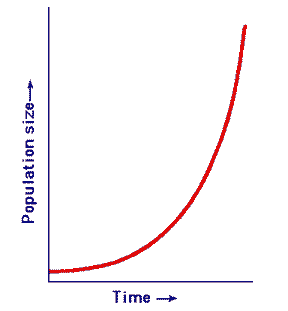
1. Growth curve under ideal conditions: Exponential growth curve
This graph shows exponential growth, which only happens under ideal conditions with unlimited space, food and no predators . So the growth curve under ideal conditions is called an Exponential curve. It shows rapidly increasing population growth due to each generation producing more offspring. It is a J shaped curve
2. Growth curve under poor growing conditions: Logistic growth curve
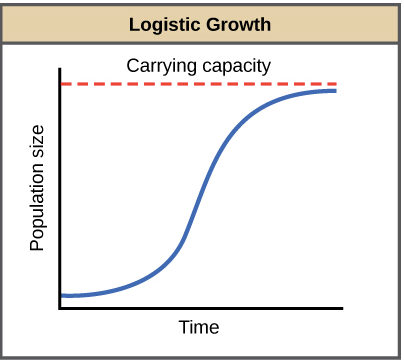
When the number of individuals gets large enough, resources start to get used up, slowing the growth rate. Eventually, the growth rate will plateau, or level off, making an S-shaped curve. The population size at which it levels off, which represents the maximum population size a particular environment can support, is called the carrying capacity, or K. For animals, important resources include food, water, shelter, and nesting space. Limited quantities of these resources results in competition between members of the same population, or intraspecific competition (intra- = within; -specific = species).
Intraspecific competition for resources may not affect populations that are well below their carrying capacity—resources are plentiful and all individuals can obtain what they need. However, as population size increases, the competition intensifies. In addition, the accumulation of waste products can reduce an environment’s carrying capacity.
Add Answer to:
Be
able to interpret growth curves for organisms grown under ideal
conditions as well as those...
Why would an agar plate contain a buffer? Look up a growth curve for organisms grown...
Why would an agar plate contain a buffer? Look up a growth curve for organisms grown on agar in your text. Why does an organism enter the stationary phase of growth?
Why would photosynthetic rates of beech grown under shelterwood be higher than those of oak grown...
Why would photosynthetic rates of beech grown under shelterwood be higher than those of oak grown under patch harvest?
What conditions are best for fossil formation? Name organisms that are well represented in the fossil...
 What conditions are best for fossil formation? Name organisms that are well represented in the fossil record Why are these types of organisms more prevalent in the fossil record? Discuss the following: Pangaea Laurasia Gondwana What organism is the major force driving evolution today?
I don't understand why it is C Commercial bananas are grown as a monoculture, with...
I don't understand why it is C
Commercial bananas are grown as a monoculture, with all banana plants cloned from one original banana plant. The commercial strains of bananas are seedless, so each new banana plant has to be manually planted from a cutting of an existing banana root. In the 1950s, the Gros Michel banana strain, the dominant export banana at that time, was destroyed by the fungus Fusarium oxysporum. A new Fusarium resistant variety, the Cavendish banana,...
I don't understand why it is C
Commercial bananas are grown as a monoculture, with all banana plants cloned from one original banana plant. The commercial strains of bananas are seedless, so each new banana plant has to be manually planted from a cutting of an existing banana root. In the 1950s, the Gros Michel banana strain, the dominant export banana at that time, was destroyed by the fungus Fusarium oxysporum. A new Fusarium resistant variety, the Cavendish banana,...
Neisseria meningitis under ideal lab conditions has a doubling time of ~30 minutes, however in cases...
Neisseria meningitis under ideal lab conditions has a doubling time of ~30 minutes, however in cases of infection the doubling time is closer to 100 minutes. What factors could potentially be affecting the growth rate?
If two cultures of a facultative anaerobe were grown under identical conditions except that one was...
If two cultures of a facultative anaerobe were grown under identical conditions except that one was exposed to oxygen and the other was completely deprived of oxygen. Which of the two cultures will contain more cells at the end of a week? Why? For microbiology
Explain why organisms that can survive and/or grow under aerobic conditions need the enzymes catalase and...
Explain why organisms that can survive and/or grow under aerobic conditions need the enzymes catalase and superoxide dismutase.
If E. coli is grown under conditions that maintain a generation time of 80 minutes and...
If E. coli is grown under conditions that maintain a generation time of 80 minutes and the cells are the quickly transferred into a new medium that allows a generation time of 40 minutes? 1. How would that affect DNA polymerase? 2. DNA replication process? 3. DNA division? 4. Will generation time change?
Exercise 1. Assuming no further physiological changes occur, calculate the daily (24 hour) carbon balance for leaves of the HL- and LL-grown plants under the following experimental conditions: 1...
 Exercise 1. Assuming no further physiological changes occur, calculate the daily (24 hour) carbon balance for leaves of the HL- and LL-grown plants under the following experimental conditions: 1A. Bright light treatment. Plants are kept at a light-level of 200 umol/m2/s for 2 hours, then switched to a light-level of 150°umol/ma/s for 10 hours, then switched back to a light-level of 200 μmol/㎡/s for 2 hours, and finally, left in darkness (0 μmol/m2/s) for 10 hours. This light regime simulates...
Conditional mutations are those where the trait is seen only under certain conditions. In permissive conditions...
Conditional mutations are those where the trait is seen only under certain conditions. In permissive conditions the mutant allele has wild-type functions and under restrictive conditions the mutant allele has defective functions. True False
 What conditions are best for fossil formation? Name organisms that are well represented in the fossil record Why are these types of organisms more prevalent in the fossil record? Discuss the following: Pangaea Laurasia Gondwana What organism is the major force driving evolution today?
I don't understand why it is C
Commercial bananas are grown as a monoculture, with all banana plants cloned from one original banana plant. The commercial strains of bananas are seedless, so each new banana plant has to be manually planted from a cutting of an existing banana root. In the 1950s, the Gros Michel banana strain, the dominant export banana at that time, was destroyed by the fungus Fusarium oxysporum. A new Fusarium resistant variety, the Cavendish banana,...
I don't understand why it is C
Commercial bananas are grown as a monoculture, with all banana plants cloned from one original banana plant. The commercial strains of bananas are seedless, so each new banana plant has to be manually planted from a cutting of an existing banana root. In the 1950s, the Gros Michel banana strain, the dominant export banana at that time, was destroyed by the fungus Fusarium oxysporum. A new Fusarium resistant variety, the Cavendish banana,...
 Exercise 1. Assuming no further physiological changes occur, calculate the daily (24 hour) carbon balance for leaves of the HL- and LL-grown plants under the following experimental conditions: 1A. Bright light treatment. Plants are kept at a light-level of 200 umol/m2/s for 2 hours, then switched to a light-level of 150°umol/ma/s for 10 hours, then switched back to a light-level of 200 μmol/㎡/s for 2 hours, and finally, left in darkness (0 μmol/m2/s) for 10 hours. This light regime simulates...
Most questions answered within 3 hours.
-
Where is the error in this code sequence?
String s1 = "Hello";
String s2 = "ello";...
asked 11 months ago -
Financial data for Joel de Paris, Inc., for last year
follow:
Joel de Paris, Inc.
Balance...
asked 11 months ago -
Consider this reaction:
Al2(SO4)3 (aq)+ BaCl3
(aq) Al2Cl6 (aq)- +
3BaSO4(s) . What is the...
asked 11 months ago -
Suppose that Savneet is considering increasing her
recent random sample from 20 car rentals to 40...
asked 11 months ago -
Trucks arrive at an unloading terminal at an average rate of 120
per hour.
Trucks arrive...
asked 11 months ago -
Why are methanol and ethanol completely soluble in water while
octanol is not very little soluble....
asked 11 months ago -
A facilities manager at a university reads in a research report
that the mean amount of...
asked 11 months ago -
When the CuSO4 is rehydrated by adding water to the anhydrous
compound, is this an endothermic...
asked 11 months ago -
A ray of sunlight is passing from diamond into crown glass; the
angle of incidence is...
asked 11 months ago -
A block of mass 0.249 kg is placed on top of a light, vertical
spring of...
asked 11 months ago -
how do the kidneys compensate in the presences of acidosis
a) trigger hyperventilate
b) reserve acid...
asked 11 months ago -
Question 501 pts
The rental rate of capital to the firm increases. Which of the
following...
asked 11 months ago