Can someone show the step by step biochemical mechanism for ALS disease and explain each step?
Can someone show the step by step biochemical mechanism for ALS disease and explain each step?
Homework Answers
ALS, amyotrophic lateral sclerosis, is a progressive neurodegenerative disease that affects nerve cells in the brain and the spinal cord. Myo means muscle and trophic means nourishment; therefore amyotrophic means lack of muscle nourishment. "Lateral" identifies the areas in a person's spinal cord where portions of the nerve cells that signal and control the muscles are located. As this area degenerates, it leads to hardening (sclerosis) in the region.
ALS kills motor neurons and causes weakening of muscles. Motor neurons reach from the brain to the spinal cord and from the spinal cord to the muscles throughout the body. When the motor neurons die, the ability of the brain to initiate and control muscle movement is lost. With voluntary muscle action progressively affected, people may lose the ability to speak, eat, move and breathe.
Commonly proposed pathogenic mechanisms include RNA metabolism and protein metabolism. Oxidative stress also induces the pathogenesis of ALS. Mitochondrial dysfunction is a common feature of many neurodegenerative disorders.
Glutamate excitotoxicity has long been implicated in ALS pathogenesis.. In ALS, there is an understandable focus on the motor neurons, but evidence exists that this is a non-cell-autonomous disease, and non-neuronal cells, in particular microglia may have an important role in pathogenesis.
Add Answer to:
Can someone show the step by step biochemical mechanism for ALS
disease and explain each step?
Can someone please discuss this mechanism explain it step by step Thank you
 Can someone please discuss this mechanism explain it step by
step
Thank you
Can someone please discuss this mechanism explain it step by
step
Thank you
can someone please show me the step by step labeled mechanism of the reaction between 3-pentanone...
can someone please show me the step by step labeled mechanism of the reaction between 3-pentanone and hydrazine. The final product should be a hydrazone. Thank you.
Can someone help explain this process in words Replication initiation in eukaryotic cells involves a step-wise...
Can someone help explain this process in words Replication initiation in eukaryotic cells involves a step-wise mechanism analogous to the initiation sequence that was discussed for E. coli. - Outline the main DNA and protein components that enable replication initiation in yeast (the representative eukaryotic cell). - For each component, specify which is the parallel functional analogue in E. coli and briefly describe key biochemical features.
Organic Chemistry question partial step of a synthesis. Can someone explain the mechanism? Thank you. c)...
 Organic Chemistry question
partial step of a synthesis. Can someone explain the mechanism?
Thank you.
c) NaOH, H2O O O HCI, H20 d) Heat cyclobutyl methyl ketone
Organic Chemistry question
partial step of a synthesis. Can someone explain the mechanism?
Thank you.
c) NaOH, H2O O O HCI, H20 d) Heat cyclobutyl methyl ketone
can someone explain step by step? thanks 7. The structure of styrene is shown below. The...
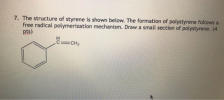 can someone explain step by step? thanks
7. The structure of styrene is shown below. The formation of polystyrene follows a free radical polymerization mechanism. Draw a small section of polystyrene. (4 pts) C=CH2
can someone explain step by step? thanks
7. The structure of styrene is shown below. The formation of polystyrene follows a free radical polymerization mechanism. Draw a small section of polystyrene. (4 pts) C=CH2
(I have to be able to teach someone this) illustrate/draw and explain each step of the...
 (I have to be able to teach someone this)
illustrate/draw and explain each step of the reaction mechanism
to show how the expected major organic products form.
you should draw and explain (what is happening and
why) at each of the steps in the reaction using
the proper terminology. please use accurate lone pair electrons,
formal charges, and accurate electron pushing arrows
throughout.
Cl2, hv
(I have to be able to teach someone this)
illustrate/draw and explain each step of the reaction mechanism
to show how the expected major organic products form.
you should draw and explain (what is happening and
why) at each of the steps in the reaction using
the proper terminology. please use accurate lone pair electrons,
formal charges, and accurate electron pushing arrows
throughout.
Cl2, hv
can someone show me how todo this problem step by step and explain? im lost. ive...
 can someone show me how todo this problem step by step
and explain? im lost. ive also attached the answers from the back
of the book. there has to be a way where i dont have to use coding
i.e. matlab in order to solve this problem
can someone show me how todo this problem step by step
and explain? im lost. ive also attached the answers from the back
of the book. there has to be a way where i dont have to use coding
i.e. matlab in order to solve this problem
Can someone show me this mechanism please and explain the underlying process? Thank you 25. Which...
 Can someone show me this mechanism please and explain the
underlying process? Thank you
25. Which of the following is the product of the reaction below? NaOEt, EtOH но IV E. None of the above.
Can someone show me this mechanism please and explain the
underlying process? Thank you
25. Which of the following is the product of the reaction below? NaOEt, EtOH но IV E. None of the above.
Can someone show me the mechanism for this reaction please!
 Can someone show me the mechanism for this reaction
please!
Can someone show me the mechanism for this reaction
please!
How can we raise awareness about ALS as a disease, at the same time we raise...
How can we raise awareness about ALS as a disease, at the same time we raise money for ALS? guiding questions: The ALSA has provided you with the following questions to help guide your work: 1. What is ALS? Describe the pathological symptoms and disease prognosis. 2. How does the familial form of ALS differ from the sporadic form? 3. How is ALS diagnosed? 4. How is ALS treated? What is the typical prognosis of a patient with ALS? 5....
 Can someone please discuss this mechanism explain it step by
step
Thank you
Can someone please discuss this mechanism explain it step by
step
Thank you
 Organic Chemistry question
partial step of a synthesis. Can someone explain the mechanism?
Thank you.
c) NaOH, H2O O O HCI, H20 d) Heat cyclobutyl methyl ketone
Organic Chemistry question
partial step of a synthesis. Can someone explain the mechanism?
Thank you.
c) NaOH, H2O O O HCI, H20 d) Heat cyclobutyl methyl ketone
 can someone explain step by step? thanks
7. The structure of styrene is shown below. The formation of polystyrene follows a free radical polymerization mechanism. Draw a small section of polystyrene. (4 pts) C=CH2
can someone explain step by step? thanks
7. The structure of styrene is shown below. The formation of polystyrene follows a free radical polymerization mechanism. Draw a small section of polystyrene. (4 pts) C=CH2
 (I have to be able to teach someone this)
illustrate/draw and explain each step of the reaction mechanism
to show how the expected major organic products form.
you should draw and explain (what is happening and
why) at each of the steps in the reaction using
the proper terminology. please use accurate lone pair electrons,
formal charges, and accurate electron pushing arrows
throughout.
Cl2, hv
(I have to be able to teach someone this)
illustrate/draw and explain each step of the reaction mechanism
to show how the expected major organic products form.
you should draw and explain (what is happening and
why) at each of the steps in the reaction using
the proper terminology. please use accurate lone pair electrons,
formal charges, and accurate electron pushing arrows
throughout.
Cl2, hv
 can someone show me how todo this problem step by step
and explain? im lost. ive also attached the answers from the back
of the book. there has to be a way where i dont have to use coding
i.e. matlab in order to solve this problem
can someone show me how todo this problem step by step
and explain? im lost. ive also attached the answers from the back
of the book. there has to be a way where i dont have to use coding
i.e. matlab in order to solve this problem
 Can someone show me this mechanism please and explain the
underlying process? Thank you
25. Which of the following is the product of the reaction below? NaOEt, EtOH но IV E. None of the above.
Can someone show me this mechanism please and explain the
underlying process? Thank you
25. Which of the following is the product of the reaction below? NaOEt, EtOH но IV E. None of the above.
 Can someone show me the mechanism for this reaction
please!
Can someone show me the mechanism for this reaction
please!
Most questions answered within 3 hours.
-
Where is the error in this code sequence?
String s1 = "Hello";
String s2 = "ello";...
asked 10 months ago -
Financial data for Joel de Paris, Inc., for last year
follow:
Joel de Paris, Inc.
Balance...
asked 10 months ago -
Consider this reaction:
Al2(SO4)3 (aq)+ BaCl3
(aq) Al2Cl6 (aq)- +
3BaSO4(s) . What is the...
asked 10 months ago -
Suppose that Savneet is considering increasing her
recent random sample from 20 car rentals to 40...
asked 10 months ago -
Trucks arrive at an unloading terminal at an average rate of 120
per hour.
Trucks arrive...
asked 10 months ago -
Why are methanol and ethanol completely soluble in water while
octanol is not very little soluble....
asked 10 months ago -
A facilities manager at a university reads in a research report
that the mean amount of...
asked 10 months ago -
When the CuSO4 is rehydrated by adding water to the anhydrous
compound, is this an endothermic...
asked 10 months ago -
A ray of sunlight is passing from diamond into crown glass; the
angle of incidence is...
asked 10 months ago -
A block of mass 0.249 kg is placed on top of a light, vertical
spring of...
asked 10 months ago -
how do the kidneys compensate in the presences of acidosis
a) trigger hyperventilate
b) reserve acid...
asked 10 months ago -
Question 501 pts
The rental rate of capital to the firm increases. Which of the
following...
asked 10 months ago