A thin, horizontal copper rod is 1.20 m long and has a mass of 44.5g. What...
A thin, horizontal copper rod is 1.20 m long and has a mass of 44.5g. What is the minimum current in the rod that can cause it to float in a horizontal magnetic field of 2.45 T?
Homework Answers
a similar question is solved below, but with different values. hope this helps you.
A thin horizontal copper rod is 1.0 m long and has a mass of 65.0 g. What is the minimum current in the rod that can cause it to float in a horizontal magnetic field of 2.0 T?
I = 6.37 *10-1 /2.0 = 0.3185 A
Add Answer to:
A thin, horizontal copper rod is 1.20
m
long and has a mass of 44.5g.
What...
A Rod Levitating in a Magnetic Field Due in 13 hours, 3d minutes thin, horizontal copper...
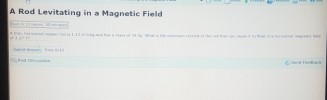 A Rod Levitating in a Magnetic Field Due in 13 hours, 3d minutes thin, horizontal copper rod is 1.13 m long and has a mass of 34.Sa. What is the minimum current in the rod that can cause it to float in a horiaontal magnetic field of 2.27 T しSubmit Answer. Tries 0/10 Send Feedback Post Discussion
A thin copper rod 1.00 m long has a mass of 50.0 g. What is the...
A thin copper rod 1.00 m long has a mass of 50.0 g. What is the minimum current in the rod that would allow it to levitate above the ground in a magnetic field of magnitude 0.100 T? a.1.20 A b.2.40 A c.4.90 A d.9.80 A e.none of these answers
A thin copper rod 2.0 m long has a mass of 0.10 kg and is in...
A thin copper rod 2.0 m long has a mass of 0.10 kg and is in a magnetic field of 0.20 T. What minimum current in the rod is needed in order for the magnetic force to balance the weight of the rod?
A thin, cylindrical rod phi = 24.0 cm long with mass m = 1.20 kg has...
 A thin, cylindrical rod phi = 24.0 cm long with mass m = 1.20 kg has a ball of diameter d = 8.00 cm and mass M = 2.00 kg attached to one end. the arrangement is originally vertical and stationary with the ball at the top as shown in Figure P10.54 the combination is free to pivot about the bottom end of the rod after being given a slight nudge, (a) After the combination rotates through 90 degrees, what...
A 0.53 m copper rod with a mass of 5.00×10⁻² kg carries a current of 13...
A 0.53 m copper rod with a mass of 5.00×10⁻² kg carries a current of 13 A in the positive x direction. Let upward be the positive y direction. A.)What is the magnitude of the minimum magnetic field needed to levitate the rod? B.)What is the direction of the minimum magnetic field needed to levitate the rod?
A 1.0 kg copper rod rests on two horizontal rails 1.0 m and carries a current...
 A 1.0 kg copper rod rests on two horizontal rails 1.0 m and carries a current of 50 A from one rail to the other. The coefficient of static friction between the rod and the rails is 0.60. What is the smallest magnetic field (not necessarily vertical) that would cause the rod to slide?
A thin, cylindrical rod ℓ = 27.0 cm long with a mass m = 1.20 kg...
A thin, cylindrical rod ℓ = 27.0 cm long with a mass m = 1.20 kg has a ball of diameter d = 10.00 cm and mass M = 2.00 kg attached to one end. The arrangement is originally vertical and stationary, with the ball at the top as shown in the figure below. The combination is free to pivot about the bottom end of the rod after being given a slight nudge. (a) After the combination rotates through 90...
A 0.48 m copper rod with a mass of 4.00×10⁻² kg carries a current of 15...
A 0.48 m copper rod with a mass of 4.00×10⁻² kg carries a current of 15 A in the positive x direction. Let upward be the positive y direction. What is the magnitude of the minimum magnetic field needed to levitate the rod? Express your answer using two significant figures. What is the direction of the minimum magnetic field needed to levitate the rod?
Question 10 A copper rod of mass m 0.912 kg rests on two horizontal rails a...
 Question 10 A copper rod of mass m 0.912 kg rests on two horizontal rails a distance L-1.08 m apart and carries a current of i 51.0 A from one rail to the other. A top view and a side view are shown in the figure. The coefficient of static friction between rod and rails is 0.580. What are the (a) magnitude and (b) angle (relative to the vertical) of the smallest magnetic field that puts the rod on the...
A 2.4 kg copper rod rests on two horizontal rails (see figure below) 1.2 m apart...
 A 2.4 kg copper rod rests on two horizontal rails (see figure
below) 1.2 m apart and carries a current of 65 A from one rail to
the other. The coefficient of static friction between rod and rails
is 0.51. What are the magnitude and angle (relative to the
vertical) of the smallest magnetic field that puts the rod on the
verge of sliding? (Based on the bottom picture, define to the right
as the +x direction and up as...
A 2.4 kg copper rod rests on two horizontal rails (see figure
below) 1.2 m apart and carries a current of 65 A from one rail to
the other. The coefficient of static friction between rod and rails
is 0.51. What are the magnitude and angle (relative to the
vertical) of the smallest magnetic field that puts the rod on the
verge of sliding? (Based on the bottom picture, define to the right
as the +x direction and up as...
 A Rod Levitating in a Magnetic Field Due in 13 hours, 3d minutes thin, horizontal copper rod is 1.13 m long and has a mass of 34.Sa. What is the minimum current in the rod that can cause it to float in a horiaontal magnetic field of 2.27 T しSubmit Answer. Tries 0/10 Send Feedback Post Discussion
 A thin, cylindrical rod phi = 24.0 cm long with mass m = 1.20 kg has a ball of diameter d = 8.00 cm and mass M = 2.00 kg attached to one end. the arrangement is originally vertical and stationary with the ball at the top as shown in Figure P10.54 the combination is free to pivot about the bottom end of the rod after being given a slight nudge, (a) After the combination rotates through 90 degrees, what...
 A 1.0 kg copper rod rests on two horizontal rails 1.0 m and carries a current of 50 A from one rail to the other. The coefficient of static friction between the rod and the rails is 0.60. What is the smallest magnetic field (not necessarily vertical) that would cause the rod to slide?
 Question 10 A copper rod of mass m 0.912 kg rests on two horizontal rails a distance L-1.08 m apart and carries a current of i 51.0 A from one rail to the other. A top view and a side view are shown in the figure. The coefficient of static friction between rod and rails is 0.580. What are the (a) magnitude and (b) angle (relative to the vertical) of the smallest magnetic field that puts the rod on the...
 A 2.4 kg copper rod rests on two horizontal rails (see figure
below) 1.2 m apart and carries a current of 65 A from one rail to
the other. The coefficient of static friction between rod and rails
is 0.51. What are the magnitude and angle (relative to the
vertical) of the smallest magnetic field that puts the rod on the
verge of sliding? (Based on the bottom picture, define to the right
as the +x direction and up as...
A 2.4 kg copper rod rests on two horizontal rails (see figure
below) 1.2 m apart and carries a current of 65 A from one rail to
the other. The coefficient of static friction between rod and rails
is 0.51. What are the magnitude and angle (relative to the
vertical) of the smallest magnetic field that puts the rod on the
verge of sliding? (Based on the bottom picture, define to the right
as the +x direction and up as...
Most questions answered within 3 hours.
-
Where is the error in this code sequence?
String s1 = "Hello";
String s2 = "ello";...
asked 11 months ago -
Financial data for Joel de Paris, Inc., for last year
follow:
Joel de Paris, Inc.
Balance...
asked 11 months ago -
Consider this reaction:
Al2(SO4)3 (aq)+ BaCl3
(aq) Al2Cl6 (aq)- +
3BaSO4(s) . What is the...
asked 11 months ago -
Suppose that Savneet is considering increasing her
recent random sample from 20 car rentals to 40...
asked 11 months ago -
Trucks arrive at an unloading terminal at an average rate of 120
per hour.
Trucks arrive...
asked 11 months ago -
Why are methanol and ethanol completely soluble in water while
octanol is not very little soluble....
asked 11 months ago -
A facilities manager at a university reads in a research report
that the mean amount of...
asked 11 months ago -
When the CuSO4 is rehydrated by adding water to the anhydrous
compound, is this an endothermic...
asked 11 months ago -
A ray of sunlight is passing from diamond into crown glass; the
angle of incidence is...
asked 11 months ago -
A block of mass 0.249 kg is placed on top of a light, vertical
spring of...
asked 11 months ago -
how do the kidneys compensate in the presences of acidosis
a) trigger hyperventilate
b) reserve acid...
asked 11 months ago -
Question 501 pts
The rental rate of capital to the firm increases. Which of the
following...
asked 11 months ago