A thin copper rod 1.00 m long has a mass of 50.0 g. What is the...
a.1.20 A
b.2.40 A
c.4.90 A
d.9.80 A
e.none of these answers
Homework Answers
The concepts used to solve this problem are magnetic force and gravitational force.
First, equate the magnitude of the magnetic force and the gravitational force acting on the copper rod to determine the condition for levitation.
Use the relationship between the magnetic field acting on the rod, length of the rod, and the acceleration due to gravity to determine the required current in the rod.
The expression for the magnetic force that acts on the copper rod is as follows:
Here, the magnetic force is , the magnetic field is , the current in the copper wire is , and the length of the wire is .
The expression for the gravitational force is as follows:
Here, the gravitational force is , the mass of the copper rod is , the acceleration due to gravity is .
The expression for the condition for levitation of copper rod is as follows:
Here, the magnitude of the magnetic force is and the magnitude of the gravitational force is
Levitation occurs when the magnetic force on the copper rod is balanced by the gravitational force acting on it.
The expression for this condition is as follows:
Substitute for and for .
Rearrange the above expression for the current.
The expression for the current in the copper wire is as follows:
Substitute for , for , for , and for .
The required current in the copper wire is .
Ans:Thus, the correct option for the required current in the copper wire for it to levitate in the magnetic field is .
A thin, horizontal copper rod is 1.20 m long and has a mass of 44.5g. What...
A thin, horizontal copper rod is 1.20 m long and has a mass of 44.5g. What is the minimum current in the rod that can cause it to float in a horizontal magnetic field of 2.45 T?
A thin copper rod 2.0 m long has a mass of 0.10 kg and is in...
A thin copper rod 2.0 m long has a mass of 0.10 kg and is in a magnetic field of 0.20 T. What minimum current in the rod is needed in order for the magnetic force to balance the weight of the rod?
A 0.53 m copper rod with a mass of 5.00×10⁻² kg carries a current of 13...
A 0.53 m copper rod with a mass of 5.00×10⁻² kg carries a current of 13 A in the positive x direction. Let upward be the positive y direction. A.)What is the magnitude of the minimum magnetic field needed to levitate the rod? B.)What is the direction of the minimum magnetic field needed to levitate the rod?
A 0.48 m copper rod with a mass of 4.00×10⁻² kg carries a current of 15...
A 0.48 m copper rod with a mass of 4.00×10⁻² kg carries a current of 15 A in the positive x direction. Let upward be the positive y direction. What is the magnitude of the minimum magnetic field needed to levitate the rod? Express your answer using two significant figures. What is the direction of the minimum magnetic field needed to levitate the rod?
Questions 1. A 10 cm wire carrying a current of 20 A is placed in a uniform magnetic field of 0.3 T. If the wire ma...
 Questions 1. A 10 cm wire carrying a current of 20 A is placed in a uniform magnetic field of 0.3 T. If the wire makes an anel 40 with the vector of magnetic field, find the magnitude of the force on the wire. 2. Should you expect that a straight line go through the origin for each experiment? 3. What assumptions are made in each experiment about the magnetic field produced by the magnets? 4. Summarize the results of...
A Rod Levitating in a Magnetic Field Due in 13 hours, 3d minutes thin, horizontal copper...
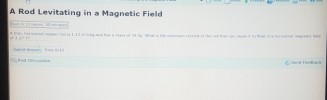 A Rod Levitating in a Magnetic Field Due in 13 hours, 3d minutes thin, horizontal copper rod is 1.13 m long and has a mass of 34.Sa. What is the minimum current in the rod that can cause it to float in a horiaontal magnetic field of 2.27 T しSubmit Answer. Tries 0/10 Send Feedback Post Discussion
2. A current carrying copper rod of mass 3.4 x 10² kg and length 0.12 m is attached in a circuit to a power supply and...
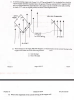 2. A current carrying copper rod of mass 3.4 x 10² kg and length 0.12 m is attached in a circuit to a power supply and held suspended above the ground. When an external 0.96 T magnetic field acts in an upward direction perpendicular to the copper rod, the rod shifts to the right, making an angle of 37° with its original position as shown in the diagrams below. power supply side-view of apparatus copper rod -- 1 = 0.12...
A 1.0-m-long, 1.0-mm-diameter copper wire (mass density 8920 kg/m3 ) carries a current of 50 A...
A 1.0-m-long, 1.0-mm-diameter copper wire (mass density 8920 kg/m3 ) carries a current of 50 A to the east. Suppose you want to levitate the wire by applying an externally created magnetic field. What field strength and direction do you need?
shows a thin, uniform rod that has a length of o.50 m and a mass of...
 shows a thin, uniform rod that has a length of o.50 m and a mass of 0.080 kg. This rod lies in the plane of the screen perpendicularly into the plane of the screen. There is a curr and is attached to the floor by a hinge at point P.A uniform magnetic field of 0.28 T is directed the a ent1-3.8 A in the rod, which does not rotate clockwise or counter clockwise. Fin . (Hint: The magnetic force may...
5) A copper rod (length L, mass m) slides with speed v over a U-shaped wire...
 5) A copper rod (length L, mass m) slides with speed v over a U-shaped wire inside a constant magnetic field (B). The loop has resistance R. a) Find the magnitude and direction of the induced current in terms of the given quantities and constants. (HINT 1: Area = x L). b) Find the force vector of the copper rod.
 Questions 1. A 10 cm wire carrying a current of 20 A is placed in a uniform magnetic field of 0.3 T. If the wire makes an anel 40 with the vector of magnetic field, find the magnitude of the force on the wire. 2. Should you expect that a straight line go through the origin for each experiment? 3. What assumptions are made in each experiment about the magnetic field produced by the magnets? 4. Summarize the results of...
 A Rod Levitating in a Magnetic Field Due in 13 hours, 3d minutes thin, horizontal copper rod is 1.13 m long and has a mass of 34.Sa. What is the minimum current in the rod that can cause it to float in a horiaontal magnetic field of 2.27 T しSubmit Answer. Tries 0/10 Send Feedback Post Discussion
 2. A current carrying copper rod of mass 3.4 x 10² kg and length 0.12 m is attached in a circuit to a power supply and held suspended above the ground. When an external 0.96 T magnetic field acts in an upward direction perpendicular to the copper rod, the rod shifts to the right, making an angle of 37° with its original position as shown in the diagrams below. power supply side-view of apparatus copper rod -- 1 = 0.12...
 shows a thin, uniform rod that has a length of o.50 m and a mass of 0.080 kg. This rod lies in the plane of the screen perpendicularly into the plane of the screen. There is a curr and is attached to the floor by a hinge at point P.A uniform magnetic field of 0.28 T is directed the a ent1-3.8 A in the rod, which does not rotate clockwise or counter clockwise. Fin . (Hint: The magnetic force may...
 5) A copper rod (length L, mass m) slides with speed v over a U-shaped wire inside a constant magnetic field (B). The loop has resistance R. a) Find the magnitude and direction of the induced current in terms of the given quantities and constants. (HINT 1: Area = x L). b) Find the force vector of the copper rod.
Most questions answered within 3 hours.
-
Where is the error in this code sequence?
String s1 = "Hello";
String s2 = "ello";...
asked 11 months ago -
Financial data for Joel de Paris, Inc., for last year
follow:
Joel de Paris, Inc.
Balance...
asked 11 months ago -
Consider this reaction:
Al2(SO4)3 (aq)+ BaCl3
(aq) Al2Cl6 (aq)- +
3BaSO4(s) . What is the...
asked 11 months ago -
Suppose that Savneet is considering increasing her
recent random sample from 20 car rentals to 40...
asked 11 months ago -
Trucks arrive at an unloading terminal at an average rate of 120
per hour.
Trucks arrive...
asked 11 months ago -
Why are methanol and ethanol completely soluble in water while
octanol is not very little soluble....
asked 11 months ago -
A facilities manager at a university reads in a research report
that the mean amount of...
asked 11 months ago -
When the CuSO4 is rehydrated by adding water to the anhydrous
compound, is this an endothermic...
asked 11 months ago -
A ray of sunlight is passing from diamond into crown glass; the
angle of incidence is...
asked 11 months ago -
A block of mass 0.249 kg is placed on top of a light, vertical
spring of...
asked 11 months ago -
how do the kidneys compensate in the presences of acidosis
a) trigger hyperventilate
b) reserve acid...
asked 11 months ago -
Question 501 pts
The rental rate of capital to the firm increases. Which of the
following...
asked 11 months ago