
Homework Answers
Add Answer to:
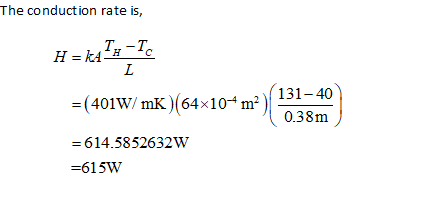
Consider a slab of face area A and thickness L. Suppose that L = 38 cm,...
Consider a slab of face area A and thickness L. Suppose that L = 20 cm,...
Consider a slab of face area A and thickness L. Suppose that L = 20 cm, A = 79 cm2, and the material is copper. If the faces of the slab are maintained at temperatures TH = 141°C and TC = 21°C, and a steady state is reached, find the conduction rate through the slab. The thermal conductivity of copper is 401 W/m·K.
Suppose that L = 26.0 cm, A = 92.0 cm2, and the material is copper. If...
Suppose that L = 26.0 cm, A = 92.0 cm2, and the material is copper. If TH = 143°C, TC = 13.0°C, and a steady state is reached, find the conduction rate through the slab.
94.0 cm?, and the material is copper. If TH = 109°C, TC Consider the slab shown...
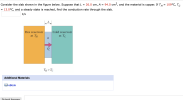 94.0 cm?, and the material is copper. If TH = 109°C, TC Consider the slab shown in the figure below. Suppose that L = 26.0 cm, A = 13.0°C, and a steady state is reached, find the conduction rate through the slab. J/s Hot reservoir at Th Cold reservoir at To k Tu>T. Additional Materials eBook Submit Answer
Consider steady one-dimensional conduction in a slab having a thickness of L and a constant thermal...
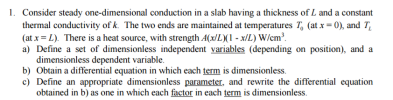 Consider steady one-dimensional conduction in a slab having a thickness of L and a constant thermal conductivity of k. The two ends are maintained at temperatures T_0 (at x = 0), and T_L (at x = L). There is a heat source, with strength A(x/L)(1 - x/L) W/cm^3. a) Define a set of dimensionless independent variables (depending on position), and a dimensionless dependent variable. b) Obtain a differential equation in which each term is dimensionless. c) Define an appropriate dimensionless...
The shield of a nuclear reactor can be idealized as a slab with a face area...
The shield of a nuclear reactor can be idealized as a slab with a face area of 6 ft2 and a thermal conductivity k = 2 Btu / hr*ft*°F. Heat is generated in the shield at a steady rate S = S0 exp(-bx) [Btu / hr*ft3 ] where x = 0 denotes the inner surface close to the nuclear reactor and the outer surface is at x = L. The temperature is maintained at 300 °F at the inner surface...
QUESTION FOUR Consider the base plate of an 900-W household iron with a thickness of L-0.6...
 QUESTION FOUR Consider the base plate of an 900-W household iron with a thickness of L-0.6 cm, base area of A-160 cm2, and the thermal conductivity of k-60 W/m.K. The inner surface of the base plate is subjected to uniform heat flux generated by the resistance heaters inside. When stea dy operating itions are reached, the outer surface temperature of the plate is measured to be 112 C. Disregarding any heat loss through the upper part of the iron, (a)...
On a winter day with a temperature of Tc, the temperature inside a room is Th,...
On a winter day with a temperature of Tc, the temperature inside a room is Th, where Th > Tc. The heat conduction rate through a slab of thickness L, surface area A, thermal conductivity k is measured to be H. Assume you found a way to triple the slab thickness and reduce the thermal conductivity to one quarter, what is the new heat transfer rate H’ in terms of H? Assume the temperatures inside and outside the room and...
Problem Two slabs are in perfect contact. In slab 1 (thickness Li, thermal conductivity ki) heat...
 Problem Two slabs are in perfect contact. In slab 1 (thickness Li, thermal conductivity ki) heat is generating at a constant rate of S per uni volume. There is no heat generation inside slab 2 (thickness L2, thermal conductivity k2). The temperature at the left face of slab 1 (x-0) is maintained at To and the temperature at the interface between slab 1 and slab 2 (at x L) is found to be T. The right face of slab 2...
Measurement of thermal diffusivity in an unsteady-state experiment. A solid slab, 1.90 cm thick, is brought...
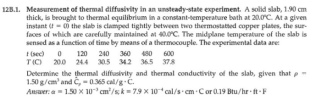 Measurement of thermal diffusivity in an unsteady-state experiment. A solid slab, 1.90 cm thick, is brought to thermal equilibrium in a constant-temperature bath at 20.0°C. At a given instant (t0) the slab is clamped tightly between two thermostatted copper plates, the sur- faces of which are carefully maintained at 40.0°C. The midplane temperature of the slab is sensed as a function of time by means of a thermocouple. The experimental data are: t (sec) 0 120 240 360 480 600...
Problem 2: Consider a large plane slab of semi-thickness L = 0.3 m, thermal conductivity k...
 Problem 2: Consider a large plane slab of semi-thickness L = 0.3 m, thermal conductivity k = 2.5 W/m K and surface area A = 20.0 m². Both sides of the slab is maintained at a constant wall temperature of 358°K while it is subjected to a uniform but constant heat flux of 950.0 W/m2 Evaluate the temperature distribution/profile within the wall. Calculate the heat flux and temperature at location x = 0.1m. Problem 3: Consider a 10.0 m long...
 94.0 cm?, and the material is copper. If TH = 109°C, TC Consider the slab shown in the figure below. Suppose that L = 26.0 cm, A = 13.0°C, and a steady state is reached, find the conduction rate through the slab. J/s Hot reservoir at Th Cold reservoir at To k Tu>T. Additional Materials eBook Submit Answer
 Consider steady one-dimensional conduction in a slab having a thickness of L and a constant thermal conductivity of k. The two ends are maintained at temperatures T_0 (at x = 0), and T_L (at x = L). There is a heat source, with strength A(x/L)(1 - x/L) W/cm^3. a) Define a set of dimensionless independent variables (depending on position), and a dimensionless dependent variable. b) Obtain a differential equation in which each term is dimensionless. c) Define an appropriate dimensionless...
 QUESTION FOUR Consider the base plate of an 900-W household iron with a thickness of L-0.6 cm, base area of A-160 cm2, and the thermal conductivity of k-60 W/m.K. The inner surface of the base plate is subjected to uniform heat flux generated by the resistance heaters inside. When stea dy operating itions are reached, the outer surface temperature of the plate is measured to be 112 C. Disregarding any heat loss through the upper part of the iron, (a)...
 Problem Two slabs are in perfect contact. In slab 1 (thickness Li, thermal conductivity ki) heat is generating at a constant rate of S per uni volume. There is no heat generation inside slab 2 (thickness L2, thermal conductivity k2). The temperature at the left face of slab 1 (x-0) is maintained at To and the temperature at the interface between slab 1 and slab 2 (at x L) is found to be T. The right face of slab 2...
 Measurement of thermal diffusivity in an unsteady-state experiment. A solid slab, 1.90 cm thick, is brought to thermal equilibrium in a constant-temperature bath at 20.0°C. At a given instant (t0) the slab is clamped tightly between two thermostatted copper plates, the sur- faces of which are carefully maintained at 40.0°C. The midplane temperature of the slab is sensed as a function of time by means of a thermocouple. The experimental data are: t (sec) 0 120 240 360 480 600...
 Problem 2: Consider a large plane slab of semi-thickness L = 0.3 m, thermal conductivity k = 2.5 W/m K and surface area A = 20.0 m². Both sides of the slab is maintained at a constant wall temperature of 358°K while it is subjected to a uniform but constant heat flux of 950.0 W/m2 Evaluate the temperature distribution/profile within the wall. Calculate the heat flux and temperature at location x = 0.1m. Problem 3: Consider a 10.0 m long...
Most questions answered within 3 hours.
-
Where is the error in this code sequence?
String s1 = "Hello";
String s2 = "ello";...
asked 11 months ago -
Financial data for Joel de Paris, Inc., for last year
follow:
Joel de Paris, Inc.
Balance...
asked 11 months ago -
Consider this reaction:
Al2(SO4)3 (aq)+ BaCl3
(aq) Al2Cl6 (aq)- +
3BaSO4(s) . What is the...
asked 11 months ago -
Suppose that Savneet is considering increasing her
recent random sample from 20 car rentals to 40...
asked 11 months ago -
Trucks arrive at an unloading terminal at an average rate of 120
per hour.
Trucks arrive...
asked 11 months ago -
Why are methanol and ethanol completely soluble in water while
octanol is not very little soluble....
asked 11 months ago -
A facilities manager at a university reads in a research report
that the mean amount of...
asked 11 months ago -
When the CuSO4 is rehydrated by adding water to the anhydrous
compound, is this an endothermic...
asked 11 months ago -
A ray of sunlight is passing from diamond into crown glass; the
angle of incidence is...
asked 11 months ago -
A block of mass 0.249 kg is placed on top of a light, vertical
spring of...
asked 11 months ago -
how do the kidneys compensate in the presences of acidosis
a) trigger hyperventilate
b) reserve acid...
asked 11 months ago -
Question 501 pts
The rental rate of capital to the firm increases. Which of the
following...
asked 11 months ago