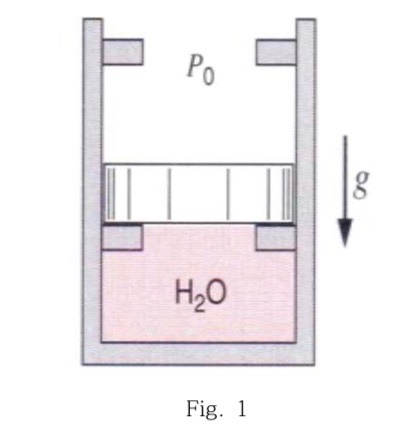
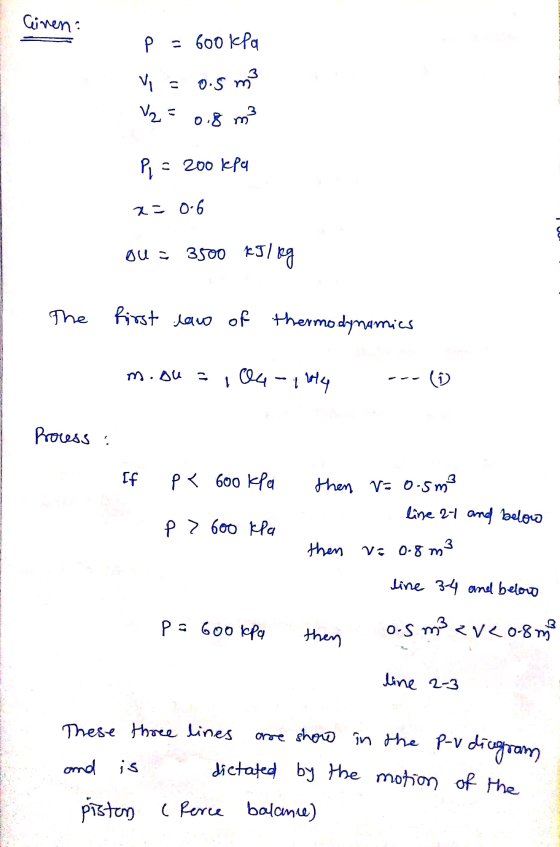
Consider the piston/cylinder arrangement shown in Fig1. A frictionless piston is free to move between two sets of stops. When 3 the piston rests on the lower stops, the enclosed volume is 0.5 m3. When the piston reaches the upper stops, the volume is 0.8 m . The cylinder initially contains water at 200 kPa, 60% quality. The mass of the piston requires 600 kPa pressure to move it against the outside ambient pressure.
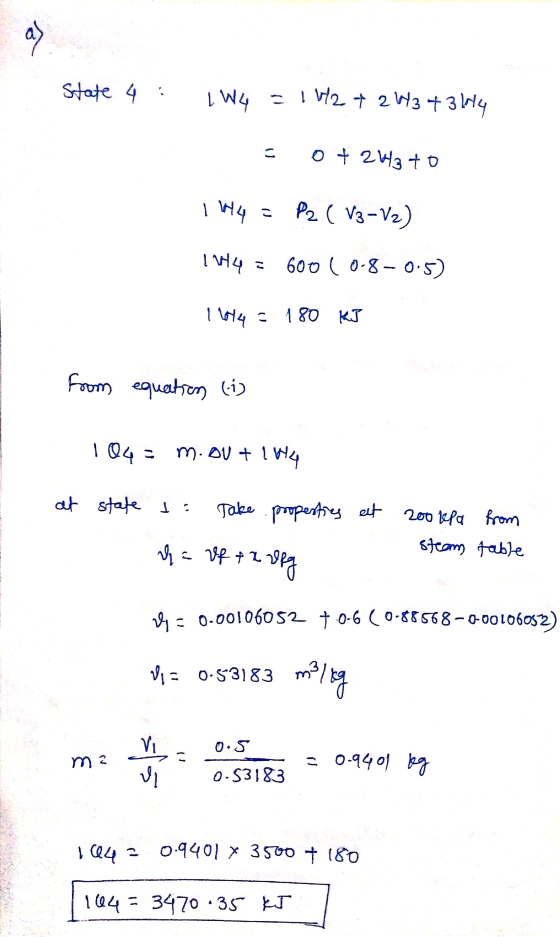
a) When heat is transferred until the internal energy of water reaches 3500 kJ/kg, find the heat (kJ) transferred until then.
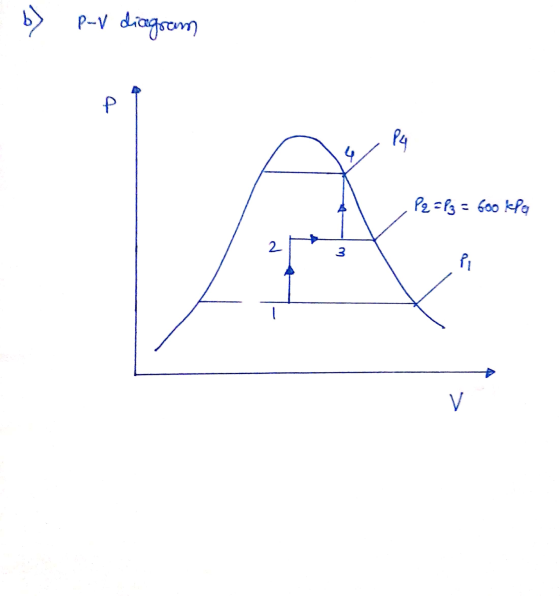
b) Draw this process on the p-v diagram, showing the temperature of the initial and later states (score 0 if not isothermal) and the pressure value.
Homework Answers
Add Answer to:
Consider the piston/cylinder arrangement shown in Fig1. A
frictionless piston is free to move between two...
Patm 100 kPa 1 kg of water is contained in a frictionless piston cylinder device fitted...
 Patm 100 kPa 1 kg of water is contained in a frictionless piston cylinder device fitted with two stops. The mass of the piston is 50 kg and the system is open to the atmosphere with Ptm - 100 kPa. The initial temperature of the system Ti Tantal 105 'C and the initial volume V1 Vinitial 1 m3 When the piston reaches the second stop, the volume of the water is doubled (V4Vinal2 Vinitial). Heat is EE transferred between the...
A cylinder fitted with a frictionless piston contains stops arranged as shown in the following figure....
 A cylinder fitted with a frictionless piston contains stops
arranged as shown in the following figure. When the piston rests on
the lower stops the volume is 0.4m3 ; when it is in contact with
the upper stops the volume is 0.6m3 . If the piston is not in
contact with the stops, it maintains a constant pressure of 200kPa
in the cylinder. Initially, the cylinder contains air at P1=150kPa
with a temperature of T1=300K. The air is then heated...
A cylinder fitted with a frictionless piston contains stops
arranged as shown in the following figure. When the piston rests on
the lower stops the volume is 0.4m3 ; when it is in contact with
the upper stops the volume is 0.6m3 . If the piston is not in
contact with the stops, it maintains a constant pressure of 200kPa
in the cylinder. Initially, the cylinder contains air at P1=150kPa
with a temperature of T1=300K. The air is then heated...
A mass of 5.5 kg of saturated liquid-vapor mixture of water is contained in a piston-cylinder...
A mass of 5.5 kg of saturated liquid-vapor mixture of water is contained in a piston-cylinder at 101.325 kPa. Initially, 2.3 kg of the water is in the liquid phase and the rest is in the vapor phase. Heat is now transferred to the water, and the piston, which is resting on a set of stops, starts moving when the pressure inside reaches 300 kPa. Heat transfer continues until the total volume increases by 21 percent. Determine: a) the initial...
(THERMODYNAMICS) A vertical cylinder fitted with a frictionless piston contains 1.5 kg of H2O initially at...
(THERMODYNAMICS) A vertical cylinder fitted with a frictionless piston contains 1.5 kg of H2O initially at 100 °C, 400 kPa. If the volume of the system reaches 0.5 m3, the piston hits a set of stops and is restrained from further upward travel. The system is heated to 200 °C. (Use saturated water tables, steam tables, and superheated tables as necessary) a) If the piston reaches the stops, determine the temperature and pressure when the piston first touches but exerts no force...
A piston–cylinder device initially contains 0.6 m3 of saturated water vapor at 250 kPa. At this...
A piston–cylinder device initially contains 0.6 m3 of saturated water vapor at 250 kPa. At this state, the piston is resting on a set of stops, and the mass of the piston is such that a pressure of 300 kPa is required to move it. Heat is now slowly transferred to the steam until the volume becomes 1.5 m3. Use the data from the steam tables. a) Determine the final temperature. b) Determine the work done during this process. c)...
Water is contained in a piston-cylinder device, where the piston can move in order to maintain...
Water is contained in a piston-cylinder device, where the piston can move in order to maintain a constant pressure of 300 kPa. Initially, the temperature of the water is 200 degrees Celcius. Heat is removed from the water until it reaches a quality of 0.1. Find the amount of heat transfer to achieve this, in kJ/kg. Answer value in kj/kg
QUESTION 24 A piston-cylinder device contains 50 kg of water at 250 kPa and 25 degree...
 QUESTION 24
A piston-cylinder device contains 50 kg of water at 250 kPa and 25 degree C. The cross-sectional area of the piston is 0.1 m2. Heat is now transferred to the water, causing part of it to evaporate and expand. When the volume reaches 0.2 m3 the piston reaches a linear spring whose spring constant is 100 kN/m. More heat is transferred to the water until the piston rises 20 cm more. Determine (a) the final pressure and temperature...
QUESTION 24
A piston-cylinder device contains 50 kg of water at 250 kPa and 25 degree C. The cross-sectional area of the piston is 0.1 m2. Heat is now transferred to the water, causing part of it to evaporate and expand. When the volume reaches 0.2 m3 the piston reaches a linear spring whose spring constant is 100 kN/m. More heat is transferred to the water until the piston rises 20 cm more. Determine (a) the final pressure and temperature...
A piston-cylinder apparatus contains 5 kg of saturated water at 55˚C. The piston’s cross sectional area...
A piston-cylinder apparatus contains 5 kg of saturated water at 55˚C. The piston’s cross sectional area is 0.04 m2, and initially is resting on stops, enclosing a volume of 0.02 m3. To raise the piston, a pressure of 500 kPa has to be applied. When the volume is 0.05 m3, the piston encounters a linear spring. To deflect the spring 1 m, a force of 400 kN is required. More heat is transferred until the final pressure is 3 MPa....
A piston–cylinder device initially contains air at 150 kPa and 27 °C. In this state, the...
A piston–cylinder device initially contains air at 150 kPa and 27 °C. In this state, the piston is resting on a pair of stops, and the enclosed volume is 400 litres. The mass of the piston is such that a 200 kPa pressure is required to move it. The air is now heated until its volume has doubled. Sketch the process on a P-V diagram and determine (a) the mass of air and the final temperature, (b) the work done...
Required information A piston-cylinder device initially contains 0.6 m3 of saturated water vapor at 250 kPa....
 Required information A piston-cylinder device initially contains 0.6 m3 of saturated water vapor at 250 kPa. At this state, the piston is resting on a set of stops, and the mass of the piston is such that a pressure of 300 kPa is required to move it. Heat is now slowly transferred to the steam until the volume becomes 1.3 m3. Use the data from the steam tables. Determine the final temperature. (You must provide an answer before moving on...
 Patm 100 kPa 1 kg of water is contained in a frictionless piston cylinder device fitted with two stops. The mass of the piston is 50 kg and the system is open to the atmosphere with Ptm - 100 kPa. The initial temperature of the system Ti Tantal 105 'C and the initial volume V1 Vinitial 1 m3 When the piston reaches the second stop, the volume of the water is doubled (V4Vinal2 Vinitial). Heat is EE transferred between the...
 A cylinder fitted with a frictionless piston contains stops
arranged as shown in the following figure. When the piston rests on
the lower stops the volume is 0.4m3 ; when it is in contact with
the upper stops the volume is 0.6m3 . If the piston is not in
contact with the stops, it maintains a constant pressure of 200kPa
in the cylinder. Initially, the cylinder contains air at P1=150kPa
with a temperature of T1=300K. The air is then heated...
A cylinder fitted with a frictionless piston contains stops
arranged as shown in the following figure. When the piston rests on
the lower stops the volume is 0.4m3 ; when it is in contact with
the upper stops the volume is 0.6m3 . If the piston is not in
contact with the stops, it maintains a constant pressure of 200kPa
in the cylinder. Initially, the cylinder contains air at P1=150kPa
with a temperature of T1=300K. The air is then heated...
 QUESTION 24
A piston-cylinder device contains 50 kg of water at 250 kPa and 25 degree C. The cross-sectional area of the piston is 0.1 m2. Heat is now transferred to the water, causing part of it to evaporate and expand. When the volume reaches 0.2 m3 the piston reaches a linear spring whose spring constant is 100 kN/m. More heat is transferred to the water until the piston rises 20 cm more. Determine (a) the final pressure and temperature...
QUESTION 24
A piston-cylinder device contains 50 kg of water at 250 kPa and 25 degree C. The cross-sectional area of the piston is 0.1 m2. Heat is now transferred to the water, causing part of it to evaporate and expand. When the volume reaches 0.2 m3 the piston reaches a linear spring whose spring constant is 100 kN/m. More heat is transferred to the water until the piston rises 20 cm more. Determine (a) the final pressure and temperature...
 Required information A piston-cylinder device initially contains 0.6 m3 of saturated water vapor at 250 kPa. At this state, the piston is resting on a set of stops, and the mass of the piston is such that a pressure of 300 kPa is required to move it. Heat is now slowly transferred to the steam until the volume becomes 1.3 m3. Use the data from the steam tables. Determine the final temperature. (You must provide an answer before moving on...
Most questions answered within 3 hours.
-
Where is the error in this code sequence?
String s1 = "Hello";
String s2 = "ello";...
asked 10 months ago -
Financial data for Joel de Paris, Inc., for last year
follow:
Joel de Paris, Inc.
Balance...
asked 10 months ago -
Consider this reaction:
Al2(SO4)3 (aq)+ BaCl3
(aq) Al2Cl6 (aq)- +
3BaSO4(s) . What is the...
asked 10 months ago -
Suppose that Savneet is considering increasing her
recent random sample from 20 car rentals to 40...
asked 10 months ago -
Trucks arrive at an unloading terminal at an average rate of 120
per hour.
Trucks arrive...
asked 10 months ago -
Why are methanol and ethanol completely soluble in water while
octanol is not very little soluble....
asked 10 months ago -
A facilities manager at a university reads in a research report
that the mean amount of...
asked 10 months ago -
When the CuSO4 is rehydrated by adding water to the anhydrous
compound, is this an endothermic...
asked 10 months ago -
A ray of sunlight is passing from diamond into crown glass; the
angle of incidence is...
asked 10 months ago -
A block of mass 0.249 kg is placed on top of a light, vertical
spring of...
asked 10 months ago -
how do the kidneys compensate in the presences of acidosis
a) trigger hyperventilate
b) reserve acid...
asked 10 months ago -
Question 501 pts
The rental rate of capital to the firm increases. Which of the
following...
asked 10 months ago