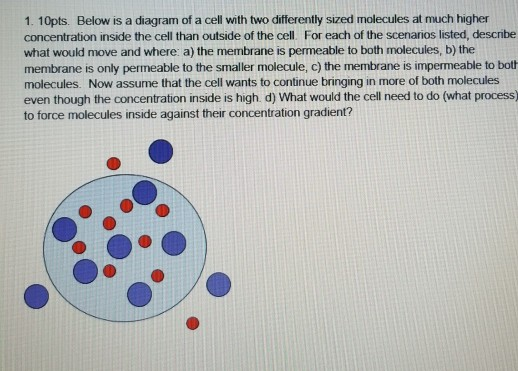
please help with this question. I am taking microbiology class and I really need help.
Homework Answers
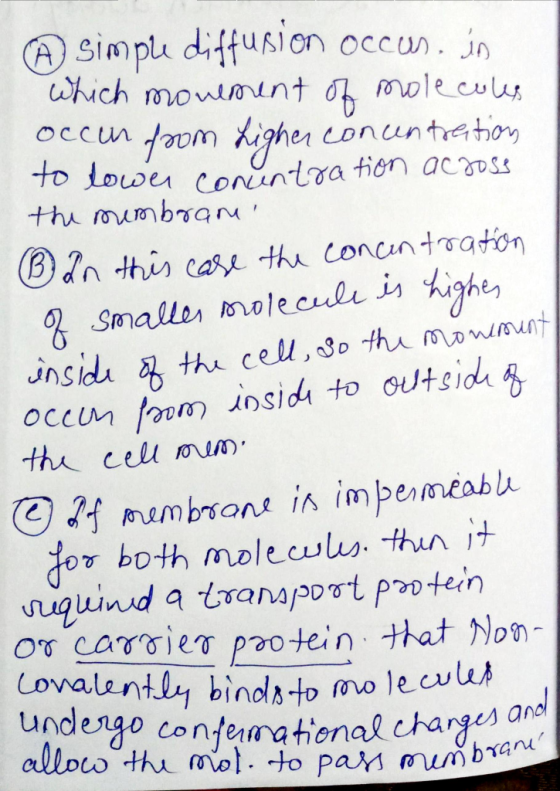
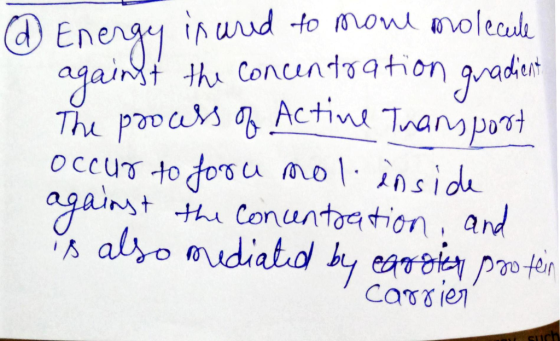
Add Answer to:
please help with this question. I am taking
microbiology class and I really need help.
1....
please I really need help! Refer to "image beaker A” doc to answer questions 1 -...
 please I really need help!
Refer to "image beaker A” doc to answer questions 1 - 4: beaker dialysis tubing contains 25% salt solution 5% salt solution outside the tubing The pores in the tubing are ldly "8a6 to pass through: .. O .. white molecules 1) Does a concentration gradient exist in beaker A? 2) Is the solute concentration outside the tubing hypertonic, isotonic, or hypotonic relative to the solute concentration inside the tubing? 3) Will solute move into...
please I really need help!
Refer to "image beaker A” doc to answer questions 1 - 4: beaker dialysis tubing contains 25% salt solution 5% salt solution outside the tubing The pores in the tubing are ldly "8a6 to pass through: .. O .. white molecules 1) Does a concentration gradient exist in beaker A? 2) Is the solute concentration outside the tubing hypertonic, isotonic, or hypotonic relative to the solute concentration inside the tubing? 3) Will solute move into...
I need help with filling out the chart in the second picture, the first photo is...
 I need help with filling out the chart in the second picture,
the first photo is the data needed to answer the questions
Figure 4.7 Osmosis demonstration. Athistle tube, covered at the broad end by a differential contains distilled water. b. The solute (starch is unable to pass the through in both directions. There is a net movement of water town and lower water concentration. c. Due to the incomi ally permeable membrane, contains a arch o n through the...
I need help with filling out the chart in the second picture,
the first photo is the data needed to answer the questions
Figure 4.7 Osmosis demonstration. Athistle tube, covered at the broad end by a differential contains distilled water. b. The solute (starch is unable to pass the through in both directions. There is a net movement of water town and lower water concentration. c. Due to the incomi ally permeable membrane, contains a arch o n through the...
I did parts 1 and 2 ONLY NEED HELP WITH C This question deals with equilibrium...
I did parts 1 and 2 ONLY NEED HELP WITH C This question deals with equilibrium potentials and ion movement. Show all of your calculation. Calculate the Equilibrium potentials for the following 2 ions. Na+ concentration inside a cell is 10 mM and outside the cell is 140 mM. K+ concentration inside a cell is 145 mM and outside the cell is 4.5 mM. The Vm for this cell is -16 mV. If a Na+ channel opens, which direction would...
Please help and I will rate a thumbs up! I really need help please. 1. What...
Please help and I will rate a thumbs up! I really need help please. 1. What is the molecular diameter of the following molecules: a) Starch b) Albumin c) Fructose d) Lactose e) Sucrose f) Maltose 2. Also, what is the diameter of a hole in an artificial membrane composed of glycerol and cellulose?
. For each of the 3 situations below, use an arrow to indicate the net movement...
. For each of the 3 situations below, use an arrow to indicate the net movement of water into or out of the cell through the semipermeable plasma membrane (i.e. osmosis). (Assume that the sugar molecules cannot pass through the plasma membrane in each case.) 1% sugar (inside a circule) 3% sugar (inside a circule) 1% sugar (inside a circule) 5% sugar 1% sugar 1% sugar 3. In each of the drawings above, indicate if the inside of the cell...
CELL MEMBRANE Protected View Saved to this PC References Mailings Review View Help Tell me what...
 CELL MEMBRANE Protected View Saved to this PC References Mailings Review View Help Tell me what you want to do et can contain viruses. Unless you need to edit, it's safer to stay in Protected View Enable Editing 1. What are the TWO MAIN COMPONENTS that make up the CELL MEMBRANE? 2. What types of molecules can EASILY go through your cell membrane or are PERMEABLE to the cell membrane? 3. What types of molecules CANNOT easily go through your...
_____membranes proteins are associated with the bilayer through interactions with other membrane component on the surface...
 _____membranes proteins are associated with the bilayer through interactions with other membrane component on the surface of the membrane. Net movement of particles from a region where they are more concentrated to a region where they are law concentrated is called Diffusion of water through a selectively permeable membrane down its own concentration gradient It called A solution with an equivalent concentration of water and hence the tame osmotic pressure as the fluid inside the cell is said to be...
Animal physiology help. I need help with part a and part b. for part a, this...
 Animal physiology help.
I need help with part a and part b.
for part a, this is as far as I've gotten. The numbers on the
left are the contents inside the cell and the numbers on the right
are contents outside of the cell. I have converted everything to
mM. H+ is hard to see becuase only 10 um passed through the
membrane to go outside of the cell. (i dont know how to show this
line better on...
Animal physiology help.
I need help with part a and part b.
for part a, this is as far as I've gotten. The numbers on the
left are the contents inside the cell and the numbers on the right
are contents outside of the cell. I have converted everything to
mM. H+ is hard to see becuase only 10 um passed through the
membrane to go outside of the cell. (i dont know how to show this
line better on...
I need help answering some questions on my microbiology study guide. Thanks. What state does a...
I need help answering some questions on my microbiology study guide. Thanks. What state does a virus consist of inside the cell? What are retroviruses? How are cell walls different between Gram positive, Gram negative, and Archaea? What is an enzyme? Where are they produced? Virion vs a virus Latency vs lysogeny What is the process of viral replication?
Hello, I am taking an electrical engineering lab course and I really need help understanding the...
 Hello, I am taking an electrical engineering lab course and I
really need help understanding the solution to this question:
Now this solution was marked as correct. Here are my
questions:
1) Could you please explain how they obtains the gain (Av) of 6
V?
2) Why did they substract 0.6 V from the gain?
If you could walk me through this solution step-by-step, I would
really appreciate it, thank you.
2. (2 points) Consider the push-pull amp sketched below....
Hello, I am taking an electrical engineering lab course and I
really need help understanding the solution to this question:
Now this solution was marked as correct. Here are my
questions:
1) Could you please explain how they obtains the gain (Av) of 6
V?
2) Why did they substract 0.6 V from the gain?
If you could walk me through this solution step-by-step, I would
really appreciate it, thank you.
2. (2 points) Consider the push-pull amp sketched below....
 please I really need help!
Refer to "image beaker A” doc to answer questions 1 - 4: beaker dialysis tubing contains 25% salt solution 5% salt solution outside the tubing The pores in the tubing are ldly "8a6 to pass through: .. O .. white molecules 1) Does a concentration gradient exist in beaker A? 2) Is the solute concentration outside the tubing hypertonic, isotonic, or hypotonic relative to the solute concentration inside the tubing? 3) Will solute move into...
please I really need help!
Refer to "image beaker A” doc to answer questions 1 - 4: beaker dialysis tubing contains 25% salt solution 5% salt solution outside the tubing The pores in the tubing are ldly "8a6 to pass through: .. O .. white molecules 1) Does a concentration gradient exist in beaker A? 2) Is the solute concentration outside the tubing hypertonic, isotonic, or hypotonic relative to the solute concentration inside the tubing? 3) Will solute move into...
 I need help with filling out the chart in the second picture,
the first photo is the data needed to answer the questions
Figure 4.7 Osmosis demonstration. Athistle tube, covered at the broad end by a differential contains distilled water. b. The solute (starch is unable to pass the through in both directions. There is a net movement of water town and lower water concentration. c. Due to the incomi ally permeable membrane, contains a arch o n through the...
I need help with filling out the chart in the second picture,
the first photo is the data needed to answer the questions
Figure 4.7 Osmosis demonstration. Athistle tube, covered at the broad end by a differential contains distilled water. b. The solute (starch is unable to pass the through in both directions. There is a net movement of water town and lower water concentration. c. Due to the incomi ally permeable membrane, contains a arch o n through the...
 CELL MEMBRANE Protected View Saved to this PC References Mailings Review View Help Tell me what you want to do et can contain viruses. Unless you need to edit, it's safer to stay in Protected View Enable Editing 1. What are the TWO MAIN COMPONENTS that make up the CELL MEMBRANE? 2. What types of molecules can EASILY go through your cell membrane or are PERMEABLE to the cell membrane? 3. What types of molecules CANNOT easily go through your...
 _____membranes proteins are associated with the bilayer through interactions with other membrane component on the surface of the membrane. Net movement of particles from a region where they are more concentrated to a region where they are law concentrated is called Diffusion of water through a selectively permeable membrane down its own concentration gradient It called A solution with an equivalent concentration of water and hence the tame osmotic pressure as the fluid inside the cell is said to be...
 Animal physiology help.
I need help with part a and part b.
for part a, this is as far as I've gotten. The numbers on the
left are the contents inside the cell and the numbers on the right
are contents outside of the cell. I have converted everything to
mM. H+ is hard to see becuase only 10 um passed through the
membrane to go outside of the cell. (i dont know how to show this
line better on...
Animal physiology help.
I need help with part a and part b.
for part a, this is as far as I've gotten. The numbers on the
left are the contents inside the cell and the numbers on the right
are contents outside of the cell. I have converted everything to
mM. H+ is hard to see becuase only 10 um passed through the
membrane to go outside of the cell. (i dont know how to show this
line better on...
 Hello, I am taking an electrical engineering lab course and I
really need help understanding the solution to this question:
Now this solution was marked as correct. Here are my
questions:
1) Could you please explain how they obtains the gain (Av) of 6
V?
2) Why did they substract 0.6 V from the gain?
If you could walk me through this solution step-by-step, I would
really appreciate it, thank you.
2. (2 points) Consider the push-pull amp sketched below....
Hello, I am taking an electrical engineering lab course and I
really need help understanding the solution to this question:
Now this solution was marked as correct. Here are my
questions:
1) Could you please explain how they obtains the gain (Av) of 6
V?
2) Why did they substract 0.6 V from the gain?
If you could walk me through this solution step-by-step, I would
really appreciate it, thank you.
2. (2 points) Consider the push-pull amp sketched below....
Most questions answered within 3 hours.
-
Where is the error in this code sequence?
String s1 = "Hello";
String s2 = "ello";...
asked 10 months ago -
Financial data for Joel de Paris, Inc., for last year
follow:
Joel de Paris, Inc.
Balance...
asked 10 months ago -
Consider this reaction:
Al2(SO4)3 (aq)+ BaCl3
(aq) Al2Cl6 (aq)- +
3BaSO4(s) . What is the...
asked 10 months ago -
Suppose that Savneet is considering increasing her
recent random sample from 20 car rentals to 40...
asked 10 months ago -
Trucks arrive at an unloading terminal at an average rate of 120
per hour.
Trucks arrive...
asked 10 months ago -
Why are methanol and ethanol completely soluble in water while
octanol is not very little soluble....
asked 10 months ago -
A facilities manager at a university reads in a research report
that the mean amount of...
asked 10 months ago -
When the CuSO4 is rehydrated by adding water to the anhydrous
compound, is this an endothermic...
asked 10 months ago -
A ray of sunlight is passing from diamond into crown glass; the
angle of incidence is...
asked 10 months ago -
A block of mass 0.249 kg is placed on top of a light, vertical
spring of...
asked 10 months ago -
how do the kidneys compensate in the presences of acidosis
a) trigger hyperventilate
b) reserve acid...
asked 10 months ago -
Question 501 pts
The rental rate of capital to the firm increases. Which of the
following...
asked 10 months ago