
Homework Answers
Request Answer!
We need at least 10 more requests to produce the answer.
0 / 10 have requested this problem solution
The more requests, the faster the answer.
Add Answer to:
13. Determine the maximum P which can be applied through the centroid of the cross section...
The truss is made from A992 steel bars, each of which has a circular cross section with a diameter of 2.1 in
 The truss is made from A992 steel bars, each of which has a circular cross section with a diameter of 2.1 in (Figure 1) Part A Determine the maximum force P that can be applied without causing any of the members to buckle. The members are pin connected at their ends. Express your answer to three significant figures and include the appropriate units.
Thank you so much. Question 6: (10 marks) Determine the maximum eccentric load P the strut...
 Thank you so much.
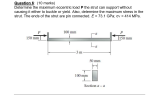
Question 6: (10 marks) Determine the maximum eccentric load P the strut can support without causing it either to buckle or yield. Also, determine the maximum stress in the strut. The ends of the strut are pin connected. E-73.1 GPa; ƠY-414 MPa. 100 mm 150 mm 150 mm L-a 3 m 50 mm 100 mm Section a a
Thank you so much.
Question 6: (10 marks) Determine the maximum eccentric load P the strut can support without causing it either to buckle or yield. Also, determine the maximum stress in the strut. The ends of the strut are pin connected. E-73.1 GPa; ƠY-414 MPa. 100 mm 150 mm 150 mm L-a 3 m 50 mm 100 mm Section a a
A cross-section is subjected to a maximum shear of V=160 kN (see figure): 1. Determine the...
 A cross-section is subjected to a maximum shear of V=160 kN (see figure): 1. Determine the centroid of the cross-section. 2. Calculate the moment of inertia (l) of the cross-section. 3. Determine the shear stress at point A in the cross-section. -250 715 -100 -145 AL -10 -300 -145 10 125 10 -200 All dimensions are in millimeters
Determine the maximum ram force P that can be applied to the clamp at D if...
 Determine the maximum ram force P that can be applied to the clamp at D if the allowable normal stress in the clamp is 180 MPa for both tension and compression. The clamp has a T-shape cross section shown through a-a. Ans: 9.08 kN
Determine the moment of inertia about the cross sectional area of the T-beam with respect to the x' axis passing through the centroid of the cross section.
 a) Determine the moment of inertia about the cross sectional area of the T-beam with respect to the x' axis passing through the centroid of the cross section. b) Determine the moment of Inertia about the cross sectional area of the T-beam with respect to the y' axis passing through the centroid of the cross section.
EMS If the 600-kN force acts through the centroid of FI-10 the cross section, determine the...
 EMS If the 600-kN force acts through the centroid of FI-10 the cross section, determine the location y of the centroid and the average normal stress on the cross section. Also, sketch the normal stress distribution over the cross section. 600 kN 300 mm 80 mm 60 mm 60 mmy 80 mm Prob. F1-10
1. Determine the maximum load P the frame in Figure 1 can support without member AB...
 1. Determine the maximum load P the frame in Figure 1 can support without member AB to buckle elastically. Assume that AB is made of steel and is pinned at its ends for x-r-axis buckling and fixed at its ends for y-y axis buckling. E - 200 GPa. 50 mm 4 m 50 mm 50 mm Figure 1
The post has a circular cross section of radius c. Determine the maximum radius e at...
 The post has a circular cross section of radius c.
Determine the maximum radius e at which the load P can be applied
so that no part of the post experiences a tensile stress. Neglect
the weight of the post
The post has a circular cross section of radius c.
Determine the maximum radius e at which the load P can be applied
so that no part of the post experiences a tensile stress. Neglect
the weight of the post
Hing PROBLEMS Determine the positon of the centroid (x,.5) in the T-beam's cross-section shown 50 mm50...
 Hing PROBLEMS Determine the positon of the centroid (x,.5) in the T-beam's cross-section shown 50 mm50 mm 300 mm 100 mm 200 mm PROBLEM 6 For the T-beam shown in problem 5, determine the moment of inertia of the cross section about the axis x' passing through the centroid.
Determine the largest load P that can be applied to the frame without causing either the...
 Determine the largest load P that can be applied to the frame without causing either the
average normal stress or the average shear stress at section a-a to exceed σ = 150 Mpa and τ =
60 Mpa, respectively. Member CB has a square cross section of 25 mm on each side.
Determine the largest load P that can be applied to the frame without causing either the
average normal stress or the average shear stress at section a-a to exceed σ = 150 Mpa and τ =
60 Mpa, respectively. Member CB has a square cross section of 25 mm on each side.
 Thank you so much.
Question 6: (10 marks) Determine the maximum eccentric load P the strut can support without causing it either to buckle or yield. Also, determine the maximum stress in the strut. The ends of the strut are pin connected. E-73.1 GPa; ƠY-414 MPa. 100 mm 150 mm 150 mm L-a 3 m 50 mm 100 mm Section a a
Thank you so much.
Question 6: (10 marks) Determine the maximum eccentric load P the strut can support without causing it either to buckle or yield. Also, determine the maximum stress in the strut. The ends of the strut are pin connected. E-73.1 GPa; ƠY-414 MPa. 100 mm 150 mm 150 mm L-a 3 m 50 mm 100 mm Section a a
 A cross-section is subjected to a maximum shear of V=160 kN (see figure): 1. Determine the centroid of the cross-section. 2. Calculate the moment of inertia (l) of the cross-section. 3. Determine the shear stress at point A in the cross-section. -250 715 -100 -145 AL -10 -300 -145 10 125 10 -200 All dimensions are in millimeters
 Determine the maximum ram force P that can be applied to the clamp at D if the allowable normal stress in the clamp is 180 MPa for both tension and compression. The clamp has a T-shape cross section shown through a-a. Ans: 9.08 kN
 EMS If the 600-kN force acts through the centroid of FI-10 the cross section, determine the location y of the centroid and the average normal stress on the cross section. Also, sketch the normal stress distribution over the cross section. 600 kN 300 mm 80 mm 60 mm 60 mmy 80 mm Prob. F1-10
 1. Determine the maximum load P the frame in Figure 1 can support without member AB to buckle elastically. Assume that AB is made of steel and is pinned at its ends for x-r-axis buckling and fixed at its ends for y-y axis buckling. E - 200 GPa. 50 mm 4 m 50 mm 50 mm Figure 1
 The post has a circular cross section of radius c.
Determine the maximum radius e at which the load P can be applied
so that no part of the post experiences a tensile stress. Neglect
the weight of the post
The post has a circular cross section of radius c.
Determine the maximum radius e at which the load P can be applied
so that no part of the post experiences a tensile stress. Neglect
the weight of the post
 Hing PROBLEMS Determine the positon of the centroid (x,.5) in the T-beam's cross-section shown 50 mm50 mm 300 mm 100 mm 200 mm PROBLEM 6 For the T-beam shown in problem 5, determine the moment of inertia of the cross section about the axis x' passing through the centroid.
 Determine the largest load P that can be applied to the frame without causing either the
average normal stress or the average shear stress at section a-a to exceed σ = 150 Mpa and τ =
60 Mpa, respectively. Member CB has a square cross section of 25 mm on each side.
Determine the largest load P that can be applied to the frame without causing either the
average normal stress or the average shear stress at section a-a to exceed σ = 150 Mpa and τ =
60 Mpa, respectively. Member CB has a square cross section of 25 mm on each side.
Most questions answered within 3 hours.
-
Where is the error in this code sequence?
String s1 = "Hello";
String s2 = "ello";...
asked 10 months ago -
Financial data for Joel de Paris, Inc., for last year
follow:
Joel de Paris, Inc.
Balance...
asked 10 months ago -
Consider this reaction:
Al2(SO4)3 (aq)+ BaCl3
(aq) Al2Cl6 (aq)- +
3BaSO4(s) . What is the...
asked 10 months ago -
Suppose that Savneet is considering increasing her
recent random sample from 20 car rentals to 40...
asked 10 months ago -
Trucks arrive at an unloading terminal at an average rate of 120
per hour.
Trucks arrive...
asked 10 months ago -
Why are methanol and ethanol completely soluble in water while
octanol is not very little soluble....
asked 10 months ago -
A facilities manager at a university reads in a research report
that the mean amount of...
asked 10 months ago -
When the CuSO4 is rehydrated by adding water to the anhydrous
compound, is this an endothermic...
asked 10 months ago -
A ray of sunlight is passing from diamond into crown glass; the
angle of incidence is...
asked 10 months ago -
A block of mass 0.249 kg is placed on top of a light, vertical
spring of...
asked 10 months ago -
how do the kidneys compensate in the presences of acidosis
a) trigger hyperventilate
b) reserve acid...
asked 10 months ago -
Question 501 pts
The rental rate of capital to the firm increases. Which of the
following...
asked 10 months ago