41. True or False? Searching the components of an unordered list ADT is faster with a...
41. True or False? Searching the components of an unordered list ADT is faster with a linked list representation than with a direct array representation.
a) true
b) false
42. True or False? If an operation that allows random access to individual components of a list ADT is defined and occurs frequently, it is better to represent the list directly as an array than to use a linked list.
a) true
b) false
43. To prevent a compile-time error, how should the code be changed?

a) Insert the following before line
1:
typedef ListNode* NodeType*;
b) Insert the following before line
1:
struct ListNode; typedef ListNode* NodeType*;
c) Replace line 4 with the
following:
ListNode* next;
d) Do either b or c above.
e) Do any of a, b, or c above.
44. Given the code fragment
struct Node Type
{
int data;
Node Type* next;
};
NodeType* p;
NodeType* q;
p = new NodeType;
p->data = 12;
p->next = NULL;
q = new NodeType;
q->data = 5;
q->next = p;
which of the following expressions has the value 12?
a) q
b) q->data
c) q->next->data
d) q->next
e) none of the above
45. If a program accidentally corrupts the next member of a node in the middle of a linked list, how much of the original linked list is now inaccessible?
a) only the corrupted node is inaccessible
b) all nodes preceding the corrupted node are inaccessible
c) all nodes following the corrupted node are inaccessible
d) the entire linked list is inaccessible
46. True or False? If currPtr points to a node in a dynamic linked list, the operation currPtr++ advances to the next node in the list.
a) true
b) false
47. True or False? With a list ADT, insertions and deletions at the back of the list are faster with a linked list representation than with a direct array representation.
a) true
b) false
48. True or False? The next item in a linked list always can be found by accessing the next physical location in memory.
a) true
b) false
49. True or False? An array-based list automatically gives you
an O(1) length operation, but in a linked implementation the
length operation can be either O(1) or O(N) depending on the design
decision.
a) true
b) false
Homework Answers
Request Answer!
We need at least 10 more requests to produce the answer.
0 / 10 have requested this problem solution
The more requests, the faster the answer.
Add Answer to:
41. True or False? Searching the components of an unordered list
ADT is faster with a...
using C++, NOT C language 1. Write a function called insert() to insert a node to...
using C++, NOT C language 1. Write a function called insert() to insert a node to the beginning of a linked list. The data is passed into the function. For example insert(8) will insert a node at the beginning of the list with the number 8 in the data field. Each node in the linked list is a ListNode struct as discussed in class. 2. Write a function called print() that will traverse the entire linked list and print out...
The source code I have is what I'm trying to fix for the assignment at the...
The source code I have is what I'm trying to fix for the assignment at the bottom. Source code: //Group 1 - Jodie Butterworth, Brandon Kidd, Matt Heckler //11-21-19 //CSC 201 // Exercise to practice the basic manipulations of a linked list // Note: Uses nullptr, so need to make sure your compiler is set to use C++11 // In Code::Blocks this is under Settings==>Compiler #include <iostream> using namespace std; // Structure to contain data for a node (Could be...
Create Functions for the following prototypes. Below is the setup.*program is in c* #include <stdio.h> #include...
 Create Functions for the following prototypes. Below is the setup.*program is in c*
#include <stdio.h>
#include <string.h>
#include <stdarg.h>
#include <stdlib.h>
//#define constant values
#define MAX_URL_LENGTH 50
#define TRUE 1
#define FALSE 0
//typedef for the Element struct which constains a c string to store a URL in the BrowserList
typedef struct
{
char szURL[MAX_URL_LENGTH];
} Element;
//Typedef for a node in the doubly linked list (has next and previous pointers).
typedef struct NodeDL
{
Element element;
struct NodeDL *pNext;...
Create Functions for the following prototypes. Below is the setup.*program is in c*
#include <stdio.h>
#include <string.h>
#include <stdarg.h>
#include <stdlib.h>
//#define constant values
#define MAX_URL_LENGTH 50
#define TRUE 1
#define FALSE 0
//typedef for the Element struct which constains a c string to store a URL in the BrowserList
typedef struct
{
char szURL[MAX_URL_LENGTH];
} Element;
//Typedef for a node in the doubly linked list (has next and previous pointers).
typedef struct NodeDL
{
Element element;
struct NodeDL *pNext;...
To solve real world problem, the programer uses ADT like list, stack, queue, set, map, ... etc. t...
To solve real world problem, the programer uses ADT like list, stack, queue, set, map, ... etc. to build our data model. In AS8, we pick and choose STL queue and stack to build a postfix calculator. In this assignment you are to Design your own linked-list, a series of integer nodes. The private attributes of this IntLinked Queue including a integer node struct and private control variables and methods: private: struct Node { int data; Node *next; }; Node...
CODE IN C++ Given: typedef char ItemType; // a struct type named NodeType that includes a...
CODE IN C++ Given: typedef char ItemType; // a struct type named NodeType that includes a ItemType and pointer // (to a NodeType) field struct NodeType { ItemType value; NodeType * next; }; bool Delete (NodeType * & firstPtr, ItemType value) { NodeType * prev, * cur; cur = Search (firstPtr, value, prev); if (cur==NULL) return false; else { // remove cur node from the linked list if (prev!=NULL) { //not the first one prev->next = cur->next;...
Programming in C: I am trying to modify this linked list to be doubly linked list....
Programming in C: I am trying to modify this linked list to be doubly linked list. I’m also trying to add a print in reverse function. I’m really struggling with how to change the insert function to doubly link the nodes without effecting the alphabetical sorting mechanism. Example of desired output: Enter your choice: 1 to insert an element into the list. 2 to delete an element from the list. 3 to end. ? 1 Enter a character: a The...
16 and 18 C++ 11. Given the dynamic linked implementation of a linked list shown below,...
 16 and 18 C++
11. Given the dynamic linked implementation of a linked list shown below, write expressions that do the following, assuming that currPtr is somewhere in the middle of the list: a. Access the component member of the first list element. b. Advance currPtr to point to the next element. c. Access the component member of the next element (the one that follows the current element). d. Access the component member of the element that follows the next...
16 and 18 C++
11. Given the dynamic linked implementation of a linked list shown below, write expressions that do the following, assuming that currPtr is somewhere in the middle of the list: a. Access the component member of the first list element. b. Advance currPtr to point to the next element. c. Access the component member of the next element (the one that follows the current element). d. Access the component member of the element that follows the next...
Using the provided table interface table.h and the sample linked list code linkedList.c, complete an implementation...
Using the provided table interface table.h and the sample linked list code linkedList.c, complete an implementation of the Table ADT. Make sure that you apply the concepts of design by contract (DbC) to your implementation. Once you have fully implemented the table, create a main.c file that implements a testing framework for your table. Your table implementation must ensure that values inserted are unique, and internally sorted within a linked list. table.h #ifndef _TABLE_H #define _TABLE_H //----------------------------------------------------------------------------- // CONSTANTS AND...
true or false A linked list is a list of items, called nodes, in which the...
 true or false
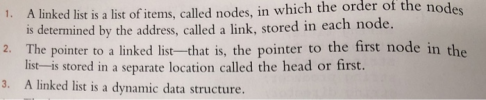
A linked list is a list of items, called nodes, in which the order is determined by the address, called of the nodes 1. 2. The pointer to a linked list-that is, the pointer to the first node in the list-is stored in a separate location called the head or first. 3. A linked list is a dynamic data structure.
true or false
A linked list is a list of items, called nodes, in which the order is determined by the address, called of the nodes 1. 2. The pointer to a linked list-that is, the pointer to the first node in the list-is stored in a separate location called the head or first. 3. A linked list is a dynamic data structure.
Codelab question! This is c++. Consider the following code: // Linked Lists: TRAVERSE struct ListNode {...
Codelab question! This is c++. Consider the following code: // Linked Lists: TRAVERSE struct ListNode { int data; struct ListNode *next; }; Assume that a linked list has been created and head points to a sentinel node. A sentinel node is an empty data node in the beginning of the list. It sometimes holds a sentinel value. The use of sentinel nodes is a popular trick to simplify the insert and delete operations. You may also assume that the list...
 Create Functions for the following prototypes. Below is the setup.*program is in c*
#include <stdio.h>
#include <string.h>
#include <stdarg.h>
#include <stdlib.h>
//#define constant values
#define MAX_URL_LENGTH 50
#define TRUE 1
#define FALSE 0
//typedef for the Element struct which constains a c string to store a URL in the BrowserList
typedef struct
{
char szURL[MAX_URL_LENGTH];
} Element;
//Typedef for a node in the doubly linked list (has next and previous pointers).
typedef struct NodeDL
{
Element element;
struct NodeDL *pNext;...
Create Functions for the following prototypes. Below is the setup.*program is in c*
#include <stdio.h>
#include <string.h>
#include <stdarg.h>
#include <stdlib.h>
//#define constant values
#define MAX_URL_LENGTH 50
#define TRUE 1
#define FALSE 0
//typedef for the Element struct which constains a c string to store a URL in the BrowserList
typedef struct
{
char szURL[MAX_URL_LENGTH];
} Element;
//Typedef for a node in the doubly linked list (has next and previous pointers).
typedef struct NodeDL
{
Element element;
struct NodeDL *pNext;...
 16 and 18 C++
11. Given the dynamic linked implementation of a linked list shown below, write expressions that do the following, assuming that currPtr is somewhere in the middle of the list: a. Access the component member of the first list element. b. Advance currPtr to point to the next element. c. Access the component member of the next element (the one that follows the current element). d. Access the component member of the element that follows the next...
16 and 18 C++
11. Given the dynamic linked implementation of a linked list shown below, write expressions that do the following, assuming that currPtr is somewhere in the middle of the list: a. Access the component member of the first list element. b. Advance currPtr to point to the next element. c. Access the component member of the next element (the one that follows the current element). d. Access the component member of the element that follows the next...
 true or false
A linked list is a list of items, called nodes, in which the order is determined by the address, called of the nodes 1. 2. The pointer to a linked list-that is, the pointer to the first node in the list-is stored in a separate location called the head or first. 3. A linked list is a dynamic data structure.
true or false
A linked list is a list of items, called nodes, in which the order is determined by the address, called of the nodes 1. 2. The pointer to a linked list-that is, the pointer to the first node in the list-is stored in a separate location called the head or first. 3. A linked list is a dynamic data structure.
Most questions answered within 3 hours.
-
Where is the error in this code sequence?
String s1 = "Hello";
String s2 = "ello";...
asked 11 months ago -
Financial data for Joel de Paris, Inc., for last year
follow:
Joel de Paris, Inc.
Balance...
asked 11 months ago -
Consider this reaction:
Al2(SO4)3 (aq)+ BaCl3
(aq) Al2Cl6 (aq)- +
3BaSO4(s) . What is the...
asked 11 months ago -
Suppose that Savneet is considering increasing her
recent random sample from 20 car rentals to 40...
asked 11 months ago -
Trucks arrive at an unloading terminal at an average rate of 120
per hour.
Trucks arrive...
asked 11 months ago -
Why are methanol and ethanol completely soluble in water while
octanol is not very little soluble....
asked 11 months ago -
A facilities manager at a university reads in a research report
that the mean amount of...
asked 11 months ago -
When the CuSO4 is rehydrated by adding water to the anhydrous
compound, is this an endothermic...
asked 11 months ago -
A ray of sunlight is passing from diamond into crown glass; the
angle of incidence is...
asked 11 months ago -
A block of mass 0.249 kg is placed on top of a light, vertical
spring of...
asked 11 months ago -
how do the kidneys compensate in the presences of acidosis
a) trigger hyperventilate
b) reserve acid...
asked 11 months ago -
Question 501 pts
The rental rate of capital to the firm increases. Which of the
following...
asked 11 months ago