
It is a question about Computer organization
Homework Answers
SOLUTION:
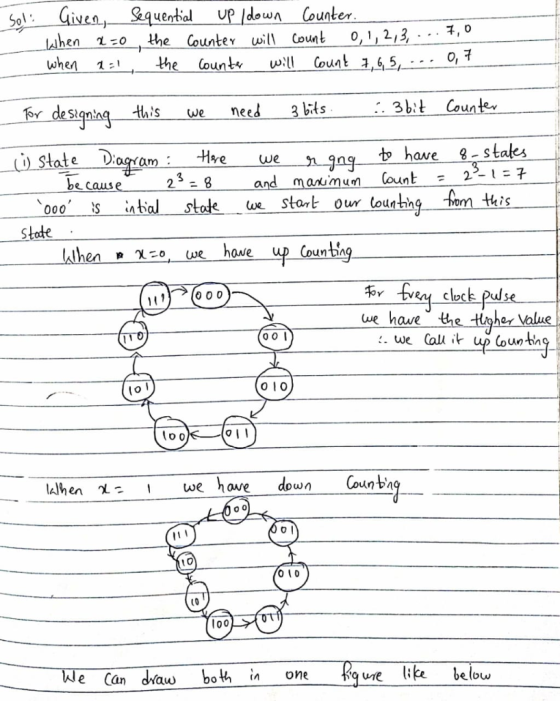

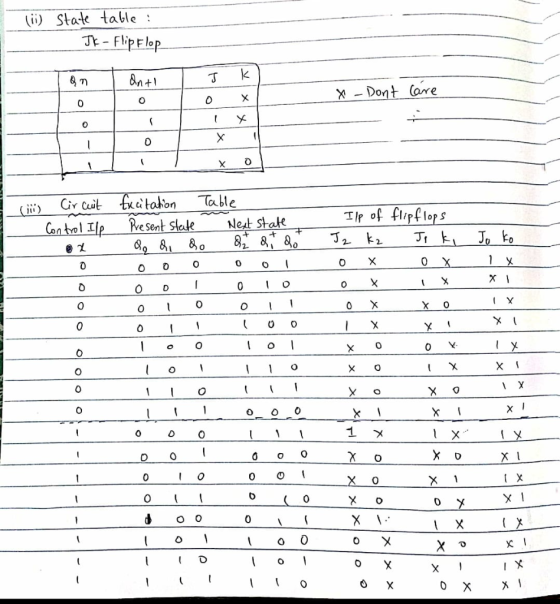
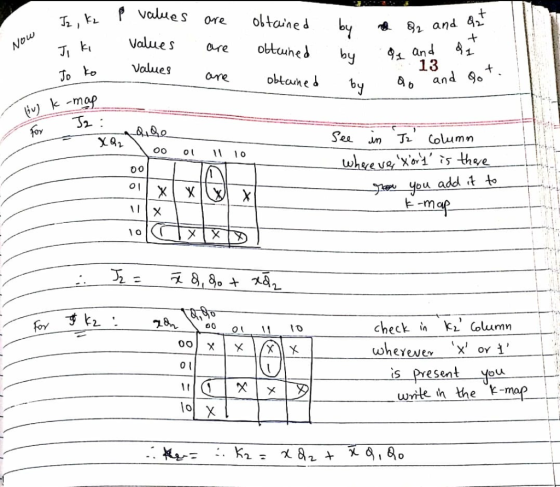
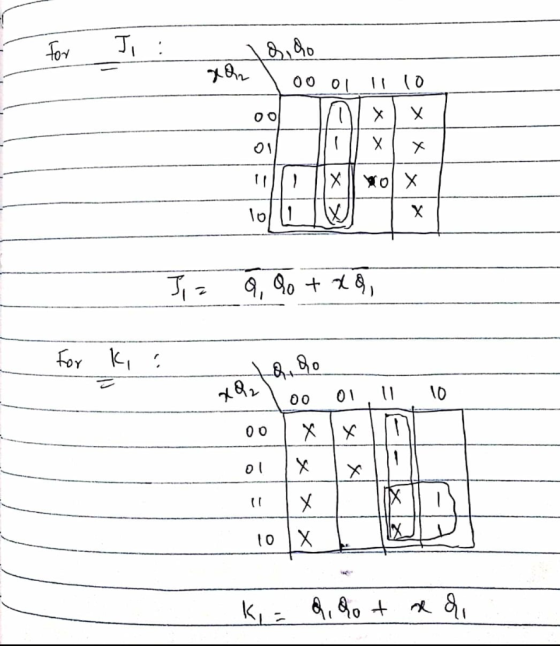


NOTE:
If you are satisfied with my answer please do up vote
and if you have any kind of doubts please post in comment section.
I'll surely help you there.
Thank You:)
Add Answer to:
It is a question about Computer organization
Design a sequential up/down counter. The counter should count...
It is a question about Computer organization 1. Design a sequential counter that counts as follows: 1.1. Draw the st...
 It is a question about Computer organization
1. Design a sequential counter that counts as follows: 1.1. Draw the state diagram 1.2. Write the State Table 1.3. Add the Excitation table using SR Flip Flop 1.4. Minimize 1.5. Draw the logic diagram
1. Design a sequential counter that counts as follows: 1.1. Draw the state diagram 1.2. Write the State Table 1.3. Add the Excitation table using SR Flip Flop 1.4. Minimize 1.5. Draw the logic diagram
It is a question about Computer organization
1. Design a sequential counter that counts as follows: 1.1. Draw the state diagram 1.2. Write the State Table 1.3. Add the Excitation table using SR Flip Flop 1.4. Minimize 1.5. Draw the logic diagram
1. Design a sequential counter that counts as follows: 1.1. Draw the state diagram 1.2. Write the State Table 1.3. Add the Excitation table using SR Flip Flop 1.4. Minimize 1.5. Draw the logic diagram
ercise 5 Part One: Sequential Logic ask 5.1,1: Design a 4-bit up/down counter that does not...
 ercise 5 Part One: Sequential Logic ask 5.1,1: Design a 4-bit up/down counter that does not overflow or underflow. That is, counting up is disabled when it reaches its maximum value and counting down is disabled when it reaches its minimum value. Use circuit simulation to verify your design. Task 5.1.2: Design a logic implementation of the Finite State Machine in Fiqure 2.3 using JK flip flops. It can be assumed that unused state combinations may be considered as don't...
(a) Design an asynchronous Binary Coded Decimal (BCD) count-up counter using JK flip-flops. Draw the counter circuit clearly showing the configuration of the JK flip-flops and the necessary logic gat...
 (a) Design an asynchronous Binary Coded Decimal (BCD) count-up counter using JK flip-flops. Draw the counter circuit clearly showing the configuration of the JK flip-flops and the necessary logic gate(s). Sketch the input and output waveforms of this counter (7 Marks) (b) The binary up/down counter for a cargo lift controller in a 7-storey building has an up-down (UID) control input and a buzzer output (B). The buzzer will sound B 1) when the lift is at level 1 or...
Question #2. Design of a Sequential Circuit: A SEQUENCE DETECTOR that detects the sequence 10 must...
 Question #2. Design of a Sequential Circuit: A SEQUENCE DETECTOR that detects the sequence 10 must be designed whose present output z(k) is set to one when the past input u(k-1) is one and the present input u(k) is zero, where for the other three possible combinations of the input pair u(k-1), u(k) the present output z(k) is set to zero. The state diagram for a sequential circuit that detects the input sequence 10 discussed above is given below: AA...
answer a,b,c,d all of them one question 1 / 2 Question #2. Design of a Sequential...
 answer a,b,c,d all of them one question
1 / 2 Question #2. Design of a Sequential Circuit: A SEQUENCE DETECTOR that detects the sequence 11 must be designed whose present output z(k) is set to one when the past input (k-1) is one and the present input u(k) is also one, where for the other three possible combinations of the input pair u(k-1), uk) the present outputz(k) is set to zero. The state diagram for a sequential circuit that detects...
answer a,b,c,d all of them one question
1 / 2 Question #2. Design of a Sequential Circuit: A SEQUENCE DETECTOR that detects the sequence 11 must be designed whose present output z(k) is set to one when the past input (k-1) is one and the present input u(k) is also one, where for the other three possible combinations of the input pair u(k-1), uk) the present outputz(k) is set to zero. The state diagram for a sequential circuit that detects...
Design a two-bit up/down binary counter using D flip-flops that can count in binary from 0 to 7.
Design a two-bit up/down binary counter using D flip-flops that can count in binary from 0 to 7. When the control input x is 0, the circuit counts down, and when it is 1, the circuit counts up. (a) Obtain the state table of the two-bit counter. (b) Obtain the state diagram (c) Draw the logic diagram of the circuit.
Design an up/down counter with four states (0, 1, 2, 3) using clocked J-K flip-flops. A...
 Design an up/down counter with four states (0, 1, 2, 3) using clocked J-K flip-flops. A control signal x is used as follows: When x 0 the machine counts forward (up), when x , backward (down). Simulate using MultiSim and attach a simulation printout X Please address the following in your report 1. State Table 2. State Diagram 3. Flip-Flop Excitation Tables 4 K-Map Simplification and resulting diagram 5. Multisim Simulation 6. Conclusion/Discussion 7. References
Design an up/down counter with...
Design an up/down counter with four states (0, 1, 2, 3) using clocked J-K flip-flops. A control signal x is used as follows: When x 0 the machine counts forward (up), when x , backward (down). Simulate using MultiSim and attach a simulation printout X Please address the following in your report 1. State Table 2. State Diagram 3. Flip-Flop Excitation Tables 4 K-Map Simplification and resulting diagram 5. Multisim Simulation 6. Conclusion/Discussion 7. References
Design an up/down counter with...
Circuit : Custom up/down counter P3. Count Sequence Generate a random sequence of 8 distinct...
Circuit : Custom up/down counter P3. Count Sequence Generate a random sequence of 8 distinct numbers between 0 and 7. Start at any number, and not “in order”,13576420 Document your count sequence in the Lab Notebook. P4. State Diagram Create an FSM state diagram to cycle through your count sequence. Implement forward and backward counting, based on X (1 = forward, 0 = backward). Include a diagram. Create it with software or very neatly...
a. Design a count up/count down counter that counts from 0 up to 4, then 4 down to 0 using D flip flop.
2. Synchronous Counters: a. Design a count up/count down counter that counts from 0 up to 4, then 4 down to 0 using D flip flop. b. Design a count up counter that counts from 0 up to 12 using JK flip flops.
1) Design a synchronous 3-bit binary UP/DOWN counter uses the following counting pattern 10.2.3.7.6.40.1.3...) the counter...
 1) Design a synchronous 3-bit binary UP/DOWN counter uses the following counting pattern 10.2.3.7.6.40.1.3...) the counter will count in this pattern indefinitely when the input X is equal to 1. When the input the counter will reverse direction and count in the opposite pattern 0. 4 7310) Complete the state diagram, transition table, New state s and solve for the recitation equations for flipflops that will perform this function. (You do not need to draw the flip-flops Use the state...
 It is a question about Computer organization
1. Design a sequential counter that counts as follows: 1.1. Draw the state diagram 1.2. Write the State Table 1.3. Add the Excitation table using SR Flip Flop 1.4. Minimize 1.5. Draw the logic diagram
1. Design a sequential counter that counts as follows: 1.1. Draw the state diagram 1.2. Write the State Table 1.3. Add the Excitation table using SR Flip Flop 1.4. Minimize 1.5. Draw the logic diagram
It is a question about Computer organization
1. Design a sequential counter that counts as follows: 1.1. Draw the state diagram 1.2. Write the State Table 1.3. Add the Excitation table using SR Flip Flop 1.4. Minimize 1.5. Draw the logic diagram
1. Design a sequential counter that counts as follows: 1.1. Draw the state diagram 1.2. Write the State Table 1.3. Add the Excitation table using SR Flip Flop 1.4. Minimize 1.5. Draw the logic diagram
 ercise 5 Part One: Sequential Logic ask 5.1,1: Design a 4-bit up/down counter that does not overflow or underflow. That is, counting up is disabled when it reaches its maximum value and counting down is disabled when it reaches its minimum value. Use circuit simulation to verify your design. Task 5.1.2: Design a logic implementation of the Finite State Machine in Fiqure 2.3 using JK flip flops. It can be assumed that unused state combinations may be considered as don't...
 (a) Design an asynchronous Binary Coded Decimal (BCD) count-up counter using JK flip-flops. Draw the counter circuit clearly showing the configuration of the JK flip-flops and the necessary logic gate(s). Sketch the input and output waveforms of this counter (7 Marks) (b) The binary up/down counter for a cargo lift controller in a 7-storey building has an up-down (UID) control input and a buzzer output (B). The buzzer will sound B 1) when the lift is at level 1 or...
 Question #2. Design of a Sequential Circuit: A SEQUENCE DETECTOR that detects the sequence 10 must be designed whose present output z(k) is set to one when the past input u(k-1) is one and the present input u(k) is zero, where for the other three possible combinations of the input pair u(k-1), u(k) the present output z(k) is set to zero. The state diagram for a sequential circuit that detects the input sequence 10 discussed above is given below: AA...
 answer a,b,c,d all of them one question
1 / 2 Question #2. Design of a Sequential Circuit: A SEQUENCE DETECTOR that detects the sequence 11 must be designed whose present output z(k) is set to one when the past input (k-1) is one and the present input u(k) is also one, where for the other three possible combinations of the input pair u(k-1), uk) the present outputz(k) is set to zero. The state diagram for a sequential circuit that detects...
answer a,b,c,d all of them one question
1 / 2 Question #2. Design of a Sequential Circuit: A SEQUENCE DETECTOR that detects the sequence 11 must be designed whose present output z(k) is set to one when the past input (k-1) is one and the present input u(k) is also one, where for the other three possible combinations of the input pair u(k-1), uk) the present outputz(k) is set to zero. The state diagram for a sequential circuit that detects...
 Design an up/down counter with four states (0, 1, 2, 3) using clocked J-K flip-flops. A control signal x is used as follows: When x 0 the machine counts forward (up), when x , backward (down). Simulate using MultiSim and attach a simulation printout X Please address the following in your report 1. State Table 2. State Diagram 3. Flip-Flop Excitation Tables 4 K-Map Simplification and resulting diagram 5. Multisim Simulation 6. Conclusion/Discussion 7. References
Design an up/down counter with...
Design an up/down counter with four states (0, 1, 2, 3) using clocked J-K flip-flops. A control signal x is used as follows: When x 0 the machine counts forward (up), when x , backward (down). Simulate using MultiSim and attach a simulation printout X Please address the following in your report 1. State Table 2. State Diagram 3. Flip-Flop Excitation Tables 4 K-Map Simplification and resulting diagram 5. Multisim Simulation 6. Conclusion/Discussion 7. References
Design an up/down counter with...
 1) Design a synchronous 3-bit binary UP/DOWN counter uses the following counting pattern 10.2.3.7.6.40.1.3...) the counter will count in this pattern indefinitely when the input X is equal to 1. When the input the counter will reverse direction and count in the opposite pattern 0. 4 7310) Complete the state diagram, transition table, New state s and solve for the recitation equations for flipflops that will perform this function. (You do not need to draw the flip-flops Use the state...
Most questions answered within 3 hours.
-
Where is the error in this code sequence?
String s1 = "Hello";
String s2 = "ello";...
asked 1 year ago -
Financial data for Joel de Paris, Inc., for last year
follow:
Joel de Paris, Inc.
Balance...
asked 1 year ago -
Consider this reaction:
Al2(SO4)3 (aq)+ BaCl3
(aq) Al2Cl6 (aq)- +
3BaSO4(s) . What is the...
asked 1 year ago -
Suppose that Savneet is considering increasing her
recent random sample from 20 car rentals to 40...
asked 1 year ago -
Trucks arrive at an unloading terminal at an average rate of 120
per hour.
Trucks arrive...
asked 1 year ago -
Why are methanol and ethanol completely soluble in water while
octanol is not very little soluble....
asked 1 year ago -
A facilities manager at a university reads in a research report
that the mean amount of...
asked 1 year ago -
When the CuSO4 is rehydrated by adding water to the anhydrous
compound, is this an endothermic...
asked 1 year ago -
A ray of sunlight is passing from diamond into crown glass; the
angle of incidence is...
asked 1 year ago -
A block of mass 0.249 kg is placed on top of a light, vertical
spring of...
asked 1 year ago -
how do the kidneys compensate in the presences of acidosis
a) trigger hyperventilate
b) reserve acid...
asked 1 year ago -
Question 501 pts
The rental rate of capital to the firm increases. Which of the
following...
asked 1 year ago