
Homework Answers

Add Answer to:
1. A linear time-invariant system hn is characterized by the following z transform function 3-42-1 1-3.5+1.5-2...
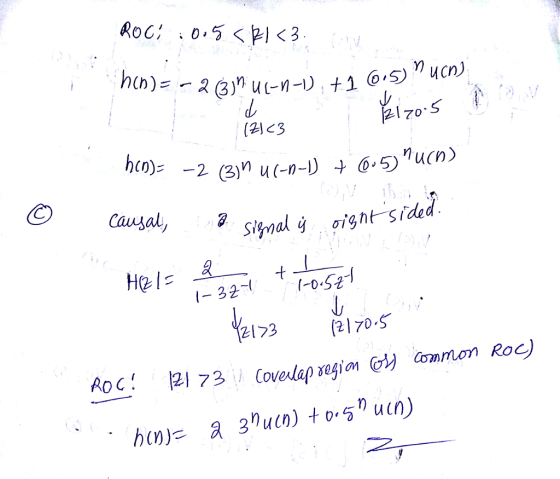
Problem 3 (30 points) An LTI system has an impulse response hin], whose z-transform equals 1-1...
 Problem 3 (30 points) An LTI system has an impulse response hin], whose z-transform equals 1-1 1. List all the poles and zeros of H(2). Sketch the pole-zero plot.. 2. If this system is causal, provide the ROC of H(2) and the expression of hin. case, is this system also stable? 3. If the ROC of H(z) does not exist, provide and the expression of hn.
5. The z transform is a very useful tool for studying difference equations. Often difference and ...
 5. The z transform is a very useful tool for studying difference equations. Often difference and differential equations are used to describe causal systems and only the causal solution is of interest. This is the "initial condition" problem of a differential equations course. But both difference and differential equations describe more than just the causal system. For instance, "backwards" solutions and "two point boundary value" solutions. One way in which to think about the problem is the ROC of the...
Problem 1 (Marks: 2+1.5+1.5+4) A linear time-invariant system has following impulse response -(よ 0otherwise 1. Determine...
 Problem 1 (Marks: 2+1.5+1.5+4) A linear time-invariant system has following impulse response -(よ 0otherwise 1. Determine if the system is stable or not. (Marks: 2) 2. Determine if the system is causal or non-causal. (Marks: 2) 3. Determine if the system is finite impulse response (FIR) or infinite impulse response (IIR). (Marks: 2) 4. If the system has input 2(n) = δ(n)-6(n-1) + δ(n-2), determine output y(n) = h(n)*2(n) for n=-1, 0, 1, 2, 3, 4, 5, 6, (Marks: 4)
a continuous time causal LTI system has a transfer function: H(s)=(s+3)/(s^2 +3s +2) a) find the...
a continuous time causal LTI system has a transfer function: H(s)=(s+3)/(s^2 +3s +2) a) find the poles and zeros b) indicate the poles and the zeros on the s-plane indicate the region of convergence (ROC) c) write the differential equation of the system. d) determine the gain of the system at dc (ie the transfer function at w=0) e) is the system described by H(s) stable? explain f) for the system described by H(s), does the Fourier transform H(jw) exist?...
1.Using the transformed-Z unilateral determine and [n] for n20 for 7t With y [-1] 1 2. it wants to design a system,...
 1.Using the transformed-Z unilateral determine and [n] for n20 for 7t With y [-1] 1 2. it wants to design a system, linear and invariant in the time with the property that for the entry unun 1 The corresponding output is 2) un) determine the transfer function H (z) and the response to the impulse H [n] of the would fulfill the response condition system that Graph the map of poles and zeros in the complex plane. . Find the...
4- Let the step response of a linear, time-invariant, causal system be (-1).uln] ylnl.ynl-ler uln...
 4- Let the step response of a linear, time-invariant, causal system be (-1).uln] ylnl.ynl-ler uln].. 15 3 3 12 a) Find the transfer function H(Z) of this system b) Find the impulse response of the system. Is this system stable? c) Find the difference equation representation of this system.
4- Let the step response of a linear, time-invariant, causal system be (-1).uln] ylnl.ynl-ler uln].. 15 3 3 12 a) Find the transfer function H(Z) of this system b) Find the...
4- Let the step response of a linear, time-invariant, causal system be (-1).uln] ylnl.ynl-ler uln].. 15 3 3 12 a) Find the transfer function H(Z) of this system b) Find the impulse response of the system. Is this system stable? c) Find the difference equation representation of this system.
4- Let the step response of a linear, time-invariant, causal system be (-1).uln] ylnl.ynl-ler uln].. 15 3 3 12 a) Find the transfer function H(Z) of this system b) Find the...
Suppose that the system function of an LTI system is 1+z H(z)=7 (1-12 '\1-22-X1 - 3z-")...
 Suppose that the system function of an LTI system is 1+z H(z)=7 (1-12 '\1-22-X1 - 3z-") (a) Determine the ROC of H(z) if it is known that the system is stable. (b) Determine the ROC of H(z) if it is known that the system is causal. (c) Is it possible for the system to be both stable and causal?
MATLAB The z-transform of LTI systems can be expressed as a ratio of two polynomials in z-1 Also,...
 MATLAB The z-transform of LTI systems can be expressed as a ratio of two polynomials in z-1 Also, the rational z-transform can be written in factored form N-M) for z → H(G) = 0, the values of z are the zeros of the system for z = p2 → H(p) = oo, the values of z are the poles of the system Use MATLAB to graph Y() 1-242+2882 x(2) 1-0.8 -2 H(z) = 0,82-1 +0 642 Hints: e z: is...
A causal,d following difference equation linear, time-invariant system is governed by the (a) Determine the transfer...
 A causal,d following difference equation linear, time-invariant system is governed by the (a) Determine the transfer function, H(2), of the system and its region of (b) Determine the output yi[n] of the system in response to the input (c) Determine the output y2fn] of the system in response to the input convergence. r2n (2). Note that z2n] does not have a z-transform.
Please solve the following with full steps. 2. Given the following z-transform of the impulse response h [n], of a causal LTI system Ti H1 (z) = (,-1)(z-0.5) (a) Find hin (b) Verify the first three no...
 Please solve the following
with full steps.
2. Given the following z-transform of the impulse response h [n], of a causal LTI system Ti H1 (z) = (,-1)(z-0.5) (a) Find hin (b) Verify the first three non-zero values of hi[n] using long division. (c) Find the z transform Hs(z) of hs[n]-2"hi[n], and specify the ROC. (d) Find thez transform H4() of han+n -1], and specify the ROC. e) Find the impulse response, hs[n], of the system Ts, which is the...
Please solve the following
with full steps.
2. Given the following z-transform of the impulse response h [n], of a causal LTI system Ti H1 (z) = (,-1)(z-0.5) (a) Find hin (b) Verify the first three non-zero values of hi[n] using long division. (c) Find the z transform Hs(z) of hs[n]-2"hi[n], and specify the ROC. (d) Find thez transform H4() of han+n -1], and specify the ROC. e) Find the impulse response, hs[n], of the system Ts, which is the...
 Problem 3 (30 points) An LTI system has an impulse response hin], whose z-transform equals 1-1 1. List all the poles and zeros of H(2). Sketch the pole-zero plot.. 2. If this system is causal, provide the ROC of H(2) and the expression of hin. case, is this system also stable? 3. If the ROC of H(z) does not exist, provide and the expression of hn.
 5. The z transform is a very useful tool for studying difference equations. Often difference and differential equations are used to describe causal systems and only the causal solution is of interest. This is the "initial condition" problem of a differential equations course. But both difference and differential equations describe more than just the causal system. For instance, "backwards" solutions and "two point boundary value" solutions. One way in which to think about the problem is the ROC of the...
 Problem 1 (Marks: 2+1.5+1.5+4) A linear time-invariant system has following impulse response -(よ 0otherwise 1. Determine if the system is stable or not. (Marks: 2) 2. Determine if the system is causal or non-causal. (Marks: 2) 3. Determine if the system is finite impulse response (FIR) or infinite impulse response (IIR). (Marks: 2) 4. If the system has input 2(n) = δ(n)-6(n-1) + δ(n-2), determine output y(n) = h(n)*2(n) for n=-1, 0, 1, 2, 3, 4, 5, 6, (Marks: 4)
 1.Using the transformed-Z unilateral determine and [n] for n20 for 7t With y [-1] 1 2. it wants to design a system, linear and invariant in the time with the property that for the entry unun 1 The corresponding output is 2) un) determine the transfer function H (z) and the response to the impulse H [n] of the would fulfill the response condition system that Graph the map of poles and zeros in the complex plane. . Find the...
 4- Let the step response of a linear, time-invariant, causal system be (-1).uln] ylnl.ynl-ler uln].. 15 3 3 12 a) Find the transfer function H(Z) of this system b) Find the impulse response of the system. Is this system stable? c) Find the difference equation representation of this system.
4- Let the step response of a linear, time-invariant, causal system be (-1).uln] ylnl.ynl-ler uln].. 15 3 3 12 a) Find the transfer function H(Z) of this system b) Find the...
4- Let the step response of a linear, time-invariant, causal system be (-1).uln] ylnl.ynl-ler uln].. 15 3 3 12 a) Find the transfer function H(Z) of this system b) Find the impulse response of the system. Is this system stable? c) Find the difference equation representation of this system.
4- Let the step response of a linear, time-invariant, causal system be (-1).uln] ylnl.ynl-ler uln].. 15 3 3 12 a) Find the transfer function H(Z) of this system b) Find the...
 Suppose that the system function of an LTI system is 1+z H(z)=7 (1-12 '\1-22-X1 - 3z-") (a) Determine the ROC of H(z) if it is known that the system is stable. (b) Determine the ROC of H(z) if it is known that the system is causal. (c) Is it possible for the system to be both stable and causal?
 MATLAB The z-transform of LTI systems can be expressed as a ratio of two polynomials in z-1 Also, the rational z-transform can be written in factored form N-M) for z → H(G) = 0, the values of z are the zeros of the system for z = p2 → H(p) = oo, the values of z are the poles of the system Use MATLAB to graph Y() 1-242+2882 x(2) 1-0.8 -2 H(z) = 0,82-1 +0 642 Hints: e z: is...
 A causal,d following difference equation linear, time-invariant system is governed by the (a) Determine the transfer function, H(2), of the system and its region of (b) Determine the output yi[n] of the system in response to the input (c) Determine the output y2fn] of the system in response to the input convergence. r2n (2). Note that z2n] does not have a z-transform.
 Please solve the following
with full steps.
2. Given the following z-transform of the impulse response h [n], of a causal LTI system Ti H1 (z) = (,-1)(z-0.5) (a) Find hin (b) Verify the first three non-zero values of hi[n] using long division. (c) Find the z transform Hs(z) of hs[n]-2"hi[n], and specify the ROC. (d) Find thez transform H4() of han+n -1], and specify the ROC. e) Find the impulse response, hs[n], of the system Ts, which is the...
Please solve the following
with full steps.
2. Given the following z-transform of the impulse response h [n], of a causal LTI system Ti H1 (z) = (,-1)(z-0.5) (a) Find hin (b) Verify the first three non-zero values of hi[n] using long division. (c) Find the z transform Hs(z) of hs[n]-2"hi[n], and specify the ROC. (d) Find thez transform H4() of han+n -1], and specify the ROC. e) Find the impulse response, hs[n], of the system Ts, which is the...
Most questions answered within 3 hours.
-
Where is the error in this code sequence?
String s1 = "Hello";
String s2 = "ello";...
asked 10 months ago -
Financial data for Joel de Paris, Inc., for last year
follow:
Joel de Paris, Inc.
Balance...
asked 10 months ago -
Consider this reaction:
Al2(SO4)3 (aq)+ BaCl3
(aq) Al2Cl6 (aq)- +
3BaSO4(s) . What is the...
asked 10 months ago -
Suppose that Savneet is considering increasing her
recent random sample from 20 car rentals to 40...
asked 10 months ago -
Trucks arrive at an unloading terminal at an average rate of 120
per hour.
Trucks arrive...
asked 10 months ago -
Why are methanol and ethanol completely soluble in water while
octanol is not very little soluble....
asked 10 months ago -
A facilities manager at a university reads in a research report
that the mean amount of...
asked 10 months ago -
When the CuSO4 is rehydrated by adding water to the anhydrous
compound, is this an endothermic...
asked 10 months ago -
A ray of sunlight is passing from diamond into crown glass; the
angle of incidence is...
asked 10 months ago -
A block of mass 0.249 kg is placed on top of a light, vertical
spring of...
asked 10 months ago -
how do the kidneys compensate in the presences of acidosis
a) trigger hyperventilate
b) reserve acid...
asked 10 months ago -
Question 501 pts
The rental rate of capital to the firm increases. Which of the
following...
asked 10 months ago