What bacteria might be, lower portion is my results. Thanks
 What bacteria
might be, lower portion is my results. Thanks
What bacteria
might be, lower portion is my results. ThanksHomework Answers
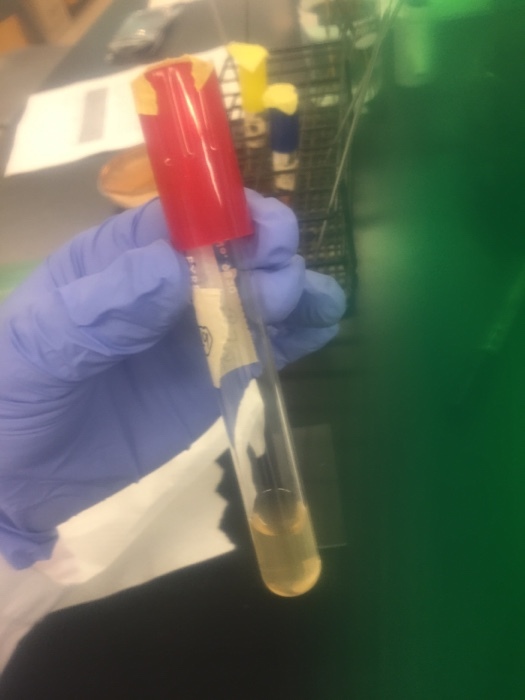
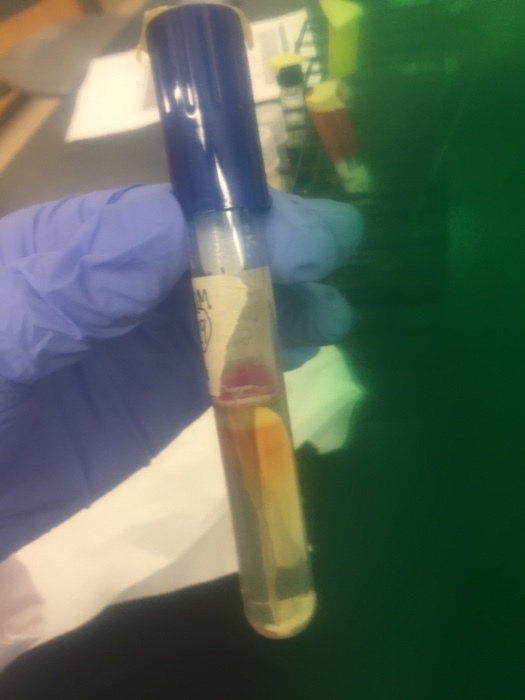
Based on the information provided in the images. The test results indicate the following characteristics of a bacterium.
- Indole production - Positive - red color is observed.
This test is used for identifying the Enterobacteriaceae family members. A compound indole is produced due to the action of tryptophanase (organism) on tryptophan (in the medium).
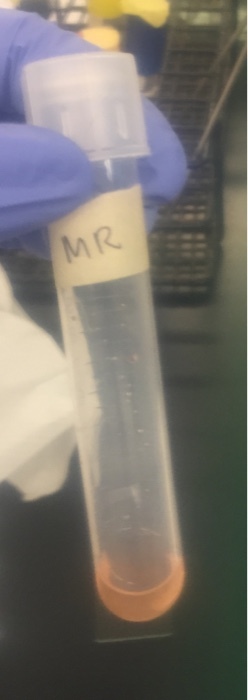
- Methyl red - Positive - pink color is observed.
This is a differentiating test and identifying the bacteria that produce acid and the methyl red reagent added, indicates the acid production by giving out a red/pink color.
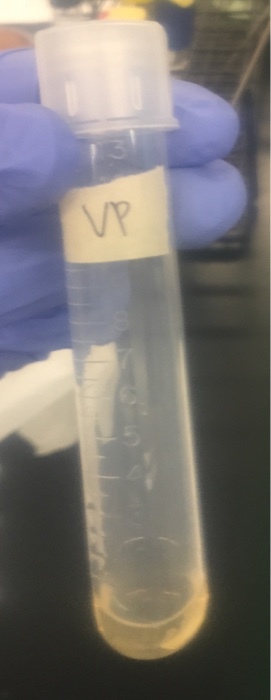
- VP/Vogues-Proskauer test - Negative - No color is observed
This is a differentiating test and identifying the bacteria that produce acetylmethylcarbinol via 2,3 butanediol fermentation. A negative test indicates that the organism uses a mixed acid production but not the 2,3- butanediol pathway.
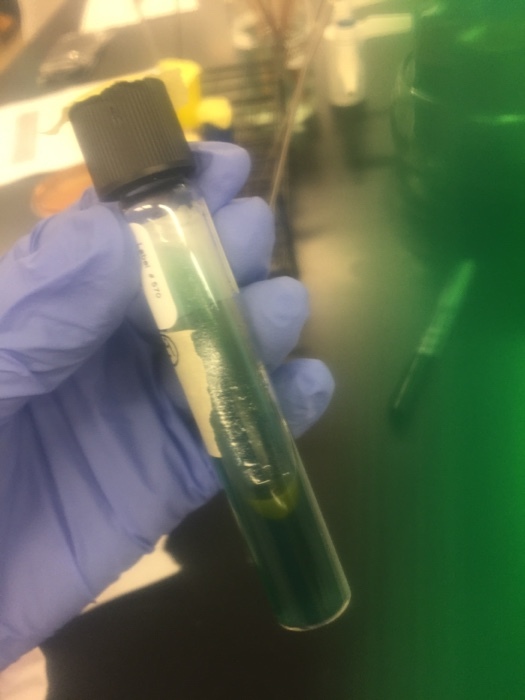
- Citrate test - Negative - Green color was observed.
Citrate reagent is initially green in color and after the addition of bromothymol blue if there was citrate usage by the organism then it turns blue in color. But in this case, there is no change in the color and hence it is citrate negative.
- Gelatin hydrolysis - No liquefaction was observed.
Gelatin is a collagen-like compound and this test determines the ability of an organism to break down the gelatin by gelatinase enzyme. This test differentiates between the
- H2S production - No production of hydrogen sulfide gas was observed.
This test signifies in identifying organisms that produce hydrogen sulfide gas when a sulfur-containing compound is provided in the medium. The results are interpreted by the observation of blackening of the medium.
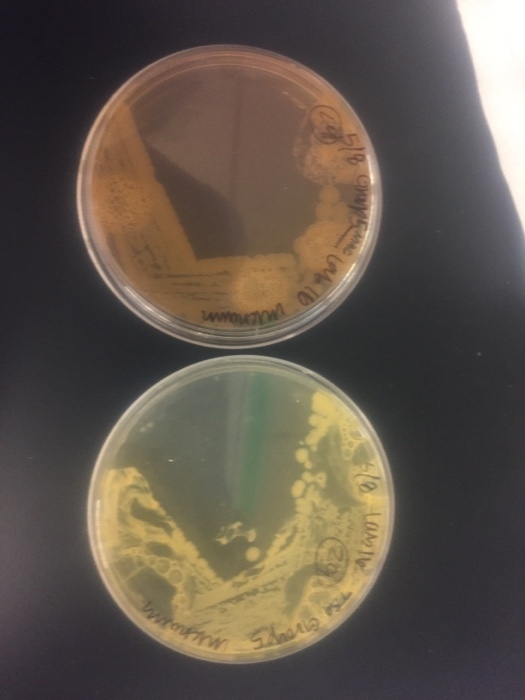
- MacConkey medium - Good growth is observed. yellow color
This medium is a selective medium for the gram-negative enteric bacteria as the bile salts present in the medium inhibit the growth of gram-positive bacteria. An additional characteristic whether the organism can ferment the lactose fermentation. Yellow color observed indicates a lac negative organism which means that the organism is a gram-negative and lac negative.
The unknown organism is a gram-negative acid producing, doesn't produce hydrogen sulfide gas, does not utilize citrate, is indole positive. These characteristics bring us down to two options E.Coli and shigella except for the final test on Mac agar where the result is a non-lactose fermenting organism which is nothing but Shigella.
these are my results for my bacteria growth curve of e coli. expected results were to...
 these are my results for my bacteria growth curve of e coli.
expected results were to have a lag phase, exponential phase,
stationary phase and death phase. the first phase is declining so
doesnt resemble a lag phase, and no death phase is present. please
explain why/ what are possible reasons in the difference in growth
curve vs what i expected
OD600 readings and cell concentration Cell Concentration (cell/mL) 1000000000 157000000 93700000 52700000 53000000 100000000 -30900000 10000000 21 SOXOXO Cell...
these are my results for my bacteria growth curve of e coli.
expected results were to have a lag phase, exponential phase,
stationary phase and death phase. the first phase is declining so
doesnt resemble a lag phase, and no death phase is present. please
explain why/ what are possible reasons in the difference in growth
curve vs what i expected
OD600 readings and cell concentration Cell Concentration (cell/mL) 1000000000 157000000 93700000 52700000 53000000 100000000 -30900000 10000000 21 SOXOXO Cell...
lake-up Micro Lab: Identifying Unknown bacteria: dentify the Unknown Bacteria Lab Experiment elow are results from...
 lake-up Micro Lab: Identifying Unknown bacteria: dentify the Unknown Bacteria Lab Experiment elow are results from the unknown lab experiment. The identity of this bacteria is not known. Your ask is to use the data below to form a hypothesis of the identity of this bacteria. Record your results on he chart (Table 1) below and make a prediction on the bacteria based on your results. There is a list of ossible bacteria below. You may need to look back...
UPM (A). What in vivo conditions might the bacteria experience to promote biofilm development? (B). Explain...
 UPM (A). What in vivo conditions might the bacteria experience to promote biofilm development? (B). Explain why growth of the bacteria in the presence of ethanol increases PIA/PNAG production and biofilm development? (C). What makes bacterial biofilms resistant to antibiotics and host immune responses? (D). What future strategies might be used to combat device related infections?
Why might green sulfur bacteria be able to out-compete purple sulfur bacteria for their common substrate,...
Why might green sulfur bacteria be able to out-compete purple sulfur bacteria for their common substrate, sulfide? Presume light is not limiting for either organism
3. What are two ways by which bacteria can overcome (or resist) the effects of antibiotics (i.e., what are 2 things bact...
3. What are two ways by which bacteria can overcome (or resist) the effects of antibiotics (i.e., what are 2 things bacteria can do to antibiotics so they do NOT work against bactertia)? Which form of DNA is most likely to contain genes that specify antibiotic resistance? 4. Some bacteria can stop the activation of complement. Suggest how this might be accomplished (ie- suggest 2 or 3 things bacteria might do to complement to stop or prevent complement activation). Describe...
on the upper portion of a C3 leaf and more There are more on the lower...
 on the upper portion of a C3 leaf and more There are more on the lower portion. gaurd cells; stomata epidermal cells; parenchyma cells spongy mesophyll; pallisade mesophyll pallisade mesophyll; spongy mesophyll
An older person wears bifocals. The lower portion of the lens is converging and has a...
 An older person wears bifocals. The lower portion of the lens is
converging and has a focal length of 80 cm. The upper portion is
diverging and has focal length of - 50 cm. What are near and far
points of person’s unaided eye?
Draw separate diagram for each lens label near and far points
which ever is applicable.
PLEASE DRAW THE 2 SEPARATE DIAGRAMS, ONE FOR EACH LENS, AND
LABEL THE NEAR AND FAR POINTS.
Problem 14 An older...
An older person wears bifocals. The lower portion of the lens is
converging and has a focal length of 80 cm. The upper portion is
diverging and has focal length of - 50 cm. What are near and far
points of person’s unaided eye?
Draw separate diagram for each lens label near and far points
which ever is applicable.
PLEASE DRAW THE 2 SEPARATE DIAGRAMS, ONE FOR EACH LENS, AND
LABEL THE NEAR AND FAR POINTS.
Problem 14 An older...
we were given an unknown bacteria to work with at lab. the results came and its...
 we were given an unknown bacteria to work with at lab. the
results came and its written in the second observation. based on
that observation i got to know that my unknown bacteria was
Enterobacter aerogenes. so based on my second observation ive
written, im to answer the last two columns( conclusion and
comments)
Gram Negative Conclusion What does be your test result Comments List all possible organisms that match your Biochemical test and gram staining Theoretical Positive Second Observation...
we were given an unknown bacteria to work with at lab. the
results came and its written in the second observation. based on
that observation i got to know that my unknown bacteria was
Enterobacter aerogenes. so based on my second observation ive
written, im to answer the last two columns( conclusion and
comments)
Gram Negative Conclusion What does be your test result Comments List all possible organisms that match your Biochemical test and gram staining Theoretical Positive Second Observation...
Imagine that you are holding an “interview” of bacteria living in an oral biofilm. How might...
Imagine that you are holding an “interview” of bacteria living in an oral biofilm. How might the bacteria respond to your question about advantages of living in a biofilm?
Please provided my credit back to my account since can't provide an answer. Thanks 5-2 Please provide help Discuss the b...
Please provided my credit back to my account since can't provide an answer. Thanks 5-2 Please provide help Discuss the benefits to financial statement users when accountants separate the debt and equity features of hybrid debt securities. Additionally, Why might this be necessary? Explain your reasoning. What might impact the way a user will classify the debt and equity features?
 these are my results for my bacteria growth curve of e coli.
expected results were to have a lag phase, exponential phase,
stationary phase and death phase. the first phase is declining so
doesnt resemble a lag phase, and no death phase is present. please
explain why/ what are possible reasons in the difference in growth
curve vs what i expected
OD600 readings and cell concentration Cell Concentration (cell/mL) 1000000000 157000000 93700000 52700000 53000000 100000000 -30900000 10000000 21 SOXOXO Cell...
these are my results for my bacteria growth curve of e coli.
expected results were to have a lag phase, exponential phase,
stationary phase and death phase. the first phase is declining so
doesnt resemble a lag phase, and no death phase is present. please
explain why/ what are possible reasons in the difference in growth
curve vs what i expected
OD600 readings and cell concentration Cell Concentration (cell/mL) 1000000000 157000000 93700000 52700000 53000000 100000000 -30900000 10000000 21 SOXOXO Cell...
 lake-up Micro Lab: Identifying Unknown bacteria: dentify the Unknown Bacteria Lab Experiment elow are results from the unknown lab experiment. The identity of this bacteria is not known. Your ask is to use the data below to form a hypothesis of the identity of this bacteria. Record your results on he chart (Table 1) below and make a prediction on the bacteria based on your results. There is a list of ossible bacteria below. You may need to look back...
 UPM (A). What in vivo conditions might the bacteria experience to promote biofilm development? (B). Explain why growth of the bacteria in the presence of ethanol increases PIA/PNAG production and biofilm development? (C). What makes bacterial biofilms resistant to antibiotics and host immune responses? (D). What future strategies might be used to combat device related infections?
 on the upper portion of a C3 leaf and more There are more on the lower portion. gaurd cells; stomata epidermal cells; parenchyma cells spongy mesophyll; pallisade mesophyll pallisade mesophyll; spongy mesophyll
 An older person wears bifocals. The lower portion of the lens is
converging and has a focal length of 80 cm. The upper portion is
diverging and has focal length of - 50 cm. What are near and far
points of person’s unaided eye?
Draw separate diagram for each lens label near and far points
which ever is applicable.
PLEASE DRAW THE 2 SEPARATE DIAGRAMS, ONE FOR EACH LENS, AND
LABEL THE NEAR AND FAR POINTS.
Problem 14 An older...
An older person wears bifocals. The lower portion of the lens is
converging and has a focal length of 80 cm. The upper portion is
diverging and has focal length of - 50 cm. What are near and far
points of person’s unaided eye?
Draw separate diagram for each lens label near and far points
which ever is applicable.
PLEASE DRAW THE 2 SEPARATE DIAGRAMS, ONE FOR EACH LENS, AND
LABEL THE NEAR AND FAR POINTS.
Problem 14 An older...
 we were given an unknown bacteria to work with at lab. the
results came and its written in the second observation. based on
that observation i got to know that my unknown bacteria was
Enterobacter aerogenes. so based on my second observation ive
written, im to answer the last two columns( conclusion and
comments)
Gram Negative Conclusion What does be your test result Comments List all possible organisms that match your Biochemical test and gram staining Theoretical Positive Second Observation...
we were given an unknown bacteria to work with at lab. the
results came and its written in the second observation. based on
that observation i got to know that my unknown bacteria was
Enterobacter aerogenes. so based on my second observation ive
written, im to answer the last two columns( conclusion and
comments)
Gram Negative Conclusion What does be your test result Comments List all possible organisms that match your Biochemical test and gram staining Theoretical Positive Second Observation...
Most questions answered within 3 hours.
-
Where is the error in this code sequence?
String s1 = "Hello";
String s2 = "ello";...
asked 11 months ago -
Financial data for Joel de Paris, Inc., for last year
follow:
Joel de Paris, Inc.
Balance...
asked 11 months ago -
Consider this reaction:
Al2(SO4)3 (aq)+ BaCl3
(aq) Al2Cl6 (aq)- +
3BaSO4(s) . What is the...
asked 11 months ago -
Suppose that Savneet is considering increasing her
recent random sample from 20 car rentals to 40...
asked 11 months ago -
Trucks arrive at an unloading terminal at an average rate of 120
per hour.
Trucks arrive...
asked 11 months ago -
Why are methanol and ethanol completely soluble in water while
octanol is not very little soluble....
asked 11 months ago -
A facilities manager at a university reads in a research report
that the mean amount of...
asked 11 months ago -
When the CuSO4 is rehydrated by adding water to the anhydrous
compound, is this an endothermic...
asked 11 months ago -
A ray of sunlight is passing from diamond into crown glass; the
angle of incidence is...
asked 11 months ago -
A block of mass 0.249 kg is placed on top of a light, vertical
spring of...
asked 11 months ago -
how do the kidneys compensate in the presences of acidosis
a) trigger hyperventilate
b) reserve acid...
asked 11 months ago -
Question 501 pts
The rental rate of capital to the firm increases. Which of the
following...
asked 11 months ago