continuous unity feedback system
Homework Answers
Request Answer!
10 have requested this problem solution
The more requests, the faster the answer.
continuous unity feedback system
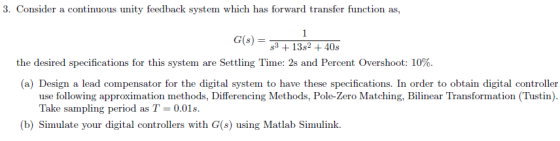
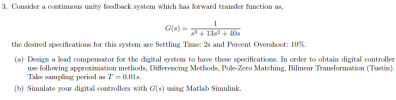 3. Consider a contintous unity feodback system which has forward transfer function as,
$$ G(s)=\frac{1}{s^{3}+13 s^{2}+40 s} $$
the desired specifications for this system are Settling Time: \(2 \mathrm{~s}\) and Percent Overshoot: \(10 \%\).
(a) Design a lead compensator for the digital system to have these specifications. In order to obtain digital controller use following approximation methods, Differencing Methods, Pole-Zero Matching, Bilinear Transformation (Tustin). Take sampling period as \(T=0.01\) s.
(b) Simulate your digital controllers with \(G(s)\) using Matlab Simulink.
3. Consider a contintous unity feodback system which has forward transfer function as,
$$ G(s)=\frac{1}{s^{3}+13 s^{2}+40 s} $$
the desired specifications for this system are Settling Time: \(2 \mathrm{~s}\) and Percent Overshoot: \(10 \%\).
(a) Design a lead compensator for the digital system to have these specifications. In order to obtain digital controller use following approximation methods, Differencing Methods, Pole-Zero Matching, Bilinear Transformation (Tustin). Take sampling period as \(T=0.01\) s.
(b) Simulate your digital controllers with \(G(s)\) using Matlab Simulink.
For the unity feedback system below, with For the unity feedback system below, with G(s) s...
 For the unity feedback system
below, with
For the unity feedback system below, with G(s) s 5) (s 6) C(s) G(s) 1 Draw Clearly the root locus 2- Find the break-in and breakaway points
For the unity feedback system
below, with
For the unity feedback system below, with G(s) s 5) (s 6) C(s) G(s) 1 Draw Clearly the root locus 2- Find the break-in and breakaway points
Given a unity feedback system with the following transfer function a)If the system is to be casca...
 Given a unity feedback system with the following transfer
function
a)If the system is to be cascade-compensated so that Ts=1 and
=0.8 find the
compensator pole if the compensator zero is at -4.5
b)determine the range of k for stability
We were unable to transcribe this image)Given 2내 5+644s(s+4
)Given 2내 5+644s(s+4
Given a unity feedback system with the following transfer
function
a)If the system is to be cascade-compensated so that Ts=1 and
=0.8 find the
compensator pole if the compensator zero is at -4.5
b)determine the range of k for stability
We were unable to transcribe this image)Given 2내 5+644s(s+4
)Given 2내 5+644s(s+4
System Transfer function/block diagrams questions Q1) how to convert non-unity feedback to unity feedback? Q2) What...
System Transfer function/block diagrams questions Q1) how to convert non-unity feedback to unity feedback? Q2) What are the steps for block diagram simplification ? For example, a system with a lot of controllers, summers, branchoff points, how should I simplify to a standard feedback loop to find transfer function? Q3) Explain Mason's transfer function formula
A unity feedback control system has the open loop TF as
A unity feedback control system has the open loop TF as: \(G(s)=\frac{K(s+a+1)(s+b)}{s(s+a)(s+a+2)}\)a) Find analytical expressions for the magnitude and phase response for \(\mathrm{G}(\mathrm{s}) .\left[K=K_{1}\right]\)b) Make a plot of the log-magnitude and the phase, using log-frequency in rad/s as the ordinate. \(\left[K=K_{1}\right]\)c) Sketch the Bode asymptotic magnitude and asymptotic phase plots. \(\left[K=K_{1}\right]\)d) Compare the results from \((a),(b)\), and \((c) .\left[K=K_{1}\right]\)e) Using the Nyquist criterion, find out if system is stable. Show your steps. \(\left[K=K_{1}\right]\)f) Using the Nyquist criterion, find the range...
Draw the diagram for the unity feedback control system, that is, the electro-mechanical system wi...
 Draw the diagram for the unity feedback control system, that is, the electro-mechanical system with controller and feedback using general parameters. 3) 4) Calculate K and K using the Torque-Speed curve (Figure 2), and information from Table 1 the translational link. The robot has an torque motor for a joint in Flgure1 ropresents a Single Joint robot model wnh Figure 1: Singla Joint Robot Model TONm) 恭.east Figure 2: Torque-Speed Qurve J Ikgm21-Armature Inertia DArmature Damping Coefficient R, [ohm]-Armature Resistance...
For Q3 and Q4, "system" refers' to a unity feedback system, as shown in Figure 1...
 For Q3 and Q4, "system" refers' to a unity feedback system, as shown in Figure 1 C)3 Given that lims"GDd(s)Kn00 (a) What is the system type? (b) What is the error coefficient for this system? (c) Take n - 1. Will the closed loop system track (i) position (ii) velocity (iii) acceleration? (d) Take G(s2 Use MATLAB to plot the step response of the closed loop system for (i) D1(s) 8 (ii) Dd(s) : 1. From the graphs, determine one...
Linear feedback systems evaluate the root locus for the unity gain negative feedback system where the...
Linear feedback systems evaluate the root locus for the unity gain negative feedback system where the feed - forward gain is G(s) = K(s+6) / s(s+1) (s+3) A. Determine and carefully draw real-line root locus and calculate the asymptotes B draw and label the root- locus. denote any angles of departure, jw-axis crossing and breakpoints
bnl dw.e blew 7. Find the unity feedback system that is equivalent to the system shown...
 bnl dw.e blew 7. Find the unity feedback system that is equivalent to the system shown in Figure P5.7. [Section: 5.2] flow the sig 1ster 30 nonin 1sdW e C6) R(s)+ s+1 2.s emolden hourpu 4 Siwollo IS.e no FIGURE P5.7 mib b
Control System Problem. Please do part A, B , and C. Consider the unity-feedback system with...
 Control System Problem. Please do part A, B , and C.
Consider the unity-feedback system with G(s)-K(st3)(s+5)/(s+(s-7)] Sketch the root locus of this system, clearly finding any asymptotes and calculating any break-in or break-away point:s. Determine the range of gain (K) to ensure that the system is stable Draw the Nyquist diagram of this system, only considering the imaginary axis of the original RHP contour (i.e. between points A and B on the original contour). Hint: You will want to...
Control System Problem. Please do part A, B , and C.
Consider the unity-feedback system with G(s)-K(st3)(s+5)/(s+(s-7)] Sketch the root locus of this system, clearly finding any asymptotes and calculating any break-in or break-away point:s. Determine the range of gain (K) to ensure that the system is stable Draw the Nyquist diagram of this system, only considering the imaginary axis of the original RHP contour (i.e. between points A and B on the original contour). Hint: You will want to...
 For the unity feedback system
below, with
For the unity feedback system below, with G(s) s 5) (s 6) C(s) G(s) 1 Draw Clearly the root locus 2- Find the break-in and breakaway points
For the unity feedback system
below, with
For the unity feedback system below, with G(s) s 5) (s 6) C(s) G(s) 1 Draw Clearly the root locus 2- Find the break-in and breakaway points
 Given a unity feedback system with the following transfer
function
a)If the system is to be cascade-compensated so that Ts=1 and
=0.8 find the
compensator pole if the compensator zero is at -4.5
b)determine the range of k for stability
We were unable to transcribe this image)Given 2내 5+644s(s+4
)Given 2내 5+644s(s+4
Given a unity feedback system with the following transfer
function
a)If the system is to be cascade-compensated so that Ts=1 and
=0.8 find the
compensator pole if the compensator zero is at -4.5
b)determine the range of k for stability
We were unable to transcribe this image)Given 2내 5+644s(s+4
)Given 2내 5+644s(s+4
 Draw the diagram for the unity feedback control system, that is, the electro-mechanical system with controller and feedback using general parameters. 3) 4) Calculate K and K using the Torque-Speed curve (Figure 2), and information from Table 1 the translational link. The robot has an torque motor for a joint in Flgure1 ropresents a Single Joint robot model wnh Figure 1: Singla Joint Robot Model TONm) 恭.east Figure 2: Torque-Speed Qurve J Ikgm21-Armature Inertia DArmature Damping Coefficient R, [ohm]-Armature Resistance...
 For Q3 and Q4, "system" refers' to a unity feedback system, as shown in Figure 1 C)3 Given that lims"GDd(s)Kn00 (a) What is the system type? (b) What is the error coefficient for this system? (c) Take n - 1. Will the closed loop system track (i) position (ii) velocity (iii) acceleration? (d) Take G(s2 Use MATLAB to plot the step response of the closed loop system for (i) D1(s) 8 (ii) Dd(s) : 1. From the graphs, determine one...
 bnl dw.e blew 7. Find the unity feedback system that is equivalent to the system shown in Figure P5.7. [Section: 5.2] flow the sig 1ster 30 nonin 1sdW e C6) R(s)+ s+1 2.s emolden hourpu 4 Siwollo IS.e no FIGURE P5.7 mib b
 Control System Problem. Please do part A, B , and C.
Consider the unity-feedback system with G(s)-K(st3)(s+5)/(s+(s-7)] Sketch the root locus of this system, clearly finding any asymptotes and calculating any break-in or break-away point:s. Determine the range of gain (K) to ensure that the system is stable Draw the Nyquist diagram of this system, only considering the imaginary axis of the original RHP contour (i.e. between points A and B on the original contour). Hint: You will want to...
Control System Problem. Please do part A, B , and C.
Consider the unity-feedback system with G(s)-K(st3)(s+5)/(s+(s-7)] Sketch the root locus of this system, clearly finding any asymptotes and calculating any break-in or break-away point:s. Determine the range of gain (K) to ensure that the system is stable Draw the Nyquist diagram of this system, only considering the imaginary axis of the original RHP contour (i.e. between points A and B on the original contour). Hint: You will want to...
Most questions answered within 3 hours.
-
Where is the error in this code sequence?
String s1 = "Hello";
String s2 = "ello";...
asked 11 months ago -
Financial data for Joel de Paris, Inc., for last year
follow:
Joel de Paris, Inc.
Balance...
asked 11 months ago -
Consider this reaction:
Al2(SO4)3 (aq)+ BaCl3
(aq) Al2Cl6 (aq)- +
3BaSO4(s) . What is the...
asked 11 months ago -
Suppose that Savneet is considering increasing her
recent random sample from 20 car rentals to 40...
asked 11 months ago -
Trucks arrive at an unloading terminal at an average rate of 120
per hour.
Trucks arrive...
asked 11 months ago -
Why are methanol and ethanol completely soluble in water while
octanol is not very little soluble....
asked 11 months ago -
A facilities manager at a university reads in a research report
that the mean amount of...
asked 11 months ago -
When the CuSO4 is rehydrated by adding water to the anhydrous
compound, is this an endothermic...
asked 11 months ago -
A ray of sunlight is passing from diamond into crown glass; the
angle of incidence is...
asked 11 months ago -
A block of mass 0.249 kg is placed on top of a light, vertical
spring of...
asked 11 months ago -
how do the kidneys compensate in the presences of acidosis
a) trigger hyperventilate
b) reserve acid...
asked 11 months ago -
Question 501 pts
The rental rate of capital to the firm increases. Which of the
following...
asked 11 months ago