Describe the photosynthetic reaction centers I and II in chloroplasts and in purple photosynthetic bacteria
Describe the photosynthetic reaction centers I and II in chloroplasts and in purple photosynthetic bacteria
Homework Answers


Add Answer to:
Describe the photosynthetic reaction centers I and II in
chloroplasts and in purple photosynthetic bacteria
Match the parts of the statements to make them correct. art 1 of 2 photosynthetic bacteria....
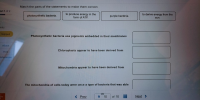 Match the parts of the statements to make them correct. art 1 of 2 photosynthetic bacteria. to produce energy in the form of ATP. purple bacteria. to derive energy from the sun. ints Skipped Photosynthetic bacteria use pigments embedded in their membranes eBook Chloroplasts appear to have been derived from Print References Mitochondria appear to have been derived from The mitochondria of cells today were once a type of bacteria that was able aw < Prev 9 10 of 10...
Photosynthesis and Chloroplasts You will read that only plants, algae, and some bacteria are photosynthetic. There...
Photosynthesis and Chloroplasts You will read that only plants, algae, and some bacteria are photosynthetic. There is an exception to this, however. One species of sea slug has found a way to steal chloroplasts, store them in glands lining its digestive tract, and live on the sugar that is produced (Milius, 2010). The sea slug has even commandeered the genes to help repair these chloroplasts to keep them working for 9 months—longer than the algae would (Fang, 2015)! What if...
Classify the statements below as to whether they describe mitochondria, chloroplasts, or both. Cannot live independently...
 Classify the statements below as to whether they describe mitochondria, chloroplasts, or both. Cannot live independently because they require some proteins and RNAS encoded by nuclear genes. In some species, some codons specify a different amino acid than is specified in the universal genetic code. Translation is inhibited by chemicals known to inhibit bacterial translation, such as chloramphenicol Carry genes for some of the enzymes of photosynthetic electron transport. rRNA gene sequences are most similar to cyanobacteria. May have arisen...
Need help with a-e 1.) The photosystem of purple bacteria absorbs light at 870 nm. (a...
 Need help with a-e
1.) The photosystem of purple bacteria absorbs light at 870 nm. (a (3 pts) Calculate the energy of one mole of photons (1 einstein) of light 1 - 870 nm. (b) ( 3 pts) How many moles of ATP under standard conditions could be theoretically synthesized using this energy? (c) (3 pts) Does this photosystem evolve Oz? Why or Why not? (d) (3 pts) The purple bacteria photoreaction center catalyzes the following reaction: 2 Cycz(Fe)+Q+ 2H...
Need help with a-e
1.) The photosystem of purple bacteria absorbs light at 870 nm. (a (3 pts) Calculate the energy of one mole of photons (1 einstein) of light 1 - 870 nm. (b) ( 3 pts) How many moles of ATP under standard conditions could be theoretically synthesized using this energy? (c) (3 pts) Does this photosystem evolve Oz? Why or Why not? (d) (3 pts) The purple bacteria photoreaction center catalyzes the following reaction: 2 Cycz(Fe)+Q+ 2H...
Fill in the blanks (0.5 mark each, 7 marks total) 1. Source of electron in photosynthesis...
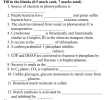 Fill in the blanks (0.5 mark each, 7 marks total) 1. Source of electron in photosynthesis is 2. Purple bacteria have and green sulfur bacteria have reaction centers. 3. The electron released from water in photosystem II is transported to 4. Cytochrome is Structurally and functionally similar to Complex III in the electron-transport chain. 5. It occurs in the of chloroplasts. 6. 2-carboxyarabinitol 1-phosphate inhibits rubisco. 7. G3P and DHAP are converted to fructose 6-phosphate by _ and fructose 1,6-bisphosphatase....
21. a) Ninhydrin reaction generates Ruhemann's comple which is in color,1) i) Red, ii) Blue, ii) Purple. b) Write the full form of Boc-protecting group? Boc is involved in solution phase pept...
 21. a) Ninhydrin reaction generates Ruhemann's comple which is in color,1) i) Red, ii) Blue, ii) Purple. b) Write the full form of Boc-protecting group? Boc is involved in solution phase peptide synthesis -T/F(2+1) 22. a) Terpenes are two or more five carbon units of i) Serpine, ii) Myrcene, c) Isoprene. b) Cholestero i) Tetra, ii) Penta, ii) Tri. c) Three dimentional functional form of protein is its i) Primary, ii) Secondary, ili) Tertiary. (2) l is actually composed of...
19) In chloroplasts, one reason why photosystem I is localized with better access to the stroma...
19) In chloroplasts, one reason why photosystem I is localized with better access to the stroma than photosystem II is to better supply NADPH and ATP for carbon assimilation. Give another reason why photosystems I and II should be physically separated. Explain your answer. (2 sentences)
I am doing a report for "Isolation of Phototrophic Bacteria." I worked with R. rubrum which...
I am doing a report for "Isolation of Phototrophic Bacteria." I worked with R. rubrum which is a purple non - sulfur bacteria. We used an enrichment medium called "Ormerod's medium" which is a non-fermentable carbon source - malate. Could anyone explain to me how this works with this bacteria and what does the medium consist of. Thank you!
Problem i: Indicate the stereo centers of stereo centers of the following natural produs natural product...
 Problem i: Indicate the stereo centers of stereo centers of the following natural produs natural product (by placing a star next to them): Paclitaxel (also known as Taxol) Problem II: For each of the following molecules, indicate if it is chiral or not chiral Problem III: Draw the enantiomers of the following molecules: Problem IV The Elimination reaction allows the removal from a molecule of a leaving Hydrogen to generate a double bond. When that reaction is performe group (Br...
For its three investment centers, Loyola Company accumulates the following data: I II III Sales $2,069,000...
 For its three investment centers, Loyola Company accumulates the
following data:
I
II
III
Sales
$2,069,000
$3,918,000
$4,087,000
Controllable margin
945,440
2,011,750
3,615,300
Average operating assets
4,976,000
8,047,000
12,051,000
Compute the return on investment (ROI) for each center.
I
II
III
The return on investment
%
%
%
For its three investment centers, Loyola Company accumulates the
following data:
I
II
III
Sales
$2,069,000
$3,918,000
$4,087,000
Controllable margin
945,440
2,011,750
3,615,300
Average operating assets
4,976,000
8,047,000
12,051,000
Compute the return on investment (ROI) for each center.
I
II
III
The return on investment
%
%
%
 Match the parts of the statements to make them correct. art 1 of 2 photosynthetic bacteria. to produce energy in the form of ATP. purple bacteria. to derive energy from the sun. ints Skipped Photosynthetic bacteria use pigments embedded in their membranes eBook Chloroplasts appear to have been derived from Print References Mitochondria appear to have been derived from The mitochondria of cells today were once a type of bacteria that was able aw < Prev 9 10 of 10...
 Classify the statements below as to whether they describe mitochondria, chloroplasts, or both. Cannot live independently because they require some proteins and RNAS encoded by nuclear genes. In some species, some codons specify a different amino acid than is specified in the universal genetic code. Translation is inhibited by chemicals known to inhibit bacterial translation, such as chloramphenicol Carry genes for some of the enzymes of photosynthetic electron transport. rRNA gene sequences are most similar to cyanobacteria. May have arisen...
 Need help with a-e
1.) The photosystem of purple bacteria absorbs light at 870 nm. (a (3 pts) Calculate the energy of one mole of photons (1 einstein) of light 1 - 870 nm. (b) ( 3 pts) How many moles of ATP under standard conditions could be theoretically synthesized using this energy? (c) (3 pts) Does this photosystem evolve Oz? Why or Why not? (d) (3 pts) The purple bacteria photoreaction center catalyzes the following reaction: 2 Cycz(Fe)+Q+ 2H...
Need help with a-e
1.) The photosystem of purple bacteria absorbs light at 870 nm. (a (3 pts) Calculate the energy of one mole of photons (1 einstein) of light 1 - 870 nm. (b) ( 3 pts) How many moles of ATP under standard conditions could be theoretically synthesized using this energy? (c) (3 pts) Does this photosystem evolve Oz? Why or Why not? (d) (3 pts) The purple bacteria photoreaction center catalyzes the following reaction: 2 Cycz(Fe)+Q+ 2H...
 Fill in the blanks (0.5 mark each, 7 marks total) 1. Source of electron in photosynthesis is 2. Purple bacteria have and green sulfur bacteria have reaction centers. 3. The electron released from water in photosystem II is transported to 4. Cytochrome is Structurally and functionally similar to Complex III in the electron-transport chain. 5. It occurs in the of chloroplasts. 6. 2-carboxyarabinitol 1-phosphate inhibits rubisco. 7. G3P and DHAP are converted to fructose 6-phosphate by _ and fructose 1,6-bisphosphatase....
 21. a) Ninhydrin reaction generates Ruhemann's comple which is in color,1) i) Red, ii) Blue, ii) Purple. b) Write the full form of Boc-protecting group? Boc is involved in solution phase peptide synthesis -T/F(2+1) 22. a) Terpenes are two or more five carbon units of i) Serpine, ii) Myrcene, c) Isoprene. b) Cholestero i) Tetra, ii) Penta, ii) Tri. c) Three dimentional functional form of protein is its i) Primary, ii) Secondary, ili) Tertiary. (2) l is actually composed of...
 Problem i: Indicate the stereo centers of stereo centers of the following natural produs natural product (by placing a star next to them): Paclitaxel (also known as Taxol) Problem II: For each of the following molecules, indicate if it is chiral or not chiral Problem III: Draw the enantiomers of the following molecules: Problem IV The Elimination reaction allows the removal from a molecule of a leaving Hydrogen to generate a double bond. When that reaction is performe group (Br...
 For its three investment centers, Loyola Company accumulates the
following data:
I
II
III
Sales
$2,069,000
$3,918,000
$4,087,000
Controllable margin
945,440
2,011,750
3,615,300
Average operating assets
4,976,000
8,047,000
12,051,000
Compute the return on investment (ROI) for each center.
I
II
III
The return on investment
%
%
%
For its three investment centers, Loyola Company accumulates the
following data:
I
II
III
Sales
$2,069,000
$3,918,000
$4,087,000
Controllable margin
945,440
2,011,750
3,615,300
Average operating assets
4,976,000
8,047,000
12,051,000
Compute the return on investment (ROI) for each center.
I
II
III
The return on investment
%
%
%
Most questions answered within 3 hours.
-
Where is the error in this code sequence?
String s1 = "Hello";
String s2 = "ello";...
asked 11 months ago -
Financial data for Joel de Paris, Inc., for last year
follow:
Joel de Paris, Inc.
Balance...
asked 11 months ago -
Consider this reaction:
Al2(SO4)3 (aq)+ BaCl3
(aq) Al2Cl6 (aq)- +
3BaSO4(s) . What is the...
asked 11 months ago -
Suppose that Savneet is considering increasing her
recent random sample from 20 car rentals to 40...
asked 11 months ago -
Trucks arrive at an unloading terminal at an average rate of 120
per hour.
Trucks arrive...
asked 11 months ago -
Why are methanol and ethanol completely soluble in water while
octanol is not very little soluble....
asked 11 months ago -
A facilities manager at a university reads in a research report
that the mean amount of...
asked 11 months ago -
When the CuSO4 is rehydrated by adding water to the anhydrous
compound, is this an endothermic...
asked 11 months ago -
A ray of sunlight is passing from diamond into crown glass; the
angle of incidence is...
asked 11 months ago -
A block of mass 0.249 kg is placed on top of a light, vertical
spring of...
asked 11 months ago -
how do the kidneys compensate in the presences of acidosis
a) trigger hyperventilate
b) reserve acid...
asked 11 months ago -
Question 501 pts
The rental rate of capital to the firm increases. Which of the
following...
asked 11 months ago