
Homework Answers
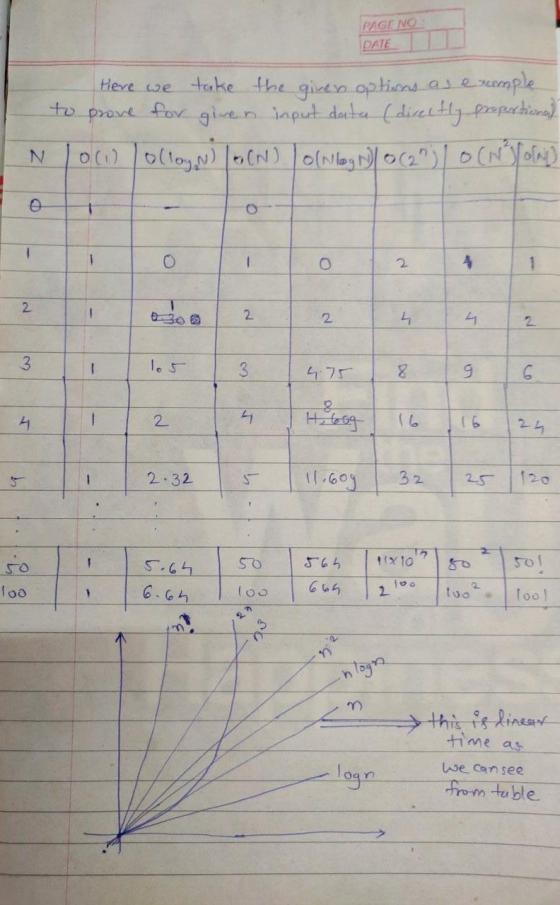
now for this question answer will be O(n)---linear time
the explanation given below
N ote:to calculate the order of complexity we consider largest possible value of n & plot the function accordingly

Add Answer to:
20. Which one of the following describes an algorithm whose performance will grow linearly and in...
(d) Consider an algorithm A, whose runtime is dependent on some "size" variable n of the...
 (d) Consider an algorithm A, whose runtime is dependent on some "size" variable n of the input. Explain the difference between the two statements below, and give an explicit example of an algorithm for which one statement is true but the other is false. 1. The worst case time complexity of A is n2. 2. A is O(n). (e) Give an example of an algorithm (with a clear input type) which has a Big-Oh (0) and Big-Omega (12) bound on...
Please answer ASAP Thank You 1Consider an algorithm that requires the following number of operations (time...
Please answer ASAP Thank You 1Consider an algorithm that requires the following number of operations (time units) for these input sizes (n). The algorithm is ___________ . Input size Operations 100 100,000 400 100,000 1600 100,000 Group of answer choices 1.O(n2) 2.O(n) 3.O(log n) 4.O(n3) 5.O(1) 2The below algorithm contains nested loops. for (int total = 1; total <= n; total++) { for (int samples = 0; samples < n; samples++) { for (int location = 1; location < 10;...
Which of the following statements is true? The best way to study algorithm efficiency is to...
Which of the following statements is true? The best way to study algorithm efficiency is to see how many milliseconds it takes to execute a program All O(log n) sort algorithms will use the same number of CPU cycles to sort identical arrays Big O notation is not useful for estimating the specific number of CPU cycles an algorithm will require A program will take the same number of millseconds to execute an algorithm each time it is run for...
1. Fractional Knapsack Problem Algorithm Which best describes the tightest range of the number of items...
1. Fractional Knapsack Problem Algorithm Which best describes the tightest range of the number of items with only fractional inclusion (i.e. not entirely included or excluded) in the knapsack? (Let n denote the number of items for possible inclusion.) A) At least 0 items and at most n items B) At least 1 items and at most n items C) Exactly n items D) At least 0 items and at most n-1 items E) At least 1 items and at...
Find and explain an example of some programming processing task that demonstrates one of the common...
Find and explain an example of some programming processing task that demonstrates one of the common growth rate functions. For example, the constant time function describes a task in which the work steps are the same regardless of the amount of input. The linear time function describes a task in which the work steps grow just as much as the input size does ('1 for 1'). The quadratic time function describes a task in which the work steps grow by...
3. For each of the following situations, name the best sorting algorithm we studied. (For one...
3. For each of the following situations, name the best sorting algorithm we studied. (For one or two questions, there may be more than one answer deserving full credit, but you only need to give one answer for each.) The array is mostly sorted already (a few elements are in the wrong place). (a) You need an O(n log n) sort even in the worst case and you cannot use any extra space except for a few local variables. (b)...
Please Help ASAP. 1Consider the below code which iterates over a linked list of n nodes...
Please Help ASAP. 1Consider the below code which iterates over a linked list of n nodes (assume the list has at least 1 node). How many lines of output will it write? Node *thisNode = headPtr; while (thisNode != null) { cout << thisNode->item << endl; thisNode = thisNode->next; } 1.n 2.1 3.n2 4.n / 2 5.2 * n 2The below algorithm contains nested loops. for (int total = 1; total <= n; total++) { for (int samples = 0;...
(30 points) Prove or disprove the following statement: There exists a comparison-based sorting algorithm whose running...
 (30 points) Prove or disprove the following statement: There exists a comparison-based sorting algorithm whose running time is linear for at least a fraction of 1/2" of the n! possible input instances of length n.
Suppose we have an algorithm A that does comparison-based sorting. Answer true or false for each...
 Suppose we have an algorithm A that does comparison-based sorting. Answer true or false for each of the following. Assume our input size is n, and that each of the n inputs is distinct. 1. There can be an input ordering for which algorithm A executes no more than n comparisons to determine the sorted order. 2. There can be an input ordering for which algorithm A executes no more than 2n comparisons to determine the sorted order. 3. There...
8. Consider the following algorithm, which finds the sum of all of the integers in a...
 8. Consider the following algorithm, which finds the sum of all of the integers in a list procedure sum(n: positive integer, a1, a2,..., an : integers) for i: 1 to n return S (a) Suppose the value for n is 4 and the elements of the list are 3, 5,-2,4. List assigned to s as the procedure is executed. (You can list the the values that are values assigned to all variables if you wish) b) When a list of...
 (d) Consider an algorithm A, whose runtime is dependent on some "size" variable n of the input. Explain the difference between the two statements below, and give an explicit example of an algorithm for which one statement is true but the other is false. 1. The worst case time complexity of A is n2. 2. A is O(n). (e) Give an example of an algorithm (with a clear input type) which has a Big-Oh (0) and Big-Omega (12) bound on...
 (30 points) Prove or disprove the following statement: There exists a comparison-based sorting algorithm whose running time is linear for at least a fraction of 1/2" of the n! possible input instances of length n.
 Suppose we have an algorithm A that does comparison-based sorting. Answer true or false for each of the following. Assume our input size is n, and that each of the n inputs is distinct. 1. There can be an input ordering for which algorithm A executes no more than n comparisons to determine the sorted order. 2. There can be an input ordering for which algorithm A executes no more than 2n comparisons to determine the sorted order. 3. There...
 8. Consider the following algorithm, which finds the sum of all of the integers in a list procedure sum(n: positive integer, a1, a2,..., an : integers) for i: 1 to n return S (a) Suppose the value for n is 4 and the elements of the list are 3, 5,-2,4. List assigned to s as the procedure is executed. (You can list the the values that are values assigned to all variables if you wish) b) When a list of...
Most questions answered within 3 hours.
-
Where is the error in this code sequence?
String s1 = "Hello";
String s2 = "ello";...
asked 11 months ago -
Financial data for Joel de Paris, Inc., for last year
follow:
Joel de Paris, Inc.
Balance...
asked 11 months ago -
Consider this reaction:
Al2(SO4)3 (aq)+ BaCl3
(aq) Al2Cl6 (aq)- +
3BaSO4(s) . What is the...
asked 11 months ago -
Suppose that Savneet is considering increasing her
recent random sample from 20 car rentals to 40...
asked 11 months ago -
Trucks arrive at an unloading terminal at an average rate of 120
per hour.
Trucks arrive...
asked 11 months ago -
Why are methanol and ethanol completely soluble in water while
octanol is not very little soluble....
asked 11 months ago -
A facilities manager at a university reads in a research report
that the mean amount of...
asked 11 months ago -
When the CuSO4 is rehydrated by adding water to the anhydrous
compound, is this an endothermic...
asked 11 months ago -
A ray of sunlight is passing from diamond into crown glass; the
angle of incidence is...
asked 11 months ago -
A block of mass 0.249 kg is placed on top of a light, vertical
spring of...
asked 11 months ago -
how do the kidneys compensate in the presences of acidosis
a) trigger hyperventilate
b) reserve acid...
asked 11 months ago -
Question 501 pts
The rental rate of capital to the firm increases. Which of the
following...
asked 11 months ago