Describe Young’s double-slit experiment. Explain the setup and the resulting pattern. You may find it helpful...
Describe Young’s double-slit experiment. Explain the setup and the resulting pattern. You may find it helpful to draw a picture. what does the distance between the resulting dots represent? How does it relate to the distance between the slits of the diffraction grating?
Homework Answers
Young's double-slit experiment is an experiment first done by English physicist Young to demonstrate wave character of light by diffraction and interference of light originating from a source and then passing through two slits or holes.
Setup and Pattern
In this experiment, light is sent through a pair of vertical slits
which is diffracted on the screen spread out horizontally into a
pattern of numerous vertical lines or dots(as these lines are very
short). Without diffraction and interference, the light would only
make two lines on the screen.
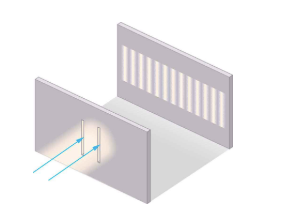
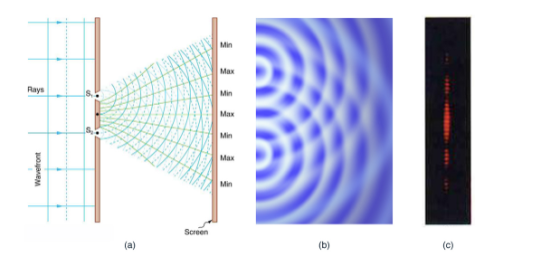
The interference pattern for a double slit has an intensity that falls off with angle. The below photograph shows multiple bright and dark lines, or fringes, formed by light passing through a double slit.
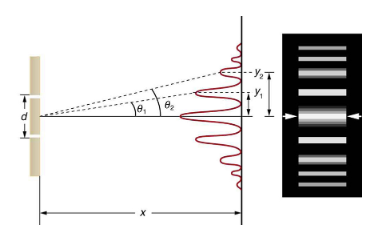
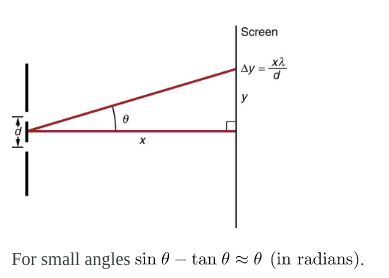
The distance((y2 - y1)) between the
resulting dots or fringes represents the fringe width.
The waves follow different paths from the slits to a common
point on a screen. If the paths taken by the two waves differ (
path difference  ) by any half-integral number of wavelengths [
 ,
,  ,
,  , etc.], then destructive
interference occurs. The waves start in phase but arrive out of
phase. f the paths taken by the two waves differ by an integral
number of wavelengths (
, etc.], then destructive
interference occurs. The waves start in phase but arrive out of
phase. f the paths taken by the two waves differ by an integral
number of wavelengths ( ,
,  ,
,  , etc.), then constructive
interference occurs. The waves start with out of phase and arrive
in phase.
, etc.), then constructive
interference occurs. The waves start with out of phase and arrive
in phase.
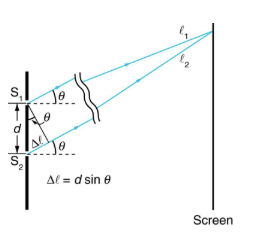
Path difference by simple trigonometry comes out to be  ,
,
If
= integral multiples of  for constructive interference producing bright fringe

= half-integral multiples of
for destructive interference producing dark fringe

The distance((y2 - y1)) between the
resulting dots or fringes represents the fringe width.
y2 - y1 = 
 (
from the traingle )
(
from the traingle )

which relates the slit width d with fringe width
Add Answer to:
Describe Young’s double-slit experiment. Explain the setup and
the resulting pattern. You may find it helpful...
Question 3: Calibrating the Double Slit You are attempting to perform a double slit experiment (see...
 Question 3: Calibrating the Double Slit You are attempting to perform a double slit experiment (see Figure 2): the distance between slits is 0.1 mm, the distance from the barrier to the screen is L = 2 m, and the distance from the coherent) laser light source to the barrier is t = 0.4 m. You are using red light, with a wavelength = 660 nm. You are worried that you have not perfectly centred the laser halfway between the...
1) In a double slit experiment, what happens to the fringe pattern when the slit separation...
1) In a double slit experiment, what happens to the fringe pattern when the slit separation (d) is decreased and the screen is moved away from the slit ( L is increased)? a) fringes get further apart b) fringes get closer together c) cannot be determined without knowing the values of d and L 2) White light is being analyzed by a diffraction grating (100 lines/mm). In the interference pattern, the third order blue (wavelength=400 nm) appears 10 cm from...
1. Double-slit Experiment (a) You are given the task of constructing a double-slit experiment for 5-eV...
1. Double-slit Experiment (a) You are given the task of constructing a double-slit experiment for 5-eV electrons. If you wish the first minimum of the diffraction pattern to occur at 5 degrees , what must be the separation of the slits? (b) How far from the slits must the detector plane be located if the first minima on each side of the central maximum are to be separated by 1 cm?
Light of wavelength 550 nm is incident on a double slit with spacing d= 1 x...
 Light of wavelength 550 nm is incident on a double slit with spacing d= 1 x 10⁻⁴ m and slit width a the slits. 1. 0.05 x 10.4 m. A screen is placed 1 m from (a) Find the spacing between bright lines on the screen. (You may use the small angle approximation) /2 (b) Find the distance to the first single slit diffraction dark fringe. /2 (e) What fringe number of the double slit pattern has the first dark...
1. Describe the interference pattern for four-slit experiment. 2. Describe the interference pattern for two-slit experiment:...
1. Describe the interference pattern for four-slit experiment. 2. Describe the interference pattern for two-slit experiment: 3. Describe the diffraction pattern for one-slit experiment: -Please provide details and explain the CORRECT answer, do not guess, only answer it if you know the correct answers.
Consider double slit experiment with two slits are separated by d=0,715 mm
Consider double slit experiment with two slits are separated by d=0.715 mm and each slit width is 0.00321 mm. Screen is placed L=1.28 m away from the slits. a) Derive an algebraic equation to find linear distance of interference bright fringe on the screen from central bright (central maxima) fringe? b) Consider interference pattern due to light of unknown wavelength and linear separation between 2 and 5" bright fringes is 3.05 mm. Find the wavelength of the light? c) Now consider double slit...
In a Young's double slit experiment, you observe a series of bright and dark fringes, the...
In a Young's double slit experiment, you observe a series of bright and dark fringes, the bright fringe to the left of central bright fringe is 1 cm away from the central bright fringe. The laser used in the experiment is 600 nm and the distance between the double slit where the pattern is projected is 1 m. What is the distance between the two slits?
Regarding double slit interference, how does the pattern change as the width of the two slits...
Regarding double slit interference, how does the pattern change as the width of the two slits increases? How does the pattern change when the width of the two slits decreases? (note this is the width of the slits, not the distance between them).
Problem 7 (20 points): Each graph below shows the relative intensity versus 0 for a double slit experiment. The horizontal scale is the same for all graphs. The only possible differences among the ca...
 Problem 7 (20 points): Each graph below shows the relative intensity versus 0 for a double slit experiment. The horizontal scale is the same for all graphs. The only possible differences among the cases are the values of the slit width (a) and distance between the centers of the slits (d). Case For each of the three cases, calculate the ratio- a) 0.5 b) Rank the cases according to distance between the centers Case 2 of the slits (d), from...
In a double-slit interference experiment the slit separation is 8.40 x 10⁻⁶ m and the slits...
In a double-slit interference experiment the slit separation is 8.40 x 10⁻⁶ m and the slits are 2.80 m from the screen. Each slit has a width of 1.20 x 10⁻⁶ m. a) An interference pattern is formed when light with a wavelength of 450 nm is shined on the slits. How far (in meters) from the center of the interference pattern on the screen do the third order (m = 3) bright fringes occur? (1.5 pts) b) If a...
 Question 3: Calibrating the Double Slit You are attempting to perform a double slit experiment (see Figure 2): the distance between slits is 0.1 mm, the distance from the barrier to the screen is L = 2 m, and the distance from the coherent) laser light source to the barrier is t = 0.4 m. You are using red light, with a wavelength = 660 nm. You are worried that you have not perfectly centred the laser halfway between the...
 Light of wavelength 550 nm is incident on a double slit with spacing d= 1 x 10⁻⁴ m and slit width a the slits. 1. 0.05 x 10.4 m. A screen is placed 1 m from (a) Find the spacing between bright lines on the screen. (You may use the small angle approximation) /2 (b) Find the distance to the first single slit diffraction dark fringe. /2 (e) What fringe number of the double slit pattern has the first dark...
 Problem 7 (20 points): Each graph below shows the relative intensity versus 0 for a double slit experiment. The horizontal scale is the same for all graphs. The only possible differences among the cases are the values of the slit width (a) and distance between the centers of the slits (d). Case For each of the three cases, calculate the ratio- a) 0.5 b) Rank the cases according to distance between the centers Case 2 of the slits (d), from...
Most questions answered within 3 hours.
-
Where is the error in this code sequence?
String s1 = "Hello";
String s2 = "ello";...
asked 10 months ago -
Financial data for Joel de Paris, Inc., for last year
follow:
Joel de Paris, Inc.
Balance...
asked 10 months ago -
Consider this reaction:
Al2(SO4)3 (aq)+ BaCl3
(aq) Al2Cl6 (aq)- +
3BaSO4(s) . What is the...
asked 10 months ago -
Suppose that Savneet is considering increasing her
recent random sample from 20 car rentals to 40...
asked 10 months ago -
Trucks arrive at an unloading terminal at an average rate of 120
per hour.
Trucks arrive...
asked 10 months ago -
Why are methanol and ethanol completely soluble in water while
octanol is not very little soluble....
asked 10 months ago -
A facilities manager at a university reads in a research report
that the mean amount of...
asked 10 months ago -
When the CuSO4 is rehydrated by adding water to the anhydrous
compound, is this an endothermic...
asked 10 months ago -
A ray of sunlight is passing from diamond into crown glass; the
angle of incidence is...
asked 10 months ago -
A block of mass 0.249 kg is placed on top of a light, vertical
spring of...
asked 10 months ago -
how do the kidneys compensate in the presences of acidosis
a) trigger hyperventilate
b) reserve acid...
asked 10 months ago -
Question 501 pts
The rental rate of capital to the firm increases. Which of the
following...
asked 10 months ago