
Homework Answers
Add Answer to:
please answer all
7. a. (1/2 pt) Which one of the following salts is expected to...
Consider the following compounds: BeF 2. CaCl2, and MgCl). Answer the following questions based on expected...
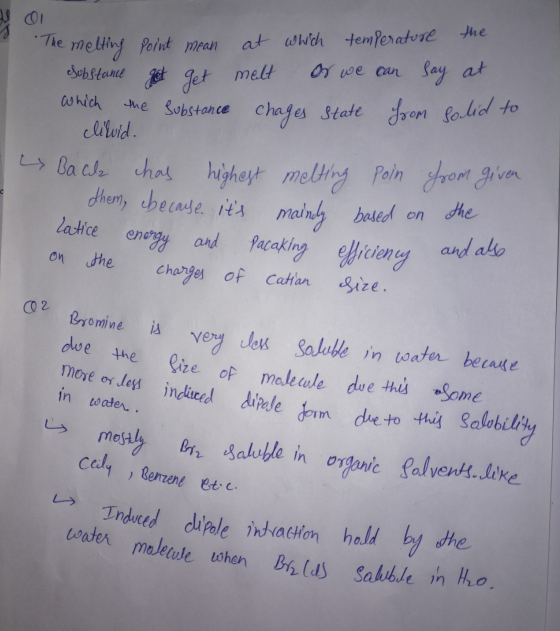
 Consider the following compounds: BeF 2. CaCl2, and MgCl). Answer the following questions based on expected periodic trends: (a) Which is expected to have the shortest ionic bonds? (b) Which is expected to have the highest lattice energy? (c) Which is expected to have the lowest melting point?
Part 1 Observe the interactions between one water moles water molecule with ethane. Within un describe...
 Part 1 Observe the interactions between one water moles water molecule with ethane. Within un describe 13. What is the intermolecular force that hold Briefly explain your answer. thin your clecule and each of the ons in NaCl Now observe one oup, describe what happens. holds Hotecther with an individual ion (either Na or CI) 14. Use your kit to assess whether you know about the actual solubility of NaCl in water to assess whether NaCl can dissolve in H.O....
Consider the molecule below: o=s=o: Select ALL the intermolecular forces that are expected to be present...
 Consider the molecule below: o=s=o: Select ALL the intermolecular forces that are expected to be present between two of these molecules. Select as many answers as are applicable, however points will be deducted for incorrect guesses. Select one or more: Dispersion forces Dipole/dipole forces Hydrogen bonding Check What amount of thermal energy (in kJ) is required to convert 136 g of ice at -16 °C completely to water vapour at 217 °C? The melting point of water is 0°C and...
1.Which of the following is expected to have the higher boiling point? fluorine gas chlorine gas...
1.Which of the following is expected to have the higher boiling point? fluorine gas chlorine gas bromine gas iodine gas 2.Which of the following statements are true about Intermolecular Forces (IMFs)? (Select all that apply.) Hydrogen bonds occur between hydrogens on two neighboring molecules. All molecules exhibit Dipole-Dipole forces. Hydrogen bonds are generally stronger than London Dispersion Forces. Intermolecular forces are weaker than bonds. Intermolecular forces are attractive forces between two atoms in the same molecule. Only polar molecules exhibit...
1. Which one of the following salts forms aqueous solutions with pH = 7? (Circle the...
 1. Which one of the following salts forms aqueous solutions with pH = 7? (Circle the correct answer) a) FeCl3 b) KBr c) LiClO2 d) NH4NO3 e) Na2CO3 2. Calculate the pH of a 0.150M solution of sodium acetate (NaC2H302) at 25°C. (Ka for acetic acid HC2H302 is 1.8 x 10⁻⁵)
7). a). Is the acetone molecule non-polar or polar? Circle. Non-polar Polar b). Sketch pictures of...
 7). a). Is the acetone molecule non-polar or polar? Circle. Non-polar Polar b). Sketch pictures of the intermolecular forces that would occur between the molecules of acetone and the molecules of 2- propanone if you have a mixture of the two liquids. What would be the main type of IMF that is responsible for the attraction? (Give a name for the IMF). c). The pentane molecule and the 2-pentanone molecule both have five carbon atoms on their structures. Why 2-pentanone...
1. (5 pt.) Soon you will synthesize the analgesic acetanilide in lab. It’s m.p. is 114C....
1. (5 pt.) Soon you will synthesize the analgesic acetanilide in lab. It’s m.p. is 114C. What does it indicate about your product if you obtain a m.p. of 103 - 112C. Explain. 2. (6 pt.) Neither aniline nor nitrobenzene is particularly water soluble. However, one is completely soluble in dilute aqueous HCl. Which one is soluble, and explain why? (For maximum credit, provide a chemical equation for your answer.) 3. (5 pt.) Name the two adsorbents that are most...
QUESTION 1 Which answer choice shows the following molecules in order from the highest boiling point...
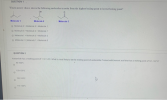 QUESTION 1 Which answer choice shows the following molecules in order from the highest boiling point to lowest boiling point? Molecule 1 Molecule 2 Molecule 3 Molecule 2 > Molecule 3 > Molecule 1 Molecule 3 > Molecule 2 > Molecule 1 Molecule 1 > Molecule 3 > Molecule 2 Molecule 2 > Molecule 1 > Molecule 3 QUESTION 2 Acetanilide hasa maling point of 113 114'C. What is mostly to be the melting point of acetanilidified with bec acid...
please answer questions 1 & 2 If the following mixtures are incubated at 37°C with the...
 please answer questions 1 & 2
If the following mixtures are incubated at 37°C with the addition of enzymes and/or bile salts, predict if the mixtures would increase in acidity and, if so, which samples increased the most. If the lipids are not digested to a great extent, there would be little change in acidity. Table 5: Testing after incubation with pancreatin or pancreatin and bile salts Test tube Substance Enzyme Prediction of drops of NaOH solution to neutralize (no...
please answer questions 1 & 2
If the following mixtures are incubated at 37°C with the addition of enzymes and/or bile salts, predict if the mixtures would increase in acidity and, if so, which samples increased the most. If the lipids are not digested to a great extent, there would be little change in acidity. Table 5: Testing after incubation with pancreatin or pancreatin and bile salts Test tube Substance Enzyme Prediction of drops of NaOH solution to neutralize (no...
Please Explain: 1. Predict the products for each of the following chemical reactions. a. CaCl2(aq) +...
Please Explain: 1. Predict the products for each of the following chemical reactions. a. CaCl2(aq) + Na2SO4(aq) → ____________( ) + ____________( ) b. KOH(aq) + HCN(aq) → ____________( ) + ____________( ) c. HBr(aq) + NaHCO3(aq) → __________( ) +__________( ) +__________( ) 2. Which of the following compounds are likely to be soluble in water? Circle your answer(s). ammonium carbonate chromium(III) hydroxide cobalt(III) sulfide lead(II) nitrate lead(II) sulfate magnesium carbonate sodium iodide zinc chloride
 Consider the following compounds: BeF 2. CaCl2, and MgCl). Answer the following questions based on expected periodic trends: (a) Which is expected to have the shortest ionic bonds? (b) Which is expected to have the highest lattice energy? (c) Which is expected to have the lowest melting point?
 Part 1 Observe the interactions between one water moles water molecule with ethane. Within un describe 13. What is the intermolecular force that hold Briefly explain your answer. thin your clecule and each of the ons in NaCl Now observe one oup, describe what happens. holds Hotecther with an individual ion (either Na or CI) 14. Use your kit to assess whether you know about the actual solubility of NaCl in water to assess whether NaCl can dissolve in H.O....
 Consider the molecule below: o=s=o: Select ALL the intermolecular forces that are expected to be present between two of these molecules. Select as many answers as are applicable, however points will be deducted for incorrect guesses. Select one or more: Dispersion forces Dipole/dipole forces Hydrogen bonding Check What amount of thermal energy (in kJ) is required to convert 136 g of ice at -16 °C completely to water vapour at 217 °C? The melting point of water is 0°C and...
 1. Which one of the following salts forms aqueous solutions with pH = 7? (Circle the correct answer) a) FeCl3 b) KBr c) LiClO2 d) NH4NO3 e) Na2CO3 2. Calculate the pH of a 0.150M solution of sodium acetate (NaC2H302) at 25°C. (Ka for acetic acid HC2H302 is 1.8 x 10⁻⁵)
 7). a). Is the acetone molecule non-polar or polar? Circle. Non-polar Polar b). Sketch pictures of the intermolecular forces that would occur between the molecules of acetone and the molecules of 2- propanone if you have a mixture of the two liquids. What would be the main type of IMF that is responsible for the attraction? (Give a name for the IMF). c). The pentane molecule and the 2-pentanone molecule both have five carbon atoms on their structures. Why 2-pentanone...
 QUESTION 1 Which answer choice shows the following molecules in order from the highest boiling point to lowest boiling point? Molecule 1 Molecule 2 Molecule 3 Molecule 2 > Molecule 3 > Molecule 1 Molecule 3 > Molecule 2 > Molecule 1 Molecule 1 > Molecule 3 > Molecule 2 Molecule 2 > Molecule 1 > Molecule 3 QUESTION 2 Acetanilide hasa maling point of 113 114'C. What is mostly to be the melting point of acetanilidified with bec acid...
 please answer questions 1 & 2
If the following mixtures are incubated at 37°C with the addition of enzymes and/or bile salts, predict if the mixtures would increase in acidity and, if so, which samples increased the most. If the lipids are not digested to a great extent, there would be little change in acidity. Table 5: Testing after incubation with pancreatin or pancreatin and bile salts Test tube Substance Enzyme Prediction of drops of NaOH solution to neutralize (no...
please answer questions 1 & 2
If the following mixtures are incubated at 37°C with the addition of enzymes and/or bile salts, predict if the mixtures would increase in acidity and, if so, which samples increased the most. If the lipids are not digested to a great extent, there would be little change in acidity. Table 5: Testing after incubation with pancreatin or pancreatin and bile salts Test tube Substance Enzyme Prediction of drops of NaOH solution to neutralize (no...
Most questions answered within 3 hours.
-
Where is the error in this code sequence?
String s1 = "Hello";
String s2 = "ello";...
asked 10 months ago -
Financial data for Joel de Paris, Inc., for last year
follow:
Joel de Paris, Inc.
Balance...
asked 10 months ago -
Consider this reaction:
Al2(SO4)3 (aq)+ BaCl3
(aq) Al2Cl6 (aq)- +
3BaSO4(s) . What is the...
asked 10 months ago -
Suppose that Savneet is considering increasing her
recent random sample from 20 car rentals to 40...
asked 10 months ago -
Trucks arrive at an unloading terminal at an average rate of 120
per hour.
Trucks arrive...
asked 10 months ago -
Why are methanol and ethanol completely soluble in water while
octanol is not very little soluble....
asked 10 months ago -
A facilities manager at a university reads in a research report
that the mean amount of...
asked 10 months ago -
When the CuSO4 is rehydrated by adding water to the anhydrous
compound, is this an endothermic...
asked 10 months ago -
A ray of sunlight is passing from diamond into crown glass; the
angle of incidence is...
asked 10 months ago -
A block of mass 0.249 kg is placed on top of a light, vertical
spring of...
asked 10 months ago -
how do the kidneys compensate in the presences of acidosis
a) trigger hyperventilate
b) reserve acid...
asked 10 months ago -
Question 501 pts
The rental rate of capital to the firm increases. Which of the
following...
asked 10 months ago