
Homework Answers
Hi,
Hope you are doing well.
PART (a):
We know that, the given circuit is a series LR circuit.
We have, Maximum value of current in the circuit is given by,

Where,
 is the maximum voltage
across the circuit (V).
is the maximum voltage
across the circuit (V).
 is the impedance of the
circuit (ohms), which is given by,
is the impedance of the
circuit (ohms), which is given by,

Where,
 is the resistance of
the resistor (ohms).
is the resistance of
the resistor (ohms).
 is the frequency
of the input source (Hz).
is the frequency
of the input source (Hz).
 is the inductance of
the inductor (H).
is the inductance of
the inductor (H).
Given that,
Resistance of the resistor, 
Frequency of the input source, 
Inductance of the inductor, 
 Impedance of
the circuit is given by,
Impedance of
the circuit is given by,



Also, Given that,
Maximum voltage across the circuit, 
Maximum
value of current in the circuit is given by,

 |
PART (b):
The maximum possible value of voltage across the resistor and inductor will be 170 V which will happen only in some special cases.
PART
(c):
We know that, According to Ohm's law, voltage across a resistor is given by,

Where,
 is the current through
the resistor (A).
is the current through
the resistor (A).
is the resistance of
the resistor (ohms).
Given that,
Current through the resistor, 
Resistance of the resistor,
Voltage
across a resistor is given by,

 |
Also, We know that, According to Ohm's law, voltage across a inductor is given by,

Where,
is the current through
the inductor (A).
 is the
inductive reactance of the inductor (ohms) which is given
by,
is the
inductive reactance of the inductor (ohms) which is given
by,

Where,
is the frequency
of the input source (Hz).
is the inductance of
the inductor (H).
Given that,
Frequency of the input source,
Inductance of the inductor,
Inductive
reactance of the inductor is given by,


Also, Given that,
Current through the inductor,
Voltage
across a inductor is given by,

 |
PART (d):
We know that, According to Ohm's law, voltage across a resistor is given by,
Where,
is the current through
the resistor (A).
is the resistance of
the resistor (ohms).
When the current through the resistor,  ,
then voltage across a resistor is given
by,
,
then voltage across a resistor is given
by,
 |
Similarly,
Voltage across a inductor is given by,
Where,
is the current through
the inductor (A).
is the
inductive reactance of the inductor (ohms) which is given
by,
When the current through the inductor, ,
then voltage across the inductor is given
by,
 |
Hope this helped for your studies. Keep learning. Have a good day.
Feel free to clear any doubts at the comment section.
Please don't forget
to give a thumbs up.
Thank you. :)
Add Answer to:
24. An AC source operating at 60. Hz with a maximum voltage of 170 V is...
An AC source operating at 60-Hz with a maximum voltage of 170 V is connected in series with a resistor (R = 1.2 k Q) and capacitor (C = 2.5 μF).
An AC source operating at 60-Hz with a maximum voltage of 170 V is connected in series with a resistor (R = 1.2 k Q) and capacitor (C = 2.5 μF). a) What is the maximum value of the current in the circuit? b) What is the maximum values of the potential difference across the resistor and capacitor? c) When the current is zero, what are the magnitudes of the potential difference across the resistor, capacitor and AC source? How much charge is...
Series and parallel RL and RC circuits with an AC source. A 60 Hz voltage source...
 Series and parallel RL and RC circuits with an AC source. A 60 Hz voltage source has an amplitude of VT-120 V. For the following problems, compute the indicated phasors including both magnitudes and phase angles, and sketch the phasor diagrams (no submission) Q1. The source is connected across a series RL ac circuit with R 7.8 Ohm and XL = ωし= 5.1 Ohm. 1a) Find the magnitude of impedance of the series combination (Unit: Ohm) Submit Answer Tries 0/3...
A series AC circuit has a power source with frequency f = 60 Hz, peak voltage...
 A series AC circuit has a power source with frequency f = 60 Hz, peak voltage of epsilon_0 = 5.0 V, resistance R = 0.50 omega, capacitance C = 320 mu F, and inductance L = 0.40 H. what is the period circuit? What is the maximum current through the inductor? What is the largest power reached in resistor? Suppose the power supply reaches maximum voltage at time t_1, how the long after t_1 does the current though the resistor...
A 2.04 kΩ resistor is connected to an AC voltage source with an rms voltage of...
A 2.04 kΩ resistor is connected to an AC voltage source with an rms voltage of 115 V. Hint: Apply Ohm's law and the relationship between the maximum and rms values in an AC circuit a.) What is the maximum potential difference across the resistor (in V)? b.) What is the maximum current through the resistor (in A)? c.) What is the rms current through the resistor (in A)? d.) What is the average power dissipated by the resistor (in...
The maximum potential difference across the terminals of a 60.0-Hz sinusoidal ac source is +17.0 V...
The maximum potential difference across the terminals of a 60.0-Hz sinusoidal ac source is +17.0 V at t = 1/4 cycle. If at t = 0 the potential difference is zero, calculate the potential difference at t = 2.00 ms please show work and explain, book says answer is 11.6V
a. An AC source of amplitude 10 Vmax and 500 Hz frequency is connected in series...
a. An AC source of amplitude 10 Vmax and 500 Hz frequency is connected in series with a 3 Kohm resistor and a 15 micro Farad capacitor. Draw the circuit. Determine the total current and the voltage drops across the resistor and the capacitor, respectively. b. An AC source of amplitude 10 Vmax and 5000 Hz frequency is connected in series with a 2 Kohm resistor and a 10 mH (milli Henry) inductor. Draw the circuit. Determine the total current...
An AC source has an output rms voltage of 78 V at a frequency of 80...
An AC source has an output rms voltage of 78 V at a frequency of 80 Hz. If the source is connected across a 25mH inductor, what are (a) the inductive reactance of the circuit, (b) the rms current in the circuit and (c) the maximum current in the circuit?
We have a series RLC circuit with an AC voltage source: The resistance is 100Ohm, the inductance ...
We have a series RLC circuit with an AC voltage source: The resistance is 100Ohm, the inductance is 10mH, the capacitance is 10mF. Select all the right answers. At 60Hz What is true? Question 10 options: The current through the inductor is larger than through the resistor The voltage across the inductor is larger than the voltage across the capacitor The voltage is lagging behind the current at the source The voltage and the current are in phase at the...
An ac source of maximum voltage V = 30 V is connected to a resistor R...
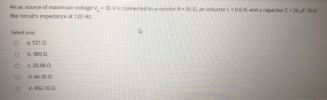 An ac source of maximum voltage V = 30 V is connected to a resistor R = 500, an inductor L = 0.6 H, and a capacitor C= 20 uF. Find the circuit's impedance at 120 Hz. Select one: O a. 521 o b. 389 O c. 20.88 d. 66.35 o e. 452.16
An AC source which provides a voltage difference of AV = (1.80 V)cos[2T(60 Hz)t] is connected...
 An AC source which provides a voltage difference of AV = (1.80 V)cos[2T(60 Hz)t] is connected in a sing le loop circuit to a 5.90 resistor (a) What is AVmfor this source? V (b) What is the magnitude of the maximum current through the resistor at any time? A (c) What is Ims? A (d) For a circuit with only a resistor, the current through the circuit will have the same time dependence as the voltage; that is I =...
 Series and parallel RL and RC circuits with an AC source. A 60 Hz voltage source has an amplitude of VT-120 V. For the following problems, compute the indicated phasors including both magnitudes and phase angles, and sketch the phasor diagrams (no submission) Q1. The source is connected across a series RL ac circuit with R 7.8 Ohm and XL = ωし= 5.1 Ohm. 1a) Find the magnitude of impedance of the series combination (Unit: Ohm) Submit Answer Tries 0/3...
 A series AC circuit has a power source with frequency f = 60 Hz, peak voltage of epsilon_0 = 5.0 V, resistance R = 0.50 omega, capacitance C = 320 mu F, and inductance L = 0.40 H. what is the period circuit? What is the maximum current through the inductor? What is the largest power reached in resistor? Suppose the power supply reaches maximum voltage at time t_1, how the long after t_1 does the current though the resistor...
 An ac source of maximum voltage V = 30 V is connected to a resistor R = 500, an inductor L = 0.6 H, and a capacitor C= 20 uF. Find the circuit's impedance at 120 Hz. Select one: O a. 521 o b. 389 O c. 20.88 d. 66.35 o e. 452.16
 An AC source which provides a voltage difference of AV = (1.80 V)cos[2T(60 Hz)t] is connected in a sing le loop circuit to a 5.90 resistor (a) What is AVmfor this source? V (b) What is the magnitude of the maximum current through the resistor at any time? A (c) What is Ims? A (d) For a circuit with only a resistor, the current through the circuit will have the same time dependence as the voltage; that is I =...
Most questions answered within 3 hours.
-
Where is the error in this code sequence?
String s1 = "Hello";
String s2 = "ello";...
asked 10 months ago -
Financial data for Joel de Paris, Inc., for last year
follow:
Joel de Paris, Inc.
Balance...
asked 10 months ago -
Consider this reaction:
Al2(SO4)3 (aq)+ BaCl3
(aq) Al2Cl6 (aq)- +
3BaSO4(s) . What is the...
asked 10 months ago -
Suppose that Savneet is considering increasing her
recent random sample from 20 car rentals to 40...
asked 10 months ago -
Trucks arrive at an unloading terminal at an average rate of 120
per hour.
Trucks arrive...
asked 10 months ago -
Why are methanol and ethanol completely soluble in water while
octanol is not very little soluble....
asked 10 months ago -
A facilities manager at a university reads in a research report
that the mean amount of...
asked 10 months ago -
When the CuSO4 is rehydrated by adding water to the anhydrous
compound, is this an endothermic...
asked 10 months ago -
A ray of sunlight is passing from diamond into crown glass; the
angle of incidence is...
asked 10 months ago -
A block of mass 0.249 kg is placed on top of a light, vertical
spring of...
asked 10 months ago -
how do the kidneys compensate in the presences of acidosis
a) trigger hyperventilate
b) reserve acid...
asked 10 months ago -
Question 501 pts
The rental rate of capital to the firm increases. Which of the
following...
asked 10 months ago