
Homework Answers

Add Answer to:
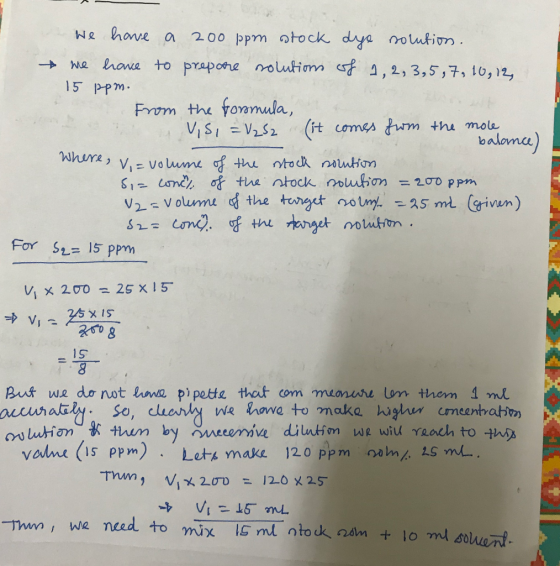
7 10, 12 15 ppm) when 1. Detail how you intend to prepare the following calibration...
3. (20) You are required to prepare standards for a calibration curve. All the glassware and...
 3. (20) You are required to prepare standards for a calibration curve. All the glassware and pipettes your method requires have a tolerance (RSD) of 0.1%. You start with a working solution of 0.1 M analyte. Remove 10 mL of that solution with a pipette, add it to a 100 mL volumetric flask and dilute it to the mark. Remove 10 mL of the newly prepared (diluted) standard, add to a 50 mL volumetric flask, and dilute it to the...
Question 4 (2 points) A working standard 1 is prepared by taking 24.00 mL of a...
 Question 4 (2 points) A working standard 1 is prepared by taking 24.00 mL of a 500.0 ppm stock solution and diluting it to a final volume of 360.0 mL. Working standard 2 is prepared by taking 3.00 mL of working standard 1 and diluting it to a final volume of 250.0 mL. Calculate the ppm concentration of the working standard 2. Provide your answer to three places after the decimal and without units. Your Answer: Answer Question 5 (2...
help Describe in detail how you would make a series of four standards ranging from 1...
 help
Describe in detail how you would make a series of four standards ranging from 1 to 100 ppm given the following constraints. a. Your stock solution is 1000 ppm. b. The available pipets have volumes of 2.00 mL, 3.00 mL, and 5.00 mL. c. The available volumetric flasks have volumes of 10.00 mL, 25.00 mL, 50.00 mL, and 100.00 mL. d. You need to make at least 10.00 mL of each of your four standards.
help
Describe in detail how you would make a series of four standards ranging from 1 to 100 ppm given the following constraints. a. Your stock solution is 1000 ppm. b. The available pipets have volumes of 2.00 mL, 3.00 mL, and 5.00 mL. c. The available volumetric flasks have volumes of 10.00 mL, 25.00 mL, 50.00 mL, and 100.00 mL. d. You need to make at least 10.00 mL of each of your four standards.
Prelab Questions 1. a. (10) Determine the a) mass of the solute and b) volume of conc. HCl you are going to a) wei...
 Prelab Questions 1. a. (10) Determine the a) mass of the solute and b) volume of conc. HCl you are going to a) weigh out and b) measure with a graduated cylinder to create 1L of 100.0 ppm stock solution of Acetylsalicylic acid (ASA) (from the pure powder) in a 2%(W/V) HCI. Show your calculation. C at:.. HALI Procedure - External Standards 1. First make 2% V/v HCI. You will make this three times. Transfer to two plastic containers (use...
1. to 10. Describe stepwise how would you prepare 1 L of a defined solid medium...
 1. to 10. Describe stepwise how would you prepare 1 L of a defined solid medium that requires vitamins B1 and B2 and penicillin. The recipe you found only has the final composition: Solidifying agent Salts 1.5% Agar 0.3% (22mM) Potassium Phosphate (KH2PO4) 0.6% (22mM) Sodium Phosphate (Na2HPO4) 0.5% (85mM) Sodium Chloride (NaCl) 0.1% Ammonium Chloride (NH4Cl) 2mM Magnesium Sulfate (MgSO) 0.1mM Calcium Chloride (CaCb) 0.4% Glucose (4.0 g/L) Carbon source 1 HM Vitamin B1 1 HM Vitamin B12 50...
1- a- How do you prepare 600 mL 4 N H2SO4 solution using 50% Sulfuric acid...
1- a- How do you prepare 600 mL 4 N H2SO4 solution using 50% Sulfuric acid stock solution (d: 1.403 g/mL MW:98g/mole)? b- If you took 10 mL from this sulfuric acid solution (4N) and diluted to 1000 mL, what would be the % (w/v) and ppm concentration of the final solution.
#1, #3, and #5-7 please!!! Pre-Lab Questions 1. Write the balanced chemical equation for the formation...
 #1, #3, and #5-7 please!!!
Pre-Lab Questions 1. Write the balanced chemical equation for the formation of FeSCN2" from Fe(NO3)3-9H:0 and NaSCN. 2. In this experiment a dilute solution of 0.1 M HNO is used to maintain the ionic strength and low pH needed for the reaction to occur. How is nitric acid classified in terms of MSDS? What are some of the safety concerns regarding the handling of nitric acid? 3. Look at the procedure for making the standard...
#1, #3, and #5-7 please!!!
Pre-Lab Questions 1. Write the balanced chemical equation for the formation of FeSCN2" from Fe(NO3)3-9H:0 and NaSCN. 2. In this experiment a dilute solution of 0.1 M HNO is used to maintain the ionic strength and low pH needed for the reaction to occur. How is nitric acid classified in terms of MSDS? What are some of the safety concerns regarding the handling of nitric acid? 3. Look at the procedure for making the standard...
(1) How much amount (in milligrams) of riboflavin (MW=376.4 g/mol) you will need to prepare a...
(1) How much amount (in milligrams) of riboflavin (MW=376.4 g/mol) you will need to prepare a 6.4x10⁻⁴M stock solution in 10 ml volume? (2) How much volume of the above stock solution will you need to prepare the riboflavin solutions of following concentrations: a. 0.059 mM in 25 ml b. 14 uM in 25 ml
4. Describe (in detail) using both words and calculations how you would prepare 2.0 L of...
 4. Describe (in detail) using both words and calculations how you would prepare 2.0 L of a 0.100 M KCl solution from a 5.5 M stock KCl solution. (2 pt) 5. Aluminum hydroxide will react with sulfuric acid to yield aluminum sulfate and water according to the equation below: (4 pt) 3H2SO4(aq) + 2Al(OH)3(aq) → Al(SO4)3(aq) + 6H20(1) a) How many grams of aluminum hydroxide will react with 75,0 mL of 0.319 M sulfuric acid solution? b) If 25.26 mL...
1. You are provided with 1M solution of CuSO4. 2. Calculate how many grams of CuSO4...
 1. You are provided with 1M solution of CuSO4. 2. Calculate how many grams of CuSO4 are dissolved in 100 mL of water to prepare this solution. Show your work in the space provided below. (Molar mass of CuSO4 = 159.6086 g/mol) (1 mark) Scso this . cutissu 159.6 خرداكولات و 3. Using a suitable transfer pipette transfer V. mL of your 1M Cuso. solution into a 100 ml volumetric flask. CV C 2V2 4. Using the equation CiV1=C2V2 calculate...
 3. (20) You are required to prepare standards for a calibration curve. All the glassware and pipettes your method requires have a tolerance (RSD) of 0.1%. You start with a working solution of 0.1 M analyte. Remove 10 mL of that solution with a pipette, add it to a 100 mL volumetric flask and dilute it to the mark. Remove 10 mL of the newly prepared (diluted) standard, add to a 50 mL volumetric flask, and dilute it to the...
 Question 4 (2 points) A working standard 1 is prepared by taking 24.00 mL of a 500.0 ppm stock solution and diluting it to a final volume of 360.0 mL. Working standard 2 is prepared by taking 3.00 mL of working standard 1 and diluting it to a final volume of 250.0 mL. Calculate the ppm concentration of the working standard 2. Provide your answer to three places after the decimal and without units. Your Answer: Answer Question 5 (2...
 help
Describe in detail how you would make a series of four standards ranging from 1 to 100 ppm given the following constraints. a. Your stock solution is 1000 ppm. b. The available pipets have volumes of 2.00 mL, 3.00 mL, and 5.00 mL. c. The available volumetric flasks have volumes of 10.00 mL, 25.00 mL, 50.00 mL, and 100.00 mL. d. You need to make at least 10.00 mL of each of your four standards.
help
Describe in detail how you would make a series of four standards ranging from 1 to 100 ppm given the following constraints. a. Your stock solution is 1000 ppm. b. The available pipets have volumes of 2.00 mL, 3.00 mL, and 5.00 mL. c. The available volumetric flasks have volumes of 10.00 mL, 25.00 mL, 50.00 mL, and 100.00 mL. d. You need to make at least 10.00 mL of each of your four standards.
 Prelab Questions 1. a. (10) Determine the a) mass of the solute and b) volume of conc. HCl you are going to a) weigh out and b) measure with a graduated cylinder to create 1L of 100.0 ppm stock solution of Acetylsalicylic acid (ASA) (from the pure powder) in a 2%(W/V) HCI. Show your calculation. C at:.. HALI Procedure - External Standards 1. First make 2% V/v HCI. You will make this three times. Transfer to two plastic containers (use...
 1. to 10. Describe stepwise how would you prepare 1 L of a defined solid medium that requires vitamins B1 and B2 and penicillin. The recipe you found only has the final composition: Solidifying agent Salts 1.5% Agar 0.3% (22mM) Potassium Phosphate (KH2PO4) 0.6% (22mM) Sodium Phosphate (Na2HPO4) 0.5% (85mM) Sodium Chloride (NaCl) 0.1% Ammonium Chloride (NH4Cl) 2mM Magnesium Sulfate (MgSO) 0.1mM Calcium Chloride (CaCb) 0.4% Glucose (4.0 g/L) Carbon source 1 HM Vitamin B1 1 HM Vitamin B12 50...
 #1, #3, and #5-7 please!!!
Pre-Lab Questions 1. Write the balanced chemical equation for the formation of FeSCN2" from Fe(NO3)3-9H:0 and NaSCN. 2. In this experiment a dilute solution of 0.1 M HNO is used to maintain the ionic strength and low pH needed for the reaction to occur. How is nitric acid classified in terms of MSDS? What are some of the safety concerns regarding the handling of nitric acid? 3. Look at the procedure for making the standard...
#1, #3, and #5-7 please!!!
Pre-Lab Questions 1. Write the balanced chemical equation for the formation of FeSCN2" from Fe(NO3)3-9H:0 and NaSCN. 2. In this experiment a dilute solution of 0.1 M HNO is used to maintain the ionic strength and low pH needed for the reaction to occur. How is nitric acid classified in terms of MSDS? What are some of the safety concerns regarding the handling of nitric acid? 3. Look at the procedure for making the standard...
 4. Describe (in detail) using both words and calculations how you would prepare 2.0 L of a 0.100 M KCl solution from a 5.5 M stock KCl solution. (2 pt) 5. Aluminum hydroxide will react with sulfuric acid to yield aluminum sulfate and water according to the equation below: (4 pt) 3H2SO4(aq) + 2Al(OH)3(aq) → Al(SO4)3(aq) + 6H20(1) a) How many grams of aluminum hydroxide will react with 75,0 mL of 0.319 M sulfuric acid solution? b) If 25.26 mL...
 1. You are provided with 1M solution of CuSO4. 2. Calculate how many grams of CuSO4 are dissolved in 100 mL of water to prepare this solution. Show your work in the space provided below. (Molar mass of CuSO4 = 159.6086 g/mol) (1 mark) Scso this . cutissu 159.6 خرداكولات و 3. Using a suitable transfer pipette transfer V. mL of your 1M Cuso. solution into a 100 ml volumetric flask. CV C 2V2 4. Using the equation CiV1=C2V2 calculate...
Most questions answered within 3 hours.
-
Where is the error in this code sequence?
String s1 = "Hello";
String s2 = "ello";...
asked 11 months ago -
Financial data for Joel de Paris, Inc., for last year
follow:
Joel de Paris, Inc.
Balance...
asked 11 months ago -
Consider this reaction:
Al2(SO4)3 (aq)+ BaCl3
(aq) Al2Cl6 (aq)- +
3BaSO4(s) . What is the...
asked 11 months ago -
Suppose that Savneet is considering increasing her
recent random sample from 20 car rentals to 40...
asked 11 months ago -
Trucks arrive at an unloading terminal at an average rate of 120
per hour.
Trucks arrive...
asked 11 months ago -
Why are methanol and ethanol completely soluble in water while
octanol is not very little soluble....
asked 11 months ago -
A facilities manager at a university reads in a research report
that the mean amount of...
asked 11 months ago -
When the CuSO4 is rehydrated by adding water to the anhydrous
compound, is this an endothermic...
asked 11 months ago -
A ray of sunlight is passing from diamond into crown glass; the
angle of incidence is...
asked 11 months ago -
A block of mass 0.249 kg is placed on top of a light, vertical
spring of...
asked 11 months ago -
how do the kidneys compensate in the presences of acidosis
a) trigger hyperventilate
b) reserve acid...
asked 11 months ago -
Question 501 pts
The rental rate of capital to the firm increases. Which of the
following...
asked 11 months ago