
Homework Answers


Add Answer to:
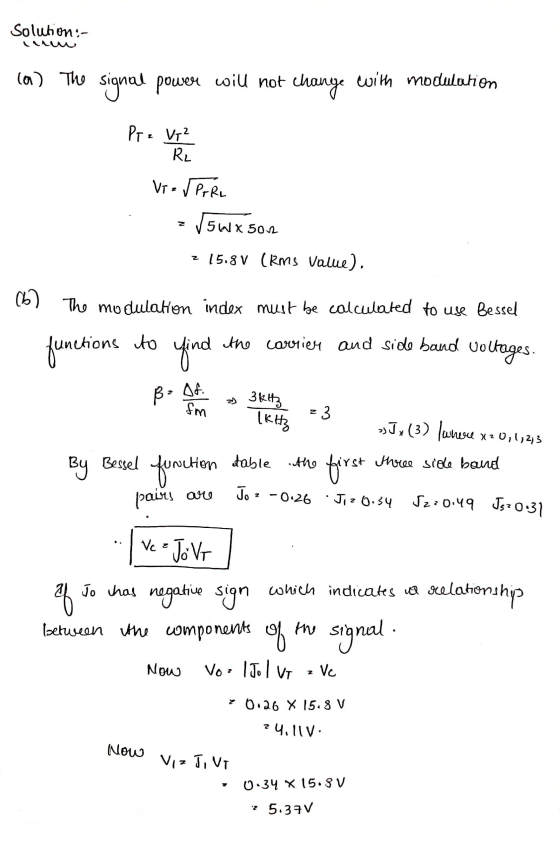
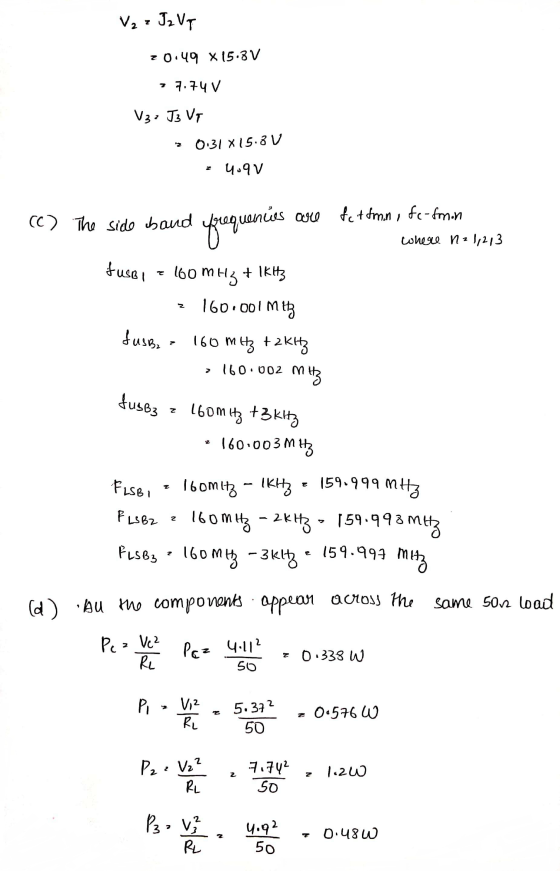
12. An FM signal has a deviation of 3 kHz and a modulating frequency of 1...
14. Given a sinusoidal modulating signal with frequencies f," 10 kHz and a carrier signal of...
 14. Given a sinusoidal modulating signal with frequencies f," 10 kHz and a carrier signal of 100 MHz, determine the bandwidth of FM for the three cases (amplitudes: 1. 10, 100, 1000) when the maximum frequency deviation is 50 kHz and k,-2? × 100 rad/sec/volt.
In an FM system the carrier frequency is 1MHz, the modulating signal at 10 kHz, the...
In an FM system the carrier frequency is 1MHz, the modulating signal at 10 kHz, the maximum deviation is 150 kHz. What is frequency modulation fm?
An FM signal has an intelligence frequency of 5 KHz, a maximum deviation of 30 KHz, and a carrier frequency of 162.4 MHz. Use the Bessel Function chart to answer the following: a) Its bandwidth b) How...
An FM signal has an intelligence frequency of 5 KHz, a maximum deviation of 30 KHz, and a carrier frequency of 162.4 MHz. Use the Bessel Function chart to answer the following: a) Its bandwidth b) How many frequency components are there in the output spectrum? c) What is the frequency of the highest frequency component within its bandwidth?
Calculate the following parameters for a Phase Modulator which has a carrier frequency of 10 kHz...
Calculate the following parameters for a Phase Modulator which has a carrier frequency of 10 kHz and a modulating data rate of 3 kHz: Modulating data time period: Baud rate: Upper sideband: Lower sideband: Bandwidth: Use the Labview circuit to verify the calculations Explain any observations and discrepancies. Use Labview to build a Phase Modulator. The sinusoidal carrier signal should be adjustable up to 12 kHz and the amplitude adjustable to 5 volts, using a “simulate signal” express vi. The...
2. A 3 KHz sinusoidal signal Phase Modulates a carrier at 245.3 MHz. The modulating tone...
 2. A 3 KHz sinusoidal signal Phase Modulates a carrier at 245.3 MHz. The modulating tone has an amplitude of 4 volts and the phase sensitivity of the modulator is 0.5 radians/volt. a. (15 points) Evaluate the required transmission bandwidth using Carson's Rule. b. (15 points) If the resulting PM signal is passed through an IBPF with bandwidth given by Carson's Rule (plus a few Hz), what percentage of the signal power is lost?
[5 Marks] uestion 1 A high frequency carrier is frequency modulated by a sinusoidal modulating frequency...
 [5 Marks] uestion 1 A high frequency carrier is frequency modulated by a sinusoidal modulating frequency of 2 KHz, resulting in a frequency deviation of 7 Khz.Calculate the bandwidth of the modulated signal. a) [1 Mark] [1.Mark] 0.5 mark] 2.5 Marks] b) Explain how noise immunity is achieved in FM With aid of a neatly labelled illustration describe the Frequency Shift Keying c) Discuss the advantages and de merits of Frequency modulation d) [5 Marks] Question 2 n SSB transmitter...
Prob. 5 (a) Consider the FM signal with modulation index B 2 is passed through an ideal band-pass...
 Prob. 5 (a) Consider the FM signal with modulation index B 2 is passed through an ideal band-pass filter (BPF) with mid-band frequency f and bandwidth 5f. where f is the carrier frequency and fmis the frequency of the baseband modulating signal (i) Sketch the spectrum of the BPF output. (ii) Determine the fraction of the power of the FM signal that is present at the output of the filter (b) Consider the FM signal given by фFM (t)-100 cos...
An AM signal is being produced with the following characteristics: fc = 560 kHz, Ec =...
An AM signal is being produced with the following characteristics: fc = 560 kHz, Ec = 1000 V, fm = 3 kHz, Em = 300 V. Calculate the following and show your work: fusb[Upper Sideband Frequency] flsb [Upper Sideband Frequency] m [Modulation Index] %m [Percentage of Modulation] Eusb [Upper Sideband Voltage] Elsb [Lower Sideband voltage] Bandwidth [BW]
1. An available channel for FM transmission is 30 kHz wide. The maximum allowable modulating signal...
1. An available channel for FM transmission is 30 kHz wide. The maximum allowable modulating signal frequency is 3.5 kHz. What deviation ratio should be used
a. For the wideband FM signal given by SFM(t) = cos[2πfct+ 3sin2π25t]
 a. For the wideband FM signal given by SFM(t) = cos[2πfct+ 3sin2π25t], draw only positive side of the spectrum, (from n=-5 to n=+5). Assume the carrier frequency (fc) of 1 KHz. Hint: First calculate β by comparing the signal with SFM(t) equation b. The FM signal of part (a) is passed through a bandpass filter centered at 1 KHz with a bandwidth of 210 Hz, as shown below. Draw the new spectrum and calculate the bandwidth and power of the filtered FM...
 14. Given a sinusoidal modulating signal with frequencies f," 10 kHz and a carrier signal of 100 MHz, determine the bandwidth of FM for the three cases (amplitudes: 1. 10, 100, 1000) when the maximum frequency deviation is 50 kHz and k,-2? × 100 rad/sec/volt.
 2. A 3 KHz sinusoidal signal Phase Modulates a carrier at 245.3 MHz. The modulating tone has an amplitude of 4 volts and the phase sensitivity of the modulator is 0.5 radians/volt. a. (15 points) Evaluate the required transmission bandwidth using Carson's Rule. b. (15 points) If the resulting PM signal is passed through an IBPF with bandwidth given by Carson's Rule (plus a few Hz), what percentage of the signal power is lost?
 [5 Marks] uestion 1 A high frequency carrier is frequency modulated by a sinusoidal modulating frequency of 2 KHz, resulting in a frequency deviation of 7 Khz.Calculate the bandwidth of the modulated signal. a) [1 Mark] [1.Mark] 0.5 mark] 2.5 Marks] b) Explain how noise immunity is achieved in FM With aid of a neatly labelled illustration describe the Frequency Shift Keying c) Discuss the advantages and de merits of Frequency modulation d) [5 Marks] Question 2 n SSB transmitter...
 Prob. 5 (a) Consider the FM signal with modulation index B 2 is passed through an ideal band-pass filter (BPF) with mid-band frequency f and bandwidth 5f. where f is the carrier frequency and fmis the frequency of the baseband modulating signal (i) Sketch the spectrum of the BPF output. (ii) Determine the fraction of the power of the FM signal that is present at the output of the filter (b) Consider the FM signal given by фFM (t)-100 cos...
Most questions answered within 3 hours.
-
Where is the error in this code sequence?
String s1 = "Hello";
String s2 = "ello";...
asked 11 months ago -
Financial data for Joel de Paris, Inc., for last year
follow:
Joel de Paris, Inc.
Balance...
asked 11 months ago -
Consider this reaction:
Al2(SO4)3 (aq)+ BaCl3
(aq) Al2Cl6 (aq)- +
3BaSO4(s) . What is the...
asked 11 months ago -
Suppose that Savneet is considering increasing her
recent random sample from 20 car rentals to 40...
asked 11 months ago -
Trucks arrive at an unloading terminal at an average rate of 120
per hour.
Trucks arrive...
asked 11 months ago -
Why are methanol and ethanol completely soluble in water while
octanol is not very little soluble....
asked 11 months ago -
A facilities manager at a university reads in a research report
that the mean amount of...
asked 11 months ago -
When the CuSO4 is rehydrated by adding water to the anhydrous
compound, is this an endothermic...
asked 11 months ago -
A ray of sunlight is passing from diamond into crown glass; the
angle of incidence is...
asked 11 months ago -
A block of mass 0.249 kg is placed on top of a light, vertical
spring of...
asked 11 months ago -
how do the kidneys compensate in the presences of acidosis
a) trigger hyperventilate
b) reserve acid...
asked 11 months ago -
Question 501 pts
The rental rate of capital to the firm increases. Which of the
following...
asked 11 months ago