Please answer the following question and show work.
Thanks.

Homework Answers
Add Answer to:
Please answer the following question and show work.
Thanks.
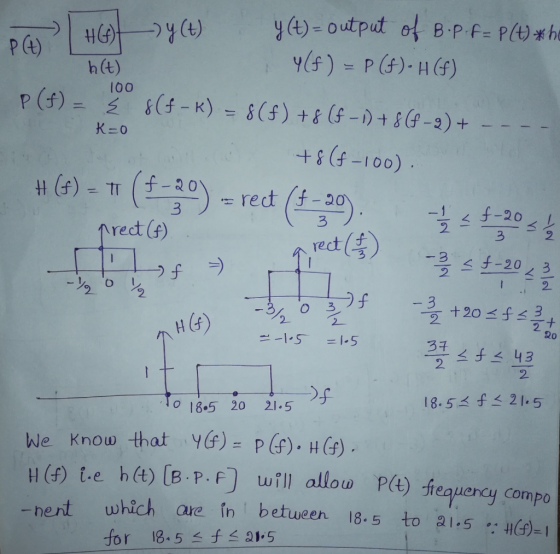
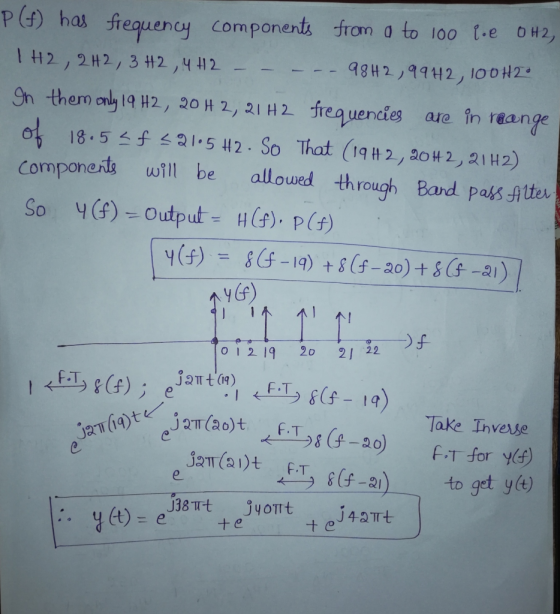
Suppose we are testing a bandpassflter by...
PLEASE SOLVE QUESTION NUMBER 2 ONLY, MAKE SURE ALL PARTS IN QUESTION 2 ARE SOLVED. THANK...
 PLEASE SOLVE QUESTION NUMBER 2 ONLY, MAKE SURE ALL PARTS IN
QUESTION 2 ARE SOLVED. THANK YOU
poirmts) l'igure output y ws an RG circuit with inpu Function Generator Model Capacitor Model i,(t) Figure 2: RC cireuit (a) (1 point) Sketch the circuit in the phasor domain by replacing the capacitor with its impedance represen- tation (b) (3 points) Using circuit analysis techniques, show that the frequency response function is F(u) UT 1 Specify the DC gain, K, and time...
PLEASE SOLVE QUESTION NUMBER 2 ONLY, MAKE SURE ALL PARTS IN
QUESTION 2 ARE SOLVED. THANK YOU
poirmts) l'igure output y ws an RG circuit with inpu Function Generator Model Capacitor Model i,(t) Figure 2: RC cireuit (a) (1 point) Sketch the circuit in the phasor domain by replacing the capacitor with its impedance represen- tation (b) (3 points) Using circuit analysis techniques, show that the frequency response function is F(u) UT 1 Specify the DC gain, K, and time...
Points) Consider the signal s(t) with Fourier Transform 10 1+ω. S(a) figure below, we impulse sam...
 points) Consider the signal s(t) with Fourier Transform 10 1+ω. S(a) figure below, we impulse sample s) at a frequency o, rads/second, e signal sa(t). Can you find a finite sampling frequency o such that ly recover s(t) from so()? If so, find it. If not, explain why not. a) (5 pts) In ting in the can perfectly you s (t) sa(t) →| Impulse sample at- rate o b) (5 pts) Now suppose we filter the signal s() with an...
H(o) s(t) ﹁ | y(t) | lyst) Impulse sample at rate o -B 0 B c) (5 pts) Using your value of B from...
 We were unable to transcribe this imageH(o) s(t) ﹁ | y(t) | lyst) Impulse sample at rate o -B 0 B c) (5 pts) Using your value of B from part b, what is minimum value of the sampling rate co, that will allow the filter output y(t) to be perfectly recovered from its impulse sampled version ys(0)? d) (5 pts) What is the purpose of the filter H()? (One sentence answer please.) e) (10 pts) Suppose the sampling rate...
I need help with number 2 . Please answer in MATLAB thank you! 1. In the lab we analyzed filtering 60 Hz power-line noi...
 I need help with number 2 . Please answer in MATLAB thank
you!
1. In the lab we analyzed filtering 60 Hz power-line noise from ECG signal using a digital (signal processing) filter. Now let's try to an analog (circuit) filter approach to remove the 60 Hz line-noise. Following is an active twin-T notch filter with transfer function: (1+m)((2joRC? +1 Z(a) 2R 2R Here m is the ratio of the two feedback 2C R resistance which determines the gain and...
I need help with number 2 . Please answer in MATLAB thank
you!
1. In the lab we analyzed filtering 60 Hz power-line noise from ECG signal using a digital (signal processing) filter. Now let's try to an analog (circuit) filter approach to remove the 60 Hz line-noise. Following is an active twin-T notch filter with transfer function: (1+m)((2joRC? +1 Z(a) 2R 2R Here m is the ratio of the two feedback 2C R resistance which determines the gain and...
The system shown in Fig.is composed of two systems in cascade. Answer the following questions. System...
 The system shown in Fig.is composed of two systems in cascade. Answer the following questions. System 2 stem 1 C1 1uF L1 1mH x(t) y(t) z(t) OMO Figure 1: Circuit for Questions 12.3and 1. For System 1 (a) Find the transfer function of System 1 (b) Find the magnitude frequency response of System 1 (c) What type of filter is System 1? Justify your answer (d) Find the 3-dB frequency of System 1 and sketch the magnitude frequency response of...
Problem 24: (18 points) 1. (6 points) Figure 2 shows an RC circuit with input f(t)...
 Problem 24: (18 points) 1. (6 points) Figure 2 shows an RC circuit with input f(t) and output y(t) Function Generator R, v, (r) y1) Figure 2: RC circuit. (a) (1 point) Sketch the circuit in the phasor domain by replacing the capacitor with its impedance represen- (b) (3 points) Using circuit analysis techniques, show that the frequency response function is Specify the DC gain, K, and the time constant, T, in terms of the parameters R, R, and C...
Please answer the following fully with detailed justification/explanation. Thank you. Consider the signal e(t) (60m sin...
 Please answer the following fully with detailed
justification/explanation. Thank you.
Consider the signal e(t) (60m sin (50t) (a) Determine Xc(jw), the Fourier transform of e(t). Plot (and label) Xe(ju) b) What is the Nyquist rate for re(t)? (c) Consider processing the signal re(t) using the system shown below: Conversion to a Ideal to an e(t) y(t) impulse train Filter H-(ju) The sampling rate for this system is f DT filter is shown below 150 Hz. The frequency response of the...
Please answer the following fully with detailed
justification/explanation. Thank you.
Consider the signal e(t) (60m sin (50t) (a) Determine Xc(jw), the Fourier transform of e(t). Plot (and label) Xe(ju) b) What is the Nyquist rate for re(t)? (c) Consider processing the signal re(t) using the system shown below: Conversion to a Ideal to an e(t) y(t) impulse train Filter H-(ju) The sampling rate for this system is f DT filter is shown below 150 Hz. The frequency response of the...
Q1) Consider an LTI system with frequency response (u) given by (a) Find the impulse response h(0) for this system. [Hint: In case of polynomial over pohnomial frequency domain representation, we...
 Q1) Consider an LTI system with frequency response (u) given by (a) Find the impulse response h(0) for this system. [Hint: In case of polynomial over pohnomial frequency domain representation, we analyce the denominator and use partial fraction expansion to write H() in the form Then we notice that each of these fraction terms is the Fourier of an exponentiol multiplied by a unit step as per the Table J (b) What is the output y(t) from the system if...
Question We are given the following signal (t), which is also known as "infinite train" of...
 Question We are given the following signal (t), which is also known as "infinite train" of Dirac delta functions. w(t) TITI t(ms) -20 -10 0 10 20 30 Write a mathematical expression for w(t) in the time domain. Find the Fourier coefficients of the signal using the definition and its Fourier transform W(S) [Note that results without correct derivation will get minimal points]. Sketch the signal magnitude spectrum | W (f). Is this signal an energy or a power signal?...
HI GUYS CAN YOU HELP ME SOLVE THIS QUESTION ASAP PLS AND THANKS!! QUESTION 6 ONLY,...
 HI GUYS CAN YOU HELP ME SOLVE THIS QUESTION ASAP PLS AND
THANKS!! QUESTION 6 ONLY, THE 15 MARK QUESTION. CAN YOU CALCULATE
THE THEOREATICAL VALUES WITH THESE 3 VALUES: 10HZ, 1KHZ, 10KHZ. AND
USING THIS VALUES. R = 1000Ω,C = 1µF, L = 0.23mh. not the L=44
thanks.
Exercise 2 [60 marks] RLC Circuit as a Low-pass Filter L 0000 in out Figure 2. RLC circuit 2 10 marks] Derive the second order input-output model (differential equation) for the...
HI GUYS CAN YOU HELP ME SOLVE THIS QUESTION ASAP PLS AND
THANKS!! QUESTION 6 ONLY, THE 15 MARK QUESTION. CAN YOU CALCULATE
THE THEOREATICAL VALUES WITH THESE 3 VALUES: 10HZ, 1KHZ, 10KHZ. AND
USING THIS VALUES. R = 1000Ω,C = 1µF, L = 0.23mh. not the L=44
thanks.
Exercise 2 [60 marks] RLC Circuit as a Low-pass Filter L 0000 in out Figure 2. RLC circuit 2 10 marks] Derive the second order input-output model (differential equation) for the...
 PLEASE SOLVE QUESTION NUMBER 2 ONLY, MAKE SURE ALL PARTS IN
QUESTION 2 ARE SOLVED. THANK YOU
poirmts) l'igure output y ws an RG circuit with inpu Function Generator Model Capacitor Model i,(t) Figure 2: RC cireuit (a) (1 point) Sketch the circuit in the phasor domain by replacing the capacitor with its impedance represen- tation (b) (3 points) Using circuit analysis techniques, show that the frequency response function is F(u) UT 1 Specify the DC gain, K, and time...
PLEASE SOLVE QUESTION NUMBER 2 ONLY, MAKE SURE ALL PARTS IN
QUESTION 2 ARE SOLVED. THANK YOU
poirmts) l'igure output y ws an RG circuit with inpu Function Generator Model Capacitor Model i,(t) Figure 2: RC cireuit (a) (1 point) Sketch the circuit in the phasor domain by replacing the capacitor with its impedance represen- tation (b) (3 points) Using circuit analysis techniques, show that the frequency response function is F(u) UT 1 Specify the DC gain, K, and time...
 points) Consider the signal s(t) with Fourier Transform 10 1+ω. S(a) figure below, we impulse sample s) at a frequency o, rads/second, e signal sa(t). Can you find a finite sampling frequency o such that ly recover s(t) from so()? If so, find it. If not, explain why not. a) (5 pts) In ting in the can perfectly you s (t) sa(t) →| Impulse sample at- rate o b) (5 pts) Now suppose we filter the signal s() with an...
 We were unable to transcribe this imageH(o) s(t) ﹁ | y(t) | lyst) Impulse sample at rate o -B 0 B c) (5 pts) Using your value of B from part b, what is minimum value of the sampling rate co, that will allow the filter output y(t) to be perfectly recovered from its impulse sampled version ys(0)? d) (5 pts) What is the purpose of the filter H()? (One sentence answer please.) e) (10 pts) Suppose the sampling rate...
 I need help with number 2 . Please answer in MATLAB thank
you!
1. In the lab we analyzed filtering 60 Hz power-line noise from ECG signal using a digital (signal processing) filter. Now let's try to an analog (circuit) filter approach to remove the 60 Hz line-noise. Following is an active twin-T notch filter with transfer function: (1+m)((2joRC? +1 Z(a) 2R 2R Here m is the ratio of the two feedback 2C R resistance which determines the gain and...
I need help with number 2 . Please answer in MATLAB thank
you!
1. In the lab we analyzed filtering 60 Hz power-line noise from ECG signal using a digital (signal processing) filter. Now let's try to an analog (circuit) filter approach to remove the 60 Hz line-noise. Following is an active twin-T notch filter with transfer function: (1+m)((2joRC? +1 Z(a) 2R 2R Here m is the ratio of the two feedback 2C R resistance which determines the gain and...
 The system shown in Fig.is composed of two systems in cascade. Answer the following questions. System 2 stem 1 C1 1uF L1 1mH x(t) y(t) z(t) OMO Figure 1: Circuit for Questions 12.3and 1. For System 1 (a) Find the transfer function of System 1 (b) Find the magnitude frequency response of System 1 (c) What type of filter is System 1? Justify your answer (d) Find the 3-dB frequency of System 1 and sketch the magnitude frequency response of...
 Problem 24: (18 points) 1. (6 points) Figure 2 shows an RC circuit with input f(t) and output y(t) Function Generator R, v, (r) y1) Figure 2: RC circuit. (a) (1 point) Sketch the circuit in the phasor domain by replacing the capacitor with its impedance represen- (b) (3 points) Using circuit analysis techniques, show that the frequency response function is Specify the DC gain, K, and the time constant, T, in terms of the parameters R, R, and C...
 Please answer the following fully with detailed
justification/explanation. Thank you.
Consider the signal e(t) (60m sin (50t) (a) Determine Xc(jw), the Fourier transform of e(t). Plot (and label) Xe(ju) b) What is the Nyquist rate for re(t)? (c) Consider processing the signal re(t) using the system shown below: Conversion to a Ideal to an e(t) y(t) impulse train Filter H-(ju) The sampling rate for this system is f DT filter is shown below 150 Hz. The frequency response of the...
Please answer the following fully with detailed
justification/explanation. Thank you.
Consider the signal e(t) (60m sin (50t) (a) Determine Xc(jw), the Fourier transform of e(t). Plot (and label) Xe(ju) b) What is the Nyquist rate for re(t)? (c) Consider processing the signal re(t) using the system shown below: Conversion to a Ideal to an e(t) y(t) impulse train Filter H-(ju) The sampling rate for this system is f DT filter is shown below 150 Hz. The frequency response of the...
 Q1) Consider an LTI system with frequency response (u) given by (a) Find the impulse response h(0) for this system. [Hint: In case of polynomial over pohnomial frequency domain representation, we analyce the denominator and use partial fraction expansion to write H() in the form Then we notice that each of these fraction terms is the Fourier of an exponentiol multiplied by a unit step as per the Table J (b) What is the output y(t) from the system if...
 Question We are given the following signal (t), which is also known as "infinite train" of Dirac delta functions. w(t) TITI t(ms) -20 -10 0 10 20 30 Write a mathematical expression for w(t) in the time domain. Find the Fourier coefficients of the signal using the definition and its Fourier transform W(S) [Note that results without correct derivation will get minimal points]. Sketch the signal magnitude spectrum | W (f). Is this signal an energy or a power signal?...
 HI GUYS CAN YOU HELP ME SOLVE THIS QUESTION ASAP PLS AND
THANKS!! QUESTION 6 ONLY, THE 15 MARK QUESTION. CAN YOU CALCULATE
THE THEOREATICAL VALUES WITH THESE 3 VALUES: 10HZ, 1KHZ, 10KHZ. AND
USING THIS VALUES. R = 1000Ω,C = 1µF, L = 0.23mh. not the L=44
thanks.
Exercise 2 [60 marks] RLC Circuit as a Low-pass Filter L 0000 in out Figure 2. RLC circuit 2 10 marks] Derive the second order input-output model (differential equation) for the...
HI GUYS CAN YOU HELP ME SOLVE THIS QUESTION ASAP PLS AND
THANKS!! QUESTION 6 ONLY, THE 15 MARK QUESTION. CAN YOU CALCULATE
THE THEOREATICAL VALUES WITH THESE 3 VALUES: 10HZ, 1KHZ, 10KHZ. AND
USING THIS VALUES. R = 1000Ω,C = 1µF, L = 0.23mh. not the L=44
thanks.
Exercise 2 [60 marks] RLC Circuit as a Low-pass Filter L 0000 in out Figure 2. RLC circuit 2 10 marks] Derive the second order input-output model (differential equation) for the...
Most questions answered within 3 hours.
-
Where is the error in this code sequence?
String s1 = "Hello";
String s2 = "ello";...
asked 10 months ago -
Financial data for Joel de Paris, Inc., for last year
follow:
Joel de Paris, Inc.
Balance...
asked 10 months ago -
Consider this reaction:
Al2(SO4)3 (aq)+ BaCl3
(aq) Al2Cl6 (aq)- +
3BaSO4(s) . What is the...
asked 10 months ago -
Suppose that Savneet is considering increasing her
recent random sample from 20 car rentals to 40...
asked 10 months ago -
Trucks arrive at an unloading terminal at an average rate of 120
per hour.
Trucks arrive...
asked 10 months ago -
Why are methanol and ethanol completely soluble in water while
octanol is not very little soluble....
asked 10 months ago -
A facilities manager at a university reads in a research report
that the mean amount of...
asked 10 months ago -
When the CuSO4 is rehydrated by adding water to the anhydrous
compound, is this an endothermic...
asked 10 months ago -
A ray of sunlight is passing from diamond into crown glass; the
angle of incidence is...
asked 10 months ago -
A block of mass 0.249 kg is placed on top of a light, vertical
spring of...
asked 10 months ago -
how do the kidneys compensate in the presences of acidosis
a) trigger hyperventilate
b) reserve acid...
asked 10 months ago -
Question 501 pts
The rental rate of capital to the firm increases. Which of the
following...
asked 10 months ago