
Homework Answers
Add Answer to:
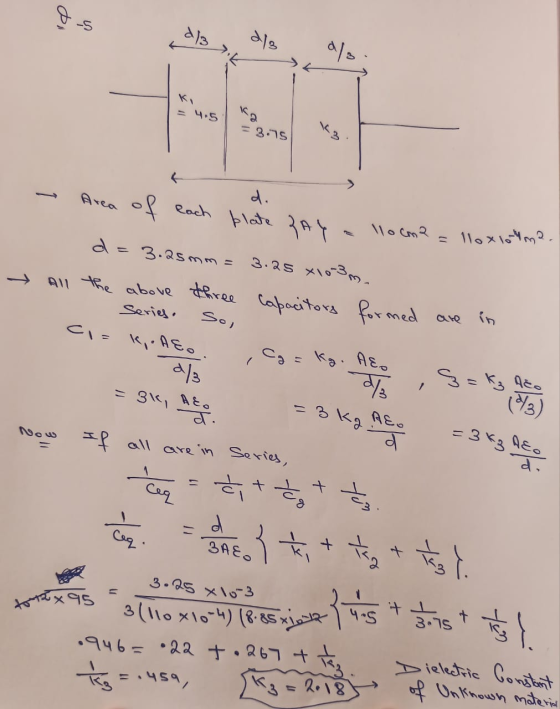
(13%) Problem 5: The gap between the plates of a parallel-plate capacitor is filled with three...
(13%) Problem 7: Consider a parallel plate capacitor having plates of area 1 .25 cmŕ that...
 (13%) Problem 7: Consider a parallel plate capacitor having plates of area 1 .25 cmŕ that are separated by 0.016 mm of neoprene rubber. You may assume the rubber has a dielectric constant x- 6.7. > 50% Part (a) What is the capacitance in μF? Grade Summary Deductions Potential 0% 100% cotan atan cosh acos sinh( tanh) cotanhh 4 5 6 1 2 3 0 Submissions Attempts remaining: 6 (3% per attempt) detailed view asin acotan o Degrees oRadians DELCLEA...
(13%) Problem 4: Suppose you have an electric field between two parallel conducting plates separated by...
 (13%) Problem 4: Suppose you have an electric field between two parallel conducting plates separated by 0.45 cm and having a potential difference (voltage) between them of 1.9 x 10* V. 4 What is the strength of such an electric field in newtons per coulomb? Grade Su Deductior Potential coS asin acotan tanh Subnissi Attempts 3% per a detailed cotan atan cosh acos sinh cotanh 4|5 6 * 1 2 3 0 END o Degrees o Radians BACKSPA E CLEA...
Problem 2: A parallel plate capacitor has a charge on one plate of q= 8.5x10^-7 C....
 Problem 2: A parallel plate capacitor has a charge on one plate
of q= 8.5x10^-7 C. Each square plate is d1= 1.1 cm wide and the
plates of the capacitor are separated by d2= 0.35mm. The gap is
filled with air, E0= 8.85x10^-12 C^2/Nm^2
Part A) What is the voltage between the plates, deltaV, in
V?
Cassandra Chapter 19-part 2 (19b) Begin Date: 1/22/2019 1:00.00 AM-Due Date: 1/27/2019 11:55:00 PM End Date: 128/2019 11:55.00 PM (20%) Problem 2: A parallel...
Problem 2: A parallel plate capacitor has a charge on one plate
of q= 8.5x10^-7 C. Each square plate is d1= 1.1 cm wide and the
plates of the capacitor are separated by d2= 0.35mm. The gap is
filled with air, E0= 8.85x10^-12 C^2/Nm^2
Part A) What is the voltage between the plates, deltaV, in
V?
Cassandra Chapter 19-part 2 (19b) Begin Date: 1/22/2019 1:00.00 AM-Due Date: 1/27/2019 11:55:00 PM End Date: 128/2019 11:55.00 PM (20%) Problem 2: A parallel...
(5%) Problem 8: Consider a 470 nm wavelength blue light falling on a pair of slits...
 (5%) Problem 8: Consider a 470 nm wavelength blue light falling on a pair of slits separated by 0.035 mm. A At what angle (in degrees) is the first-order maximum for the blue light? Grade Summary Deductions 0% Potential 100% sino TT ( 9 HOME 7 8 45 E 6 cotan atan cosh cos tano asino acos acotan tanh cotanh Degrees O Radians Submissions Attempts remaining: 3 (0% per attempt) letailed view sinho 12 برا + - 0 END NO...
A parallel-plate capacitor, of area 6.62×10⁻² m2, has the gap between the plates filled by Teflon,...
A parallel-plate capacitor, of area 6.62×10⁻² m2, has the gap between the plates filled by Teflon, a dielectric. If a laboratory meter measures the capacitance to be 290 pF. What is the separation of the plates? Dielectric Constant κ at 20 °C Teflon 2.1 polyethylene 2.25 benzene 2.28 Mylar 3.1 Plexiglas 3.4 neoprene 6.7 glycerin 42.5 water 80.4
A parallel-plate capacitor, of area 6.06×10⁻² m2, has a gap between the plates filled by polyethylene,...
A parallel-plate capacitor, of area 6.06×10⁻² m2, has a gap between the plates filled by polyethylene, a dielectric. A laboratory meter measures the capacitance as 450 pF. What is the capacitance when there is only air in the gap? What is the separation of the plates?
A 2.5 nF parallel-plate capacitor has an air gap between its plates. Its capacitance increases by...
A 2.5 nF parallel-plate capacitor has an air gap between its plates. Its capacitance increases by 2.5 nF when the gap is filled by a dielectric What is the dielectric constant of that dielectric?
The drawing shows a parallel plate capacitor. One-half of the region between the plates is filled...
The drawing shows a parallel plate capacitor. One-half of the region between the plates is filled with a material that has a dielectric constant κ1=2.4. The other half is filled with a material that has a dielectric constant κ2=4.4. The area of each plate is 1.2cm2, and the plate separation is 0.19 mm. Find the capacitance.
Problem 5: A 95-g aluminum calorimeter contains 241 g of water. The aluminum and water are...
 Problem 5: A 95-g aluminum calorimeter contains 241 g of water. The aluminum and water are initially in thermal equilibrium at a temperature of 9.3°C. Two solid objects are then placed in the water. One is a 50.3-g piece of copper with a specific heat of 390 J/(kg:°C) and an initial temperature of 81.2°C. The other is of unknown material with a mass of 69 g and an initial temperature of 100°C. The entire system reaches thermal equilibrium at a...
A parallel-plate capacitor (air-filled gap, dielectric constant = 1) is constructed with plates of area 0.028...
A parallel-plate capacitor (air-filled gap, dielectric constant = 1) is constructed with plates of area 0.028 m^2 and separation 0.550 mm. Find magnitude of the charge on each plate of this capacitor when the voltage difference between the plates is 20.1 V. a.) 3.5*10^(-9) C b.) 9.1*10^(-9) C c.) 6.6*10^(-9) C d.) 1.5*10^(-9) C
 (13%) Problem 7: Consider a parallel plate capacitor having plates of area 1 .25 cmŕ that are separated by 0.016 mm of neoprene rubber. You may assume the rubber has a dielectric constant x- 6.7. > 50% Part (a) What is the capacitance in μF? Grade Summary Deductions Potential 0% 100% cotan atan cosh acos sinh( tanh) cotanhh 4 5 6 1 2 3 0 Submissions Attempts remaining: 6 (3% per attempt) detailed view asin acotan o Degrees oRadians DELCLEA...
 (13%) Problem 4: Suppose you have an electric field between two parallel conducting plates separated by 0.45 cm and having a potential difference (voltage) between them of 1.9 x 10* V. 4 What is the strength of such an electric field in newtons per coulomb? Grade Su Deductior Potential coS asin acotan tanh Subnissi Attempts 3% per a detailed cotan atan cosh acos sinh cotanh 4|5 6 * 1 2 3 0 END o Degrees o Radians BACKSPA E CLEA...
 Problem 2: A parallel plate capacitor has a charge on one plate
of q= 8.5x10^-7 C. Each square plate is d1= 1.1 cm wide and the
plates of the capacitor are separated by d2= 0.35mm. The gap is
filled with air, E0= 8.85x10^-12 C^2/Nm^2
Part A) What is the voltage between the plates, deltaV, in
V?
Cassandra Chapter 19-part 2 (19b) Begin Date: 1/22/2019 1:00.00 AM-Due Date: 1/27/2019 11:55:00 PM End Date: 128/2019 11:55.00 PM (20%) Problem 2: A parallel...
Problem 2: A parallel plate capacitor has a charge on one plate
of q= 8.5x10^-7 C. Each square plate is d1= 1.1 cm wide and the
plates of the capacitor are separated by d2= 0.35mm. The gap is
filled with air, E0= 8.85x10^-12 C^2/Nm^2
Part A) What is the voltage between the plates, deltaV, in
V?
Cassandra Chapter 19-part 2 (19b) Begin Date: 1/22/2019 1:00.00 AM-Due Date: 1/27/2019 11:55:00 PM End Date: 128/2019 11:55.00 PM (20%) Problem 2: A parallel...
 (5%) Problem 8: Consider a 470 nm wavelength blue light falling on a pair of slits separated by 0.035 mm. A At what angle (in degrees) is the first-order maximum for the blue light? Grade Summary Deductions 0% Potential 100% sino TT ( 9 HOME 7 8 45 E 6 cotan atan cosh cos tano asino acos acotan tanh cotanh Degrees O Radians Submissions Attempts remaining: 3 (0% per attempt) letailed view sinho 12 برا + - 0 END NO...
 Problem 5: A 95-g aluminum calorimeter contains 241 g of water. The aluminum and water are initially in thermal equilibrium at a temperature of 9.3°C. Two solid objects are then placed in the water. One is a 50.3-g piece of copper with a specific heat of 390 J/(kg:°C) and an initial temperature of 81.2°C. The other is of unknown material with a mass of 69 g and an initial temperature of 100°C. The entire system reaches thermal equilibrium at a...
Most questions answered within 3 hours.
-
Where is the error in this code sequence?
String s1 = "Hello";
String s2 = "ello";...
asked 10 months ago -
Financial data for Joel de Paris, Inc., for last year
follow:
Joel de Paris, Inc.
Balance...
asked 10 months ago -
Consider this reaction:
Al2(SO4)3 (aq)+ BaCl3
(aq) Al2Cl6 (aq)- +
3BaSO4(s) . What is the...
asked 10 months ago -
Suppose that Savneet is considering increasing her
recent random sample from 20 car rentals to 40...
asked 10 months ago -
Trucks arrive at an unloading terminal at an average rate of 120
per hour.
Trucks arrive...
asked 10 months ago -
Why are methanol and ethanol completely soluble in water while
octanol is not very little soluble....
asked 10 months ago -
A facilities manager at a university reads in a research report
that the mean amount of...
asked 10 months ago -
When the CuSO4 is rehydrated by adding water to the anhydrous
compound, is this an endothermic...
asked 10 months ago -
A ray of sunlight is passing from diamond into crown glass; the
angle of incidence is...
asked 10 months ago -
A block of mass 0.249 kg is placed on top of a light, vertical
spring of...
asked 10 months ago -
how do the kidneys compensate in the presences of acidosis
a) trigger hyperventilate
b) reserve acid...
asked 10 months ago -
Question 501 pts
The rental rate of capital to the firm increases. Which of the
following...
asked 10 months ago