PLEASE please be very very clear and please show me step by step
please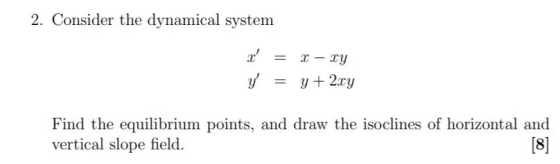
Homework Answers
ANSWER:
Add Answer to:
PLEASE please be very very clear and please show me step by step
please
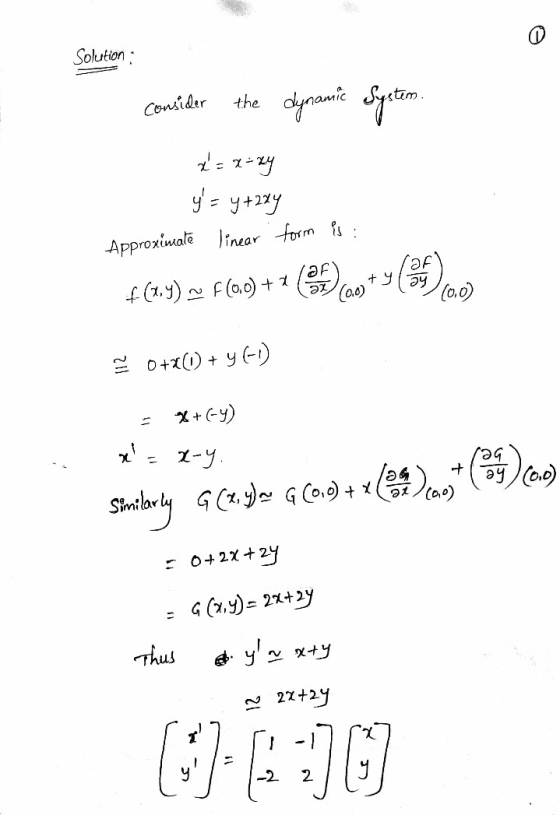
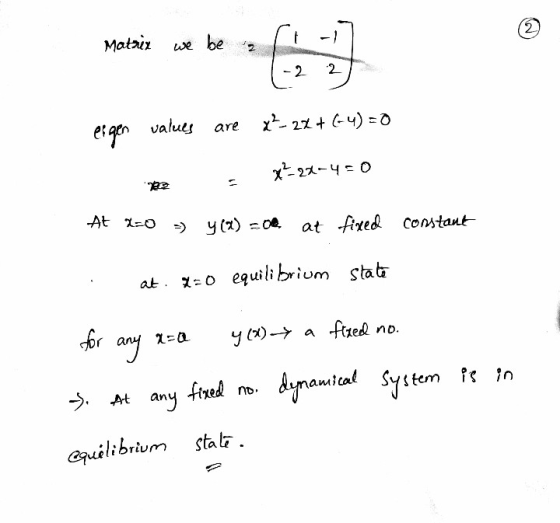
2. Consider...
8. Consider the DE: y' =y-2 e Label the isoclines below by the corresponding values a)...
 8. Consider the DE: y' =y-2 e Label the isoclines below by the corresponding values a) of m: 0, 1, t2 b) Find the region where the solutions are decreasing. Draw the direction field c) d) Sketch two solutions passing respectively through the points (0, 0) and (2, 2) (15 pts) 4 3 2 -2 -3
8. Consider the DE: y' =y-2 e Label the isoclines below by the corresponding values a) of m: 0, 1, t2 b) Find the...
8. Consider the DE: y' =y-2 e Label the isoclines below by the corresponding values a) of m: 0, 1, t2 b) Find the region where the solutions are decreasing. Draw the direction field c) d) Sketch two solutions passing respectively through the points (0, 0) and (2, 2) (15 pts) 4 3 2 -2 -3
8. Consider the DE: y' =y-2 e Label the isoclines below by the corresponding values a) of m: 0, 1, t2 b) Find the...
*PLEASE SHOW ALL WORK AND STEP BY STEP SOLUTION* 7.+-/3 points MarsVectorCalc6 2.6.011. For the functions below, what is the direction of fastest increase at (1, 1, 1)? 8 (a) f(x, y 2) -2+ y2 +2 x2 +...
 *PLEASE SHOW ALL WORK AND STEP BY STEP SOLUTION*
7.+-/3 points MarsVectorCalc6 2.6.011. For the functions below, what is the direction of fastest increase at (1, 1, 1)? 8 (a) f(x, y 2) -2+ y2 +2 x2 + y2 + z2 (b) f(x, y, z)-2xy + 2yz + 2xz 8 (cx,2x2 + y2+ 2 2 + z2
7.+-/3 points MarsVectorCalc6 2.6.011. For the functions below, what is the direction of fastest increase at (1, 1, 1)? 8 (a) f(x, y...
*PLEASE SHOW ALL WORK AND STEP BY STEP SOLUTION*
7.+-/3 points MarsVectorCalc6 2.6.011. For the functions below, what is the direction of fastest increase at (1, 1, 1)? 8 (a) f(x, y 2) -2+ y2 +2 x2 + y2 + z2 (b) f(x, y, z)-2xy + 2yz + 2xz 8 (cx,2x2 + y2+ 2 2 + z2
7.+-/3 points MarsVectorCalc6 2.6.011. For the functions below, what is the direction of fastest increase at (1, 1, 1)? 8 (a) f(x, y...
Please answer this question step by step correctly parts a, b, and c so I can...
 Please answer this question step by step correctly parts
a, b, and c so I can understand it. I'm having trouble
understanding VISUALIZATION OF DYNAMICAL SYSTEMS. For each part,
determine all the equilibrium points by hand. Then, PLOT THE VECTOR
FIELD AND THE PHASE PORTRAIT. From the phase portrait, determine
stability(stable ISL, locally or globally asymptotically stable, or
unstable) of EACH EQUILIBRIUM POINT. PLEASE ANSWER ALL THE PARTS.
Here is the rest of the question. This is due
tomorrow.
1....
Please answer this question step by step correctly parts
a, b, and c so I can understand it. I'm having trouble
understanding VISUALIZATION OF DYNAMICAL SYSTEMS. For each part,
determine all the equilibrium points by hand. Then, PLOT THE VECTOR
FIELD AND THE PHASE PORTRAIT. From the phase portrait, determine
stability(stable ISL, locally or globally asymptotically stable, or
unstable) of EACH EQUILIBRIUM POINT. PLEASE ANSWER ALL THE PARTS.
Here is the rest of the question. This is due
tomorrow.
1....
Please explain and show the steps very clear, also solve all a, b and c. thank...
 Please explain and show the steps very clear, also solve all a,
b and c.
thank you,
Please consider the cireuit shown below R. fl) C-4 a. Please fmd the transfer function from the input fe) to the output (). Please leave your answer in terms of R. (10 points) t y(t). Please leave b. Please design R so that impulse response has the form h(t) -Ae-* +Be-qt, i.e. it contains a decaying exponential term proportional to e-3. Also, please...
Please explain and show the steps very clear, also solve all a,
b and c.
thank you,
Please consider the cireuit shown below R. fl) C-4 a. Please fmd the transfer function from the input fe) to the output (). Please leave your answer in terms of R. (10 points) t y(t). Please leave b. Please design R so that impulse response has the form h(t) -Ae-* +Be-qt, i.e. it contains a decaying exponential term proportional to e-3. Also, please...
please be very clear and detailed in showing each step taken to solve. please don't skip...
 please be very clear and detailed in showing each step taken
to solve. please don't skip any steps either. thank you!
1. (25pt) The velocity for a two-dimensional flow is defined by V = ((0.5x3yt)i - (2x - yt)j)m/s, where x and y are in meters. Determine the magnitudes of the velocity and acceleration of a particle located at the point x = 1m, y = 2m.
please be very clear and detailed in showing each step taken
to solve. please don't skip any steps either. thank you!
1. (25pt) The velocity for a two-dimensional flow is defined by V = ((0.5x3yt)i - (2x - yt)j)m/s, where x and y are in meters. Determine the magnitudes of the velocity and acceleration of a particle located at the point x = 1m, y = 2m.
Please solve f, g, h, and i. Please no excel! Show all work please! 1.2 Consider...
 Please solve f, g, h, and i. Please no excel! Show all work
please!
1.2 Consider the following five points: Name X-Value Y-Value L. (a) Plot the five points and the centroid. Be sure that Y is the vertical axis and X is the horizontal axis. (b) Draw a line that appears to fit the five points. (c) Find the bo and b, for the line you drew in part (b). (d) Find the residuals. Specifically, calculate e,Yb bX) for...
Please solve f, g, h, and i. Please no excel! Show all work
please!
1.2 Consider the following five points: Name X-Value Y-Value L. (a) Plot the five points and the centroid. Be sure that Y is the vertical axis and X is the horizontal axis. (b) Draw a line that appears to fit the five points. (c) Find the bo and b, for the line you drew in part (b). (d) Find the residuals. Specifically, calculate e,Yb bX) for...
Hi, please help me with this exercise, please explain me step by step and please write...
 Hi, please help me with this exercise, please explain me step by
step and please write with very very good calligraphy. Thank you
very much.
* From an urn containing 4 white balls and 3 black balls 3 balls
are removed with replacement. Following this, a coin is thrown as
many times as black balls have been removed and the amount of heads
obtained is evaluated. We define X as the random variable that
represents the quantity of black balls...
Hi, please help me with this exercise, please explain me step by
step and please write with very very good calligraphy. Thank you
very much.
* From an urn containing 4 white balls and 3 black balls 3 balls
are removed with replacement. Following this, a coin is thrown as
many times as black balls have been removed and the amount of heads
obtained is evaluated. We define X as the random variable that
represents the quantity of black balls...
4. Consider the system ry(1 +) -(42 2) (a) Show that the origin is an equilibrium point and it is...
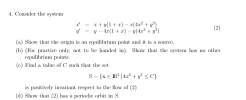 4. Consider the system ry(1 +) -(42 2) (a) Show that the origin is an equilibrium point and it is a source (b) (For practice only, not to be handed in). Show that the system has no other equilibrium points (c) Find a value of C such that the set is positively invariant respect to the flow of (2) (d) Show that (2) has a periodic orbit in S.
4. Consider the system ry(1 +) -(42 2) (a) Show that...
4. Consider the system ry(1 +) -(42 2) (a) Show that the origin is an equilibrium point and it is a source (b) (For practice only, not to be handed in). Show that the system has no other equilibrium points (c) Find a value of C such that the set is positively invariant respect to the flow of (2) (d) Show that (2) has a periodic orbit in S.
4. Consider the system ry(1 +) -(42 2) (a) Show that...
PLEASE SHOW EACH STEP AND BE VERY CLEAR AND NEAT SO I UNDERSTAND HOW TO SOLVE...
PLEASE SHOW EACH STEP AND BE VERY CLEAR AND NEAT SO I UNDERSTAND HOW TO SOLVE A GEAR TRAIN, thank you In a simple gear train, use the following information to solve for the 8th shaft speed: Find: n9 Given: Motor Speed: 1750 N1 = 20 N2 = 40 N3 = 64 N4 = 20 N5 = 64 N6 = 30 N7 = 20 N8 =40 N9 = 20 N10 = 64
please write step by step and clear extend answer (d) Consider two random variables X and...
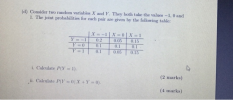 please write step by step and clear extend answer
(d) Consider two random variables X and Y. They both take the values -1,0 and 1. The joint probabilities for each pair are given by the following table: Y = -1 Y=0 Y = 1 X = -1 X = 0 X = 1 0.2 0.05 0.15 0.1 0.1 0.1 0.1 0.05 0.15 i. Calculate P(Y = 1). ii. Calculate P(Y = 0 X + Y = 0). (2 marks) (4...
please write step by step and clear extend answer
(d) Consider two random variables X and Y. They both take the values -1,0 and 1. The joint probabilities for each pair are given by the following table: Y = -1 Y=0 Y = 1 X = -1 X = 0 X = 1 0.2 0.05 0.15 0.1 0.1 0.1 0.1 0.05 0.15 i. Calculate P(Y = 1). ii. Calculate P(Y = 0 X + Y = 0). (2 marks) (4...
 8. Consider the DE: y' =y-2 e Label the isoclines below by the corresponding values a) of m: 0, 1, t2 b) Find the region where the solutions are decreasing. Draw the direction field c) d) Sketch two solutions passing respectively through the points (0, 0) and (2, 2) (15 pts) 4 3 2 -2 -3
8. Consider the DE: y' =y-2 e Label the isoclines below by the corresponding values a) of m: 0, 1, t2 b) Find the...
8. Consider the DE: y' =y-2 e Label the isoclines below by the corresponding values a) of m: 0, 1, t2 b) Find the region where the solutions are decreasing. Draw the direction field c) d) Sketch two solutions passing respectively through the points (0, 0) and (2, 2) (15 pts) 4 3 2 -2 -3
8. Consider the DE: y' =y-2 e Label the isoclines below by the corresponding values a) of m: 0, 1, t2 b) Find the...
 *PLEASE SHOW ALL WORK AND STEP BY STEP SOLUTION*
7.+-/3 points MarsVectorCalc6 2.6.011. For the functions below, what is the direction of fastest increase at (1, 1, 1)? 8 (a) f(x, y 2) -2+ y2 +2 x2 + y2 + z2 (b) f(x, y, z)-2xy + 2yz + 2xz 8 (cx,2x2 + y2+ 2 2 + z2
7.+-/3 points MarsVectorCalc6 2.6.011. For the functions below, what is the direction of fastest increase at (1, 1, 1)? 8 (a) f(x, y...
*PLEASE SHOW ALL WORK AND STEP BY STEP SOLUTION*
7.+-/3 points MarsVectorCalc6 2.6.011. For the functions below, what is the direction of fastest increase at (1, 1, 1)? 8 (a) f(x, y 2) -2+ y2 +2 x2 + y2 + z2 (b) f(x, y, z)-2xy + 2yz + 2xz 8 (cx,2x2 + y2+ 2 2 + z2
7.+-/3 points MarsVectorCalc6 2.6.011. For the functions below, what is the direction of fastest increase at (1, 1, 1)? 8 (a) f(x, y...
 Please answer this question step by step correctly parts
a, b, and c so I can understand it. I'm having trouble
understanding VISUALIZATION OF DYNAMICAL SYSTEMS. For each part,
determine all the equilibrium points by hand. Then, PLOT THE VECTOR
FIELD AND THE PHASE PORTRAIT. From the phase portrait, determine
stability(stable ISL, locally or globally asymptotically stable, or
unstable) of EACH EQUILIBRIUM POINT. PLEASE ANSWER ALL THE PARTS.
Here is the rest of the question. This is due
tomorrow.
1....
Please answer this question step by step correctly parts
a, b, and c so I can understand it. I'm having trouble
understanding VISUALIZATION OF DYNAMICAL SYSTEMS. For each part,
determine all the equilibrium points by hand. Then, PLOT THE VECTOR
FIELD AND THE PHASE PORTRAIT. From the phase portrait, determine
stability(stable ISL, locally or globally asymptotically stable, or
unstable) of EACH EQUILIBRIUM POINT. PLEASE ANSWER ALL THE PARTS.
Here is the rest of the question. This is due
tomorrow.
1....
 Please explain and show the steps very clear, also solve all a,
b and c.
thank you,
Please consider the cireuit shown below R. fl) C-4 a. Please fmd the transfer function from the input fe) to the output (). Please leave your answer in terms of R. (10 points) t y(t). Please leave b. Please design R so that impulse response has the form h(t) -Ae-* +Be-qt, i.e. it contains a decaying exponential term proportional to e-3. Also, please...
Please explain and show the steps very clear, also solve all a,
b and c.
thank you,
Please consider the cireuit shown below R. fl) C-4 a. Please fmd the transfer function from the input fe) to the output (). Please leave your answer in terms of R. (10 points) t y(t). Please leave b. Please design R so that impulse response has the form h(t) -Ae-* +Be-qt, i.e. it contains a decaying exponential term proportional to e-3. Also, please...
 please be very clear and detailed in showing each step taken
to solve. please don't skip any steps either. thank you!
1. (25pt) The velocity for a two-dimensional flow is defined by V = ((0.5x3yt)i - (2x - yt)j)m/s, where x and y are in meters. Determine the magnitudes of the velocity and acceleration of a particle located at the point x = 1m, y = 2m.
please be very clear and detailed in showing each step taken
to solve. please don't skip any steps either. thank you!
1. (25pt) The velocity for a two-dimensional flow is defined by V = ((0.5x3yt)i - (2x - yt)j)m/s, where x and y are in meters. Determine the magnitudes of the velocity and acceleration of a particle located at the point x = 1m, y = 2m.
 Please solve f, g, h, and i. Please no excel! Show all work
please!
1.2 Consider the following five points: Name X-Value Y-Value L. (a) Plot the five points and the centroid. Be sure that Y is the vertical axis and X is the horizontal axis. (b) Draw a line that appears to fit the five points. (c) Find the bo and b, for the line you drew in part (b). (d) Find the residuals. Specifically, calculate e,Yb bX) for...
Please solve f, g, h, and i. Please no excel! Show all work
please!
1.2 Consider the following five points: Name X-Value Y-Value L. (a) Plot the five points and the centroid. Be sure that Y is the vertical axis and X is the horizontal axis. (b) Draw a line that appears to fit the five points. (c) Find the bo and b, for the line you drew in part (b). (d) Find the residuals. Specifically, calculate e,Yb bX) for...
 Hi, please help me with this exercise, please explain me step by
step and please write with very very good calligraphy. Thank you
very much.
* From an urn containing 4 white balls and 3 black balls 3 balls
are removed with replacement. Following this, a coin is thrown as
many times as black balls have been removed and the amount of heads
obtained is evaluated. We define X as the random variable that
represents the quantity of black balls...
Hi, please help me with this exercise, please explain me step by
step and please write with very very good calligraphy. Thank you
very much.
* From an urn containing 4 white balls and 3 black balls 3 balls
are removed with replacement. Following this, a coin is thrown as
many times as black balls have been removed and the amount of heads
obtained is evaluated. We define X as the random variable that
represents the quantity of black balls...
 4. Consider the system ry(1 +) -(42 2) (a) Show that the origin is an equilibrium point and it is a source (b) (For practice only, not to be handed in). Show that the system has no other equilibrium points (c) Find a value of C such that the set is positively invariant respect to the flow of (2) (d) Show that (2) has a periodic orbit in S.
4. Consider the system ry(1 +) -(42 2) (a) Show that...
4. Consider the system ry(1 +) -(42 2) (a) Show that the origin is an equilibrium point and it is a source (b) (For practice only, not to be handed in). Show that the system has no other equilibrium points (c) Find a value of C such that the set is positively invariant respect to the flow of (2) (d) Show that (2) has a periodic orbit in S.
4. Consider the system ry(1 +) -(42 2) (a) Show that...
 please write step by step and clear extend answer
(d) Consider two random variables X and Y. They both take the values -1,0 and 1. The joint probabilities for each pair are given by the following table: Y = -1 Y=0 Y = 1 X = -1 X = 0 X = 1 0.2 0.05 0.15 0.1 0.1 0.1 0.1 0.05 0.15 i. Calculate P(Y = 1). ii. Calculate P(Y = 0 X + Y = 0). (2 marks) (4...
please write step by step and clear extend answer
(d) Consider two random variables X and Y. They both take the values -1,0 and 1. The joint probabilities for each pair are given by the following table: Y = -1 Y=0 Y = 1 X = -1 X = 0 X = 1 0.2 0.05 0.15 0.1 0.1 0.1 0.1 0.05 0.15 i. Calculate P(Y = 1). ii. Calculate P(Y = 0 X + Y = 0). (2 marks) (4...
Most questions answered within 3 hours.
-
Where is the error in this code sequence?
String s1 = "Hello";
String s2 = "ello";...
asked 11 months ago -
Financial data for Joel de Paris, Inc., for last year
follow:
Joel de Paris, Inc.
Balance...
asked 11 months ago -
Consider this reaction:
Al2(SO4)3 (aq)+ BaCl3
(aq) Al2Cl6 (aq)- +
3BaSO4(s) . What is the...
asked 11 months ago -
Suppose that Savneet is considering increasing her
recent random sample from 20 car rentals to 40...
asked 11 months ago -
Trucks arrive at an unloading terminal at an average rate of 120
per hour.
Trucks arrive...
asked 11 months ago -
Why are methanol and ethanol completely soluble in water while
octanol is not very little soluble....
asked 11 months ago -
A facilities manager at a university reads in a research report
that the mean amount of...
asked 11 months ago -
When the CuSO4 is rehydrated by adding water to the anhydrous
compound, is this an endothermic...
asked 11 months ago -
A ray of sunlight is passing from diamond into crown glass; the
angle of incidence is...
asked 11 months ago -
A block of mass 0.249 kg is placed on top of a light, vertical
spring of...
asked 11 months ago -
how do the kidneys compensate in the presences of acidosis
a) trigger hyperventilate
b) reserve acid...
asked 11 months ago -
Question 501 pts
The rental rate of capital to the firm increases. Which of the
following...
asked 11 months ago