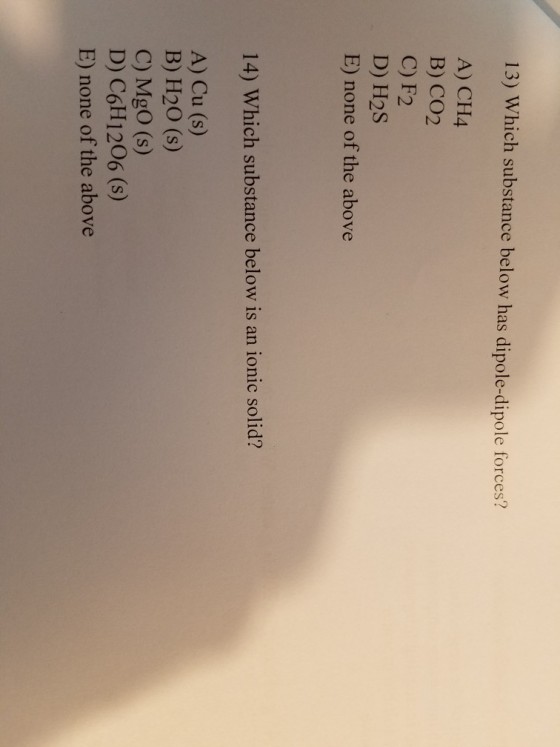
please answer and explain
thanks
Homework Answers

Add Answer to:
please answer and explain
thanks
13) Which substance below has dipole-dipole forces? A) CH4 B) CO2...
9. Which intermolecular forces are found in CO2? A) dispersion forces and dipole-dipole forces B) hydrogen bonding  
9. Which intermolecular forces are found in CO2? A) dispersion forces and dipole-dipole forces B) hydrogen bonding C) dipole-dipole forces D) dispersion forces E) none of the above
Which of the following molecules is nonpolar? a. H2 b. HF c. HCl d. HI e....
Which of the following molecules is nonpolar? a. H2 b. HF c. HCl d. HI e. HBr Which of the following molecules can participate in Hydrogen bonding? a. HF b. CO2 c. CH4 d. H2S Which of the following molecules is polar? a. H2O b. CO2 c. CH4 d. N2 e. None of the above In lab, temperature changes caused by ________________ of liquids will be related to the strength of intermolecular forces. a. Evaporation b. Mass c. Density d....
9. Large intermolecular forces in a substance A) low vapor pressure B) high boiling point C)...
 9. Large intermolecular forces in a substance A) low vapor pressure B) high boiling point C) high heats of fusion and vaporization O) high critical temperatures and pressures E) all of the above are manifested by 10. Of the following A) CBr4 is the most volatile. B) CCl4 C) CH4 D) CF4 E) C6H14 Refer to the phase diagram below to complete questions 11-13 1.5 P (atm) 1.0 0.5 0 100-1-20 30 40 50 6070 T C'C) 11. What is...
37. Which of the following substances has bonding best described as ionic bonding? A) SiO2 B)...
 37. Which of the following substances has bonding best described as ionic bonding? A) SiO2 B) NO2 C) S02 D) CO2 E) A1203 38. Which of the following compounds is likely to occur as a liquid at room temperature? A) CaF2 B) Mgo C) C3H12 D) FeCl3 E) LiF --* 39. Which of the following compounds is likely to occur as a solid at room temperature? A) CH4 B) SO2 C) N2 D) FeCl3 E) H20
Match the following 81) Lil+H2O A) dispersion forces 82) CH2F2 B) dipole-dipole forces 83) LII C)...
 Match the following 81) Lil+H2O A) dispersion forces 82) CH2F2 B) dipole-dipole forces 83) LII C) ionic bond 84) CH3 CH3 D) H2 + H20 E) ion-dipole forces 85) CH3OH F) hydrogen bonding
Please help me with questions 1-7? Thanks! :) CE112-03 Name: January 27, 2016 Spring 2016 Quiz...
 Please help me with questions 1-7? Thanks! :)
CE112-03 Name: January 27, 2016 Spring 2016 Quiz 1 Due Date: January 29, 2016 1. Which pair of the following materials has London dispersion forces as the only intermolecular forces? A. Kr, CH4. B. H20, HCI C. NH3. C6H 13NH2 D. AlF3, H3COCH3 E. CH3CI, NaBr 2. When NaCl dissolves in water, aqueous Nat and Cl- ions result, The force of attraction that exists between Nat ions and H20 molecules is called...
Please help me with questions 1-7? Thanks! :)
CE112-03 Name: January 27, 2016 Spring 2016 Quiz 1 Due Date: January 29, 2016 1. Which pair of the following materials has London dispersion forces as the only intermolecular forces? A. Kr, CH4. B. H20, HCI C. NH3. C6H 13NH2 D. AlF3, H3COCH3 E. CH3CI, NaBr 2. When NaCl dissolves in water, aqueous Nat and Cl- ions result, The force of attraction that exists between Nat ions and H20 molecules is called...
12) 12) As defined in the text, identify the "gas evolution" reactions among the following 1. 2HCl(aq) +K2CO3(aq) -...
 12) 12) As defined in the text, identify the "gas evolution" reactions among the following 1. 2HCl(aq) +K2CO3(aq) --H2O(l) + CO2(g) + 2Cl(aq) 2. CH4(g)+202(g) + CO2(g) + 2H2O(1) 3. 2HCl(aq) +K2S(aq) -- H2S(g)+2KCl(aq) A) 1 and 2 only B) 1 and 3 only C) 2 and 3 only D) All of 1, 2, and 3 E) None of 1, 2, and 3 13) 13) Identify the oxidation-reduction reactions among the following: 1. Zn(s)+Cu2(aq) -- Zn2+aq) + Cu(s) 2. 2...
8:59 Question 14 of 16 Submit Which of the following exhibits dipole-dipole intermolecular forces? A) BF...
 8:59 Question 14 of 16 Submit Which of the following exhibits dipole-dipole intermolecular forces? A) BF B) CO2 C) NH, D) Brz E) CF.
42) Which of the following compounds will be affected by the presence of an electric field...
 42) Which of the following compounds will be affected by the presence of an electric field AH2 B) 02 C) HCI D) N2 43) In which of the three phases of matter would you expect hydrogen bonding between watet molecules to be the strongest? (A) solid phase (H20 Os very close together) B) liquid phase (H20 Os more separated than solid phase) C) gas phase (H20 Os much farther apart than liquid phase) D) It is equally strong in all...
Hydrogen bonds are essentially a stronger version of which int force? 5. a. Ion-dipole forces b....
 Hydrogen bonds are essentially a stronger version of which int force? 5. a. Ion-dipole forces b. London forces c. Dipole-dipole foces d. lon-ion forces 6. Increasing the pressure by 1000-fold on a solid or liquid dramatically decreases its volume. a. causes it to undergo thermal expansion. b. significantly decreases the density. c. does not have a significant effect on the volume. d. 7. A gas at 550 torr and 1.2 liters is allowed to expand to 4.3 liters. What is...
 9. Large intermolecular forces in a substance A) low vapor pressure B) high boiling point C) high heats of fusion and vaporization O) high critical temperatures and pressures E) all of the above are manifested by 10. Of the following A) CBr4 is the most volatile. B) CCl4 C) CH4 D) CF4 E) C6H14 Refer to the phase diagram below to complete questions 11-13 1.5 P (atm) 1.0 0.5 0 100-1-20 30 40 50 6070 T C'C) 11. What is...
 37. Which of the following substances has bonding best described as ionic bonding? A) SiO2 B) NO2 C) S02 D) CO2 E) A1203 38. Which of the following compounds is likely to occur as a liquid at room temperature? A) CaF2 B) Mgo C) C3H12 D) FeCl3 E) LiF --* 39. Which of the following compounds is likely to occur as a solid at room temperature? A) CH4 B) SO2 C) N2 D) FeCl3 E) H20
 Match the following 81) Lil+H2O A) dispersion forces 82) CH2F2 B) dipole-dipole forces 83) LII C) ionic bond 84) CH3 CH3 D) H2 + H20 E) ion-dipole forces 85) CH3OH F) hydrogen bonding
 Please help me with questions 1-7? Thanks! :)
CE112-03 Name: January 27, 2016 Spring 2016 Quiz 1 Due Date: January 29, 2016 1. Which pair of the following materials has London dispersion forces as the only intermolecular forces? A. Kr, CH4. B. H20, HCI C. NH3. C6H 13NH2 D. AlF3, H3COCH3 E. CH3CI, NaBr 2. When NaCl dissolves in water, aqueous Nat and Cl- ions result, The force of attraction that exists between Nat ions and H20 molecules is called...
Please help me with questions 1-7? Thanks! :)
CE112-03 Name: January 27, 2016 Spring 2016 Quiz 1 Due Date: January 29, 2016 1. Which pair of the following materials has London dispersion forces as the only intermolecular forces? A. Kr, CH4. B. H20, HCI C. NH3. C6H 13NH2 D. AlF3, H3COCH3 E. CH3CI, NaBr 2. When NaCl dissolves in water, aqueous Nat and Cl- ions result, The force of attraction that exists between Nat ions and H20 molecules is called...
 12) 12) As defined in the text, identify the "gas evolution" reactions among the following 1. 2HCl(aq) +K2CO3(aq) --H2O(l) + CO2(g) + 2Cl(aq) 2. CH4(g)+202(g) + CO2(g) + 2H2O(1) 3. 2HCl(aq) +K2S(aq) -- H2S(g)+2KCl(aq) A) 1 and 2 only B) 1 and 3 only C) 2 and 3 only D) All of 1, 2, and 3 E) None of 1, 2, and 3 13) 13) Identify the oxidation-reduction reactions among the following: 1. Zn(s)+Cu2(aq) -- Zn2+aq) + Cu(s) 2. 2...
 8:59 Question 14 of 16 Submit Which of the following exhibits dipole-dipole intermolecular forces? A) BF B) CO2 C) NH, D) Brz E) CF.
 42) Which of the following compounds will be affected by the presence of an electric field AH2 B) 02 C) HCI D) N2 43) In which of the three phases of matter would you expect hydrogen bonding between watet molecules to be the strongest? (A) solid phase (H20 Os very close together) B) liquid phase (H20 Os more separated than solid phase) C) gas phase (H20 Os much farther apart than liquid phase) D) It is equally strong in all...
 Hydrogen bonds are essentially a stronger version of which int force? 5. a. Ion-dipole forces b. London forces c. Dipole-dipole foces d. lon-ion forces 6. Increasing the pressure by 1000-fold on a solid or liquid dramatically decreases its volume. a. causes it to undergo thermal expansion. b. significantly decreases the density. c. does not have a significant effect on the volume. d. 7. A gas at 550 torr and 1.2 liters is allowed to expand to 4.3 liters. What is...
Most questions answered within 3 hours.
-
Where is the error in this code sequence?
String s1 = "Hello";
String s2 = "ello";...
asked 10 months ago -
Financial data for Joel de Paris, Inc., for last year
follow:
Joel de Paris, Inc.
Balance...
asked 10 months ago -
Consider this reaction:
Al2(SO4)3 (aq)+ BaCl3
(aq) Al2Cl6 (aq)- +
3BaSO4(s) . What is the...
asked 10 months ago -
Suppose that Savneet is considering increasing her
recent random sample from 20 car rentals to 40...
asked 10 months ago -
Trucks arrive at an unloading terminal at an average rate of 120
per hour.
Trucks arrive...
asked 10 months ago -
Why are methanol and ethanol completely soluble in water while
octanol is not very little soluble....
asked 10 months ago -
A facilities manager at a university reads in a research report
that the mean amount of...
asked 10 months ago -
When the CuSO4 is rehydrated by adding water to the anhydrous
compound, is this an endothermic...
asked 10 months ago -
A ray of sunlight is passing from diamond into crown glass; the
angle of incidence is...
asked 10 months ago -
A block of mass 0.249 kg is placed on top of a light, vertical
spring of...
asked 10 months ago -
how do the kidneys compensate in the presences of acidosis
a) trigger hyperventilate
b) reserve acid...
asked 10 months ago -
Question 501 pts
The rental rate of capital to the firm increases. Which of the
following...
asked 10 months ago