What is the niche of each of the four Eukaryotic Kingdoms (Animalia, Fungi, Plantae and Protista)?
What is the niche of each of the four Eukaryotic Kingdoms (Animalia, Fungi, Plantae and Protista)?
Homework Answers
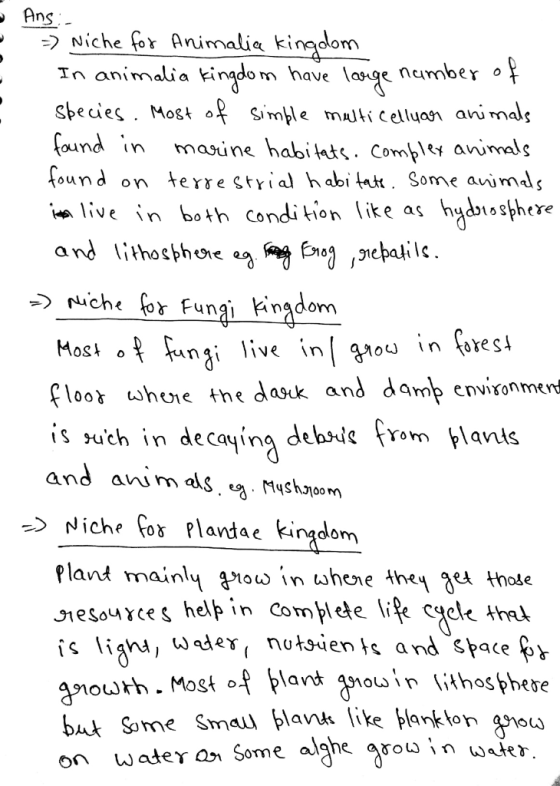
 Ans- Animalia kingdom mostly
found on lithosphere and hydrosphere.
Ans- Animalia kingdom mostly
found on lithosphere and hydrosphere.
Fungi kingdom found on decay materials.
Plantae kingdom most of on lithosphere but some also in hydrosphere.
Protista kingdom most of in damp soil and hydrosphere.
Add Answer to:
What is the niche of each of the four Eukaryotic Kingdoms
(Animalia, Fungi, Plantae and Protista)?
Most of the organisms in which group are photosynthetic and multicellular. (Pick only one). Animalia Plantae...
 Most of the organisms in which group are photosynthetic and
multicellular. (Pick only one).
Animalia
Plantae
Arachaea
Protista
Fungi
QUESTION 6 Most of the organisms in which group are photosynthetic and multicellular. Animalia Plantae Arachaea Protista Fungi
Most of the organisms in which group are photosynthetic and
multicellular. (Pick only one).
Animalia
Plantae
Arachaea
Protista
Fungi
QUESTION 6 Most of the organisms in which group are photosynthetic and multicellular. Animalia Plantae Arachaea Protista Fungi
Molecular and DNA evidence supports the hypothesis that Kingdom fungi and Kingdom Animalia share a more...
Molecular and DNA evidence supports the hypothesis that Kingdom fungi and Kingdom Animalia share a more recent common ancestor with each other than with Kingdom Plantae. What is a shared derived characteristic these two kingdoms share? What would be a derived characteristic for each kingdom that is not shared by the other? Shared derived character: Fungi have : Animalia have:
In this assignment, you will summarize the differences between the four Eukaryotic Kingdoms into a table...
 In this assignment, you will summarize the differences between the four Eukaryotic Kingdoms into a table See the note below the table for information regarding "Kingdom Protista, Once you are satisfied with your table, submit it as usual as an attached file. Be sure to include the assignment name and your name on your document. The assignment will be evaluated based on completeness and accuracy. Total value of this assignment is 19 marks You may want to copy and paste...
PRELAB QUESTIONS Animalia: Ctenophores, Poriferans, Crida selline 1. What do the fungi, choanoflagellates, and animals have...
 PRELAB QUESTIONS Animalia: Ctenophores, Poriferans, Crida selline 1. What do the fungi, choanoflagellates, and animals have in common? 2. The animals are often described as being "eukaryotic, multicellular heterotrophs". What does this mean? 3. 4. Approximately – _% of all animals are vertebrates. Refer to the figure below. Name the 2 animal phyla that 1) exhibit radial symmetry and 2) have a body consisting of two layers are diploblastie)? Com - Crorocytes spis Uroductions Chapter 31 Bal symmetry song anterior...
please answer just 90-93. thanks! R6.What do "fimbriae" of bacteria do? A) catch food B) absorbing...
 please answer just 90-93. thanks!
R6.What do "fimbriae" of bacteria do? A) catch food B) absorbing liquid food. c) sticking to a substrate D) help in sexual reproduction. E) all of the above t is the evolutionary advantage of closed circulatory system over an open circulatory system? A) open circulatory system are subject to contamination from the environment. B) blood pressure is higher in an open circulatory system. ci blood in a closed circulatory system can be shunted where it...
please answer just 90-93. thanks!
R6.What do "fimbriae" of bacteria do? A) catch food B) absorbing liquid food. c) sticking to a substrate D) help in sexual reproduction. E) all of the above t is the evolutionary advantage of closed circulatory system over an open circulatory system? A) open circulatory system are subject to contamination from the environment. B) blood pressure is higher in an open circulatory system. ci blood in a closed circulatory system can be shunted where it...
1. What characteristic does not describe both plants and fungi? a) Cell wall b) Eukaryotic c)...
 1. What characteristic does not describe both plants and fungi? a) Cell wall b) Eukaryotic c) Stationary d) Mostly multicellular e) Photosynthetic 2. Which of the following does not describe plants? a) Photosynthetic b) Eukaryotic c) Cell wall made of cellulose d) Non-motile e) Heterotrophic 3. Which of the following is a characteristic of fungi? a) Photosynthetic b) Motile c) Mostly unicellular d) Prokaryotic e) Cell wall made of chitin
What are the three domains of life? Are humans prokaryotic or eukaryotic? What are the four...
What are the three domains of life? Are humans prokaryotic or eukaryotic? What are the four elements that make up ~96% of the human body? Name the four properties that make water such a cool molecule for life. Does molecule shape have any importance in biology? Oil is considered to be _________________________ (hydrophobic/hydrophilic)
What are the four common core promoter elements for eukaryotic genes transcribed by RNA polymerase II?...
What are the four common core promoter elements for eukaryotic genes transcribed by RNA polymerase II? Must all of these elements be present in the promoter for transcription of every gene to occur? Explain
QUESTION 32 2.5 points Save Answer Bacteria and archaea are both classified as Oa. prokaryotes. b....
 QUESTION 32 2.5 points Save Answer Bacteria and archaea are both classified as Oa. prokaryotes. b. protists. c. eukaryotes. d. fungi QUESTION 33 2.5 points Save Answer Prokaryotes are capable of reproducing more rapidly than eukaryotes because prokaryotes a. use asexual reproduction. b. have smaller ribosomes c. have less genetic material d. have more flexible plasma membranes. QUESTION 34 2.5 points Save Answer Speciation a. can result from geographic isolation. b.occurs in the absence of genetic divergence. Oc. occurs only...
Part A What is the type of each eukaryotic protein that primarily transcribes mRNA, RNA, and...
 Part A What is the type of each eukaryotic protein that primarily transcribes mRNA, RNA, and rRNA, respectively? O RNA Polymerase I, III, II O RNA Polymerase II, I, III O RNA Polymerase I, II, III RNA Polymerase II, III, I O RNA Polymerase III, II, I Submit Request Answer Provide Feedback
 Most of the organisms in which group are photosynthetic and
multicellular. (Pick only one).
Animalia
Plantae
Arachaea
Protista
Fungi
QUESTION 6 Most of the organisms in which group are photosynthetic and multicellular. Animalia Plantae Arachaea Protista Fungi
Most of the organisms in which group are photosynthetic and
multicellular. (Pick only one).
Animalia
Plantae
Arachaea
Protista
Fungi
QUESTION 6 Most of the organisms in which group are photosynthetic and multicellular. Animalia Plantae Arachaea Protista Fungi
 In this assignment, you will summarize the differences between the four Eukaryotic Kingdoms into a table See the note below the table for information regarding "Kingdom Protista, Once you are satisfied with your table, submit it as usual as an attached file. Be sure to include the assignment name and your name on your document. The assignment will be evaluated based on completeness and accuracy. Total value of this assignment is 19 marks You may want to copy and paste...
 PRELAB QUESTIONS Animalia: Ctenophores, Poriferans, Crida selline 1. What do the fungi, choanoflagellates, and animals have in common? 2. The animals are often described as being "eukaryotic, multicellular heterotrophs". What does this mean? 3. 4. Approximately – _% of all animals are vertebrates. Refer to the figure below. Name the 2 animal phyla that 1) exhibit radial symmetry and 2) have a body consisting of two layers are diploblastie)? Com - Crorocytes spis Uroductions Chapter 31 Bal symmetry song anterior...
 please answer just 90-93. thanks!
R6.What do "fimbriae" of bacteria do? A) catch food B) absorbing liquid food. c) sticking to a substrate D) help in sexual reproduction. E) all of the above t is the evolutionary advantage of closed circulatory system over an open circulatory system? A) open circulatory system are subject to contamination from the environment. B) blood pressure is higher in an open circulatory system. ci blood in a closed circulatory system can be shunted where it...
please answer just 90-93. thanks!
R6.What do "fimbriae" of bacteria do? A) catch food B) absorbing liquid food. c) sticking to a substrate D) help in sexual reproduction. E) all of the above t is the evolutionary advantage of closed circulatory system over an open circulatory system? A) open circulatory system are subject to contamination from the environment. B) blood pressure is higher in an open circulatory system. ci blood in a closed circulatory system can be shunted where it...
 1. What characteristic does not describe both plants and fungi? a) Cell wall b) Eukaryotic c) Stationary d) Mostly multicellular e) Photosynthetic 2. Which of the following does not describe plants? a) Photosynthetic b) Eukaryotic c) Cell wall made of cellulose d) Non-motile e) Heterotrophic 3. Which of the following is a characteristic of fungi? a) Photosynthetic b) Motile c) Mostly unicellular d) Prokaryotic e) Cell wall made of chitin
 QUESTION 32 2.5 points Save Answer Bacteria and archaea are both classified as Oa. prokaryotes. b. protists. c. eukaryotes. d. fungi QUESTION 33 2.5 points Save Answer Prokaryotes are capable of reproducing more rapidly than eukaryotes because prokaryotes a. use asexual reproduction. b. have smaller ribosomes c. have less genetic material d. have more flexible plasma membranes. QUESTION 34 2.5 points Save Answer Speciation a. can result from geographic isolation. b.occurs in the absence of genetic divergence. Oc. occurs only...
 Part A What is the type of each eukaryotic protein that primarily transcribes mRNA, RNA, and rRNA, respectively? O RNA Polymerase I, III, II O RNA Polymerase II, I, III O RNA Polymerase I, II, III RNA Polymerase II, III, I O RNA Polymerase III, II, I Submit Request Answer Provide Feedback
Most questions answered within 3 hours.
-
Where is the error in this code sequence?
String s1 = "Hello";
String s2 = "ello";...
asked 11 months ago -
Financial data for Joel de Paris, Inc., for last year
follow:
Joel de Paris, Inc.
Balance...
asked 11 months ago -
Consider this reaction:
Al2(SO4)3 (aq)+ BaCl3
(aq) Al2Cl6 (aq)- +
3BaSO4(s) . What is the...
asked 11 months ago -
Suppose that Savneet is considering increasing her
recent random sample from 20 car rentals to 40...
asked 11 months ago -
Trucks arrive at an unloading terminal at an average rate of 120
per hour.
Trucks arrive...
asked 11 months ago -
Why are methanol and ethanol completely soluble in water while
octanol is not very little soluble....
asked 11 months ago -
A facilities manager at a university reads in a research report
that the mean amount of...
asked 11 months ago -
When the CuSO4 is rehydrated by adding water to the anhydrous
compound, is this an endothermic...
asked 11 months ago -
A ray of sunlight is passing from diamond into crown glass; the
angle of incidence is...
asked 11 months ago -
A block of mass 0.249 kg is placed on top of a light, vertical
spring of...
asked 11 months ago -
how do the kidneys compensate in the presences of acidosis
a) trigger hyperventilate
b) reserve acid...
asked 11 months ago -
Question 501 pts
The rental rate of capital to the firm increases. Which of the
following...
asked 11 months ago