define the accomplishments of women rights movement
Homework Answers
Answer-
-Here’s a look at some of the major accomplishments of the women’s movement over the years:
•1850: The Women’s Movement Gets Organized
Two years after the famous Seneca Falls Convention, which helped define what the women’s movement would entail, the first National Women’s Rights Convention took place in Massachusetts. Over 1,000 people attended, and the convention became an annual event.
•1893: States Begin to Grant Women the Right to Vote
Colorado becomes the first state to adopt an amendment granting women the right to vote. Utah and Idaho followed in 1896. In 1910, Washington state jumped on board, along with California in 1911, and Kansas, Oregon and Arizona in 1912.
•1903: A Union Is Formed for Working Women
The National Women’s Trade Union League was formed to “assist in the organization of women wage workers into trade unions and thereby to help them secure conditions necessary for healthful and efficient work and to obtain a just reward for such work.” The effort bonded women across economic and social divides, attracting “a coalition of working-class women, professional reformers, and women from wealthy and prominent families.”
•1916: Women Gain Access to Birth Control
As a nurse in immigrant communities, Margaret Sanger met many women who experienced multiple childbirths, miscarriages and self-induced abortions because they lacked the proper information about how to avoid unwanted pregnancy. She decided to take matters into her own hands, opening up the first family planning and birth control clinic in Brooklyn, New York. While she faced initial challenges with this first clinic, her idea eventually evolved into Planned Parenthood.
•1920: The 19th Amendment Becomes Law
Congress finally ratified the 19th Amendment in 1920, granting women across the United States the right to vote and moving one step closer toward equality for women.
•1963: Congress Passes the Equal Pay Act
President John F. Kennedy appointed Eleanor Roosevelt chairwoman of the President’s Commission on the Status of Women in 1961, and a report published by the commission in 1963 found “substantial discrimination against women in the workplace.” As a result, Congress passed the Equal Pay Act, aimed at eradicating the pay gap between men and women.
•1972: Title IX Brings Equal Opportunity to Education
Title IX, now known as the Patsy Mink Equal Opportunity in Education Act, was authored by Senator Birch Bayh of Indiana. It brought greater educational opportunities to women. The 1964 Civil Rights Act included gender equality, but it left out public education. Title IX had an especially significant impact on American sports because it required high schools and colleges to provide equal opportunities for female athletes. The landmark legislation is credited with greatly increasing the participation of young women in sports.
•2013: Ban on Women in Combat Is Lifted
Defense Secretary Leon Panetta petitioned the Joint Chiefs of Staff to reverse a 1994 rule that prevented women from serving in combat. The result? An announcement from Chairman Gen. Martin Dempsey that said, “The time has come to rescind the direct combat exclusion rule for women and to eliminate all unnecessary gender-based barriers to service.”
Please like my answer..
1. Compare the disabled rights movement to the civil rights movement. Discuss the connection between the...
1. Compare the disabled rights movement to the civil rights movement. Discuss the connection between the civil rights movement to secure the rights of African-Americans to the rights movement that fought for the rights of persons with disabilities. 2. Find an article relating to the struggle of persons with disabilities to achieve equal rights in any one of the areas mentioned above. (Please no articles on the ADA as we will focus on legal aspects later in the course). Summarize...
Choose the statement that best describes the Civil Rights movement Although well-intentioned, the Civil Rights movement...
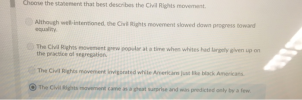 Choose the statement that best describes the Civil Rights movement Although well-intentioned, the Civil Rights movement slowed down progress toward equality. The Civil Rights movement grew popular at a time when whites had largely given up on the practice of segregation The Civil Rights movement invigorated white Americans just like black Americans O The Civil Rights movement came as a great surprise and was predicted only by a few
Write a case study on History of the LGBT rights movement?
Write a case study on History of the LGBT rights movement?
Question 87 The prominence of women in the reform movement can be seen in... Fewer women...
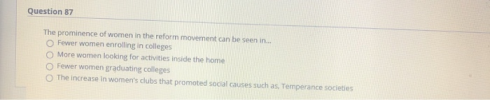 Question 87 The prominence of women in the reform movement can be seen in... Fewer women enrolling in colleges More women looking for activities inside the home Fewer women graduating colleges The increase in women's clubs that promoted social causes such as, Temperance societies
Why was the federal government reluctant to fully support the civil rights movement? What role did...
Why was the federal government reluctant to fully support the civil rights movement? What role did the federal government eventually play in the civil rights movement?
How did the movement for women’s rights in the 19th and early 20th centuries compare to...
How did the movement for women’s rights in the 19th and early 20th centuries compare to the women’s liberation movement of the 1960s-1970s?
Is the U.N. Universal Declaration of Human Rights movement in the right direction, or an example...
Is the U.N. Universal Declaration of Human Rights movement in the right direction, or an example of their bureaucratic meddling undermining the Doctrine of Comity?
Who was A. Philip Randolph? What are two contributions he made to the Civil Rights Movement...
Who was A. Philip Randolph? What are two contributions he made to the Civil Rights Movement between 1920 and 1964?
9. Explain the direct non-violent action campaigns of the Civil Rights movement of the 1960s Be sure to identify important figures, events, and explain how the movement aggressively confronted ra...
 9. Explain the direct non-violent action campaigns of the Civil Rights movement of the 1960s Be sure to identify important figures, events, and explain how the movement aggressively confronted racism to turn U.S. publie opinion against Jim Crow segregation.
9. Explain the direct non-violent action campaigns of the Civil Rights movement of the 1960s Be sure to identify important figures, events, and explain how the movement aggressively confronted racism to turn U.S. publie opinion against Jim Crow segregation.
9. Explain the direct non-violent action campaigns of the Civil Rights movement of the 1960s Be sure to identify important figures, events, and explain how the movement aggressively confronted racism to turn U.S. publie opinion against Jim Crow segregation.
Investigate the positions of black Conservatives who remain critical of the goals of the Civil Rights Movement and the G...
Investigate the positions of black Conservatives who remain critical of the goals of the Civil Rights Movement and the Great Society.
 Choose the statement that best describes the Civil Rights movement Although well-intentioned, the Civil Rights movement slowed down progress toward equality. The Civil Rights movement grew popular at a time when whites had largely given up on the practice of segregation The Civil Rights movement invigorated white Americans just like black Americans O The Civil Rights movement came as a great surprise and was predicted only by a few
 Question 87 The prominence of women in the reform movement can be seen in... Fewer women enrolling in colleges More women looking for activities inside the home Fewer women graduating colleges The increase in women's clubs that promoted social causes such as, Temperance societies
 9. Explain the direct non-violent action campaigns of the Civil Rights movement of the 1960s Be sure to identify important figures, events, and explain how the movement aggressively confronted racism to turn U.S. publie opinion against Jim Crow segregation.
9. Explain the direct non-violent action campaigns of the Civil Rights movement of the 1960s Be sure to identify important figures, events, and explain how the movement aggressively confronted racism to turn U.S. publie opinion against Jim Crow segregation.
9. Explain the direct non-violent action campaigns of the Civil Rights movement of the 1960s Be sure to identify important figures, events, and explain how the movement aggressively confronted racism to turn U.S. publie opinion against Jim Crow segregation.
Most questions answered within 3 hours.
-
Where is the error in this code sequence?
String s1 = "Hello";
String s2 = "ello";...
asked 11 months ago -
Financial data for Joel de Paris, Inc., for last year
follow:
Joel de Paris, Inc.
Balance...
asked 11 months ago -
Consider this reaction:
Al2(SO4)3 (aq)+ BaCl3
(aq) Al2Cl6 (aq)- +
3BaSO4(s) . What is the...
asked 11 months ago -
Suppose that Savneet is considering increasing her
recent random sample from 20 car rentals to 40...
asked 11 months ago -
Trucks arrive at an unloading terminal at an average rate of 120
per hour.
Trucks arrive...
asked 11 months ago -
Why are methanol and ethanol completely soluble in water while
octanol is not very little soluble....
asked 11 months ago -
A facilities manager at a university reads in a research report
that the mean amount of...
asked 11 months ago -
When the CuSO4 is rehydrated by adding water to the anhydrous
compound, is this an endothermic...
asked 11 months ago -
A ray of sunlight is passing from diamond into crown glass; the
angle of incidence is...
asked 11 months ago -
A block of mass 0.249 kg is placed on top of a light, vertical
spring of...
asked 11 months ago -
how do the kidneys compensate in the presences of acidosis
a) trigger hyperventilate
b) reserve acid...
asked 11 months ago -
Question 501 pts
The rental rate of capital to the firm increases. Which of the
following...
asked 11 months ago