How can Glutamate depolarize or hyperpolarize bipolar cells?
How can Glutamate depolarize or hyperpolarize bipolar cells?
Homework Answers
The functioning of bipolar cells depends on two mechanisms. First, the continuous release of glutamate from photoreceptors in the dark depolarizes some bipolar cells and hyperpolarizes other cells, depending on whether the cells have excitatory or inhibitory glutamate receptors. Second, light causes photoreceptors to be hyperpolarized, thereby reducing glutamate release.
Glutamate binds to specific receptor present on the bipolar cells, these receptors are associated with types of ion channels. Depending on the kinds of ion channels present, the bipolar cell may become depolarized (as do most neurons when glutamate is released), or it may become hyperpolarized.
Hair cells in the endolymph hyperpolarize and depolarize as a result of the activity of their...
Hair cells in the endolymph hyperpolarize and depolarize as a result of the activity of their ____ channels. A. Mechanically gated calcium B. Voltage-dependent sodium C. Transmitter-gated potassium D. Mechanically gated potassium
Question 8 0.5 pts In photoreceptors, in the presence of light, injection of cGMP would: depolarize...
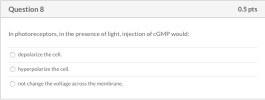 Question 8 0.5 pts In photoreceptors, in the presence of light, injection of cGMP would: depolarize the cell. hyperpolarize the cell. not change the voltage across the membrane.
Decide if these retinal events occur in the dark or in the light. Rods continuously release...
 Decide if these retinal events occur in the dark or in the light. Rods continuously release the neurotransmitter glutamate. Glutamate inhibits the bipolar cells that synapse with the rods. The bipolar cells do not stimulate the ganglion cells. Activated rhodopsin inhibits the product on of glutamate by rods. The bipolar cells stimulate the ganglion cells. Action potentials are transmitted out of the optic nerve.
If an Inhibitory Interneuron is stimulated & generates an Action Potential, it will: A. first hyperpolarize,...
If an Inhibitory Interneuron is stimulated & generates an Action Potential, it will: A. first hyperpolarize, and then release a neurotransmitter B. release a neurotransmitter that hyperpolarizes the postsynpatic cells C. release an enzyme that hydrolyzes an excitatory neurotransmitter D. release a neurotransmitter that depolarizes the postsynpatic cells E. Inhibitory Interneurons can not depolarize and conduct action potentials
How can the glutamate induced down regulation of GABA B receptors be specific?
How can the glutamate induced down regulation of GABA B receptors be specific?
Graded potentials may: W. initiate an action potential. X. depolarize the membrane to the threshold voltage....
Graded potentials may: W. initiate an action potential. X. depolarize the membrane to the threshold voltage. Y. hyperpolarize the membrane. Z. be called EPSPs or IPSPs. Select one: a. if only W, X and Y are correct b. if only W and Y are correct c. if only X and Z are correct d. if only Z is correct e. if all are correct Feedback The correct answer is: if all are correct explanations all options plz abcde short answer
The neurons of the retina that sense light include what? A. Cones B. Bipolar cells C....
The neurons of the retina that sense light include what? A. Cones B. Bipolar cells C. Amacrine cells D. Rods E. Optic nerve cells
Explain how the base width of a bipolar transistor is determined in the standard bipolar fabrication...
Explain how the base width of a bipolar transistor is determined in the standard bipolar fabrication process.
18. The carbon atoms of glutamate can enter the citric acid cycle after transamination to the...
 18. The carbon atoms of glutamate can enter the citric acid cycle after transamination to the corresponding a-keto acid (see question #7). When [a-14C]-glutamate undergoes transamination, what is the labeling pattern (if any) in the succinate generated immediately from the labeled glutamate? A. 2014C-CH=CHCOO is produced from la calutamate A. None, OOC-CH2-CH2-COO is produced from [a-14C]-glutamate B. 0014C-CH=14CH-COO is produced from [a-14C]-glutamate C. OOC-14CH2-14CH2-COO is produced from [a-14C]-glutamate D. 0014C-CH2-CH2-14COO is produced from [a-14C]-glutamate E. OOC-14C0-14CH2-COO is produced from [a-14C]-glutamate
How can stem cells replace faulty cells in the body? Multiple Choice Stem cells can be...
How can stem cells replace faulty cells in the body? Multiple Choice Stem cells can be coaxed to differentiate into the needed specific cell type. Stem cells can mitotically divide, providing more stem cells to directly replace the faulty cells and their functions. Stem cells can meiotically divide, providing more stem cells to directly replace the faulty cells and their functions. Faulty cells can be coaxed to differentiate into stem cells and directly replace the faulty cells and their functions....
 Question 8 0.5 pts In photoreceptors, in the presence of light, injection of cGMP would: depolarize the cell. hyperpolarize the cell. not change the voltage across the membrane.
 Decide if these retinal events occur in the dark or in the light. Rods continuously release the neurotransmitter glutamate. Glutamate inhibits the bipolar cells that synapse with the rods. The bipolar cells do not stimulate the ganglion cells. Activated rhodopsin inhibits the product on of glutamate by rods. The bipolar cells stimulate the ganglion cells. Action potentials are transmitted out of the optic nerve.
 18. The carbon atoms of glutamate can enter the citric acid cycle after transamination to the corresponding a-keto acid (see question #7). When [a-14C]-glutamate undergoes transamination, what is the labeling pattern (if any) in the succinate generated immediately from the labeled glutamate? A. 2014C-CH=CHCOO is produced from la calutamate A. None, OOC-CH2-CH2-COO is produced from [a-14C]-glutamate B. 0014C-CH=14CH-COO is produced from [a-14C]-glutamate C. OOC-14CH2-14CH2-COO is produced from [a-14C]-glutamate D. 0014C-CH2-CH2-14COO is produced from [a-14C]-glutamate E. OOC-14C0-14CH2-COO is produced from [a-14C]-glutamate
Most questions answered within 3 hours.
-
Where is the error in this code sequence?
String s1 = "Hello";
String s2 = "ello";...
asked 11 months ago -
Financial data for Joel de Paris, Inc., for last year
follow:
Joel de Paris, Inc.
Balance...
asked 11 months ago -
Consider this reaction:
Al2(SO4)3 (aq)+ BaCl3
(aq) Al2Cl6 (aq)- +
3BaSO4(s) . What is the...
asked 11 months ago -
Suppose that Savneet is considering increasing her
recent random sample from 20 car rentals to 40...
asked 11 months ago -
Trucks arrive at an unloading terminal at an average rate of 120
per hour.
Trucks arrive...
asked 11 months ago -
Why are methanol and ethanol completely soluble in water while
octanol is not very little soluble....
asked 11 months ago -
A facilities manager at a university reads in a research report
that the mean amount of...
asked 11 months ago -
When the CuSO4 is rehydrated by adding water to the anhydrous
compound, is this an endothermic...
asked 11 months ago -
A ray of sunlight is passing from diamond into crown glass; the
angle of incidence is...
asked 11 months ago -
A block of mass 0.249 kg is placed on top of a light, vertical
spring of...
asked 11 months ago -
how do the kidneys compensate in the presences of acidosis
a) trigger hyperventilate
b) reserve acid...
asked 11 months ago -
Question 501 pts
The rental rate of capital to the firm increases. Which of the
following...
asked 11 months ago