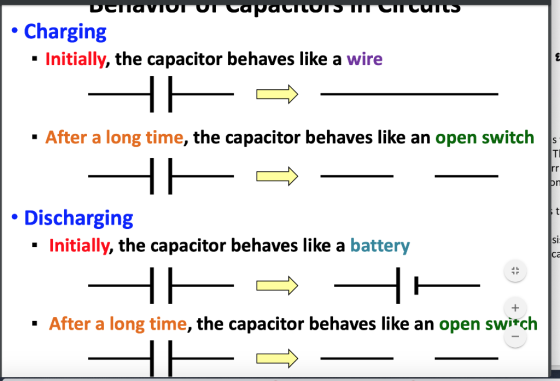
I want to know the behavior of a capacitor which is connected to a battery and a resistor after time t=0. The only thing is that the capacitor carries an INITIAL CHARGE of some columns. will the capacitor act as a wire or battery. please explain well.
Homework Answers
As you say in the circuit there will be the only battery, resistor, and capacitor at time t=0. Then as we close the switch of the circuit, the capacitor starts to charge i.e. current flows and the potential difference across the capacitor starts to rise. Then after a long time when the capacitor is fully charged it acts as an open switch.
As the circuit contain resistance it just increases the charging time of the capacitor. The higher the resistor the longer the time taken by the capacitor to charge.
As we know, Capacitors don't store the charge. In fact, the capacitor stores an imbalance of charge.
i.e.

Then the capacitor with INITIAL CHARGE of some columns will act as a small pseudo battery which discharges quickly.
Note: Capacitors don't store energy but supercapacitors can do.
Add Answer to:
I want to know the behavior of a capacitor which is connected to
a battery and...
A 10-V-emf battery is connected in series with the following: a 2-uF capacitor, a 2- resistor,...
A 10-V-emf battery is connected in series with the following: a 2-uF capacitor, a 2- resistor, an ammeter, and a switch, initially open; a voltmeter is connected in parallel across the capacitor. After the switch has been closed for a relatively long period(several seconds, say) what are the current and capacitor voltage readings respectively
How do I do all parts above? A battery, capacitor, resistor, and switch are connected as...
 How do I do all parts above?
A battery, capacitor, resistor, and switch are connected as shown. The capacitor is initially uncharged, and the switch is closed at a time t = t_0. Recall that charges cannot flow across the gap between capacitor plates. Just after the switch is closed, what is the potential difference across the resistor and capacitor? Assume the charge on the capacitor at this instant is still zero. In the space below, draw and label separate...
How do I do all parts above?
A battery, capacitor, resistor, and switch are connected as shown. The capacitor is initially uncharged, and the switch is closed at a time t = t_0. Recall that charges cannot flow across the gap between capacitor plates. Just after the switch is closed, what is the potential difference across the resistor and capacitor? Assume the charge on the capacitor at this instant is still zero. In the space below, draw and label separate...
What is the Kirchhoff's junction rule equation for this junction? A 10-V-emf battery is connected in...
 What is the Kirchhoff's junction rule equation for this junction? A 10-V-emf battery is connected in series with the following: a 2-mu F capacitor, a 2-Ohm resistor, an ammeter, and a switch, initially open; a voltmeter is connected in parallel across the capacitor. After the switch has been closed for a relatively long period (several seconds, say), what are the current and capacitor voltage readings, respectively? A resistor, inductor, battery, and switch are all hooked up in series. Draw a...
A 6.0 V battery, a 220 W resistor, a 680 µF capacitor (initially uncharged), and a...
A 6.0 V battery, a 220 W resistor, a 680 µF capacitor (initially uncharged), and a switch (initially open) are all connected in series, forming a loop. At t = 0 the switch is closed. (a) Find the initial current in the loop. (b) Find the charge on the capacitor at t = 0.100 s. (c) At what point in time will the voltage across the resistor equal 5.0 V? (d) What will be the maximum energy stored in the...
1. A circuit is composed of a capacitor connected in series to an inductor (L=2E-3 H)...
1. A circuit is composed of a capacitor connected in series to an inductor (L=2E-3 H) and resistor (R=100 Ohms). The capacitor is initially uncharged. What is the instantaneous current flowing through the circuit at time t = 0.34 s. 2. An LR circuit contains an ideal 50-V battery, a 42-H inductor having no resistance, a 21-Ω resistor, and a switch S, all in series. Initially, the switch is open and has been open for a very long time. At...
2Ω Four resistors and a capacitor are connected to an 18 V battery with negligible internal...
 2Ω Four resistors and a capacitor are connected to an 18 V battery with negligible internal resistance, as shown on the diagram. Initially the capacitor is disconnected from the battery- the switch is open Calculate the net resistance of the circuit. a) b) Calculate the current in the 2-Ω resistor. Calculate the current in the 3-Ω resistor. c) The switch is then closed and the current reaches a constant value. d) Calculate the charge on the capacitor. e) Calculate the...
Example 23.1: A 60.0 pF and a 30.0 pF capacitor are connected in series with a...
 Example 23.1: A 60.0 pF and a 30.0 pF capacitor are connected in series with a 12 Volt battery. Find: a) the total capacitance; b) the charge on each capacitor (same for both). Example 23.2: A 3.42 nF capacitor is connected to a 36.0 ohm resistor, a 6 volt battery and an open switch. A) Find the time constant for the RC circuit. B) What is the initial current through the battery when the switch is closed? C) After a...
Example 23.2: A 3.42 nF capacitor is connected to a 36.0 ohm resistor, a 6 volt...
Example 23.2: A 3.42 nF capacitor is connected to a 36.0 ohm resistor, a 6 volt battery and an open switch. A) Find the time constant for the RC circuit. B) What is the initial current through the battery when the switch is closed? C) After a long time, what is the potential difference across the capacitor, and across the resistor?
1. A 450 nF capacitor is initially uncharged. The capacitor is connected in series with a...
1. A 450 nF capacitor is initially uncharged. The capacitor is connected in series with a 2,500 resistor and a 6.00 V ideal battery. The circuit is “closed” allowing current to flow and the capacitor to start charging. a. What is the time constant of this RC circuit? b. What is the current through the resistor when the circuit is first “closed”? c. How much time is required for the voltage across the capacitor to reach 5.00 V? d....
Consider an RC circuit in which a capacitor is being charged by a battery connected in...
Consider an RC circuit in which a capacitor is being charged by a battery connected in a circuit. Initially the capacitor is uncharged. Then the switch is closed. After a time equal to 2.9 time constants, what percent of the final charge is present on the capacitor? Answer in units of %.
 How do I do all parts above?
A battery, capacitor, resistor, and switch are connected as shown. The capacitor is initially uncharged, and the switch is closed at a time t = t_0. Recall that charges cannot flow across the gap between capacitor plates. Just after the switch is closed, what is the potential difference across the resistor and capacitor? Assume the charge on the capacitor at this instant is still zero. In the space below, draw and label separate...
How do I do all parts above?
A battery, capacitor, resistor, and switch are connected as shown. The capacitor is initially uncharged, and the switch is closed at a time t = t_0. Recall that charges cannot flow across the gap between capacitor plates. Just after the switch is closed, what is the potential difference across the resistor and capacitor? Assume the charge on the capacitor at this instant is still zero. In the space below, draw and label separate...
 What is the Kirchhoff's junction rule equation for this junction? A 10-V-emf battery is connected in series with the following: a 2-mu F capacitor, a 2-Ohm resistor, an ammeter, and a switch, initially open; a voltmeter is connected in parallel across the capacitor. After the switch has been closed for a relatively long period (several seconds, say), what are the current and capacitor voltage readings, respectively? A resistor, inductor, battery, and switch are all hooked up in series. Draw a...
 2Ω Four resistors and a capacitor are connected to an 18 V battery with negligible internal resistance, as shown on the diagram. Initially the capacitor is disconnected from the battery- the switch is open Calculate the net resistance of the circuit. a) b) Calculate the current in the 2-Ω resistor. Calculate the current in the 3-Ω resistor. c) The switch is then closed and the current reaches a constant value. d) Calculate the charge on the capacitor. e) Calculate the...
 Example 23.1: A 60.0 pF and a 30.0 pF capacitor are connected in series with a 12 Volt battery. Find: a) the total capacitance; b) the charge on each capacitor (same for both). Example 23.2: A 3.42 nF capacitor is connected to a 36.0 ohm resistor, a 6 volt battery and an open switch. A) Find the time constant for the RC circuit. B) What is the initial current through the battery when the switch is closed? C) After a...
Most questions answered within 3 hours.
-
Where is the error in this code sequence?
String s1 = "Hello";
String s2 = "ello";...
asked 11 months ago -
Financial data for Joel de Paris, Inc., for last year
follow:
Joel de Paris, Inc.
Balance...
asked 11 months ago -
Consider this reaction:
Al2(SO4)3 (aq)+ BaCl3
(aq) Al2Cl6 (aq)- +
3BaSO4(s) . What is the...
asked 11 months ago -
Suppose that Savneet is considering increasing her
recent random sample from 20 car rentals to 40...
asked 11 months ago -
Trucks arrive at an unloading terminal at an average rate of 120
per hour.
Trucks arrive...
asked 11 months ago -
Why are methanol and ethanol completely soluble in water while
octanol is not very little soluble....
asked 11 months ago -
A facilities manager at a university reads in a research report
that the mean amount of...
asked 11 months ago -
When the CuSO4 is rehydrated by adding water to the anhydrous
compound, is this an endothermic...
asked 11 months ago -
A ray of sunlight is passing from diamond into crown glass; the
angle of incidence is...
asked 11 months ago -
A block of mass 0.249 kg is placed on top of a light, vertical
spring of...
asked 11 months ago -
how do the kidneys compensate in the presences of acidosis
a) trigger hyperventilate
b) reserve acid...
asked 11 months ago -
Question 501 pts
The rental rate of capital to the firm increases. Which of the
following...
asked 11 months ago