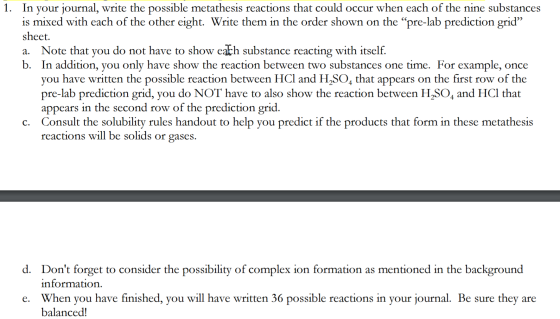
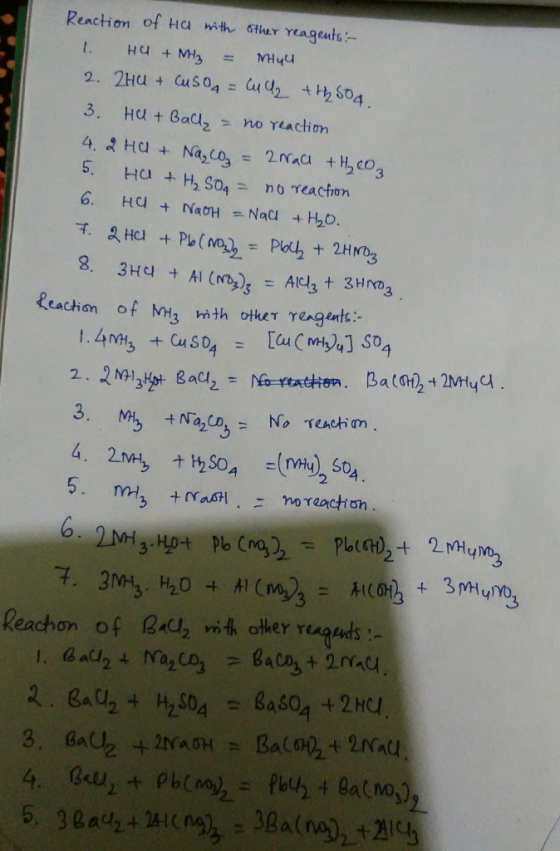
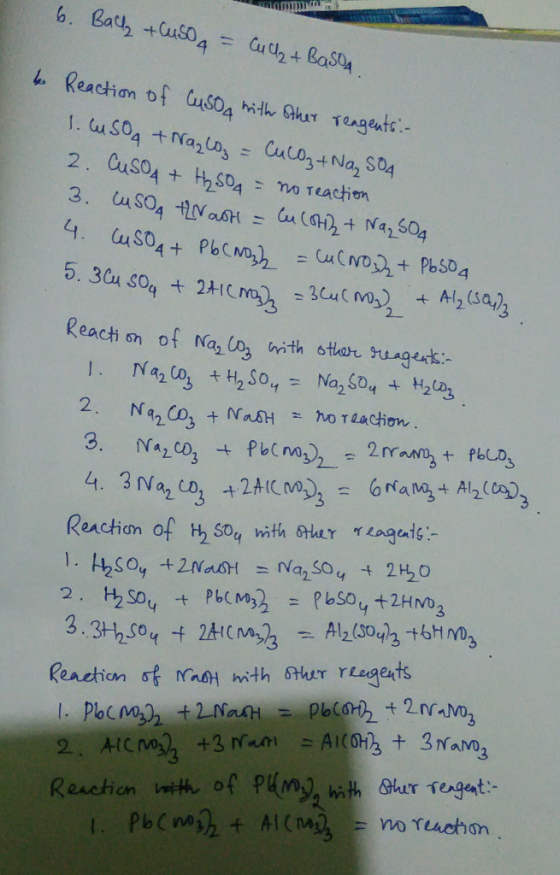
Nine Test Tube Mystery: 36 Metathesis Reactions.
Please complete the following 36 reactions, showing complete balanced equations following the guidelines that are given in 1 a-e.

Homework Answers
Add Answer to:
Nine Test Tube Mystery: 36 Metathesis Reactions.
Please complete the following 36 reactions, showing complete
balanced...
Question: Nine Test Tube Mystery: 36 Metathesis Reactions. Please complete the following 36 reactions, show... Nine...
Question: Nine Test Tube Mystery: 36 Metathesis Reactions. Please complete the following 36 reactions, show... Nine Test Tube Mystery: 36 Metathesis Reactions. Please complete the following 36 reactions, showing complete balanced equations following the guidelines that are given in 1 a-e. The purpose of this lab is to determine which one of the solutions listed below is found in each of the nine test tubes given to you by mixing them only. The nine possible solutions are: 0.1 M BaCl2...
This lab is the ten test tube mystery The ten solutions are as followed: 1: ammonium...
 This lab is the ten test tube mystery The ten solutions are as
followed:
1: ammonium chloride, NH4Cl
2:barium chloride, BaCl2
3:copper sulfate, CuSO4
4:salt hydrochloric acid, HCl
5:potassium iodide, KI
6:silver nitrate, AgNO3
7:salt sodium bromide, NaBr
8:sodium hydroxide, NaOH
9:sodium sulfide, Na2S
10:sulfuric acid, H2SO4
I am just totally lost as it wants me to test all the reactions
and say which solution is what, if you could please just answer
which solution goes where and possibly fill...
This lab is the ten test tube mystery The ten solutions are as
followed:
1: ammonium chloride, NH4Cl
2:barium chloride, BaCl2
3:copper sulfate, CuSO4
4:salt hydrochloric acid, HCl
5:potassium iodide, KI
6:silver nitrate, AgNO3
7:salt sodium bromide, NaBr
8:sodium hydroxide, NaOH
9:sodium sulfide, Na2S
10:sulfuric acid, H2SO4
I am just totally lost as it wants me to test all the reactions
and say which solution is what, if you could please just answer
which solution goes where and possibly fill...
3. Complete the following balanced equations for the reactions in test tubes A-E. Enter the name and formula of e...
 3. Complete the following balanced equations for the reactions in test tubes A-E. Enter the name and formula of each gas in the data table. (a) NaHCO3(aq) + HCI (aq) → NaCl(aq) + H2O(l) + — (8) (b) Cu(s) + 4HNO3(aq) → Cu(NO3)2(aq) + 2H,0(1) + 2 _ (g) (C) NH,Cl(aq) + NaOH(aq) → NaCl(aq) + H20(1) + — (8) (d) 2H,O, (aq) → 2H,O(1) + - Note: The catalyst (Mn0,) is not represented in the balanced chemical equation. (e)...
Test Table 1 Single Displacement Reactions Tube Equation (Complete) 1 epr Cuts + AG NO- 210...
 Test Table 1 Single Displacement Reactions Tube Equation (Complete) 1 epr Cuts + AG NO- 210 PB + Cu(NO 32 Zn + Pb (NO) Zn + MgSO4 Cu + H2 SO. - Zn + H2SO4 (ag) - Observations bere dissolved. che Lly Owych NO ACES Na reaches Hydelse Table# 2 Relative Reactivities Test Tube Number 1 2 Greater Activity Lesser Activity Silver cu 1 2 3 4 cu Pb Pb Mg ₂ ] in 1. Arrange the metals Pb and...
are theses correct? please correct me if they are not. Results Fe Test Tube 2: FeSCN...
 are
theses correct?
please correct me if they are not.
Results Fe Test Tube 2: FeSCN (aa) SCN () Fe Chemical equation: Explanation: The equilibrium shifted toward the increased the due to the addition of Fe(NO,)) because it of the Test Tube 3: FESCN 0) SCN () (as Chemical equation: Fe(ag) Explanation: Test Tube 4: Chemical equation: Fe(agk FeSCN( (aq)h Explanation: Test Tube 5: Chemical equation: Fe"( SCN () FESCN 3+ + (sq) Explanation: Test Tube 6 Chemical equation: Fe(a...
are
theses correct?
please correct me if they are not.
Results Fe Test Tube 2: FeSCN (aa) SCN () Fe Chemical equation: Explanation: The equilibrium shifted toward the increased the due to the addition of Fe(NO,)) because it of the Test Tube 3: FESCN 0) SCN () (as Chemical equation: Fe(ag) Explanation: Test Tube 4: Chemical equation: Fe(agk FeSCN( (aq)h Explanation: Test Tube 5: Chemical equation: Fe"( SCN () FESCN 3+ + (sq) Explanation: Test Tube 6 Chemical equation: Fe(a...
1. Write net ionic equations for ALL precipitation reactions of each anion studied in this e with Ag'(aq) and Ba (a), respectively, (in the absence of HNO,) at Bad 2 ptt disalv...
 1. Write net ionic equations for ALL precipitation reactions of each anion studied in this e with Ag'(aq) and Ba (a), respectively, (in the absence of HNO,) at Bad 2 ptt disalve 51 과 IND Add about 10 drops of deionized water and 10 drops of 6 MNH, to the precipitate and mix thoroughly. Note that the Agl precipitate will persist; Agl is not soluble in NHs solution Confirmation Test for lodide Carry out confirmatory test for iodide as follow:...
Question: Procedure Separation and Identification of Pb2 (aq), Fe (aq), Al(a), and Cu Note: Tests should...
 Question:
Procedure Separation and Identification of Pb2 (aq), Fe (aq), Al(a), and Cu Note: Tests should be performed concurrently on the known and the unknown solutions. Volumes are approximate. All work excepting the centrifugation should be done in the fume hood 1. To about 2. mL of your sample in a test tube, add 5 drops (-0.2 mL) of 6 M HCl(a). Mix well and centrifuge. Decant the clear liquid into a clean test tube and save it for Step...
Question:
Procedure Separation and Identification of Pb2 (aq), Fe (aq), Al(a), and Cu Note: Tests should be performed concurrently on the known and the unknown solutions. Volumes are approximate. All work excepting the centrifugation should be done in the fume hood 1. To about 2. mL of your sample in a test tube, add 5 drops (-0.2 mL) of 6 M HCl(a). Mix well and centrifuge. Decant the clear liquid into a clean test tube and save it for Step...
Part I Color changes of Methyl Violet. We will study the following reaction: HMV (aq) +...
 Part I Color changes of Methyl Violet. We will study the following reaction: HMV (aq) + MV (aq) + H* (aq) yellow greenish-blue violet Step 1. Place about 4 mL of distilled water in a regular test tube. Add two drops of methyl violet indicator. Record the color of the solution. Violet Next, add drop by drop, add 6M HCI. This forces equilibrium to be shifted to the left or right-circle the right answer). Adding HCl changes color from to...
I just need the blank data table with all the reactions shown. I need ALL 36...
 I just need the blank data table with
all the reactions shown. I need ALL 36 spaces for reacting
solutions. I don't need the observations. Please
help.
ARE hem 310 LAB EXPERIMENT #6 Chemical Reactions: Double Replacements I. OBJECTIVES 1. To perform and record observations of some chemical reactions. 2. To gain skill in writing balanced equations from observations of chemical reactions using known reactants. 3. To look for ions that, if present, may cause the compounds to be insoluble...
I just need the blank data table with
all the reactions shown. I need ALL 36 spaces for reacting
solutions. I don't need the observations. Please
help.
ARE hem 310 LAB EXPERIMENT #6 Chemical Reactions: Double Replacements I. OBJECTIVES 1. To perform and record observations of some chemical reactions. 2. To gain skill in writing balanced equations from observations of chemical reactions using known reactants. 3. To look for ions that, if present, may cause the compounds to be insoluble...
Microscale techniques: In today's experiment we will be using very small amounts of chemical reactants. This...
 Microscale techniques: In today's experiment we will be using very small amounts of chemical reactants. This method is generally less expensive and more environmentally-friendly than traditional "test tube" chemistry. Some of the waste products produced in today's experiment, particularly those containing lead and barium, are harmful to the environment. By using such small amounts of chemical reactants we generate far less waste than by using larger scale methods. Procedure 1. Put on your safety goggles. Be sure to wear them...
 This lab is the ten test tube mystery The ten solutions are as
followed:
1: ammonium chloride, NH4Cl
2:barium chloride, BaCl2
3:copper sulfate, CuSO4
4:salt hydrochloric acid, HCl
5:potassium iodide, KI
6:silver nitrate, AgNO3
7:salt sodium bromide, NaBr
8:sodium hydroxide, NaOH
9:sodium sulfide, Na2S
10:sulfuric acid, H2SO4
I am just totally lost as it wants me to test all the reactions
and say which solution is what, if you could please just answer
which solution goes where and possibly fill...
This lab is the ten test tube mystery The ten solutions are as
followed:
1: ammonium chloride, NH4Cl
2:barium chloride, BaCl2
3:copper sulfate, CuSO4
4:salt hydrochloric acid, HCl
5:potassium iodide, KI
6:silver nitrate, AgNO3
7:salt sodium bromide, NaBr
8:sodium hydroxide, NaOH
9:sodium sulfide, Na2S
10:sulfuric acid, H2SO4
I am just totally lost as it wants me to test all the reactions
and say which solution is what, if you could please just answer
which solution goes where and possibly fill...
 3. Complete the following balanced equations for the reactions in test tubes A-E. Enter the name and formula of each gas in the data table. (a) NaHCO3(aq) + HCI (aq) → NaCl(aq) + H2O(l) + — (8) (b) Cu(s) + 4HNO3(aq) → Cu(NO3)2(aq) + 2H,0(1) + 2 _ (g) (C) NH,Cl(aq) + NaOH(aq) → NaCl(aq) + H20(1) + — (8) (d) 2H,O, (aq) → 2H,O(1) + - Note: The catalyst (Mn0,) is not represented in the balanced chemical equation. (e)...
 Test Table 1 Single Displacement Reactions Tube Equation (Complete) 1 epr Cuts + AG NO- 210 PB + Cu(NO 32 Zn + Pb (NO) Zn + MgSO4 Cu + H2 SO. - Zn + H2SO4 (ag) - Observations bere dissolved. che Lly Owych NO ACES Na reaches Hydelse Table# 2 Relative Reactivities Test Tube Number 1 2 Greater Activity Lesser Activity Silver cu 1 2 3 4 cu Pb Pb Mg ₂ ] in 1. Arrange the metals Pb and...
 are
theses correct?
please correct me if they are not.
Results Fe Test Tube 2: FeSCN (aa) SCN () Fe Chemical equation: Explanation: The equilibrium shifted toward the increased the due to the addition of Fe(NO,)) because it of the Test Tube 3: FESCN 0) SCN () (as Chemical equation: Fe(ag) Explanation: Test Tube 4: Chemical equation: Fe(agk FeSCN( (aq)h Explanation: Test Tube 5: Chemical equation: Fe"( SCN () FESCN 3+ + (sq) Explanation: Test Tube 6 Chemical equation: Fe(a...
are
theses correct?
please correct me if they are not.
Results Fe Test Tube 2: FeSCN (aa) SCN () Fe Chemical equation: Explanation: The equilibrium shifted toward the increased the due to the addition of Fe(NO,)) because it of the Test Tube 3: FESCN 0) SCN () (as Chemical equation: Fe(ag) Explanation: Test Tube 4: Chemical equation: Fe(agk FeSCN( (aq)h Explanation: Test Tube 5: Chemical equation: Fe"( SCN () FESCN 3+ + (sq) Explanation: Test Tube 6 Chemical equation: Fe(a...
 1. Write net ionic equations for ALL precipitation reactions of each anion studied in this e with Ag'(aq) and Ba (a), respectively, (in the absence of HNO,) at Bad 2 ptt disalve 51 과 IND Add about 10 drops of deionized water and 10 drops of 6 MNH, to the precipitate and mix thoroughly. Note that the Agl precipitate will persist; Agl is not soluble in NHs solution Confirmation Test for lodide Carry out confirmatory test for iodide as follow:...
 Question:
Procedure Separation and Identification of Pb2 (aq), Fe (aq), Al(a), and Cu Note: Tests should be performed concurrently on the known and the unknown solutions. Volumes are approximate. All work excepting the centrifugation should be done in the fume hood 1. To about 2. mL of your sample in a test tube, add 5 drops (-0.2 mL) of 6 M HCl(a). Mix well and centrifuge. Decant the clear liquid into a clean test tube and save it for Step...
Question:
Procedure Separation and Identification of Pb2 (aq), Fe (aq), Al(a), and Cu Note: Tests should be performed concurrently on the known and the unknown solutions. Volumes are approximate. All work excepting the centrifugation should be done in the fume hood 1. To about 2. mL of your sample in a test tube, add 5 drops (-0.2 mL) of 6 M HCl(a). Mix well and centrifuge. Decant the clear liquid into a clean test tube and save it for Step...
 Part I Color changes of Methyl Violet. We will study the following reaction: HMV (aq) + MV (aq) + H* (aq) yellow greenish-blue violet Step 1. Place about 4 mL of distilled water in a regular test tube. Add two drops of methyl violet indicator. Record the color of the solution. Violet Next, add drop by drop, add 6M HCI. This forces equilibrium to be shifted to the left or right-circle the right answer). Adding HCl changes color from to...
 I just need the blank data table with
all the reactions shown. I need ALL 36 spaces for reacting
solutions. I don't need the observations. Please
help.
ARE hem 310 LAB EXPERIMENT #6 Chemical Reactions: Double Replacements I. OBJECTIVES 1. To perform and record observations of some chemical reactions. 2. To gain skill in writing balanced equations from observations of chemical reactions using known reactants. 3. To look for ions that, if present, may cause the compounds to be insoluble...
I just need the blank data table with
all the reactions shown. I need ALL 36 spaces for reacting
solutions. I don't need the observations. Please
help.
ARE hem 310 LAB EXPERIMENT #6 Chemical Reactions: Double Replacements I. OBJECTIVES 1. To perform and record observations of some chemical reactions. 2. To gain skill in writing balanced equations from observations of chemical reactions using known reactants. 3. To look for ions that, if present, may cause the compounds to be insoluble...
 Microscale techniques: In today's experiment we will be using very small amounts of chemical reactants. This method is generally less expensive and more environmentally-friendly than traditional "test tube" chemistry. Some of the waste products produced in today's experiment, particularly those containing lead and barium, are harmful to the environment. By using such small amounts of chemical reactants we generate far less waste than by using larger scale methods. Procedure 1. Put on your safety goggles. Be sure to wear them...
Most questions answered within 3 hours.
-
Where is the error in this code sequence?
String s1 = "Hello";
String s2 = "ello";...
asked 11 months ago -
Financial data for Joel de Paris, Inc., for last year
follow:
Joel de Paris, Inc.
Balance...
asked 11 months ago -
Consider this reaction:
Al2(SO4)3 (aq)+ BaCl3
(aq) Al2Cl6 (aq)- +
3BaSO4(s) . What is the...
asked 11 months ago -
Suppose that Savneet is considering increasing her
recent random sample from 20 car rentals to 40...
asked 11 months ago -
Trucks arrive at an unloading terminal at an average rate of 120
per hour.
Trucks arrive...
asked 11 months ago -
Why are methanol and ethanol completely soluble in water while
octanol is not very little soluble....
asked 11 months ago -
A facilities manager at a university reads in a research report
that the mean amount of...
asked 11 months ago -
When the CuSO4 is rehydrated by adding water to the anhydrous
compound, is this an endothermic...
asked 11 months ago -
A ray of sunlight is passing from diamond into crown glass; the
angle of incidence is...
asked 11 months ago -
A block of mass 0.249 kg is placed on top of a light, vertical
spring of...
asked 11 months ago -
how do the kidneys compensate in the presences of acidosis
a) trigger hyperventilate
b) reserve acid...
asked 11 months ago -
Question 501 pts
The rental rate of capital to the firm increases. Which of the
following...
asked 11 months ago