
Homework Answers
Add Answer to:
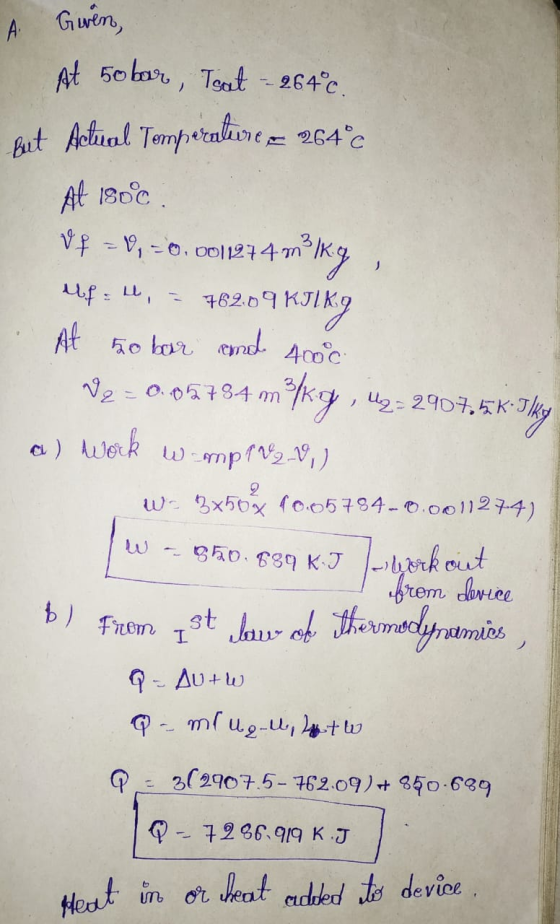
A frictionless vertical piston-cylinder device contains 3 kg of H2O initially at T1 = 180°C and...
Five kg of water is contained in a piston–cylinder assembly, initially at 5 bar and 200°C....
Five kg of water is contained in a piston–cylinder assembly, initially at 5 bar and 200°C. The water is slowly heated at constant pressure to a final state. The heat transfer for the process is 3260 kJ and kinetic and potential energy effects are negligible. Determine the final volume, in m3, and the work for the process, in kJ.
Five kg of water is contained in a piston–cylinder assembly, initially at 5 bar and 360°C....
Five kg of water is contained in a piston–cylinder assembly, initially at 5 bar and 360°C. The water is slowly heated at constant pressure to a final state. The heat transfer for the process is 2960 kJ and kinetic and potential energy effects are negligible. Determine the final volume, in m3, and the work for the process, in kJ.
frictionless piston-cylinder device initially contains 0.85 kg of helium at 18°C and 100 kPa. By taking...
frictionless piston-cylinder device initially contains 0.85 kg of helium at 18°C and 100 kPa. By taking specific heat at room temperature, please calculate; a) the initial volume of the helium in the frictionless piston-cylinder device, and b) the heat required to increase the volume of the frictionless piston-cylinder device to 10800 liter in (kJ).
A cylinder fitted with a frictionless piston contains stops arranged as shown in the following figure....
 A cylinder fitted with a frictionless piston contains stops
arranged as shown in the following figure. When the piston rests on
the lower stops the volume is 0.4m3 ; when it is in contact with
the upper stops the volume is 0.6m3 . If the piston is not in
contact with the stops, it maintains a constant pressure of 200kPa
in the cylinder. Initially, the cylinder contains air at P1=150kPa
with a temperature of T1=300K. The air is then heated...
A cylinder fitted with a frictionless piston contains stops
arranged as shown in the following figure. When the piston rests on
the lower stops the volume is 0.4m3 ; when it is in contact with
the upper stops the volume is 0.6m3 . If the piston is not in
contact with the stops, it maintains a constant pressure of 200kPa
in the cylinder. Initially, the cylinder contains air at P1=150kPa
with a temperature of T1=300K. The air is then heated...
Thermodynamics question Initially, 0.05kg of air is contained in a piston cylinder device at 200 °C...
 Thermodynamics question
Initially, 0.05kg of air is contained in a piston cylinder device at 200 °C and 1.6 MPa. The air then expands at constant temperature to a pressure of 0.4 MPa. Assume the process occurs slowly enough that the acceleration of the piston can be neglected. The ambient pressure is 101.35kPa. (i) Determine the work (kJ) performed bt the air in the cylinder on the piston. (ii) Determine the work (kJ) performed by the piston on the ambient environment....
Thermodynamics question
Initially, 0.05kg of air is contained in a piston cylinder device at 200 °C and 1.6 MPa. The air then expands at constant temperature to a pressure of 0.4 MPa. Assume the process occurs slowly enough that the acceleration of the piston can be neglected. The ambient pressure is 101.35kPa. (i) Determine the work (kJ) performed bt the air in the cylinder on the piston. (ii) Determine the work (kJ) performed by the piston on the ambient environment....
Question 1 A piston-cylinder assembly contains 3.2 kg of water at 211.9oC and 3 bar. The...
Question 1 A piston-cylinder assembly contains 3.2 kg of water at 211.9oC and 3 bar. The water is compressed to a saturated vapor state where the pressure is 51.5 bar. During compression, there is a heat transfer of energy from the water to its surroundings having a magnitude of 230 kJ. Neglecting changes in kinetic energy and potential energy, determine the work, in kJ, for the process of the water. Question 2 Water, initially saturated vapor at 10.2 bar, fills...
A piston-cylinder assembly contains propane, initially at 27 °C, 1 bar, and a volume of 0.2...
 A piston-cylinder assembly contains propane, initially at 27 °C,
1 bar, and a volume of 0.2 m3 . The propane undergoes a process to
a final pressure of 6 bar, during which the pressure-volume
relationship is pV1.1 = constant. For the propane, evaluate the
work and heat transfer, each in kJ. Kinetic and potential energy
effects can be ignored.
Problem 10. A piston-cylinder assembly contains propane, initially at 27 'C, 1 bar, and a volume of 0.2 m2. The propane...
A piston-cylinder assembly contains propane, initially at 27 °C,
1 bar, and a volume of 0.2 m3 . The propane undergoes a process to
a final pressure of 6 bar, during which the pressure-volume
relationship is pV1.1 = constant. For the propane, evaluate the
work and heat transfer, each in kJ. Kinetic and potential energy
effects can be ignored.
Problem 10. A piston-cylinder assembly contains propane, initially at 27 'C, 1 bar, and a volume of 0.2 m2. The propane...
(THERMODYNAMICS) A vertical cylinder fitted with a frictionless piston contains 1.5 kg of H2O initially at...
(THERMODYNAMICS) A vertical cylinder fitted with a frictionless piston contains 1.5 kg of H2O initially at 100 °C, 400 kPa. If the volume of the system reaches 0.5 m3, the piston hits a set of stops and is restrained from further upward travel. The system is heated to 200 °C. (Use saturated water tables, steam tables, and superheated tables as necessary) a) If the piston reaches the stops, determine the temperature and pressure when the piston first touches but exerts no force...
2 A frictionless piston-cylinder device initially contains 0.5-m2 of air at 200 kPs and 207℃·luri...
 2 A frictionless piston-cylinder device initially contains 0.5-m2 of air at 200 kPs and 207℃·luring the process. Air is stirred by a paddle wheel at į00 kJ while the pressure remains constant during the process. A heat loss of 85 kJ occurs and an electric energy of 50 kJ through a resistor is placed in the eylinder (a) Write the assumptions (b) Show the 1 law of thermodynamies for the control volume (c) Determine the mass of air in the...
A piston-cylinder device contains water which is initially at 100 C and 20 bar. It undergoes...
A piston-cylinder device contains water which is initially at 100 C and 20 bar. It undergoes two processes. The first process is isothermal and the second process is constant volume. The final condition is a saturated vapour at 2 bar. Calculate heat transfer and work (both in kJ/kg) for each process.
 A cylinder fitted with a frictionless piston contains stops
arranged as shown in the following figure. When the piston rests on
the lower stops the volume is 0.4m3 ; when it is in contact with
the upper stops the volume is 0.6m3 . If the piston is not in
contact with the stops, it maintains a constant pressure of 200kPa
in the cylinder. Initially, the cylinder contains air at P1=150kPa
with a temperature of T1=300K. The air is then heated...
A cylinder fitted with a frictionless piston contains stops
arranged as shown in the following figure. When the piston rests on
the lower stops the volume is 0.4m3 ; when it is in contact with
the upper stops the volume is 0.6m3 . If the piston is not in
contact with the stops, it maintains a constant pressure of 200kPa
in the cylinder. Initially, the cylinder contains air at P1=150kPa
with a temperature of T1=300K. The air is then heated...
 Thermodynamics question
Initially, 0.05kg of air is contained in a piston cylinder device at 200 °C and 1.6 MPa. The air then expands at constant temperature to a pressure of 0.4 MPa. Assume the process occurs slowly enough that the acceleration of the piston can be neglected. The ambient pressure is 101.35kPa. (i) Determine the work (kJ) performed bt the air in the cylinder on the piston. (ii) Determine the work (kJ) performed by the piston on the ambient environment....
Thermodynamics question
Initially, 0.05kg of air is contained in a piston cylinder device at 200 °C and 1.6 MPa. The air then expands at constant temperature to a pressure of 0.4 MPa. Assume the process occurs slowly enough that the acceleration of the piston can be neglected. The ambient pressure is 101.35kPa. (i) Determine the work (kJ) performed bt the air in the cylinder on the piston. (ii) Determine the work (kJ) performed by the piston on the ambient environment....
 A piston-cylinder assembly contains propane, initially at 27 °C,
1 bar, and a volume of 0.2 m3 . The propane undergoes a process to
a final pressure of 6 bar, during which the pressure-volume
relationship is pV1.1 = constant. For the propane, evaluate the
work and heat transfer, each in kJ. Kinetic and potential energy
effects can be ignored.
Problem 10. A piston-cylinder assembly contains propane, initially at 27 'C, 1 bar, and a volume of 0.2 m2. The propane...
A piston-cylinder assembly contains propane, initially at 27 °C,
1 bar, and a volume of 0.2 m3 . The propane undergoes a process to
a final pressure of 6 bar, during which the pressure-volume
relationship is pV1.1 = constant. For the propane, evaluate the
work and heat transfer, each in kJ. Kinetic and potential energy
effects can be ignored.
Problem 10. A piston-cylinder assembly contains propane, initially at 27 'C, 1 bar, and a volume of 0.2 m2. The propane...
 2 A frictionless piston-cylinder device initially contains 0.5-m2 of air at 200 kPs and 207℃·luring the process. Air is stirred by a paddle wheel at į00 kJ while the pressure remains constant during the process. A heat loss of 85 kJ occurs and an electric energy of 50 kJ through a resistor is placed in the eylinder (a) Write the assumptions (b) Show the 1 law of thermodynamies for the control volume (c) Determine the mass of air in the...
Most questions answered within 3 hours.
-
Where is the error in this code sequence?
String s1 = "Hello";
String s2 = "ello";...
asked 10 months ago -
Financial data for Joel de Paris, Inc., for last year
follow:
Joel de Paris, Inc.
Balance...
asked 10 months ago -
Consider this reaction:
Al2(SO4)3 (aq)+ BaCl3
(aq) Al2Cl6 (aq)- +
3BaSO4(s) . What is the...
asked 10 months ago -
Suppose that Savneet is considering increasing her
recent random sample from 20 car rentals to 40...
asked 10 months ago -
Trucks arrive at an unloading terminal at an average rate of 120
per hour.
Trucks arrive...
asked 10 months ago -
Why are methanol and ethanol completely soluble in water while
octanol is not very little soluble....
asked 10 months ago -
A facilities manager at a university reads in a research report
that the mean amount of...
asked 10 months ago -
When the CuSO4 is rehydrated by adding water to the anhydrous
compound, is this an endothermic...
asked 10 months ago -
A ray of sunlight is passing from diamond into crown glass; the
angle of incidence is...
asked 10 months ago -
A block of mass 0.249 kg is placed on top of a light, vertical
spring of...
asked 10 months ago -
how do the kidneys compensate in the presences of acidosis
a) trigger hyperventilate
b) reserve acid...
asked 10 months ago -
Question 501 pts
The rental rate of capital to the firm increases. Which of the
following...
asked 10 months ago