A patient wants to know if he is heterozygous for a rare allele that could predispose...
A patient wants to know if he is heterozygous for a rare allele that could predispose him to cancer. The gene concerned contains the sequence, 5-prime GACAGTTCCCGTATTCTTG 3-prime. Using an appropriate PCR primer, this sequence (including adjacent 5-prime and 3-prime regions) was amplified from a sample of the patients DNA. Unfortunately, the lab technician forgot to label which lane contained which dideoxynucleotide when he ran the gel.
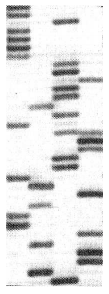
Which lane corrresponds to which dideoxynucleotide? Answer with A for dideoxyadenine, C for dideoxycytosine, G for dideoxyguanine, and T for dideoxythymine. List the lanes in order from left to right, e.g. ACGT.
Is the man heterozygous for the rare allele and, if so, what nucleotide substitution has occurred to convert the normal allele into the mutant allele? Answer yes or no followed by the original base and the mutated base, N N if no change seen here, e.g. yes A T or no N N. Note the space between each component.
What amino acid sequence does the mutant allele have in this region of the protein if the normal amino acid sequence is gln-phe-pro-tyr-ser? For your answer, follow this model using the standard 3-letter amino acid identifiers.
Homework Answers
According to the given information, the lane 1 indicates C followed by T, A, and G from left.

In the given sequence, C is followed by C, while in the gel the C is followed by T.

Thus, it indicates base substitution (transition) where cytosine is replaced with thymine in the individual.

According to the above picture, the base substitution has replaced proline with leucine in the mutated sequence.
Add Answer to:
A patient wants to know if he is heterozygous for a rare allele
that could predispose...
Please note that Questions 15 to 17 are connected questions. Question 15: The following shows a...
 Please note that Questions 15 to 17 are connected
questions.
Question 15:
The following shows a partial DNA sequence from the wild-type
(normal) allele for the human leukemia-linked apoptotic
gene.
5' ATGCGATTAATCGGTAAA 3' (non-template strand)
3' TACGCTAATTAGCCATTT 5' (template strand)
Please answer the following questions:
(a) If the bottom strand serves as the DNA template for
transcription, what is the resulting mRNA sequence?
The mRNA sequence is 5' 3'. (2
marks)
5' AUG CGA UUA AUC GGU AAA 3' ?
Please enter...
Please note that Questions 15 to 17 are connected
questions.
Question 15:
The following shows a partial DNA sequence from the wild-type
(normal) allele for the human leukemia-linked apoptotic
gene.
5' ATGCGATTAATCGGTAAA 3' (non-template strand)
3' TACGCTAATTAGCCATTT 5' (template strand)
Please answer the following questions:
(a) If the bottom strand serves as the DNA template for
transcription, what is the resulting mRNA sequence?
The mRNA sequence is 5' 3'. (2
marks)
5' AUG CGA UUA AUC GGU AAA 3' ?
Please enter...
11 Department of Biological Sciences BIOCHEMISTRY Test 2.2018 H. Nucleic Acid, Sequencing of DNA: Amino Acids...
 11 Department of Biological Sciences BIOCHEMISTRY Test 2.2018 H. Nucleic Acid, Sequencing of DNA: Amino Acids Hydrolysis of salt Laboratory buffers, Polyprotie acids QUESTIONS 1. The DNA strand complementary to the strand 3-GTAGCGTAT-Y' would have the sequence a SLTACOCATAT-3 b.3.CATOXICATA-S c. 3-ATGCGTATA-S" ATATGCGTAS 2. When cytosine is treated with bisulfite, the amino group is replaced with a carbonyl group. Identify the resulting base a. adenine b. guanine c uracil d. thyminee. typoxanthine 3. How many amino acids would be in...
2. A dominant allele H reduces the number of body bristles that Drosophila flies have, giving...
2. A dominant allele H reduces the number of body bristles that Drosophila flies have, giving rise to a “hairless” phenotype. In the homozygous condition, H is lethal. An independently assorting dominant allele S has no effect on bristle number except in the presence of H, in which case a single dose of S suppresses the hairless phenotype, thus restoring the "hairy" phenotype. However, S also is lethal in the homozygous (S/S) condition. What ratio of hairy to hairless flies...
 Please note that Questions 15 to 17 are connected
questions.
Question 15:
The following shows a partial DNA sequence from the wild-type
(normal) allele for the human leukemia-linked apoptotic
gene.
5' ATGCGATTAATCGGTAAA 3' (non-template strand)
3' TACGCTAATTAGCCATTT 5' (template strand)
Please answer the following questions:
(a) If the bottom strand serves as the DNA template for
transcription, what is the resulting mRNA sequence?
The mRNA sequence is 5' 3'. (2
marks)
5' AUG CGA UUA AUC GGU AAA 3' ?
Please enter...
Please note that Questions 15 to 17 are connected
questions.
Question 15:
The following shows a partial DNA sequence from the wild-type
(normal) allele for the human leukemia-linked apoptotic
gene.
5' ATGCGATTAATCGGTAAA 3' (non-template strand)
3' TACGCTAATTAGCCATTT 5' (template strand)
Please answer the following questions:
(a) If the bottom strand serves as the DNA template for
transcription, what is the resulting mRNA sequence?
The mRNA sequence is 5' 3'. (2
marks)
5' AUG CGA UUA AUC GGU AAA 3' ?
Please enter...
 11 Department of Biological Sciences BIOCHEMISTRY Test 2.2018 H. Nucleic Acid, Sequencing of DNA: Amino Acids Hydrolysis of salt Laboratory buffers, Polyprotie acids QUESTIONS 1. The DNA strand complementary to the strand 3-GTAGCGTAT-Y' would have the sequence a SLTACOCATAT-3 b.3.CATOXICATA-S c. 3-ATGCGTATA-S" ATATGCGTAS 2. When cytosine is treated with bisulfite, the amino group is replaced with a carbonyl group. Identify the resulting base a. adenine b. guanine c uracil d. thyminee. typoxanthine 3. How many amino acids would be in...
Most questions answered within 3 hours.
-
Where is the error in this code sequence?
String s1 = "Hello";
String s2 = "ello";...
asked 11 months ago -
Financial data for Joel de Paris, Inc., for last year
follow:
Joel de Paris, Inc.
Balance...
asked 11 months ago -
Consider this reaction:
Al2(SO4)3 (aq)+ BaCl3
(aq) Al2Cl6 (aq)- +
3BaSO4(s) . What is the...
asked 11 months ago -
Suppose that Savneet is considering increasing her
recent random sample from 20 car rentals to 40...
asked 11 months ago -
Trucks arrive at an unloading terminal at an average rate of 120
per hour.
Trucks arrive...
asked 11 months ago -
Why are methanol and ethanol completely soluble in water while
octanol is not very little soluble....
asked 11 months ago -
A facilities manager at a university reads in a research report
that the mean amount of...
asked 11 months ago -
When the CuSO4 is rehydrated by adding water to the anhydrous
compound, is this an endothermic...
asked 11 months ago -
A ray of sunlight is passing from diamond into crown glass; the
angle of incidence is...
asked 11 months ago -
A block of mass 0.249 kg is placed on top of a light, vertical
spring of...
asked 11 months ago -
how do the kidneys compensate in the presences of acidosis
a) trigger hyperventilate
b) reserve acid...
asked 11 months ago -
Question 501 pts
The rental rate of capital to the firm increases. Which of the
following...
asked 11 months ago