
Homework Answers
Consider polynomial interpolation of the function f(x)=1/(1+25x^2) on the interval [-1,1] by (1) ...
Consider polynomial interpolation of the function f(x)=1/(1+25x^2) on the interval [-1,1] by (1) an interpolating polynomial determined by m equidistant interpolation points, (2) an interpolating polynomial determined by interpolation at the m zeros of the Chebyshev polynomial T_m(x), and (3) by interpolating by cubic splines instead of by a polynomial. Estimate the approximation error by evaluation max_i |f(z_i)-p(z_i)| for many points z_i on [-1,1]. For instance, you could use 10m points z_i. The cubic spline interpolant can be determined in...
2. Consider interpolating the data (x0,yo), . . . , (x64%) given by Xi | 0.1...
 2. Consider interpolating the data (x0,yo), . . . , (x64%) given by Xi | 0.1 | 0.15 | 0.2 | 0.3 | 0.35 | 0.5 | 0.75 yi 4.0 1.0 1.22.12.02.52.5 For all tasks below, please submit your MATLAB code and your plots. You can write all code in a single (a) Using MATLAB, plot the interpolating (6th degree) polynomial given these data on the domain .m-file [0.1,0.75] using the polyfit and polyval commands. To learn how to use...
1. Fit cubic splines to the following data (1) using natural end condition and estimate f(4.0)...
 1. Fit cubic splines to the following data
(1) using natural end condition and estimate f(4.0) with the
cubic spline.
(2) using clamped end condition with f1’=-2.5, f5’=3.0 and
estimate f(4.0) with the cubic spline.
(3) using “not-a-knot” end condition and estimate f(4.0) with
the cubic spline.
4 2 9.0 7.0 5.0 2.5 1.0 Xi 2.5 0.5 2.5 1.0 fi 2,5 er
4 2 9.0 7.0 5.0 2.5 1.0 Xi 2.5 0.5 2.5 1.0 fi 2,5 er
1. Fit cubic splines to the following data
(1) using natural end condition and estimate f(4.0) with the
cubic spline.
(2) using clamped end condition with f1’=-2.5, f5’=3.0 and
estimate f(4.0) with the cubic spline.
(3) using “not-a-knot” end condition and estimate f(4.0) with
the cubic spline.
4 2 9.0 7.0 5.0 2.5 1.0 Xi 2.5 0.5 2.5 1.0 fi 2,5 er
4 2 9.0 7.0 5.0 2.5 1.0 Xi 2.5 0.5 2.5 1.0 fi 2,5 er
Problem 2. Given the data points (xi. yi), with xi 2 02 4 yil 5 1 1.25 find the following interpo...
 Problem 2. Given the data points (xi. yi), with xi 2 02 4 yil 5 1 1.25 find the following interpolating polynomials, and use MATLAB to graph both the interpolating polynomials and the data points: a) The piecewise linear Lagrange interpolating polynomialx) b) The piecewise quadratic Lagrange interpolating polynomial q(x) c) Newton's divided difference interpolation pa(x) of degree s 4
Problem 2. Given the data points (xi. yi), with xi 2 02 4 yil 5 1 1.25 find the following...
Problem 2. Given the data points (xi. yi), with xi 2 02 4 yil 5 1 1.25 find the following interpolating polynomials, and use MATLAB to graph both the interpolating polynomials and the data points: a) The piecewise linear Lagrange interpolating polynomialx) b) The piecewise quadratic Lagrange interpolating polynomial q(x) c) Newton's divided difference interpolation pa(x) of degree s 4
Problem 2. Given the data points (xi. yi), with xi 2 02 4 yil 5 1 1.25 find the following...
Find the natural cubic spline interpolant to f(x) = e^(x^3) at the nodes {xi} i=0 = {−2, 0, 2} . ...
Find the natural cubic spline interpolant to f(x) = e^(x^3) at the nodes {xi} i=0 = {−2, 0, 2} . Calculate the value of the interpolant at x = 1. What is the error at this point?
0.19 0.. 1. (Natural Splines) Find the natural cubic spline S(x) satisfying S(0) = 0, S(1/2)...
 0.19 0.. 1. (Natural Splines) Find the natural cubic spline S(x) satisfying S(0) = 0, S(1/2) = 1, S(1) = 0. Your answer will be 2 cubic polynomials, S.(x), S1(x). Verify that your answer satisfies all the necessary conditions (interpolation, continuity of 1st and 2nd derivatives, boundary conditions). We were unable to transcribe this image
Homework Problem Set 16 x-1)3 for 0 sx$1 a cubic spline? 1. Is the function s (x) = {2(-1)3 for 1...
 Homework Problem Set 16 x-1)3 for 0 sx$1 a cubic spline? 1. Is the function s (x) = {2(-1)3 for 1 < x 2 -5 +8x-6x2 2x3 for1 sx s 2 Is the function s(x)-[ natural? Let x for j 1,2,3,4 by a calculation on paper 3 a cubic spline? Is it [1,0,1,0]. Determine the natural spline s with s(y)-yi 2. 18x2-2x3 for 2
its a numerical analysis question QUESTION 4 (a) A natural cubic spline that fits the data...
 its a numerical analysis question
QUESTION 4 (a) A natural cubic spline that fits the data given by (10) f(3.0) = -5.6790, f(3.1) = -3.6674, f(3.2) = -2.2178 is to be constructed. Write down explicitly the system of equations that need to be used to construct the required natural cubic spline. (b) Consider the nonlinear system (10) z+ y = 9, 1² + y2 = 25, 2, y > 0. Perform one iteration of Newton's method to approximate the solution,...
its a numerical analysis question
QUESTION 4 (a) A natural cubic spline that fits the data given by (10) f(3.0) = -5.6790, f(3.1) = -3.6674, f(3.2) = -2.2178 is to be constructed. Write down explicitly the system of equations that need to be used to construct the required natural cubic spline. (b) Consider the nonlinear system (10) z+ y = 9, 1² + y2 = 25, 2, y > 0. Perform one iteration of Newton's method to approximate the solution,...
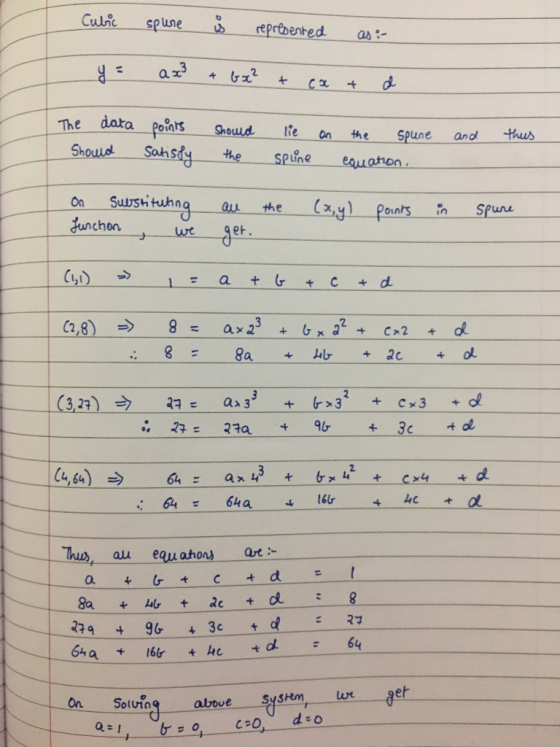
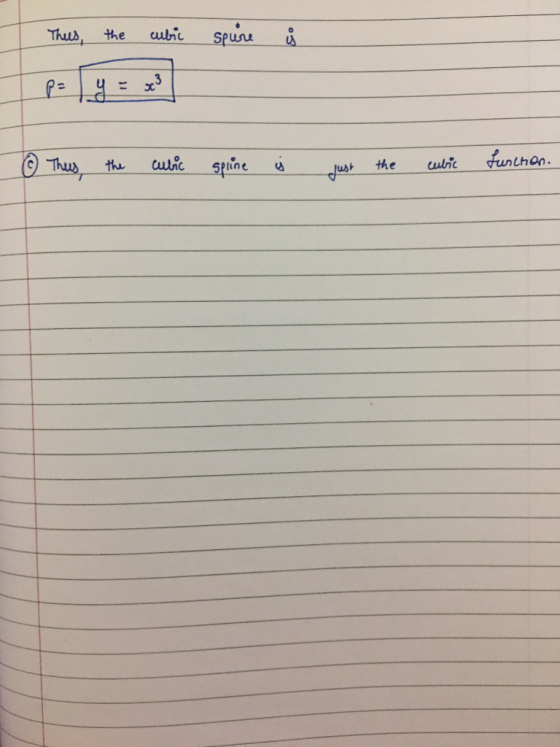
6. lol suppose a cubic polynomial y = a +br +cr2-dr3 goes through the points (zi, yi) for i 1, 2,...
 6. lol suppose a cubic polynomial y = a +br +cr2-dr3 goes through the points (zi, yi) for i 1, 2,3,4, where r, f a, for i,j 1,2,3,4 and i f j (a) 2 Find the system of equations that determines the coefficients a, b, c and d (b) (61 Find the determinant of the coefficiant matrix using row operations, and show that the coefficient matrix is invertible. Note that you will receive no mark if you compute the determinant...
(a) Given the (z, y) values (1, 2), (2, 4), (3, 10), (5,8) write in matrix...
 (a) Given the (z, y) values (1, 2), (2, 4), (3, 10), (5,8) write in matrix form the linear system to solve for the b, coelicients in the interpolating cubic spline with natural boundary conditions. (b) If an interpolating cubic spline is as given below, find (1) what points it interpolates and (2) its value at z= 0. -1.27(r +1)3 + 6.54(r + 1) – 2 for -1 <r<1 9.15(r - 1)3 - 7.57(r - 1)? - 8.59( - 1)...
 2. Consider interpolating the data (x0,yo), . . . , (x64%) given by Xi | 0.1 | 0.15 | 0.2 | 0.3 | 0.35 | 0.5 | 0.75 yi 4.0 1.0 1.22.12.02.52.5 For all tasks below, please submit your MATLAB code and your plots. You can write all code in a single (a) Using MATLAB, plot the interpolating (6th degree) polynomial given these data on the domain .m-file [0.1,0.75] using the polyfit and polyval commands. To learn how to use...
 1. Fit cubic splines to the following data
(1) using natural end condition and estimate f(4.0) with the
cubic spline.
(2) using clamped end condition with f1’=-2.5, f5’=3.0 and
estimate f(4.0) with the cubic spline.
(3) using “not-a-knot” end condition and estimate f(4.0) with
the cubic spline.
4 2 9.0 7.0 5.0 2.5 1.0 Xi 2.5 0.5 2.5 1.0 fi 2,5 er
4 2 9.0 7.0 5.0 2.5 1.0 Xi 2.5 0.5 2.5 1.0 fi 2,5 er
1. Fit cubic splines to the following data
(1) using natural end condition and estimate f(4.0) with the
cubic spline.
(2) using clamped end condition with f1’=-2.5, f5’=3.0 and
estimate f(4.0) with the cubic spline.
(3) using “not-a-knot” end condition and estimate f(4.0) with
the cubic spline.
4 2 9.0 7.0 5.0 2.5 1.0 Xi 2.5 0.5 2.5 1.0 fi 2,5 er
4 2 9.0 7.0 5.0 2.5 1.0 Xi 2.5 0.5 2.5 1.0 fi 2,5 er
 Problem 2. Given the data points (xi. yi), with xi 2 02 4 yil 5 1 1.25 find the following interpolating polynomials, and use MATLAB to graph both the interpolating polynomials and the data points: a) The piecewise linear Lagrange interpolating polynomialx) b) The piecewise quadratic Lagrange interpolating polynomial q(x) c) Newton's divided difference interpolation pa(x) of degree s 4
Problem 2. Given the data points (xi. yi), with xi 2 02 4 yil 5 1 1.25 find the following...
Problem 2. Given the data points (xi. yi), with xi 2 02 4 yil 5 1 1.25 find the following interpolating polynomials, and use MATLAB to graph both the interpolating polynomials and the data points: a) The piecewise linear Lagrange interpolating polynomialx) b) The piecewise quadratic Lagrange interpolating polynomial q(x) c) Newton's divided difference interpolation pa(x) of degree s 4
Problem 2. Given the data points (xi. yi), with xi 2 02 4 yil 5 1 1.25 find the following...
 0.19 0.. 1. (Natural Splines) Find the natural cubic spline S(x) satisfying S(0) = 0, S(1/2) = 1, S(1) = 0. Your answer will be 2 cubic polynomials, S.(x), S1(x). Verify that your answer satisfies all the necessary conditions (interpolation, continuity of 1st and 2nd derivatives, boundary conditions). We were unable to transcribe this image
 Homework Problem Set 16 x-1)3 for 0 sx$1 a cubic spline? 1. Is the function s (x) = {2(-1)3 for 1 < x 2 -5 +8x-6x2 2x3 for1 sx s 2 Is the function s(x)-[ natural? Let x for j 1,2,3,4 by a calculation on paper 3 a cubic spline? Is it [1,0,1,0]. Determine the natural spline s with s(y)-yi 2. 18x2-2x3 for 2
 its a numerical analysis question
QUESTION 4 (a) A natural cubic spline that fits the data given by (10) f(3.0) = -5.6790, f(3.1) = -3.6674, f(3.2) = -2.2178 is to be constructed. Write down explicitly the system of equations that need to be used to construct the required natural cubic spline. (b) Consider the nonlinear system (10) z+ y = 9, 1² + y2 = 25, 2, y > 0. Perform one iteration of Newton's method to approximate the solution,...
its a numerical analysis question
QUESTION 4 (a) A natural cubic spline that fits the data given by (10) f(3.0) = -5.6790, f(3.1) = -3.6674, f(3.2) = -2.2178 is to be constructed. Write down explicitly the system of equations that need to be used to construct the required natural cubic spline. (b) Consider the nonlinear system (10) z+ y = 9, 1² + y2 = 25, 2, y > 0. Perform one iteration of Newton's method to approximate the solution,...
 6. lol suppose a cubic polynomial y = a +br +cr2-dr3 goes through the points (zi, yi) for i 1, 2,3,4, where r, f a, for i,j 1,2,3,4 and i f j (a) 2 Find the system of equations that determines the coefficients a, b, c and d (b) (61 Find the determinant of the coefficiant matrix using row operations, and show that the coefficient matrix is invertible. Note that you will receive no mark if you compute the determinant...
 (a) Given the (z, y) values (1, 2), (2, 4), (3, 10), (5,8) write in matrix form the linear system to solve for the b, coelicients in the interpolating cubic spline with natural boundary conditions. (b) If an interpolating cubic spline is as given below, find (1) what points it interpolates and (2) its value at z= 0. -1.27(r +1)3 + 6.54(r + 1) – 2 for -1 <r<1 9.15(r - 1)3 - 7.57(r - 1)? - 8.59( - 1)...
Most questions answered within 3 hours.
-
Where is the error in this code sequence?
String s1 = "Hello";
String s2 = "ello";...
asked 10 months ago -
Financial data for Joel de Paris, Inc., for last year
follow:
Joel de Paris, Inc.
Balance...
asked 10 months ago -
Consider this reaction:
Al2(SO4)3 (aq)+ BaCl3
(aq) Al2Cl6 (aq)- +
3BaSO4(s) . What is the...
asked 10 months ago -
Suppose that Savneet is considering increasing her
recent random sample from 20 car rentals to 40...
asked 10 months ago -
Trucks arrive at an unloading terminal at an average rate of 120
per hour.
Trucks arrive...
asked 10 months ago -
Why are methanol and ethanol completely soluble in water while
octanol is not very little soluble....
asked 10 months ago -
A facilities manager at a university reads in a research report
that the mean amount of...
asked 10 months ago -
When the CuSO4 is rehydrated by adding water to the anhydrous
compound, is this an endothermic...
asked 10 months ago -
A ray of sunlight is passing from diamond into crown glass; the
angle of incidence is...
asked 10 months ago -
A block of mass 0.249 kg is placed on top of a light, vertical
spring of...
asked 10 months ago -
how do the kidneys compensate in the presences of acidosis
a) trigger hyperventilate
b) reserve acid...
asked 10 months ago -
Question 501 pts
The rental rate of capital to the firm increases. Which of the
following...
asked 10 months ago