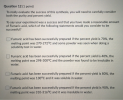
To really evaluate the success of this synthesis, you will need to carefully consider the following;...
To really evaluate the success of this synthesis, you will need to carefully consider the following; purity, percent yield, melting point behaviour.
To say your experiment was a success and that you have made a reasonable amount of cholesteryl nonanoate, you want to make sure all of these were successful.
Which of the following statements is true?
1- Cholesteryl nonanoate has been successfully prepared if the percent yield is 90%, the melting point was 74-86oC and liquid crystaline behaviour was not observed when preparing a liquid crystal display.
2- Cholesteryl nonanoate has been successfully prepared if the percent yield is 80%, the melting point was 130oC and liquid crystalline behaviour was observed when preparing a liquid crystal display.
3- Cholesteryl nonanoate has been successfully prepared if the percent yield is 60%, the melting point was 72-80oC and liquid crystalline behaviour was observed when preparing a liquid crystal display.
4- Cholesteryl nonanoate has been successfully prepared if the percent yield is 20%, the melting point was 73-75oC and liquid crystalline behaviour was observed when preparing a liquid crystal display.
Homework Answers
Cholesteryl nonanoate is a liquid crystal with melting point in the range of 77 to 82 °C. If the prepared sample is not showing liquid crystal behavior, then the synthesis is unsuccessful
1) Cholesteryl nonanoate has been successfully prepared if the percent yield is 90%, the melting point was 74-86oC and liquid crystalline behavior was not observed when preparing a liquid crystal display.
Here percent yield is high, but liquid crystalline behavior was not observed. Therefore this is not a successful synthesis
This is not true
2) Cholesteryl nonanoate has been successfully prepared if the percent yield is 80%, the melting point was 130 oC and liquid crystalline behavior was observed when preparing a liquid crystal display.
Here percent yield is good, however melting point was above the melting point of Cholesteryl nonanoate. Therefore this is not a successful synthesis
This is not true
3) Cholesteryl nonanoate has been successfully prepared if the percent yield is 60%, the melting point was 72-80oC and liquid crystalline behavior was observed when preparing a liquid crystal display.
Here percent yield is good, liquid crystalline behavior was observed and a range of melting point was comparable to Cholesteryl nonanoate. Therefore this is not a successful synthesis
This is true
4) Cholesteryl nonanoate has been successfully prepared if the percent yield is 20%, the melting point was 73-75oC and liquid crystalline behavior was observed when preparing a liquid crystal display.
Here percent yield is very low, liquid crystalline behavior was observed
Therefore this is not a successful synthesis
This is not true
Answer:
Cholesteryl nonanoate has been successfully prepared if the percent yield is 60%, the melting point was 72-80 oC and liquid crystalline behavior was observed when preparing a liquid crystal display.
Add Answer to:
To really evaluate the success of this synthesis, you will need
to carefully consider the following;...
Question 12 (1 point) To really evaluate the success of this synthesis, you will need to...
 Question 12 (1 point) To really evaluate the success of this synthesis, you will need to carefully consider both the purity and percent yield. To say your experiment was a success and that you have made a reasonable amount of Fumaric acid, which of the following statements would you consider to be successful? Fumaric acid has been successfully prepared if the percent yield is 70%, the melting point was 270-272°C and some powder was seen when doing a solubility test...
Please answer the following questions/fill in the data tables based on the following experiment. EXPERIMENTAL PROCEDURE:...
Please answer the following questions/fill in the data tables based on the following experiment. EXPERIMENTAL PROCEDURE: Place sodium hydroxide (2.500 g) in a 100 mL Erlenmeyer flask and add water (25.0 mL) and ethanol (20.0 mL). Add a magnetic stirrer bar and stir until all the NaOH has dissolved. To a second reaction vessel, add benzaldehyde (2.650 g, 0.025 mol) and acetone (0.725 g, 0.0125 mol). Add approximately half of the aldehyde-ketone solution to the sodium hydroxide solution, and stir...
I really just need all the equations, please and thank you. MATERIALS: cene nitric acid, HNO,...
 I really just need all the equations, please and thank you.
MATERIALS: cene nitric acid, HNO, 3.0M sodium hydroxide, NaOH 6.0 M sulfuric acid, H2SO4 zine metal DI water PROCEDURE: Make sure you record detailed observations after almost every step. You will also need to write the balanced chemical equations for almost every step. Make sure you answer any questions associated with a step 1. Weigh approximately 0.5 g of copper metal and record the weight. Place the copper in...
I really just need all the equations, please and thank you.
MATERIALS: cene nitric acid, HNO, 3.0M sodium hydroxide, NaOH 6.0 M sulfuric acid, H2SO4 zine metal DI water PROCEDURE: Make sure you record detailed observations after almost every step. You will also need to write the balanced chemical equations for almost every step. Make sure you answer any questions associated with a step 1. Weigh approximately 0.5 g of copper metal and record the weight. Place the copper in...
need help with the boxed bullet point. writing the chemical reaction scheme for the experiment. Synthesis of an A...
 need help with the boxed bullet point. writing the chemical
reaction scheme for the experiment.
Synthesis of an Alkyl Halide: A Nucleophilic Substitution Reaction, Part I Pre-lab Assignment for Synthesis of an Alkyl Halide: A Nucleophilic Substitution Reaction, Part 1 1. From The Organic Chem Lab Survival Manual ( edition) by Zubrick • Review pages 201-204: Standard Reflux. • Review pages 127-140: Extraction • Review pages 164-189: Distillation, Simple Distillation. The Distillation Example, and The Distillation Mistake. 2. Read this...
need help with the boxed bullet point. writing the chemical
reaction scheme for the experiment.
Synthesis of an Alkyl Halide: A Nucleophilic Substitution Reaction, Part I Pre-lab Assignment for Synthesis of an Alkyl Halide: A Nucleophilic Substitution Reaction, Part 1 1. From The Organic Chem Lab Survival Manual ( edition) by Zubrick • Review pages 201-204: Standard Reflux. • Review pages 127-140: Extraction • Review pages 164-189: Distillation, Simple Distillation. The Distillation Example, and The Distillation Mistake. 2. Read this...
Separating a Mixture, Recrystallization, pre-lab assignment could you also explain why you chose that substance for...
 Separating a Mixture, Recrystallization, pre-lab
assignment
could you also explain why you chose that substance for the empty
spaces and question marks
EXPERIMENT 4 Pre-Lab Assignment Separating a Mixture, Recrystalliration Name Date 1. Complete the following flowchart which shows how to separate a mixture of sand, sodium chloride and acetanilide. Notice that after a separation process (a down arrow) the filtered solids are shown on the left and the filtrate (the liquid) is shown on the right. The terminal step...
Separating a Mixture, Recrystallization, pre-lab
assignment
could you also explain why you chose that substance for the empty
spaces and question marks
EXPERIMENT 4 Pre-Lab Assignment Separating a Mixture, Recrystalliration Name Date 1. Complete the following flowchart which shows how to separate a mixture of sand, sodium chloride and acetanilide. Notice that after a separation process (a down arrow) the filtered solids are shown on the left and the filtrate (the liquid) is shown on the right. The terminal step...
Given that the final mass of acetaminophen crystals= 0.320g, - What is the percent recovery or...
 Given that the final mass of acetaminophen crystals=
0.320g,
- What is the percent recovery or your product?
- If this is above 100%, propose reasons for this. If not,
list possible sources for the loss lf product.
- What is the melting point (mp) of your product? The expected
mp is 170C. What can you say about the purity of your
product?
The
weight of the acetaminophen tablet is 500mg as stated in
step#15.
133 Experiment 11 Isolation of...
Given that the final mass of acetaminophen crystals=
0.320g,
- What is the percent recovery or your product?
- If this is above 100%, propose reasons for this. If not,
list possible sources for the loss lf product.
- What is the melting point (mp) of your product? The expected
mp is 170C. What can you say about the purity of your
product?
The
weight of the acetaminophen tablet is 500mg as stated in
step#15.
133 Experiment 11 Isolation of...
Experiment Write Up Proposal You will write up a synthesis procedure for one reaction that could...
 Experiment Write Up Proposal You will write up a synthesis procedure for one reaction that could be potentially run in a face- to-face Chem 2321 lab session. Your proposal will include an introduction and procedure. The procedure will include step-by-step instructions for running the reaction (including reaction monitoring), work-up. (product isolation and purification), and analysis (characterization). You will need to include sample calculations for percent yield and provide sample spectra analysis. You must upload your proposal as a single document...
What is the percent recovery of the product? (weight of product, acetaminophen=0.320g) EXPERIMENTAL PROCEDURE 1. Use...
 What is the percent recovery of the product? (weight of
product, acetaminophen=0.320g)
EXPERIMENTAL PROCEDURE 1. Use a mortar and pestle to crush one tablet completely to powder. 2. Transfer the powder to a 5 ml. conical viale be sure to thoroughly scrape the residue from the mortar. 3. Add methanol to the 2 mL mark. 4. Cap the vial do not use an o-ring mix with an automatic mixer for 1 minute, and set aside to let the solids settle....
What is the percent recovery of the product? (weight of
product, acetaminophen=0.320g)
EXPERIMENTAL PROCEDURE 1. Use a mortar and pestle to crush one tablet completely to powder. 2. Transfer the powder to a 5 ml. conical viale be sure to thoroughly scrape the residue from the mortar. 3. Add methanol to the 2 mL mark. 4. Cap the vial do not use an o-ring mix with an automatic mixer for 1 minute, and set aside to let the solids settle....
Grignard Reaction with a Ketone: Triphenylmethanol Introduction: The purpose of this lab is to prepare phenylmagnesium...
Grignard Reaction with a Ketone: Triphenylmethanol Introduction: The purpose of this lab is to prepare phenylmagnesium bromide, a Grignard reagent, and react it with benzophenone to give triphenylmethanol. Grignard reagents are very reactive and must be synthesized in an environment free of water or any other source of potential proton donor. Once made, the Grignard reagent will do a nucleophilic attack on the carbonyl carbon of the ketone, benzophenone. The result is an alkoxide that is then protonated to give...
CHEM 242L Exp. 4 Report/ Synthesis of Oil of Wintergreen Name Score: 20 1) Assess the effectivene...
 please answer all these questions, thank you.
CHEM 242L Exp. 4 Report/ Synthesis of Oil of Wintergreen Name Score: 20 1) Assess the effectiveness of the experiment and your technique by A) reporting the yield of each step in grams and percent as well as the overall percent yield (What is "overall percent yield?). SHOW ALL CALCULATIONS! B) Give a complete analysis of the identity and purity of your final product and any isolated intermediates 2 What was the purpose...
please answer all these questions, thank you.
CHEM 242L Exp. 4 Report/ Synthesis of Oil of Wintergreen Name Score: 20 1) Assess the effectiveness of the experiment and your technique by A) reporting the yield of each step in grams and percent as well as the overall percent yield (What is "overall percent yield?). SHOW ALL CALCULATIONS! B) Give a complete analysis of the identity and purity of your final product and any isolated intermediates 2 What was the purpose...
 Question 12 (1 point) To really evaluate the success of this synthesis, you will need to carefully consider both the purity and percent yield. To say your experiment was a success and that you have made a reasonable amount of Fumaric acid, which of the following statements would you consider to be successful? Fumaric acid has been successfully prepared if the percent yield is 70%, the melting point was 270-272°C and some powder was seen when doing a solubility test...
 I really just need all the equations, please and thank you.
MATERIALS: cene nitric acid, HNO, 3.0M sodium hydroxide, NaOH 6.0 M sulfuric acid, H2SO4 zine metal DI water PROCEDURE: Make sure you record detailed observations after almost every step. You will also need to write the balanced chemical equations for almost every step. Make sure you answer any questions associated with a step 1. Weigh approximately 0.5 g of copper metal and record the weight. Place the copper in...
I really just need all the equations, please and thank you.
MATERIALS: cene nitric acid, HNO, 3.0M sodium hydroxide, NaOH 6.0 M sulfuric acid, H2SO4 zine metal DI water PROCEDURE: Make sure you record detailed observations after almost every step. You will also need to write the balanced chemical equations for almost every step. Make sure you answer any questions associated with a step 1. Weigh approximately 0.5 g of copper metal and record the weight. Place the copper in...
 need help with the boxed bullet point. writing the chemical
reaction scheme for the experiment.
Synthesis of an Alkyl Halide: A Nucleophilic Substitution Reaction, Part I Pre-lab Assignment for Synthesis of an Alkyl Halide: A Nucleophilic Substitution Reaction, Part 1 1. From The Organic Chem Lab Survival Manual ( edition) by Zubrick • Review pages 201-204: Standard Reflux. • Review pages 127-140: Extraction • Review pages 164-189: Distillation, Simple Distillation. The Distillation Example, and The Distillation Mistake. 2. Read this...
need help with the boxed bullet point. writing the chemical
reaction scheme for the experiment.
Synthesis of an Alkyl Halide: A Nucleophilic Substitution Reaction, Part I Pre-lab Assignment for Synthesis of an Alkyl Halide: A Nucleophilic Substitution Reaction, Part 1 1. From The Organic Chem Lab Survival Manual ( edition) by Zubrick • Review pages 201-204: Standard Reflux. • Review pages 127-140: Extraction • Review pages 164-189: Distillation, Simple Distillation. The Distillation Example, and The Distillation Mistake. 2. Read this...
 Separating a Mixture, Recrystallization, pre-lab
assignment
could you also explain why you chose that substance for the empty
spaces and question marks
EXPERIMENT 4 Pre-Lab Assignment Separating a Mixture, Recrystalliration Name Date 1. Complete the following flowchart which shows how to separate a mixture of sand, sodium chloride and acetanilide. Notice that after a separation process (a down arrow) the filtered solids are shown on the left and the filtrate (the liquid) is shown on the right. The terminal step...
Separating a Mixture, Recrystallization, pre-lab
assignment
could you also explain why you chose that substance for the empty
spaces and question marks
EXPERIMENT 4 Pre-Lab Assignment Separating a Mixture, Recrystalliration Name Date 1. Complete the following flowchart which shows how to separate a mixture of sand, sodium chloride and acetanilide. Notice that after a separation process (a down arrow) the filtered solids are shown on the left and the filtrate (the liquid) is shown on the right. The terminal step...
 Given that the final mass of acetaminophen crystals=
0.320g,
- What is the percent recovery or your product?
- If this is above 100%, propose reasons for this. If not,
list possible sources for the loss lf product.
- What is the melting point (mp) of your product? The expected
mp is 170C. What can you say about the purity of your
product?
The
weight of the acetaminophen tablet is 500mg as stated in
step#15.
133 Experiment 11 Isolation of...
Given that the final mass of acetaminophen crystals=
0.320g,
- What is the percent recovery or your product?
- If this is above 100%, propose reasons for this. If not,
list possible sources for the loss lf product.
- What is the melting point (mp) of your product? The expected
mp is 170C. What can you say about the purity of your
product?
The
weight of the acetaminophen tablet is 500mg as stated in
step#15.
133 Experiment 11 Isolation of...
 Experiment Write Up Proposal You will write up a synthesis procedure for one reaction that could be potentially run in a face- to-face Chem 2321 lab session. Your proposal will include an introduction and procedure. The procedure will include step-by-step instructions for running the reaction (including reaction monitoring), work-up. (product isolation and purification), and analysis (characterization). You will need to include sample calculations for percent yield and provide sample spectra analysis. You must upload your proposal as a single document...
 What is the percent recovery of the product? (weight of
product, acetaminophen=0.320g)
EXPERIMENTAL PROCEDURE 1. Use a mortar and pestle to crush one tablet completely to powder. 2. Transfer the powder to a 5 ml. conical viale be sure to thoroughly scrape the residue from the mortar. 3. Add methanol to the 2 mL mark. 4. Cap the vial do not use an o-ring mix with an automatic mixer for 1 minute, and set aside to let the solids settle....
What is the percent recovery of the product? (weight of
product, acetaminophen=0.320g)
EXPERIMENTAL PROCEDURE 1. Use a mortar and pestle to crush one tablet completely to powder. 2. Transfer the powder to a 5 ml. conical viale be sure to thoroughly scrape the residue from the mortar. 3. Add methanol to the 2 mL mark. 4. Cap the vial do not use an o-ring mix with an automatic mixer for 1 minute, and set aside to let the solids settle....
 please answer all these questions, thank you.
CHEM 242L Exp. 4 Report/ Synthesis of Oil of Wintergreen Name Score: 20 1) Assess the effectiveness of the experiment and your technique by A) reporting the yield of each step in grams and percent as well as the overall percent yield (What is "overall percent yield?). SHOW ALL CALCULATIONS! B) Give a complete analysis of the identity and purity of your final product and any isolated intermediates 2 What was the purpose...
please answer all these questions, thank you.
CHEM 242L Exp. 4 Report/ Synthesis of Oil of Wintergreen Name Score: 20 1) Assess the effectiveness of the experiment and your technique by A) reporting the yield of each step in grams and percent as well as the overall percent yield (What is "overall percent yield?). SHOW ALL CALCULATIONS! B) Give a complete analysis of the identity and purity of your final product and any isolated intermediates 2 What was the purpose...
Most questions answered within 3 hours.
-
Where is the error in this code sequence?
String s1 = "Hello";
String s2 = "ello";...
asked 11 months ago -
Financial data for Joel de Paris, Inc., for last year
follow:
Joel de Paris, Inc.
Balance...
asked 11 months ago -
Consider this reaction:
Al2(SO4)3 (aq)+ BaCl3
(aq) Al2Cl6 (aq)- +
3BaSO4(s) . What is the...
asked 11 months ago -
Suppose that Savneet is considering increasing her
recent random sample from 20 car rentals to 40...
asked 11 months ago -
Trucks arrive at an unloading terminal at an average rate of 120
per hour.
Trucks arrive...
asked 11 months ago -
Why are methanol and ethanol completely soluble in water while
octanol is not very little soluble....
asked 11 months ago -
A facilities manager at a university reads in a research report
that the mean amount of...
asked 11 months ago -
When the CuSO4 is rehydrated by adding water to the anhydrous
compound, is this an endothermic...
asked 11 months ago -
A ray of sunlight is passing from diamond into crown glass; the
angle of incidence is...
asked 11 months ago -
A block of mass 0.249 kg is placed on top of a light, vertical
spring of...
asked 11 months ago -
how do the kidneys compensate in the presences of acidosis
a) trigger hyperventilate
b) reserve acid...
asked 11 months ago -
Question 501 pts
The rental rate of capital to the firm increases. Which of the
following...
asked 11 months ago