
Homework Answers
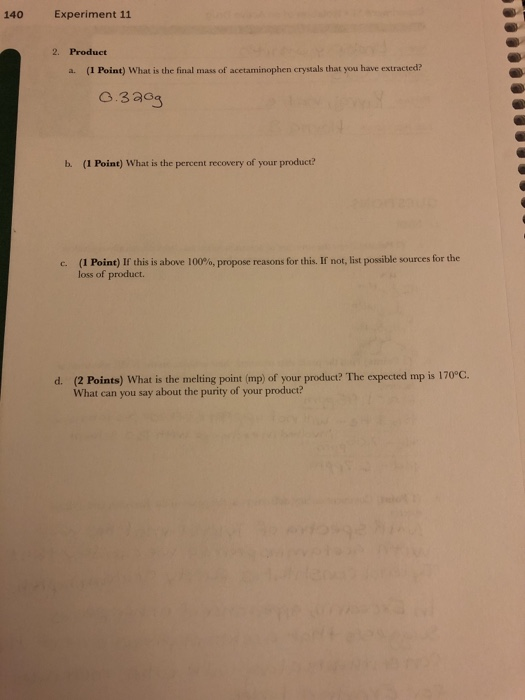
C) some of the compound might get adsorbed strongly on the column and not come down even on adding methanol. proper column packing might be an issue. also some of the compound could remain dissolved in the solvent while recrystallization. these are the probable reasons of getting low yield.
D) observed melting point is not provided.
Add Answer to:
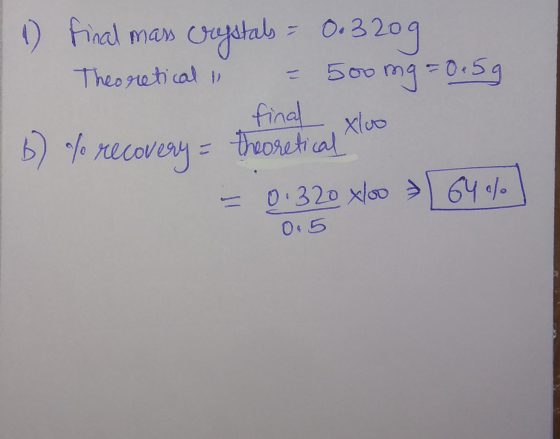
Given that the final mass of acetaminophen crystals=
0.320g,
- What is the percent recovery or...
What is the percent recovery of the product? (weight of product, acetaminophen=0.320g) EXPERIMENTAL PROCEDURE 1. Use...
 What is the percent recovery of the product? (weight of
product, acetaminophen=0.320g)
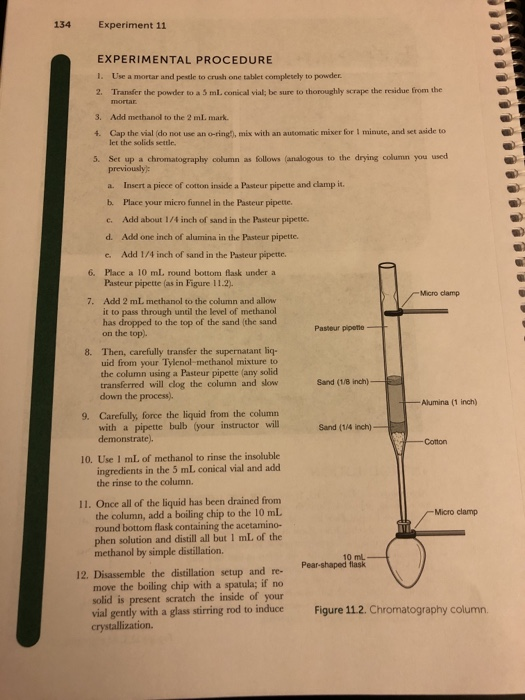
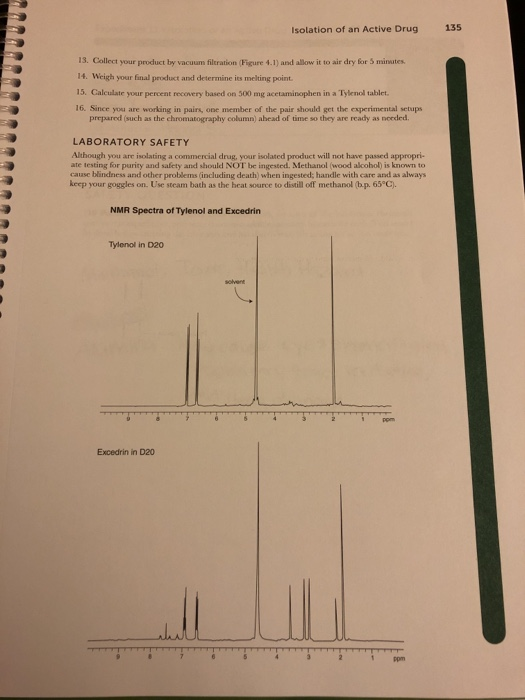
EXPERIMENTAL PROCEDURE 1. Use a mortar and pestle to crush one tablet completely to powder. 2. Transfer the powder to a 5 ml. conical viale be sure to thoroughly scrape the residue from the mortar. 3. Add methanol to the 2 mL mark. 4. Cap the vial do not use an o-ring mix with an automatic mixer for 1 minute, and set aside to let the solids settle....
What is the percent recovery of the product? (weight of
product, acetaminophen=0.320g)
EXPERIMENTAL PROCEDURE 1. Use a mortar and pestle to crush one tablet completely to powder. 2. Transfer the powder to a 5 ml. conical viale be sure to thoroughly scrape the residue from the mortar. 3. Add methanol to the 2 mL mark. 4. Cap the vial do not use an o-ring mix with an automatic mixer for 1 minute, and set aside to let the solids settle....
NaBH4(Sodium Borohydride) Reduction of Ketone (Organic Chemistry Lab) Questions 1. Explain the...
 NaBH4(Sodium Borohydride) Reduction of Ketone (Organic
Chemistry Lab)
Questions
1.
Explain the reaction mechanism and why each reagent was used.
2. Explain the need for 2 different drying agents
3. Use
IR stretches and melting point determination to explain your
results.
4.
Report sources of error.
Experiment Procedure
Assemble the reaction apparatus as shown in Figure 14.2a,
consisting of a 3.0 mL conical vial charged with 4-t-
butylcyclohexanone (amount calculated in pre-lab) and methanol (100
μL). Attach the air condenser...
NaBH4(Sodium Borohydride) Reduction of Ketone (Organic
Chemistry Lab)
Questions
1.
Explain the reaction mechanism and why each reagent was used.
2. Explain the need for 2 different drying agents
3. Use
IR stretches and melting point determination to explain your
results.
4.
Report sources of error.
Experiment Procedure
Assemble the reaction apparatus as shown in Figure 14.2a,
consisting of a 3.0 mL conical vial charged with 4-t-
butylcyclohexanone (amount calculated in pre-lab) and methanol (100
μL). Attach the air condenser...
Hydroboration-Oxidation (Organic Chemistry Laboratory) 1.Explain the mechanism of the reaction. 2.What was the most important piece...
Hydroboration-Oxidation (Organic Chemistry Laboratory) 1.Explain the mechanism of the reaction. 2.What was the most important piece of equipment for the success of the reaction? 3.Was there a rate determining step in the reaction? 4.Explain the purpose of the key reagent(s) in the reaction. Experiment Procedure Flame dry a 5.0 mL conical vial and a Claisen head at the start of the lab period. Place a dry spin vane in the dried conical vial. Assemble these pieces with a calcium chloride...
I need help finding the theoretical yield (in grams) of triphenyl methanol product in this experiment....
 I need help finding the theoretical yield (in grams) of
triphenyl methanol product in this experiment. PLEASE SHOW WORK, I
would like to learn the steps.
below is pictures of the procedure with amounts of chemicals
used
126 Experiment 10 EXPERIMENTAL PROCEDURE All glassware used in a Grignard reaction must be scrupulously dried, Dry the following glasstare in an af 110°C for at last 20 mini drying to Canadair 8 ml comical rial 5 ml con vial, air cond glass...
I need help finding the theoretical yield (in grams) of
triphenyl methanol product in this experiment. PLEASE SHOW WORK, I
would like to learn the steps.
below is pictures of the procedure with amounts of chemicals
used
126 Experiment 10 EXPERIMENTAL PROCEDURE All glassware used in a Grignard reaction must be scrupulously dried, Dry the following glasstare in an af 110°C for at last 20 mini drying to Canadair 8 ml comical rial 5 ml con vial, air cond glass...
if applicacable, please write clear stepwise mechanism for all synthetic transformations, showing important internediates where appropriate....
 if applicacable, please write clear stepwise mechanism for all
synthetic transformations, showing important internediates where
appropriate. only do this if applicable for this lab.
Experiment SD Column Chromatography Running the Reaction. Once sodium borohydride has been added to the reaction meture Isee next paragraph take samples at the times just indicated. Because this must be done in such a short time you must be well prepared before starting the reaction. One person should be the timekeeper, and the other person...
if applicacable, please write clear stepwise mechanism for all
synthetic transformations, showing important internediates where
appropriate. only do this if applicable for this lab.
Experiment SD Column Chromatography Running the Reaction. Once sodium borohydride has been added to the reaction meture Isee next paragraph take samples at the times just indicated. Because this must be done in such a short time you must be well prepared before starting the reaction. One person should be the timekeeper, and the other person...
question in first picture information located below mass of empty vial (979.2mg) then mass with crude...
 question in first picture
information located below
mass of empty vial (979.2mg) then mass with crude
(1769.1mg)
mass of empty vial (1769.1mg) then yield with pure
ester product(18535.6mg)
Actual ester yield (calculations in your lab notebook must be present, re-type it in the report). Theoretical yield (calculations in your lab notebook must be present, re-type it in the report). Percent yield (calculations in your lab notebook must be present, re-type it in the report). in loto in table format) drawstructure...
question in first picture
information located below
mass of empty vial (979.2mg) then mass with crude
(1769.1mg)
mass of empty vial (1769.1mg) then yield with pure
ester product(18535.6mg)
Actual ester yield (calculations in your lab notebook must be present, re-type it in the report). Theoretical yield (calculations in your lab notebook must be present, re-type it in the report). Percent yield (calculations in your lab notebook must be present, re-type it in the report). in loto in table format) drawstructure...
What is the percent yield of the lab procedure below? my final weight of the product is 0.0519 g
 what is the percent yield of the lab procedure below?
my final weight of the product is 0.0519 g
sure of the proper disposal methodl, properly Check with your laboratory insructor if you are PROCEDURE Be sure to dry the 5-mL reaction vial in the oven for at least twenty minutes. Water is experiment. this Preparation of the Ylide 1. Place 0.480 g of benzyltriphenylphosphonium chloride in a dry, 5-mlL reaction vial containing a magnetic spin vane Add 2 mL...
what is the percent yield of the lab procedure below?
my final weight of the product is 0.0519 g
sure of the proper disposal methodl, properly Check with your laboratory insructor if you are PROCEDURE Be sure to dry the 5-mL reaction vial in the oven for at least twenty minutes. Water is experiment. this Preparation of the Ylide 1. Place 0.480 g of benzyltriphenylphosphonium chloride in a dry, 5-mlL reaction vial containing a magnetic spin vane Add 2 mL...
What is the theoretical yield (in grams) and percent yield of your triphenylmethanol product in this...
 What is the theoretical yield (in grams) and percent yield of your
triphenylmethanol product in this experiment? (Weight of
triphenylmethanol: 0.060g)
BACKGROUND AND THEORY The Grignard reaction was one of the first organometallic reactions discovered and is still one of the most useful synthetically. By reacting an organohalide (usually a bromide) with magnesium in ethereal solvent, carbon becomes a nucleophile. Grignard reagents are the starting points for the syntheses of many alkanes, primary, secondary, and tertiary alcohols, alkenes, and carboxylic...
What is the theoretical yield (in grams) and percent yield of your
triphenylmethanol product in this experiment? (Weight of
triphenylmethanol: 0.060g)
BACKGROUND AND THEORY The Grignard reaction was one of the first organometallic reactions discovered and is still one of the most useful synthetically. By reacting an organohalide (usually a bromide) with magnesium in ethereal solvent, carbon becomes a nucleophile. Grignard reagents are the starting points for the syntheses of many alkanes, primary, secondary, and tertiary alcohols, alkenes, and carboxylic...
Draw a pathway for the reaction of phenylboronic acid with 4-iodophenol to obtain 4-phenylphenol in the...
 Draw a pathway for the
reaction of phenylboronic acid with 4-iodophenol to obtain
4-phenylphenol in the form of a catalytic
cycle. EXPLAIN and STATE all complexes formed in
EACH STEP by their electron counts (count how many
e- are there, e.g. 18 e- or 16
e- etc.), formal
oxidation states and all the reactions with
mechanistic labels (i.e. oxidative
addition, reductive elimination, etc.)
(note the amount of base used). Be sure to
EXPLAIN the catalytic cycle as to what happens...
Draw a pathway for the
reaction of phenylboronic acid with 4-iodophenol to obtain
4-phenylphenol in the form of a catalytic
cycle. EXPLAIN and STATE all complexes formed in
EACH STEP by their electron counts (count how many
e- are there, e.g. 18 e- or 16
e- etc.), formal
oxidation states and all the reactions with
mechanistic labels (i.e. oxidative
addition, reductive elimination, etc.)
(note the amount of base used). Be sure to
EXPLAIN the catalytic cycle as to what happens...
Determine the yield limiting reagent and the theoretical yield for the following multistep synthesis from the reaction of ethyl acetoacetate. Draw the chemical complete chemical reaction and mechanism...
Determine the yield limiting reagent and the theoretical yield for the following multistep synthesis from the reaction of ethyl acetoacetate. Draw the chemical complete chemical reaction and mechanism of Product C (determined to be 4-hydroxy-4 4-diphenylbutan-2-one) to Product E provided the procedure below. Procedure Step 4B [Product C to Product E] Place product [C] (0.5 g) in a 50 mL round bottomed flask, add acetone (15 mL), and concentrated HCl (2.5 mL). Boil under reflux on a water bath for...
 What is the percent recovery of the product? (weight of
product, acetaminophen=0.320g)
EXPERIMENTAL PROCEDURE 1. Use a mortar and pestle to crush one tablet completely to powder. 2. Transfer the powder to a 5 ml. conical viale be sure to thoroughly scrape the residue from the mortar. 3. Add methanol to the 2 mL mark. 4. Cap the vial do not use an o-ring mix with an automatic mixer for 1 minute, and set aside to let the solids settle....
What is the percent recovery of the product? (weight of
product, acetaminophen=0.320g)
EXPERIMENTAL PROCEDURE 1. Use a mortar and pestle to crush one tablet completely to powder. 2. Transfer the powder to a 5 ml. conical viale be sure to thoroughly scrape the residue from the mortar. 3. Add methanol to the 2 mL mark. 4. Cap the vial do not use an o-ring mix with an automatic mixer for 1 minute, and set aside to let the solids settle....
 NaBH4(Sodium Borohydride) Reduction of Ketone (Organic
Chemistry Lab)
Questions
1.
Explain the reaction mechanism and why each reagent was used.
2. Explain the need for 2 different drying agents
3. Use
IR stretches and melting point determination to explain your
results.
4.
Report sources of error.
Experiment Procedure
Assemble the reaction apparatus as shown in Figure 14.2a,
consisting of a 3.0 mL conical vial charged with 4-t-
butylcyclohexanone (amount calculated in pre-lab) and methanol (100
μL). Attach the air condenser...
NaBH4(Sodium Borohydride) Reduction of Ketone (Organic
Chemistry Lab)
Questions
1.
Explain the reaction mechanism and why each reagent was used.
2. Explain the need for 2 different drying agents
3. Use
IR stretches and melting point determination to explain your
results.
4.
Report sources of error.
Experiment Procedure
Assemble the reaction apparatus as shown in Figure 14.2a,
consisting of a 3.0 mL conical vial charged with 4-t-
butylcyclohexanone (amount calculated in pre-lab) and methanol (100
μL). Attach the air condenser...
 I need help finding the theoretical yield (in grams) of
triphenyl methanol product in this experiment. PLEASE SHOW WORK, I
would like to learn the steps.
below is pictures of the procedure with amounts of chemicals
used
126 Experiment 10 EXPERIMENTAL PROCEDURE All glassware used in a Grignard reaction must be scrupulously dried, Dry the following glasstare in an af 110°C for at last 20 mini drying to Canadair 8 ml comical rial 5 ml con vial, air cond glass...
I need help finding the theoretical yield (in grams) of
triphenyl methanol product in this experiment. PLEASE SHOW WORK, I
would like to learn the steps.
below is pictures of the procedure with amounts of chemicals
used
126 Experiment 10 EXPERIMENTAL PROCEDURE All glassware used in a Grignard reaction must be scrupulously dried, Dry the following glasstare in an af 110°C for at last 20 mini drying to Canadair 8 ml comical rial 5 ml con vial, air cond glass...
 if applicacable, please write clear stepwise mechanism for all
synthetic transformations, showing important internediates where
appropriate. only do this if applicable for this lab.
Experiment SD Column Chromatography Running the Reaction. Once sodium borohydride has been added to the reaction meture Isee next paragraph take samples at the times just indicated. Because this must be done in such a short time you must be well prepared before starting the reaction. One person should be the timekeeper, and the other person...
if applicacable, please write clear stepwise mechanism for all
synthetic transformations, showing important internediates where
appropriate. only do this if applicable for this lab.
Experiment SD Column Chromatography Running the Reaction. Once sodium borohydride has been added to the reaction meture Isee next paragraph take samples at the times just indicated. Because this must be done in such a short time you must be well prepared before starting the reaction. One person should be the timekeeper, and the other person...
 question in first picture
information located below
mass of empty vial (979.2mg) then mass with crude
(1769.1mg)
mass of empty vial (1769.1mg) then yield with pure
ester product(18535.6mg)
Actual ester yield (calculations in your lab notebook must be present, re-type it in the report). Theoretical yield (calculations in your lab notebook must be present, re-type it in the report). Percent yield (calculations in your lab notebook must be present, re-type it in the report). in loto in table format) drawstructure...
question in first picture
information located below
mass of empty vial (979.2mg) then mass with crude
(1769.1mg)
mass of empty vial (1769.1mg) then yield with pure
ester product(18535.6mg)
Actual ester yield (calculations in your lab notebook must be present, re-type it in the report). Theoretical yield (calculations in your lab notebook must be present, re-type it in the report). Percent yield (calculations in your lab notebook must be present, re-type it in the report). in loto in table format) drawstructure...
 what is the percent yield of the lab procedure below?
my final weight of the product is 0.0519 g
sure of the proper disposal methodl, properly Check with your laboratory insructor if you are PROCEDURE Be sure to dry the 5-mL reaction vial in the oven for at least twenty minutes. Water is experiment. this Preparation of the Ylide 1. Place 0.480 g of benzyltriphenylphosphonium chloride in a dry, 5-mlL reaction vial containing a magnetic spin vane Add 2 mL...
what is the percent yield of the lab procedure below?
my final weight of the product is 0.0519 g
sure of the proper disposal methodl, properly Check with your laboratory insructor if you are PROCEDURE Be sure to dry the 5-mL reaction vial in the oven for at least twenty minutes. Water is experiment. this Preparation of the Ylide 1. Place 0.480 g of benzyltriphenylphosphonium chloride in a dry, 5-mlL reaction vial containing a magnetic spin vane Add 2 mL...
 What is the theoretical yield (in grams) and percent yield of your
triphenylmethanol product in this experiment? (Weight of
triphenylmethanol: 0.060g)
BACKGROUND AND THEORY The Grignard reaction was one of the first organometallic reactions discovered and is still one of the most useful synthetically. By reacting an organohalide (usually a bromide) with magnesium in ethereal solvent, carbon becomes a nucleophile. Grignard reagents are the starting points for the syntheses of many alkanes, primary, secondary, and tertiary alcohols, alkenes, and carboxylic...
What is the theoretical yield (in grams) and percent yield of your
triphenylmethanol product in this experiment? (Weight of
triphenylmethanol: 0.060g)
BACKGROUND AND THEORY The Grignard reaction was one of the first organometallic reactions discovered and is still one of the most useful synthetically. By reacting an organohalide (usually a bromide) with magnesium in ethereal solvent, carbon becomes a nucleophile. Grignard reagents are the starting points for the syntheses of many alkanes, primary, secondary, and tertiary alcohols, alkenes, and carboxylic...
 Draw a pathway for the
reaction of phenylboronic acid with 4-iodophenol to obtain
4-phenylphenol in the form of a catalytic
cycle. EXPLAIN and STATE all complexes formed in
EACH STEP by their electron counts (count how many
e- are there, e.g. 18 e- or 16
e- etc.), formal
oxidation states and all the reactions with
mechanistic labels (i.e. oxidative
addition, reductive elimination, etc.)
(note the amount of base used). Be sure to
EXPLAIN the catalytic cycle as to what happens...
Draw a pathway for the
reaction of phenylboronic acid with 4-iodophenol to obtain
4-phenylphenol in the form of a catalytic
cycle. EXPLAIN and STATE all complexes formed in
EACH STEP by their electron counts (count how many
e- are there, e.g. 18 e- or 16
e- etc.), formal
oxidation states and all the reactions with
mechanistic labels (i.e. oxidative
addition, reductive elimination, etc.)
(note the amount of base used). Be sure to
EXPLAIN the catalytic cycle as to what happens...
Most questions answered within 3 hours.
-
Where is the error in this code sequence?
String s1 = "Hello";
String s2 = "ello";...
asked 10 months ago -
Financial data for Joel de Paris, Inc., for last year
follow:
Joel de Paris, Inc.
Balance...
asked 10 months ago -
Consider this reaction:
Al2(SO4)3 (aq)+ BaCl3
(aq) Al2Cl6 (aq)- +
3BaSO4(s) . What is the...
asked 10 months ago -
Suppose that Savneet is considering increasing her
recent random sample from 20 car rentals to 40...
asked 10 months ago -
Trucks arrive at an unloading terminal at an average rate of 120
per hour.
Trucks arrive...
asked 10 months ago -
Why are methanol and ethanol completely soluble in water while
octanol is not very little soluble....
asked 10 months ago -
A facilities manager at a university reads in a research report
that the mean amount of...
asked 10 months ago -
When the CuSO4 is rehydrated by adding water to the anhydrous
compound, is this an endothermic...
asked 10 months ago -
A ray of sunlight is passing from diamond into crown glass; the
angle of incidence is...
asked 10 months ago -
A block of mass 0.249 kg is placed on top of a light, vertical
spring of...
asked 10 months ago -
how do the kidneys compensate in the presences of acidosis
a) trigger hyperventilate
b) reserve acid...
asked 10 months ago -
Question 501 pts
The rental rate of capital to the firm increases. Which of the
following...
asked 10 months ago