
Homework Answers
Add Answer to:
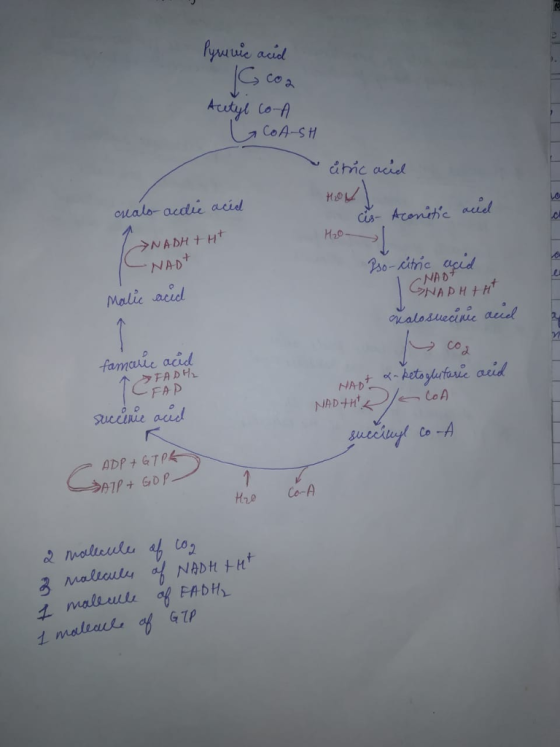
Fill in this diagram of the Kreb's Cycle Pyruvate ooo (these circles are Carbon atoms) How...
© pyruvate NAD+ Coenzyme A There are carbon atoms (C) brought in by pyruvate at the...
 © pyruvate NAD+ Coenzyme A There are carbon atoms (C) brought in by pyruvate at the start of step 1. COCOA acetyl-CoA There are carbon atoms (C) present in citrate. Step 2 coeruryme There is a total of molecule(s) of FADH2 produced during the entire series of reactions (steps 1 and 2). GGGGGG GOOG QUAD Krebs Cycle FADHI Which of the following molecules are created during the second stage of aerobic respiration and then leave to do work elsewhere in...
Question 5 1 pts What is the main purpose of the Kreb's cycle (also known as...
 Question 5 1 pts What is the main purpose of the Kreb's cycle (also known as the TCA or Citric Acid cycle) To produce ATP from the energy stored in acetyl-CoA To oxidize pyruvate and produce NAD and FADH2 To recycle NADH for use back in glycolysis To produce carbon dioxide by the reduction of pyruvate To produce NADH/FADH2 from the oxidation of acetyl-CoA
The succinyl CoA to citrate pathway of the citric acid cycle is shown below. Identify the...
 The succinyl CoA to citrate pathway of the citric acid cycle is
shown below. Identify the missing intermediates by dragging the
item to the appropriate position. Then identify the missing
cofactors below.
I have pulled up the "drop down" menu for
the options for the "Cofactors"
Citrate H2C-CO2 H2C-co Succinyl CoA H2O AcCoA HO CO2 H2 GDP+P GTP CoA-SH CoA-SH CoA CO2 HO-C-H CH2 CO2 CO2 CO2 CH2 CH2 CO2 CO2 H-C-OH CH2 CO2 2 H CO2 CH2 CO2 factor...
The succinyl CoA to citrate pathway of the citric acid cycle is
shown below. Identify the missing intermediates by dragging the
item to the appropriate position. Then identify the missing
cofactors below.
I have pulled up the "drop down" menu for
the options for the "Cofactors"
Citrate H2C-CO2 H2C-co Succinyl CoA H2O AcCoA HO CO2 H2 GDP+P GTP CoA-SH CoA-SH CoA CO2 HO-C-H CH2 CO2 CO2 CO2 CH2 CH2 CO2 CO2 H-C-OH CH2 CO2 2 H CO2 CH2 CO2 factor...
For each two carbon fragment that is removed in beta oxidation, 1 FADH2 and 1 NADH...
For each two carbon fragment that is removed in beta oxidation, 1 FADH2 and 1 NADH + H+ are produced. Each FADH2 can produce two ATP, and each NADH can produce 3 ATP. Each two carbon fragment enters the Kreb's cycle. If you were to completely metabolize a 14 carbon fatty acid by beta oxidation, you would get 6 FADH2 and 6 NADH + 6H+ from beta oxidation, and you would have 7 acetyl CoA molecules that would enter the...
Assume a cell has just completed glycolysis and the resulting pyruvate has a c-14 radio label...
 Assume a cell has just completed glycolysis and the resulting
pyruvate has a c-14 radio label on carbon -1. Highlight the carbon
on the attached pages as it passes through the PDH complex and the
TCA cycle until it is lost as CO2. If only a portion of the carbons
are lost stop highlighting when the CO2 first starts to come off.
ONLY ONE TIME THRU THE CYCLE ON EACH PAGE
2. Repeat question 1 but now assume the radio...
Assume a cell has just completed glycolysis and the resulting
pyruvate has a c-14 radio label on carbon -1. Highlight the carbon
on the attached pages as it passes through the PDH complex and the
TCA cycle until it is lost as CO2. If only a portion of the carbons
are lost stop highlighting when the CO2 first starts to come off.
ONLY ONE TIME THRU THE CYCLE ON EACH PAGE
2. Repeat question 1 but now assume the radio...
As pyruvate is completely broken down in the TCA (Krebs) cycle, some of its energy is...
As pyruvate is completely broken down in the TCA (Krebs) cycle, some of its energy is A) conserved in the water molecules resulting from reduction of oxygen. B) conserved in the carbon dioxide molecules released by the processes. C) conserved in FAD and NAD+. D) conserved in NADH + H+ and FADH2. E) found in the oxygen used in the electron transport chain.
acetyl-CoA COA The reactions of the citric acid cycle are shown in the image. As labeled...
 acetyl-CoA COA The reactions of the citric acid cycle are shown in the image. As labeled in the diagram, reactions 1, 3, and 4 are regulation points in the citric acid cycle. oxaloacetate citrate synthase citrate NADH +Hi 7 malate dehydrogenase NAD malate aconitase 2 Which molecule inhibits reaction 1? isocitrate 7 fumarase NAD isocitrate dehydrogenase 3 NADH + H+ O citrate O NAD acetyl-CoA + CO2 fumarate C-ketoglutarate FADH succinate O dehydrogenase FAD O-ketoglutarate a dehydrogenase NAD + COA...
The common molecule produced from all foods at the second stage of catabolism is A) ADP. B acetyl...
 just checking my answers, except for number 10.
The common molecule produced from all foods at the second stage of catabolism is A) ADP. B acetyl-CoA. C) glucose. D) citric acid. Which group of compounds includes only low-energy molecules? 1. 2. Hih A)ATP; acetyl-CoA; NADH; FADH2 C) ADP: CO2; NADH; FADH2 DONO BADP: acetyl-CoA; NAD+:FAD-mau ADP: CO2: NAD+, FAD After O2 has been reduced in the electron transport chain, the oxygen atoms are part of what molecules? A) ATP 3....
just checking my answers, except for number 10.
The common molecule produced from all foods at the second stage of catabolism is A) ADP. B acetyl-CoA. C) glucose. D) citric acid. Which group of compounds includes only low-energy molecules? 1. 2. Hih A)ATP; acetyl-CoA; NADH; FADH2 C) ADP: CO2; NADH; FADH2 DONO BADP: acetyl-CoA; NAD+:FAD-mau ADP: CO2: NAD+, FAD After O2 has been reduced in the electron transport chain, the oxygen atoms are part of what molecules? A) ATP 3....
1. Select the TRUE statement about the citric acid cycle. A. Isocitrate dehydrogenase is a multienzyme...
1. Select the TRUE statement about the citric acid cycle. A. Isocitrate dehydrogenase is a multienzyme complex that is very similar to the pyruvate dehydrogenase complex B. The two decarboxylation steps occur right after each other, first via oxidative alpha- decarboxylation, then via oxidative beta- decarboxylation. C. In one turn of the cycle, the two carbons that enter the cycle as acetyl CoA are the same two carbons that are released as CO2. D. A flavin containing dehydrogenase enzymes oxidizes...
You are carrying out an experiment in the lab to study the citric acid cycle. To do this, you add 14C-labeled pyruvate at carbon 3 (this is the methyl carbon) to metabolically active mitochondria. Bas...
You are carrying out an experiment in the lab to study the citric acid cycle. To do this, you add 14C-labeled pyruvate at carbon 3 (this is the methyl carbon) to metabolically active mitochondria. Based on your knowledge of the citric acid cycle, what is the location of the 14C-label in oxaloacetate after one turn of the cycle? How many turns of the cycle are required to release all of the14C-label as CO2? Be sure to justify your answers by...
 © pyruvate NAD+ Coenzyme A There are carbon atoms (C) brought in by pyruvate at the start of step 1. COCOA acetyl-CoA There are carbon atoms (C) present in citrate. Step 2 coeruryme There is a total of molecule(s) of FADH2 produced during the entire series of reactions (steps 1 and 2). GGGGGG GOOG QUAD Krebs Cycle FADHI Which of the following molecules are created during the second stage of aerobic respiration and then leave to do work elsewhere in...
 Question 5 1 pts What is the main purpose of the Kreb's cycle (also known as the TCA or Citric Acid cycle) To produce ATP from the energy stored in acetyl-CoA To oxidize pyruvate and produce NAD and FADH2 To recycle NADH for use back in glycolysis To produce carbon dioxide by the reduction of pyruvate To produce NADH/FADH2 from the oxidation of acetyl-CoA
 The succinyl CoA to citrate pathway of the citric acid cycle is
shown below. Identify the missing intermediates by dragging the
item to the appropriate position. Then identify the missing
cofactors below.
I have pulled up the "drop down" menu for
the options for the "Cofactors"
Citrate H2C-CO2 H2C-co Succinyl CoA H2O AcCoA HO CO2 H2 GDP+P GTP CoA-SH CoA-SH CoA CO2 HO-C-H CH2 CO2 CO2 CO2 CH2 CH2 CO2 CO2 H-C-OH CH2 CO2 2 H CO2 CH2 CO2 factor...
The succinyl CoA to citrate pathway of the citric acid cycle is
shown below. Identify the missing intermediates by dragging the
item to the appropriate position. Then identify the missing
cofactors below.
I have pulled up the "drop down" menu for
the options for the "Cofactors"
Citrate H2C-CO2 H2C-co Succinyl CoA H2O AcCoA HO CO2 H2 GDP+P GTP CoA-SH CoA-SH CoA CO2 HO-C-H CH2 CO2 CO2 CO2 CH2 CH2 CO2 CO2 H-C-OH CH2 CO2 2 H CO2 CH2 CO2 factor...
 Assume a cell has just completed glycolysis and the resulting
pyruvate has a c-14 radio label on carbon -1. Highlight the carbon
on the attached pages as it passes through the PDH complex and the
TCA cycle until it is lost as CO2. If only a portion of the carbons
are lost stop highlighting when the CO2 first starts to come off.
ONLY ONE TIME THRU THE CYCLE ON EACH PAGE
2. Repeat question 1 but now assume the radio...
Assume a cell has just completed glycolysis and the resulting
pyruvate has a c-14 radio label on carbon -1. Highlight the carbon
on the attached pages as it passes through the PDH complex and the
TCA cycle until it is lost as CO2. If only a portion of the carbons
are lost stop highlighting when the CO2 first starts to come off.
ONLY ONE TIME THRU THE CYCLE ON EACH PAGE
2. Repeat question 1 but now assume the radio...
 acetyl-CoA COA The reactions of the citric acid cycle are shown in the image. As labeled in the diagram, reactions 1, 3, and 4 are regulation points in the citric acid cycle. oxaloacetate citrate synthase citrate NADH +Hi 7 malate dehydrogenase NAD malate aconitase 2 Which molecule inhibits reaction 1? isocitrate 7 fumarase NAD isocitrate dehydrogenase 3 NADH + H+ O citrate O NAD acetyl-CoA + CO2 fumarate C-ketoglutarate FADH succinate O dehydrogenase FAD O-ketoglutarate a dehydrogenase NAD + COA...
 just checking my answers, except for number 10.
The common molecule produced from all foods at the second stage of catabolism is A) ADP. B acetyl-CoA. C) glucose. D) citric acid. Which group of compounds includes only low-energy molecules? 1. 2. Hih A)ATP; acetyl-CoA; NADH; FADH2 C) ADP: CO2; NADH; FADH2 DONO BADP: acetyl-CoA; NAD+:FAD-mau ADP: CO2: NAD+, FAD After O2 has been reduced in the electron transport chain, the oxygen atoms are part of what molecules? A) ATP 3....
just checking my answers, except for number 10.
The common molecule produced from all foods at the second stage of catabolism is A) ADP. B acetyl-CoA. C) glucose. D) citric acid. Which group of compounds includes only low-energy molecules? 1. 2. Hih A)ATP; acetyl-CoA; NADH; FADH2 C) ADP: CO2; NADH; FADH2 DONO BADP: acetyl-CoA; NAD+:FAD-mau ADP: CO2: NAD+, FAD After O2 has been reduced in the electron transport chain, the oxygen atoms are part of what molecules? A) ATP 3....
Most questions answered within 3 hours.
-
Where is the error in this code sequence?
String s1 = "Hello";
String s2 = "ello";...
asked 11 months ago -
Financial data for Joel de Paris, Inc., for last year
follow:
Joel de Paris, Inc.
Balance...
asked 11 months ago -
Consider this reaction:
Al2(SO4)3 (aq)+ BaCl3
(aq) Al2Cl6 (aq)- +
3BaSO4(s) . What is the...
asked 11 months ago -
Suppose that Savneet is considering increasing her
recent random sample from 20 car rentals to 40...
asked 11 months ago -
Trucks arrive at an unloading terminal at an average rate of 120
per hour.
Trucks arrive...
asked 11 months ago -
Why are methanol and ethanol completely soluble in water while
octanol is not very little soluble....
asked 11 months ago -
A facilities manager at a university reads in a research report
that the mean amount of...
asked 11 months ago -
When the CuSO4 is rehydrated by adding water to the anhydrous
compound, is this an endothermic...
asked 11 months ago -
A ray of sunlight is passing from diamond into crown glass; the
angle of incidence is...
asked 11 months ago -
A block of mass 0.249 kg is placed on top of a light, vertical
spring of...
asked 11 months ago -
how do the kidneys compensate in the presences of acidosis
a) trigger hyperventilate
b) reserve acid...
asked 11 months ago -
Question 501 pts
The rental rate of capital to the firm increases. Which of the
following...
asked 11 months ago