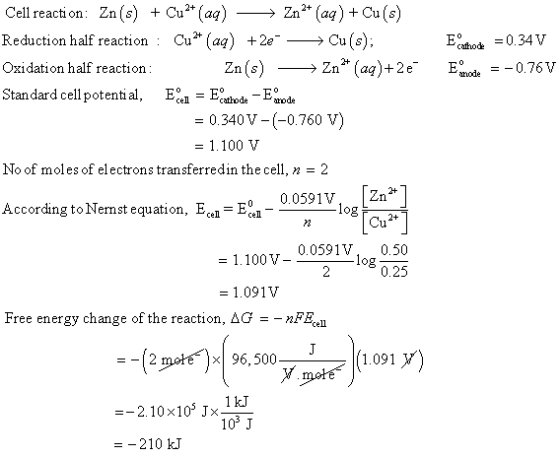
Calculate the expected E value for the cell in which E0= 1.100 V, F=96,500 J/V R=8.31...
Calculate the expected E value for the cell in which E0= 1.100 V, F=96,500 J/V R=8.31 T=25 0degrees celcius. Zn+Cu2+ (.25M) ----> Zn2+ (.5M) +Cu
What is Delta G?
Homework Answers
Add Answer to:
Calculate the expected E value for the cell in which E0= 1.100
V, F=96,500 J/V R=8.31...
8. The standard cell potential (E°cell) for the reaction below is +1.10 V. Calculate the cell...
8. The standard cell potential (E°cell) for the reaction below is +1.10 V. Calculate the cell potential for this reaction when the concentration of [Cu2+] = 1.0 × 10⁻⁵ M and [Zn2+] = 3.5 M. Zn (s) + Cu2+ (aq) → Cu (s) + Zn2+ (aq)
Constants The following values may be useful when solving this tutorial. Constant Value E∘Cu 0.337 V...
Constants The following values may be useful when solving this tutorial. Constant Value E∘Cu 0.337 V E∘Zn -0.763 V R 8.314 J⋅mol−1⋅K−1 F 96,485 C/mol T 298 K Part A Part complete In the activity, click on the E∘cell and Keq quantities to observe how they are related. Use this relation to calculate Keq for the following redox reaction that occurs in an electrochemical cell having two electrodes: a cathode and an anode. The two half-reactions that occur in the...
8. The standard cell potential (E°cell) for the reaction below is +1.10 V. Calculate the cell pot...
8. The standard cell potential (E°cell) for the reaction below is +1.10 V. Calculate the cell potential for this reaction when the concentration of [Cu2+] = 1.0 × 10⁻⁵ M and [Zn2+] = 3.5 M. Zn (s) + Cu2+ (aq) → Cu (s) + Zn2+ (aq)
The cell Cu(s)(1M) | Cu2+ || (1M) | Cu(s) has E = 0.182 V The cell...
The cell Cu(s)(1M) | Cu2+ || (1M) | Cu(s) has E = 0.182 V The cell Pt(s) | Cu+(1M) | Cu2+ || Cu+ | (1M) | Cu(s) has E = 0.364 V How do you calculate delta G?
Calculate E for the following electrochemical cell at 25°C Cu|Cu2+(0.01M) || Zn2+(0.05M)]Zn Select one: a. -0.977V...
 Calculate E for the following electrochemical cell at 25°C Cu|Cu2+(0.01M) || Zn2+(0.05M)]Zn Select one: a. -0.977V cb. -1.598V c. -1.080V d. -1.122V ce. -1.311V
Half-cell Potentials: Half Reaction: E value +0.80 V Agt + e → Ag Fe3+ + €...
 Half-cell Potentials: Half Reaction: E value +0.80 V Agt + e → Ag Fe3+ + € → Fe2+ +0.77 v +0.34 V -0.13 V Cu2+ +2e → Cu Pb2+ + 2e - → Ib Ni2+ + 2e → Ni Cd2+ +2e → Cd -0.25 V -0.40 V Fe2+ + 2e → Fe -0.44 V Zn2+ + 2e → Zn -0.76 V Al3+ +3e → AI - 1.66 V Consider an electrochemical cell constructed from the following half cells, linked by...
1) Calculate the cell potential, E°cell, for the following electrochemical reaction. Cu(s) + I2(g) → Cu+2(aq)...
1) Calculate the cell potential, E°cell, for the following electrochemical reaction. Cu(s) + I2(g) → Cu+2(aq) + 2I-1(aq) E = ? a.-0.87 V b.-0.19 V c.0.19 V d.0.87 V 2) Calculate the equilibrium constant (Keq) for the following reaction at 25 °C? (Faraday's Constant = 96,500 J / V · mol) & (R = 8.314 J / mol · K) 2Fe+3(aq) + Sn+2(aq) → 2Fe+2(aq) + Sn+4(aq) K = ? a. 4.04 x 10⁷ b. 3.44 x 10¹⁸ c. 4.48...
se the tabulated half-cell potentials to calculate ??-for the following ,edo-m-mm in (7 points ) Tabulated...
 se the tabulated half-cell potentials to calculate ??-for the following ,edo-m-mm in (7 points ) Tabulated half-cell potentials (Reduction) Zar" (aq) + 2 e-? Zn(s) E.--0763 V Cl:(g) +2e2 CT(a)+1.358 F-96,485 C/mol. electron, 13-1 C.V and 1kJ -1000 C). (7 points) 4) Calculate K for the oxidation of copper by H' (at 25 Cu(s) + 2 r(aq) ? Cu2+(aq) + H2(g) Tabulated half-cell potentials (Reduction) Cu2 (aq) + 2 e-Al(s) E-0.34 v 2H+(aq) + 2 e--+ H2 (g) E#20.00 V...
Calculate the E°cell for the following reaction: Cu2+ (aq) + Ni (s) → Cu (s)...
Calculate the E°cell for the following reaction: Cu2+ (aq) + Ni (s) → Cu (s) + Ni2+ (aq) A) (-0.59 ± 0.01) V B) (-0.09 ± 0.01) V C) (0.59 ± 0.01) V D) (0.09 ± 0.01) V --------------------------------------------------------------------------------------------------------- What is the proper line notation for the following reaction? Cu (s) + 2Ag+ (aq) → Cu2+ (aq) + 2Ag (s) A) Cu2+ | Cu || Ag | Ag+ B) Ag+ | Ag || Cu | Cu2+ C) Cu |...
Using the information in the table: Which combination of metals, if used to create an electrochemical...
 Using the information in the table:
Which combination of metals, if used to create an
electrochemical cell, would produce the largest voltage?
Liu lur the reaction between Zn and Cu2+ ions is 1.1030 V, we can use the known value for the half-cell potential for zinc to determine the half-cell potential for copper: Zn(s) → Zn2+(aq) + 2e + Cu2+(aq) + 2e → Cu(s) Zn(s) + Cu2+ (aq) → Zn2+ (aq) + Cu(s) E half-cell = 0.7628 V Eºhalf-cell =...
Using the information in the table:
Which combination of metals, if used to create an
electrochemical cell, would produce the largest voltage?
Liu lur the reaction between Zn and Cu2+ ions is 1.1030 V, we can use the known value for the half-cell potential for zinc to determine the half-cell potential for copper: Zn(s) → Zn2+(aq) + 2e + Cu2+(aq) + 2e → Cu(s) Zn(s) + Cu2+ (aq) → Zn2+ (aq) + Cu(s) E half-cell = 0.7628 V Eºhalf-cell =...
 Calculate E for the following electrochemical cell at 25°C Cu|Cu2+(0.01M) || Zn2+(0.05M)]Zn Select one: a. -0.977V cb. -1.598V c. -1.080V d. -1.122V ce. -1.311V
 Half-cell Potentials: Half Reaction: E value +0.80 V Agt + e → Ag Fe3+ + € → Fe2+ +0.77 v +0.34 V -0.13 V Cu2+ +2e → Cu Pb2+ + 2e - → Ib Ni2+ + 2e → Ni Cd2+ +2e → Cd -0.25 V -0.40 V Fe2+ + 2e → Fe -0.44 V Zn2+ + 2e → Zn -0.76 V Al3+ +3e → AI - 1.66 V Consider an electrochemical cell constructed from the following half cells, linked by...
 se the tabulated half-cell potentials to calculate ??-for the following ,edo-m-mm in (7 points ) Tabulated half-cell potentials (Reduction) Zar" (aq) + 2 e-? Zn(s) E.--0763 V Cl:(g) +2e2 CT(a)+1.358 F-96,485 C/mol. electron, 13-1 C.V and 1kJ -1000 C). (7 points) 4) Calculate K for the oxidation of copper by H' (at 25 Cu(s) + 2 r(aq) ? Cu2+(aq) + H2(g) Tabulated half-cell potentials (Reduction) Cu2 (aq) + 2 e-Al(s) E-0.34 v 2H+(aq) + 2 e--+ H2 (g) E#20.00 V...
 Using the information in the table:
Which combination of metals, if used to create an
electrochemical cell, would produce the largest voltage?
Liu lur the reaction between Zn and Cu2+ ions is 1.1030 V, we can use the known value for the half-cell potential for zinc to determine the half-cell potential for copper: Zn(s) → Zn2+(aq) + 2e + Cu2+(aq) + 2e → Cu(s) Zn(s) + Cu2+ (aq) → Zn2+ (aq) + Cu(s) E half-cell = 0.7628 V Eºhalf-cell =...
Using the information in the table:
Which combination of metals, if used to create an
electrochemical cell, would produce the largest voltage?
Liu lur the reaction between Zn and Cu2+ ions is 1.1030 V, we can use the known value for the half-cell potential for zinc to determine the half-cell potential for copper: Zn(s) → Zn2+(aq) + 2e + Cu2+(aq) + 2e → Cu(s) Zn(s) + Cu2+ (aq) → Zn2+ (aq) + Cu(s) E half-cell = 0.7628 V Eºhalf-cell =...
Most questions answered within 3 hours.
-
Where is the error in this code sequence?
String s1 = "Hello";
String s2 = "ello";...
asked 11 months ago -
Financial data for Joel de Paris, Inc., for last year
follow:
Joel de Paris, Inc.
Balance...
asked 11 months ago -
Consider this reaction:
Al2(SO4)3 (aq)+ BaCl3
(aq) Al2Cl6 (aq)- +
3BaSO4(s) . What is the...
asked 11 months ago -
Suppose that Savneet is considering increasing her
recent random sample from 20 car rentals to 40...
asked 11 months ago -
Trucks arrive at an unloading terminal at an average rate of 120
per hour.
Trucks arrive...
asked 11 months ago -
Why are methanol and ethanol completely soluble in water while
octanol is not very little soluble....
asked 11 months ago -
A facilities manager at a university reads in a research report
that the mean amount of...
asked 11 months ago -
When the CuSO4 is rehydrated by adding water to the anhydrous
compound, is this an endothermic...
asked 11 months ago -
A ray of sunlight is passing from diamond into crown glass; the
angle of incidence is...
asked 11 months ago -
A block of mass 0.249 kg is placed on top of a light, vertical
spring of...
asked 11 months ago -
how do the kidneys compensate in the presences of acidosis
a) trigger hyperventilate
b) reserve acid...
asked 11 months ago -
Question 501 pts
The rental rate of capital to the firm increases. Which of the
following...
asked 11 months ago