
Homework Answers
Add Answer to:
The next three questions will take you through the calculation of Delta H for the following...
The next three questions will take you through the calculation of Delta H for the following...
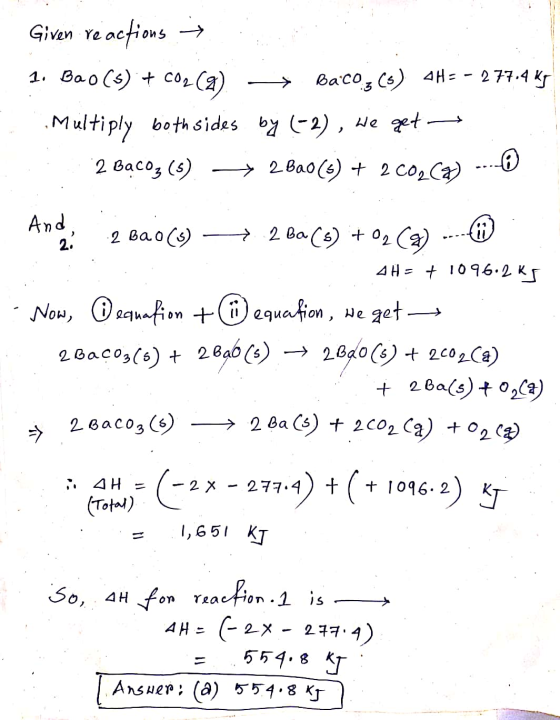
 The next three questions will take you through the calculation of Delta H for the following reaction using Hess's Law. Follow the steps and answer each question in turn 2Baco, (s) -----> 2Ba (s) + O2(g) + 2CO2 (g) AH = ? Given the following reactions and thermochemical data: 1. BaO (8) + CO2 (g) ----ảy> BaCO3 (5) AH = 274 VI 2. 2 Bao (s) -------> 2 Ba (s) + O2(g) AH + 1096.2 kJ After rearranging as if...
my answer is wrong please help Calculate AHan for the following reaction: BaO(s) + CO2(g) →...
 my answer is wrong please help
Calculate AHan for the following reaction: BaO(s) + CO2(g) → BaCO3(s) Use the following reactions and the given values of AH for them: Ba(s) + CO2(g) + O2(g) → BaCO3(8), AH = -826.5 kJ 2Ba(s) + O2(g) + 2BaO(s), AH = -1184.0 kJ Express your answer to four significant figures in kilojoules. ► View Available Hint(s) IO AD * * O2 ? AH.= 269.0
my answer is wrong please help
Calculate AHan for the following reaction: BaO(s) + CO2(g) → BaCO3(s) Use the following reactions and the given values of AH for them: Ba(s) + CO2(g) + O2(g) → BaCO3(8), AH = -826.5 kJ 2Ba(s) + O2(g) + 2BaO(s), AH = -1184.0 kJ Express your answer to four significant figures in kilojoules. ► View Available Hint(s) IO AD * * O2 ? AH.= 269.0
(Please explain) Hess Law delta H Manipulate the data provided to find the ΔHrxnfor the reaction:...
(Please explain) Hess Law delta H Manipulate the data provided to find the ΔHrxnfor the reaction: CH4(s) + 2 O2(g) →CO2(g)+ 2 H2O(l) (1) 2 CH4(g)+ 3 O2(g) →2 CO(g) + 4 H2O (l) ΔH= −1215 kJ (2) 2C + O2(g) →2 CO(g) ΔH= −221 kJ (3) C (s) + O2(g) → CO2(g) ΔH= −394 kJ I have solved it myself but I am not sure of the answer I have gotten. my answer was about -228.5kj
The direct reaction of methane (CH) with oxygen to give carbon monoxide is hard to accomplish without also producin...
 The direct reaction of methane (CH) with oxygen to give carbon monoxide is hard to accomplish without also producing carbon dioxide. However, we can use a Hess's law calculation to calculate AH,anyway. Calculate AH in kJ for the following reaction from the thermochemical equations given. 35. 2CO(g) + 4H2O() 2CH&(g) +302(g) Use the following thermochemical equations: AH-221.08 kJ 2CO(g) (1) 2C(s)+O2(g) AH=-890.4 kJ CH&g)+202(g) CO2(g)+ 2H20() (2) AH -393.51 kJ CO2(g) C(s)+O2(g) (3)
5. Use the following data to determine the delta H for the conversion of diamond into...
5. Use the following data to determine the delta H for the conversion of diamond into graphite: C(diamind) (s) + O2(g) = CO2(g) delta H degrees = -395.4 kJ 2CO2(g) = 2 CO(g) + O2(g) delta H degrees = 566.0 kJ 2CO(g) = C(graphite) (s) + CO2 (g) delta H degrees = -172.5 kJ C(diamond) (s) = C(graphite) delta H degrees = ?
DaC. NUL20 1) Find AH, for the reaction 2H2(g) + 2C(s) + O2(g) → C2H5OH(I), using...
 DaC. NUL20 1) Find AH, for the reaction 2H2(g) + 2C(s) + O2(g) → C2H5OH(I), using the following thermochemical data. For Hess's Law, rewrite equations to find out AH. C2H5OH (1) +2 02 (g) → 2 CO2 (g) + 3H20 (1) AH = -875.J C(s) + O2(g) → CO2 (g) AH = -394,51 kJ H2(g) + 12 02 (g) → H20 (1) AH = -285.8 kJ
The value of AH for the reaction below is -1107 kJ: 2Ba(s) + O2 (g) -...
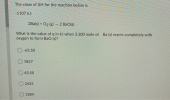 The value of AH for the reaction below is -1107 kJ: 2Ba(s) + O2 (g) - 2 BaO(s) What is the value of q in kJ when 3.300 mole of Ba (s) reacts completely with oxygen to form Bao (s)? O-63.50 1827 63.50 2435 1384
help The value of H° for the reaction below is -1107 kJ: 2Ba (s) + O2...
help The value of H° for the reaction below is -1107 kJ: 2Ba (s) + O2 (g) 2BaO (s) How many kJ of heat are released when 5.75 g of Ba (s) reacts completely with oxygen to form BaO (s)? 23.2 kJ 26.3 kJ 96.3 kJ 46.4 kJ 193 kJ
Given the following reactions and subsequent delta H values, C2H6 (g) -> C2H2 (g) + 2H2...
Given the following reactions and subsequent delta H values, C2H6 (g) -> C2H2 (g) + 2H2 (g) delta H= 283.5 kJ H2 (g) + 1/2 O2 (g) -> H2O (g) delta H= -213.7 kJ 2CO2 (g) + 3H2O (g) -> C2H6 (g) + H2O (g) delta H= 849 kJ Find the delta H for the reaction: C2H2 (g) + 5/2 O2 (g) -> 2CO2 (g) + H2O (g)
Determine the amount of heat involved in a chemical change using. Hess's Law Question 2C(s) +...
 Determine the amount of heat involved in a chemical change using. Hess's Law Question 2C(s) + 0,(g) + 2 CO(g) AH = -222 kJ 2 H, (g) + O2(g) + 2H2O(g) AH = -484 kJ H,0(1) H2O(g) AH = +44 kJ Use the thermochemical data above to calculate the change in enthalpy for the reaction below. H,0(1) + C(s) + CO(g) +H, () . Your answer should have three significant figures. Provide your answer below: Activity Details You have viewed...
 The next three questions will take you through the calculation of Delta H for the following reaction using Hess's Law. Follow the steps and answer each question in turn 2Baco, (s) -----> 2Ba (s) + O2(g) + 2CO2 (g) AH = ? Given the following reactions and thermochemical data: 1. BaO (8) + CO2 (g) ----ảy> BaCO3 (5) AH = 274 VI 2. 2 Bao (s) -------> 2 Ba (s) + O2(g) AH + 1096.2 kJ After rearranging as if...
 my answer is wrong please help
Calculate AHan for the following reaction: BaO(s) + CO2(g) → BaCO3(s) Use the following reactions and the given values of AH for them: Ba(s) + CO2(g) + O2(g) → BaCO3(8), AH = -826.5 kJ 2Ba(s) + O2(g) + 2BaO(s), AH = -1184.0 kJ Express your answer to four significant figures in kilojoules. ► View Available Hint(s) IO AD * * O2 ? AH.= 269.0
my answer is wrong please help
Calculate AHan for the following reaction: BaO(s) + CO2(g) → BaCO3(s) Use the following reactions and the given values of AH for them: Ba(s) + CO2(g) + O2(g) → BaCO3(8), AH = -826.5 kJ 2Ba(s) + O2(g) + 2BaO(s), AH = -1184.0 kJ Express your answer to four significant figures in kilojoules. ► View Available Hint(s) IO AD * * O2 ? AH.= 269.0
 The direct reaction of methane (CH) with oxygen to give carbon monoxide is hard to accomplish without also producing carbon dioxide. However, we can use a Hess's law calculation to calculate AH,anyway. Calculate AH in kJ for the following reaction from the thermochemical equations given. 35. 2CO(g) + 4H2O() 2CH&(g) +302(g) Use the following thermochemical equations: AH-221.08 kJ 2CO(g) (1) 2C(s)+O2(g) AH=-890.4 kJ CH&g)+202(g) CO2(g)+ 2H20() (2) AH -393.51 kJ CO2(g) C(s)+O2(g) (3)
 DaC. NUL20 1) Find AH, for the reaction 2H2(g) + 2C(s) + O2(g) → C2H5OH(I), using the following thermochemical data. For Hess's Law, rewrite equations to find out AH. C2H5OH (1) +2 02 (g) → 2 CO2 (g) + 3H20 (1) AH = -875.J C(s) + O2(g) → CO2 (g) AH = -394,51 kJ H2(g) + 12 02 (g) → H20 (1) AH = -285.8 kJ
 The value of AH for the reaction below is -1107 kJ: 2Ba(s) + O2 (g) - 2 BaO(s) What is the value of q in kJ when 3.300 mole of Ba (s) reacts completely with oxygen to form Bao (s)? O-63.50 1827 63.50 2435 1384
 Determine the amount of heat involved in a chemical change using. Hess's Law Question 2C(s) + 0,(g) + 2 CO(g) AH = -222 kJ 2 H, (g) + O2(g) + 2H2O(g) AH = -484 kJ H,0(1) H2O(g) AH = +44 kJ Use the thermochemical data above to calculate the change in enthalpy for the reaction below. H,0(1) + C(s) + CO(g) +H, () . Your answer should have three significant figures. Provide your answer below: Activity Details You have viewed...
Most questions answered within 3 hours.
-
Where is the error in this code sequence?
String s1 = "Hello";
String s2 = "ello";...
asked 10 months ago -
Financial data for Joel de Paris, Inc., for last year
follow:
Joel de Paris, Inc.
Balance...
asked 10 months ago -
Consider this reaction:
Al2(SO4)3 (aq)+ BaCl3
(aq) Al2Cl6 (aq)- +
3BaSO4(s) . What is the...
asked 10 months ago -
Suppose that Savneet is considering increasing her
recent random sample from 20 car rentals to 40...
asked 10 months ago -
Trucks arrive at an unloading terminal at an average rate of 120
per hour.
Trucks arrive...
asked 10 months ago -
Why are methanol and ethanol completely soluble in water while
octanol is not very little soluble....
asked 10 months ago -
A facilities manager at a university reads in a research report
that the mean amount of...
asked 10 months ago -
When the CuSO4 is rehydrated by adding water to the anhydrous
compound, is this an endothermic...
asked 10 months ago -
A ray of sunlight is passing from diamond into crown glass; the
angle of incidence is...
asked 10 months ago -
A block of mass 0.249 kg is placed on top of a light, vertical
spring of...
asked 10 months ago -
how do the kidneys compensate in the presences of acidosis
a) trigger hyperventilate
b) reserve acid...
asked 10 months ago -
Question 501 pts
The rental rate of capital to the firm increases. Which of the
following...
asked 10 months ago