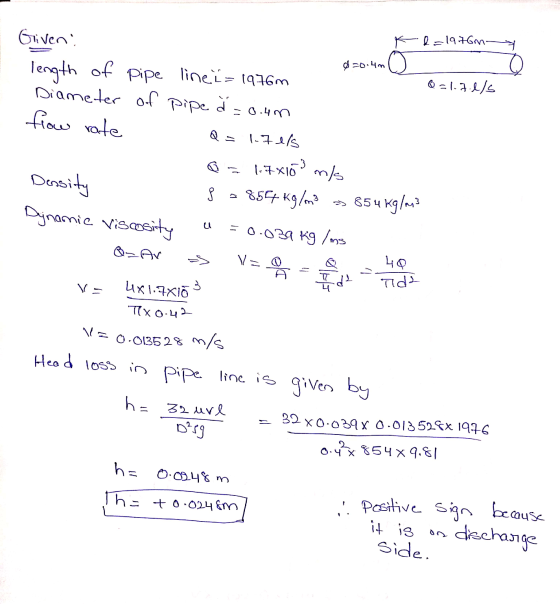
QUESTION 2 Calculate the head loss in an oil pipe line of length 1,976 m and...
QUESTION 2
-
Calculate the head loss in an oil pipe line of length 1,976 m and diameter 0.4 m for a flow rate of 1.7 l/s.
Density: 854 kg/m3 ; dynamic viscosity: 0.039 kg/ (ms)
Give the answer in metre fluid head to +/- 0.0001 m.
Homework Answers
Add Answer to:
QUESTION 2
Calculate the head loss in an oil pipe line of length 1,976 m
and...
1. Calculate the experimental head loss from the readings taken in the manometer below and compare...
 1. Calculate the experimental head loss from the
readings taken in the manometer below and compare them with
theoretical predictions. NOTE: The table is only provided
for inputting the answers. The only given parameters are the
temperature of the water, flow rate and manometer reading.
Calculate the velocity, Reynolds Number, Darcy Friction
Factor, Theoretical Head Loss and Experimental Head
Loss.
2. Compare the differences of using a
Moody Chart and the Haaland Approximation
of the Darcy Friction Factor by calculating...
1. Calculate the experimental head loss from the
readings taken in the manometer below and compare them with
theoretical predictions. NOTE: The table is only provided
for inputting the answers. The only given parameters are the
temperature of the water, flow rate and manometer reading.
Calculate the velocity, Reynolds Number, Darcy Friction
Factor, Theoretical Head Loss and Experimental Head
Loss.
2. Compare the differences of using a
Moody Chart and the Haaland Approximation
of the Darcy Friction Factor by calculating...
(a) A horizontal pipe of diameter 10 cm carries crude oil from A to C as...
 (a) A horizontal pipe of diameter 10 cm carries crude oil from A
to C as shown in Figure 4. At a point B, midway between A and C,
oil leaks at a volume flow rate of QL . The pressure
drop per unit length along AB is 640 Pa/m and along BC is 600 Pa/m.
Determine the leakage flow rate QL . The density of oil
is 800 kg/m3 and its dynamic viscosity is 0.1 N.s/
m2 . You...
(a) A horizontal pipe of diameter 10 cm carries crude oil from A
to C as shown in Figure 4. At a point B, midway between A and C,
oil leaks at a volume flow rate of QL . The pressure
drop per unit length along AB is 640 Pa/m and along BC is 600 Pa/m.
Determine the leakage flow rate QL . The density of oil
is 800 kg/m3 and its dynamic viscosity is 0.1 N.s/
m2 . You...
2. The kinetic viscosity of a hydraulic oil is 110cP. The oil is flowing in a 20-mm diameter commercial steel pipe with the length of 45-m. If the velocity of oil is 4-m/s and specific gravity is...
 2. The kinetic viscosity of a hydraulic oil is 110cP. The oil is flowing in a 20-mm diameter commercial steel pipe with the length of 45-m. If the velocity of oil is 4-m/s and specific gravity is 0.9 find the following a. Reynolds number b. Friction factor c. Head losses.
2. The kinetic viscosity of a hydraulic oil is 110cP. The oil is flowing in a 20-mm diameter commercial steel pipe with the length of 45-m. If the velocity of...
2. The kinetic viscosity of a hydraulic oil is 110cP. The oil is flowing in a 20-mm diameter commercial steel pipe with the length of 45-m. If the velocity of oil is 4-m/s and specific gravity is 0.9 find the following a. Reynolds number b. Friction factor c. Head losses.
2. The kinetic viscosity of a hydraulic oil is 110cP. The oil is flowing in a 20-mm diameter commercial steel pipe with the length of 45-m. If the velocity of...
LECTURE Sp 1. Oil (relative density 0.85, dynamic viscosity-4.5x10⁻²kg/m-s) flows through a 75 mm diameter pipe...
 LECTURE Sp 1. Oil (relative density 0.85, dynamic viscosity-4.5x10⁻²kg/m-s) flows through a 75 mm diameter pipe with a mean velocity of 0.65 m/s. Determine i. the pressure drop in a 500 m length, ii- the friction factor, ii the head loss due to friction, iv. the maximunn velocity, and v. the velocity at 30 mm from the pipe wall. (10 marks) 46 2 9 3 8 4 5 6
4. In a cylindrical pipe of uniform diameter D, the pressure loss per unit length (pa/m)...
 4. In a cylindrical pipe of uniform diameter D, the pressure loss per unit length (pa/m) due to viscous effects can be computed using the Darcy-Weisbach equation: Use a first order error analysis to determine the error in the pressure loss for a fluid of with density ρ=876±3 kg/m3 flowing in a pipe of diameter D 0.45 ±0.001 m with a mean velocity of u 10t0.1 m/s. The Darcy-Weisbach factor is gives as fp 0.064 ves as JD
Sulphuric acid is flowing through a pipe (2.5 inch diameter, 50 ft length) in a velocity...
Sulphuric acid is flowing through a pipe (2.5 inch diameter, 50 ft length) in a velocity of 0.006 m3 /s. The sulphuric acid has a viscosity of 25 mN.s/m2 and density of 1680 kg/m3 while the roughness of the pipe surface is 1.3 mm. If the operating temperature is 290K, determine fluid flow (i.e. laminar, turbulent or others). (Given that 1 m = 39.37 inch).
Problem 1. Water flows from a large tank through a smooth pipe of length 80 m....
 Problem 1. Water flows from a large tank through a smooth pipe of length 80 m. Both the tank free surface and jet exit are exposed to the atmosphere. Take the density of water p = 1000 kg/m3, dynamic viscosity of water u = 0.001 kg/m.s, atmospheric pressure = 100 kPa, and gravity = 9.8 m/s2. Calculate the volumetric flow rate through the pipe. Neglect entrance losses to the pipe. Hint: Consider the inlet and outlet sections of the pipe...
help Fluid enters to the section of the pipe as shown in the figure below. Density...
 help
Fluid enters to the section of the pipe as shown in the figure below. Density and dynamic viscosity of the fluid are 1000 kg/mº and 8.90 x 10⁻⁴ Pa's respectively. A pressure of the fluid at point A is 30 kPa and diameter of the pipe is 100 mm. Find the volumetric flow rate of the fluid at B. Flow is laminar and viscous, consider the pressure loss. 4 m B 100 mm
help
Fluid enters to the section of the pipe as shown in the figure below. Density and dynamic viscosity of the fluid are 1000 kg/mº and 8.90 x 10⁻⁴ Pa's respectively. A pressure of the fluid at point A is 30 kPa and diameter of the pipe is 100 mm. Find the volumetric flow rate of the fluid at B. Flow is laminar and viscous, consider the pressure loss. 4 m B 100 mm
A pipeline transports oil, featuring the parameters given below. Determine the head loss (ℎ?) in the...
A pipeline transports oil, featuring the parameters given below. Determine the head loss (ℎ?) in the pipeline. f = 0.009 (friction factor) l = 480m (length of pipe) u = 0.8m.s-1 (velocity of fluid) g = 9.81m.s-2 (acceleration due to gravity) d = 0.24m (diameter of the pipe)
Problem 1. Water flows from a large tank through a smooth pipe of length 80 m....
 Problem 1. Water flows from a large tank through a smooth pipe of length 80 m. Both the tank free surface and jet exit are exposed to the atmosphere. Take the density of water p = 1000 kg/m3, dynamic viscosity of water j = 0.001 kg/m.s, atmospheric pressure = 100 kPa, and gravity = 9.8 m/s2. Calculate the volumetric flow rate through the pipe. Neglect entrance losses to the pipe. Hint: Consider the inlet and outlet sections of the pipe...
 1. Calculate the experimental head loss from the
readings taken in the manometer below and compare them with
theoretical predictions. NOTE: The table is only provided
for inputting the answers. The only given parameters are the
temperature of the water, flow rate and manometer reading.
Calculate the velocity, Reynolds Number, Darcy Friction
Factor, Theoretical Head Loss and Experimental Head
Loss.
2. Compare the differences of using a
Moody Chart and the Haaland Approximation
of the Darcy Friction Factor by calculating...
1. Calculate the experimental head loss from the
readings taken in the manometer below and compare them with
theoretical predictions. NOTE: The table is only provided
for inputting the answers. The only given parameters are the
temperature of the water, flow rate and manometer reading.
Calculate the velocity, Reynolds Number, Darcy Friction
Factor, Theoretical Head Loss and Experimental Head
Loss.
2. Compare the differences of using a
Moody Chart and the Haaland Approximation
of the Darcy Friction Factor by calculating...
 (a) A horizontal pipe of diameter 10 cm carries crude oil from A
to C as shown in Figure 4. At a point B, midway between A and C,
oil leaks at a volume flow rate of QL . The pressure
drop per unit length along AB is 640 Pa/m and along BC is 600 Pa/m.
Determine the leakage flow rate QL . The density of oil
is 800 kg/m3 and its dynamic viscosity is 0.1 N.s/
m2 . You...
(a) A horizontal pipe of diameter 10 cm carries crude oil from A
to C as shown in Figure 4. At a point B, midway between A and C,
oil leaks at a volume flow rate of QL . The pressure
drop per unit length along AB is 640 Pa/m and along BC is 600 Pa/m.
Determine the leakage flow rate QL . The density of oil
is 800 kg/m3 and its dynamic viscosity is 0.1 N.s/
m2 . You...
 2. The kinetic viscosity of a hydraulic oil is 110cP. The oil is flowing in a 20-mm diameter commercial steel pipe with the length of 45-m. If the velocity of oil is 4-m/s and specific gravity is 0.9 find the following a. Reynolds number b. Friction factor c. Head losses.
2. The kinetic viscosity of a hydraulic oil is 110cP. The oil is flowing in a 20-mm diameter commercial steel pipe with the length of 45-m. If the velocity of...
2. The kinetic viscosity of a hydraulic oil is 110cP. The oil is flowing in a 20-mm diameter commercial steel pipe with the length of 45-m. If the velocity of oil is 4-m/s and specific gravity is 0.9 find the following a. Reynolds number b. Friction factor c. Head losses.
2. The kinetic viscosity of a hydraulic oil is 110cP. The oil is flowing in a 20-mm diameter commercial steel pipe with the length of 45-m. If the velocity of...
 LECTURE Sp 1. Oil (relative density 0.85, dynamic viscosity-4.5x10⁻²kg/m-s) flows through a 75 mm diameter pipe with a mean velocity of 0.65 m/s. Determine i. the pressure drop in a 500 m length, ii- the friction factor, ii the head loss due to friction, iv. the maximunn velocity, and v. the velocity at 30 mm from the pipe wall. (10 marks) 46 2 9 3 8 4 5 6
 4. In a cylindrical pipe of uniform diameter D, the pressure loss per unit length (pa/m) due to viscous effects can be computed using the Darcy-Weisbach equation: Use a first order error analysis to determine the error in the pressure loss for a fluid of with density ρ=876±3 kg/m3 flowing in a pipe of diameter D 0.45 ±0.001 m with a mean velocity of u 10t0.1 m/s. The Darcy-Weisbach factor is gives as fp 0.064 ves as JD
 Problem 1. Water flows from a large tank through a smooth pipe of length 80 m. Both the tank free surface and jet exit are exposed to the atmosphere. Take the density of water p = 1000 kg/m3, dynamic viscosity of water u = 0.001 kg/m.s, atmospheric pressure = 100 kPa, and gravity = 9.8 m/s2. Calculate the volumetric flow rate through the pipe. Neglect entrance losses to the pipe. Hint: Consider the inlet and outlet sections of the pipe...
 help
Fluid enters to the section of the pipe as shown in the figure below. Density and dynamic viscosity of the fluid are 1000 kg/mº and 8.90 x 10⁻⁴ Pa's respectively. A pressure of the fluid at point A is 30 kPa and diameter of the pipe is 100 mm. Find the volumetric flow rate of the fluid at B. Flow is laminar and viscous, consider the pressure loss. 4 m B 100 mm
help
Fluid enters to the section of the pipe as shown in the figure below. Density and dynamic viscosity of the fluid are 1000 kg/mº and 8.90 x 10⁻⁴ Pa's respectively. A pressure of the fluid at point A is 30 kPa and diameter of the pipe is 100 mm. Find the volumetric flow rate of the fluid at B. Flow is laminar and viscous, consider the pressure loss. 4 m B 100 mm
 Problem 1. Water flows from a large tank through a smooth pipe of length 80 m. Both the tank free surface and jet exit are exposed to the atmosphere. Take the density of water p = 1000 kg/m3, dynamic viscosity of water j = 0.001 kg/m.s, atmospheric pressure = 100 kPa, and gravity = 9.8 m/s2. Calculate the volumetric flow rate through the pipe. Neglect entrance losses to the pipe. Hint: Consider the inlet and outlet sections of the pipe...
Most questions answered within 3 hours.
-
Where is the error in this code sequence?
String s1 = "Hello";
String s2 = "ello";...
asked 11 months ago -
Financial data for Joel de Paris, Inc., for last year
follow:
Joel de Paris, Inc.
Balance...
asked 11 months ago -
Consider this reaction:
Al2(SO4)3 (aq)+ BaCl3
(aq) Al2Cl6 (aq)- +
3BaSO4(s) . What is the...
asked 11 months ago -
Suppose that Savneet is considering increasing her
recent random sample from 20 car rentals to 40...
asked 11 months ago -
Trucks arrive at an unloading terminal at an average rate of 120
per hour.
Trucks arrive...
asked 11 months ago -
Why are methanol and ethanol completely soluble in water while
octanol is not very little soluble....
asked 11 months ago -
A facilities manager at a university reads in a research report
that the mean amount of...
asked 11 months ago -
When the CuSO4 is rehydrated by adding water to the anhydrous
compound, is this an endothermic...
asked 11 months ago -
A ray of sunlight is passing from diamond into crown glass; the
angle of incidence is...
asked 11 months ago -
A block of mass 0.249 kg is placed on top of a light, vertical
spring of...
asked 11 months ago -
how do the kidneys compensate in the presences of acidosis
a) trigger hyperventilate
b) reserve acid...
asked 11 months ago -
Question 501 pts
The rental rate of capital to the firm increases. Which of the
following...
asked 11 months ago