Why is there a maximum in the rate of reaction with respect to conversion(hene with respect...
Why is there a maximum in the rate of reaction with respect to conversion(hene with respect to temperature and reactor volume) for an adiabatic reactor?
Homework Answers
Algorithm Adiabatic Reactions:
Suppose we have the Gas Phase Reaction

that follows an elementary rate law. To generate a Levenspiel plot to size CSTRs and PFRs we use the following steps or as we will see later use POLYMATH.
| 1. Choose X | |
| Calculate T |  |
| Calculate k |  |
| Calculate KC |  |
| Calculate To/T | |
| Calculate CA |  |
| Calculate CB |  |
| Calculate -rA |  |
| 2. Increment X and then repeat calculations. | |
3. When finished, plot vs. X or use some
numerical technique to find V. vs. X or use some
numerical technique to find V. |
|
 Levenspiel Plot for an exothermic, adiabatic reaction. Reactor Sizing We can now use the techniques developed in Chapter 2 to size reactors and reactors in series to compare and size CSTRs and PFRs. |
|
|
Consider:  |
|
|
PFR Shaded area is the volume. |
||
|
For an exit conversion of 40% |
For an exit conversion of 70% |
|
 |
 |
|
|
CSTR |
||
|
For an exit conversion of 40% |
For an exit conversion of 70% |
|
 |

|
|
|
We see for 40% conversion very little volume is
required. CSTR+PFR |
||
 |
 |
|
| (a) | (b) | |
|
For an intermediate conversion of 40% and exit conversion of 70% |
||
 |
 |
|
| (a) | (b) | |
 Shaded area is the
reactor volume.
Shaded area is the
reactor volume.Looks like the best arrangement is a CSTR with a 40% conversion followed by a PFR up to 70% conversion.
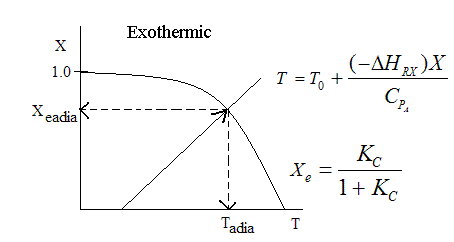
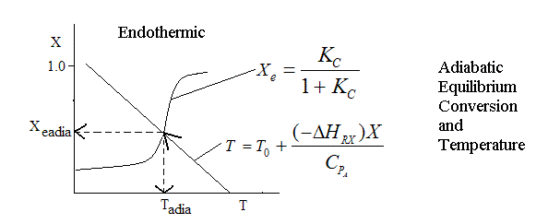
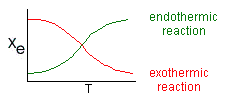
Adiabatic Equilibrium :
Conversion on Temperature
Exothermic ΔH is negative
Adiabatic Equilibrium temperature (Tadia) and conversion (Xeadia
Endothermic ΔH is positive
| Reversible Reactions : |
Consider the reversible gas phase elementary reaction.

The rate law for this gas phase reaction will follow an elementary rate law.
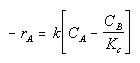
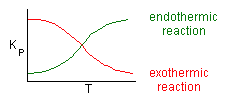
Where Kc is the concentration equilibrium constant. We know from Le Chaltlier's Law that if the reaction is exothermic, Kc will decrease as the temperature is increased and the reaction will be shifted back to the left. If the reaction is endothermic and the temperature is increased, Kcwill increase and the reaction will shift to the right.
at equilibrium
 |
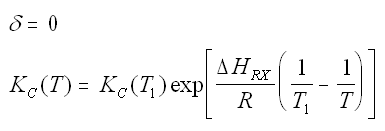
Van't Hoff Equation
|
|
For the special case of Integrating the Van't Hoff Equation gives: |
|
 |
|

 :
:
GLOSSARY :
Adiabatic reactor: Vessel that is well insulated to minimize heat transfer and has an
increase or decrease in temperature from the initial inlet conditions due solely to the
heats of reaction.
Batch reactor: Vessel used for chemical reaction that has no feed or effluent streams.
The reactor is well stirred and usually run either isothermally or adiabatically. The
main design variable is how much time the reactants are allowed to remain in the
reactor to achieve the desired level of conversion.
Catalyst: Substance that increases the rate of a chemical reaction without being
consumed in the reaction.
Continuous stirred tank reactor: Sometimes called a continuous-flow stirred-tank
reactor, ideal mixer, or mixed-flow reactor, all describing reactors with continuous
input and output of material. The outlet concentration is assumed to be the same as
the concentration at any point in the reactor.
Conversion: Fraction or percentage that describes the extent of a chemical reaction.
Conversion is calculated by dividing the number of moles of a reactant that reacted
by the initial moles of reactant. Conversion is defined only in terms of a reactant.
Elementary reaction: Reaction that has a rate equation that can be written directly
from a knowledge of the stoichiometry.
Isothermal reactor: Any type of chemical reactor operated at constant temperature.
Mean residence time: Average time molecules remain in the reactor. Note that this is
different from space time.
Multiple reactions: Series or parallel reactions that take place simultaneously in a
reactor. For example, A + B → C and A + D → E are parallel reactions, and A + B
→ C + D → E + F are series reactions.
Plug flow reactor: Sometimes called a piston flow or a perfect flow reactor. The plug
flow reactor has continuous input and output of material. The plug flow assumption
generally requires turbulent flow. No radial concentration gradients are assumed.
Product distribution: Fraction or percent of products in the reactor effluent.
Rate constant: Constant that allows the proportionality between rate and concentration
to be written as a mathematical relationship.
Reactor Classifications :
Reactors may be classified by several different methods depending on the variables of
interest. There is no single clear cut procedure for reactor classification. As a result,
several of the more common classification schemes are presented here.
A. OPERATION TYPE
The operational configuration for the reactor can be a primary method of classification.
1. Batch
Batch reactors are operated with all the material placed in the
reactor prior to the start of
reaction, and all the material is removed after the reaction has been completed. There is
no addition or withdrawal of material during the reaction process.
Semibatch
The semibatch reactor combines attributes of the batch and the continuous-stirred tank.
The reactor is essentially batch but has either a continuous input or output stream during
operation.
3. Continuous Flow Reactors
Continuous flow reactors represent the largest group of reactor types by operational
classification. Several continuous flow reactors are used industrially.
a. The continuous-stirred tank reactor (CSTR) involves feeding reactants into a
wellmixed tank with simultaneous product removal.
b. The plug flow reactor (PFR) consists of a long pipe or tube. The reacting mixture
moves down the tube resulting in a change in concentration down the length of the
reactor.
c. In the recycle reactor part of the outlet stream is returned to the inlet of the reactor.
Although not a typical reactor classification by type, the recycle reactor allows for
continuous operation in regimes between CSTR and PFR conditions.
Add Answer to:
Why is there a maximum in the rate of reaction with respect to
conversion(hene with respect...
QUESTION 2: Design of Multiple Reactors: 30 marks B +C was a a) An elementary reaction...
 QUESTION 2: Design of Multiple Reactors: 30 marks B +C was a a) An elementary reaction A reaction A B +C was carried out in a reactor system using an ideal STR followed by an ideal PER Isothermany. The rate constant is k = 0.4 min ". The volumetric flow rate is 20 L/min. The concentration of A in the feed is 5 moles/L. 1. Calculate the volume of the CSTR necessary to achieve a conversion of 50%. (7 marks)...
3. The endothemic irreversible 2nd order reaction A +B C is carried out in a pressurised...
 3. The endothemic irreversible 2nd order reaction A +B C is carried out in a pressurised adiabatic batch reactor. The initial temperature is 120°C and the initial concentrations of both A and B are 2.0 kmol m2 Kinetic studies showed that the reaction rate constant is given by: 6000 k 2 x 10⁵ exp(- m3kmol 1s1 T (8) (a) Derive the mass and energy balances for the reactor. Calculate the conversion achieved and the reactor temperature (b) (12) after 30...
The elementary gas phase reaction (A <--> 2B) is to be carried out in an adiabatic...
The elementary gas phase reaction (A <--> 2B) is to be carried out in an adiabatic CSTR. The feed which is at a temperature of 27oC, consists of 80% of A and the remainder inerts. The volumetric flow rate entering the reactor at this temperature is 100 l/min. The concentration of A in the feed at 27oC is 0.5 mol/liter. For 80% of the adiabatic equilibrium conversion, calculate the required reactor volume. DATA: CpA=12 J/mol.K; CpB=10 J/mol.K; CpI=15 J/mol.K deltaHrxn=-75000...
PLEASE HELP!! Consider an adiabatic constant pressure batch reactor for the following ideal gas phase reaction:...
 PLEASE HELP!!
Consider an adiabatic constant pressure batch reactor for the following ideal gas phase reaction: 2. A—В+С The reactor initial composition is of 50 mol% A and 50 mol% inert material. The initial reactor temperature is 300 K and the pressure is 101.325 kPa. The reaction rate is: -2,500 (-) kCwhere k=exp| Т The enthalpy of reaction can be assumed constant at -5,000 J/mol. The heat capacities are assumed to be constant, with the following values: В: 5 mol...
PLEASE HELP!!
Consider an adiabatic constant pressure batch reactor for the following ideal gas phase reaction: 2. A—В+С The reactor initial composition is of 50 mol% A and 50 mol% inert material. The initial reactor temperature is 300 K and the pressure is 101.325 kPa. The reaction rate is: -2,500 (-) kCwhere k=exp| Т The enthalpy of reaction can be assumed constant at -5,000 J/mol. The heat capacities are assumed to be constant, with the following values: В: 5 mol...
1. Consider the following irreversible, zero-order, liquid-phase reaction: A ➝ B. The reaction is strongly exothermic,...
1. Consider the following irreversible, zero-order, liquid-phase reaction: A ➝ B. The reaction is strongly exothermic, or ∆???? ? ≪ 0. For a given conversion XA, would an adiabatic CSTR and an adiabatic PFR require the same volume? If not, which reactor requires less volume? Justify your answer physically.
What is the equations to design Plug Flow Reactor of Adiabatic operation . if the reaction...
What is the equations to design Plug Flow Reactor of Adiabatic operation . if the reaction is in gas phase and first order .Please provide me with all the equation of (volume,material balance for each material,calculate the temperature,Volumetric flowrate,Molar flowrate ,Mass flowrate and conversion )
. Question 2: The elementary, reversible, organic, liquid-phase reaction is carried out adiabatically in a CSTR...
 .
Question 2: The elementary, reversible, organic, liquid-phase reaction is carried out adiabatically in a CSTR where 65% conversion is achiewd Ated'anonn of A and 50% excess 8, enters the reactor at 27°C with a volumetric flow rate of 2 L/s and a Cos of O.1 mol/L culate the temperature inside the reactor 2. Calculate the equilibrium conversion at the operating temperature. How close (in 3. Calculate the CSTR volume percentage) the conversion is from the equilsbrium conversion? If the...
.
Question 2: The elementary, reversible, organic, liquid-phase reaction is carried out adiabatically in a CSTR where 65% conversion is achiewd Ated'anonn of A and 50% excess 8, enters the reactor at 27°C with a volumetric flow rate of 2 L/s and a Cos of O.1 mol/L culate the temperature inside the reactor 2. Calculate the equilibrium conversion at the operating temperature. How close (in 3. Calculate the CSTR volume percentage) the conversion is from the equilsbrium conversion? If the...
QUESTION 1: 20 marks 20 points It is planned to carry out the following second-order, elementary,...
 QUESTION 1: 20 marks 20 points It is planned to carry out the following second-order, elementary, non- catalytic gas-phase reaction in an adiabatic CSTR: A+B_C+3D. Only A and B (no inerts) are fed to the reactor at equimolar flow rates of 150 mol/min each. The rate constant is related to the temperature by Arrhenius law as follows: k = 37.68x10^10 exp(-80000/RT) L/mol.min. The heats of formation of A, B, C and D (at 298 K) in kJ/mol are -235.3, -393.5,...
Question 4. A gas phase reaction of the type A+B - C, is to be carried...
 Question 4. A gas phase reaction of the type A+B - C, is to be carried out isothermally in a PFR. A feed consisting of 90% of A and 10% of B enters the reactor at a temperature of 27 °C and 10 atm. The reaction is second order with respect to A and zero order with respect to B. The rate constant, ka, is 1.5 dm²/mol.s. a) Calculate the volume required to achieve 60% conversion of A for an...
The irreversible gas phase rxn, A=> B+C is performed in an adiabatic, 800‐liter PFR with a rate...
 The irreversible gas phase rxn, A=> B+C is performed in
an adiabatic, 800‐liter PFR with a rate constant, k, as
below: k=60*exp(‐5000/T) s‐1 The feed is pure A at 15 bar and 450 K
with a volumetric flow rate of 1.956 L/s. The heat of
rxnis ‐12 kJ/mol(independent of temperature), heat
capacities are CPA= 40 J/mol/K, CPB= 15 J/mol/K, and CPC
= 25 J/mol/K. The reaction is operated at constant
pressure Plot (a) FAand FBversus reactor volume (b) Temperature
versus reactor volume (c) volumetric flow...
The irreversible gas phase rxn, A=> B+C is performed in
an adiabatic, 800‐liter PFR with a rate constant, k, as
below: k=60*exp(‐5000/T) s‐1 The feed is pure A at 15 bar and 450 K
with a volumetric flow rate of 1.956 L/s. The heat of
rxnis ‐12 kJ/mol(independent of temperature), heat
capacities are CPA= 40 J/mol/K, CPB= 15 J/mol/K, and CPC
= 25 J/mol/K. The reaction is operated at constant
pressure Plot (a) FAand FBversus reactor volume (b) Temperature
versus reactor volume (c) volumetric flow...
 QUESTION 2: Design of Multiple Reactors: 30 marks B +C was a a) An elementary reaction A reaction A B +C was carried out in a reactor system using an ideal STR followed by an ideal PER Isothermany. The rate constant is k = 0.4 min ". The volumetric flow rate is 20 L/min. The concentration of A in the feed is 5 moles/L. 1. Calculate the volume of the CSTR necessary to achieve a conversion of 50%. (7 marks)...
 3. The endothemic irreversible 2nd order reaction A +B C is carried out in a pressurised adiabatic batch reactor. The initial temperature is 120°C and the initial concentrations of both A and B are 2.0 kmol m2 Kinetic studies showed that the reaction rate constant is given by: 6000 k 2 x 10⁵ exp(- m3kmol 1s1 T (8) (a) Derive the mass and energy balances for the reactor. Calculate the conversion achieved and the reactor temperature (b) (12) after 30...
 PLEASE HELP!!
Consider an adiabatic constant pressure batch reactor for the following ideal gas phase reaction: 2. A—В+С The reactor initial composition is of 50 mol% A and 50 mol% inert material. The initial reactor temperature is 300 K and the pressure is 101.325 kPa. The reaction rate is: -2,500 (-) kCwhere k=exp| Т The enthalpy of reaction can be assumed constant at -5,000 J/mol. The heat capacities are assumed to be constant, with the following values: В: 5 mol...
PLEASE HELP!!
Consider an adiabatic constant pressure batch reactor for the following ideal gas phase reaction: 2. A—В+С The reactor initial composition is of 50 mol% A and 50 mol% inert material. The initial reactor temperature is 300 K and the pressure is 101.325 kPa. The reaction rate is: -2,500 (-) kCwhere k=exp| Т The enthalpy of reaction can be assumed constant at -5,000 J/mol. The heat capacities are assumed to be constant, with the following values: В: 5 mol...
 .
Question 2: The elementary, reversible, organic, liquid-phase reaction is carried out adiabatically in a CSTR where 65% conversion is achiewd Ated'anonn of A and 50% excess 8, enters the reactor at 27°C with a volumetric flow rate of 2 L/s and a Cos of O.1 mol/L culate the temperature inside the reactor 2. Calculate the equilibrium conversion at the operating temperature. How close (in 3. Calculate the CSTR volume percentage) the conversion is from the equilsbrium conversion? If the...
.
Question 2: The elementary, reversible, organic, liquid-phase reaction is carried out adiabatically in a CSTR where 65% conversion is achiewd Ated'anonn of A and 50% excess 8, enters the reactor at 27°C with a volumetric flow rate of 2 L/s and a Cos of O.1 mol/L culate the temperature inside the reactor 2. Calculate the equilibrium conversion at the operating temperature. How close (in 3. Calculate the CSTR volume percentage) the conversion is from the equilsbrium conversion? If the...
 QUESTION 1: 20 marks 20 points It is planned to carry out the following second-order, elementary, non- catalytic gas-phase reaction in an adiabatic CSTR: A+B_C+3D. Only A and B (no inerts) are fed to the reactor at equimolar flow rates of 150 mol/min each. The rate constant is related to the temperature by Arrhenius law as follows: k = 37.68x10^10 exp(-80000/RT) L/mol.min. The heats of formation of A, B, C and D (at 298 K) in kJ/mol are -235.3, -393.5,...
 Question 4. A gas phase reaction of the type A+B - C, is to be carried out isothermally in a PFR. A feed consisting of 90% of A and 10% of B enters the reactor at a temperature of 27 °C and 10 atm. The reaction is second order with respect to A and zero order with respect to B. The rate constant, ka, is 1.5 dm²/mol.s. a) Calculate the volume required to achieve 60% conversion of A for an...
 The irreversible gas phase rxn, A=> B+C is performed in
an adiabatic, 800‐liter PFR with a rate constant, k, as
below: k=60*exp(‐5000/T) s‐1 The feed is pure A at 15 bar and 450 K
with a volumetric flow rate of 1.956 L/s. The heat of
rxnis ‐12 kJ/mol(independent of temperature), heat
capacities are CPA= 40 J/mol/K, CPB= 15 J/mol/K, and CPC
= 25 J/mol/K. The reaction is operated at constant
pressure Plot (a) FAand FBversus reactor volume (b) Temperature
versus reactor volume (c) volumetric flow...
The irreversible gas phase rxn, A=> B+C is performed in
an adiabatic, 800‐liter PFR with a rate constant, k, as
below: k=60*exp(‐5000/T) s‐1 The feed is pure A at 15 bar and 450 K
with a volumetric flow rate of 1.956 L/s. The heat of
rxnis ‐12 kJ/mol(independent of temperature), heat
capacities are CPA= 40 J/mol/K, CPB= 15 J/mol/K, and CPC
= 25 J/mol/K. The reaction is operated at constant
pressure Plot (a) FAand FBversus reactor volume (b) Temperature
versus reactor volume (c) volumetric flow...
Most questions answered within 3 hours.
-
Where is the error in this code sequence?
String s1 = "Hello";
String s2 = "ello";...
asked 11 months ago -
Financial data for Joel de Paris, Inc., for last year
follow:
Joel de Paris, Inc.
Balance...
asked 11 months ago -
Consider this reaction:
Al2(SO4)3 (aq)+ BaCl3
(aq) Al2Cl6 (aq)- +
3BaSO4(s) . What is the...
asked 11 months ago -
Suppose that Savneet is considering increasing her
recent random sample from 20 car rentals to 40...
asked 11 months ago -
Trucks arrive at an unloading terminal at an average rate of 120
per hour.
Trucks arrive...
asked 11 months ago -
Why are methanol and ethanol completely soluble in water while
octanol is not very little soluble....
asked 11 months ago -
A facilities manager at a university reads in a research report
that the mean amount of...
asked 11 months ago -
When the CuSO4 is rehydrated by adding water to the anhydrous
compound, is this an endothermic...
asked 11 months ago -
A ray of sunlight is passing from diamond into crown glass; the
angle of incidence is...
asked 11 months ago -
A block of mass 0.249 kg is placed on top of a light, vertical
spring of...
asked 11 months ago -
how do the kidneys compensate in the presences of acidosis
a) trigger hyperventilate
b) reserve acid...
asked 11 months ago -
Question 501 pts
The rental rate of capital to the firm increases. Which of the
following...
asked 11 months ago