

Homework Answers
Add Answer to:
This is a genetic question
Question 1 (1 point) Pop. 1 Pop. 2 Pop. 3 P....
This is a genetic question Question 2 (1 point) Pop. 1 Pop. 2 Pop. 3 p....
 This is a genetic question
Question 2 (1 point) Pop. 1 Pop. 2 Pop. 3 p. 0,100 0,500 0,250 Starting conditions g. 0,900 0,500 0,750 WA 0,500 0,000 0,500 Selection W. 0.000 0.500 1,000 (fitness) We 0.500 0,990 0,350 Drift TN 33 1 000 30 000 On Off In this simulation scenario, indicate the starting selection (fitness) value for (1) population 1, (2) population 2 and (3) population 3. Each numerical value should contain exactly two digits after the decimal...
This is a genetic question
Question 2 (1 point) Pop. 1 Pop. 2 Pop. 3 p. 0,100 0,500 0,250 Starting conditions g. 0,900 0,500 0,750 WA 0,500 0,000 0,500 Selection W. 0.000 0.500 1,000 (fitness) We 0.500 0,990 0,350 Drift TN 33 1 000 30 000 On Off In this simulation scenario, indicate the starting selection (fitness) value for (1) population 1, (2) population 2 and (3) population 3. Each numerical value should contain exactly two digits after the decimal...
Question 2 (1 point) Pop. 1 Pop. 2 Pop. 3 P. 0,250 0,900 Starting 0,600 conditions...
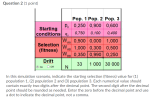 Question 2 (1 point) Pop. 1 Pop. 2 Pop. 3 P. 0,250 0,900 Starting 0,600 conditions q 0,750 0,100 0,400 WA 0,500 0,000 1,000 Selection (fitness) AB 1,000 0,300 0,500 W38 0,350 0,990 0,250 Drift T 33 1 000 30 000 Oon O Off N 33 1 000 30 000 In this simulation scenario, indicate the starting selection (fitness) value for (1) population 1, (2) population 2 and (3) population 3. Each numerical value should contain exactly two digits after...
Question 8 (0.66 points) You are studying a genetic system involving two unlinked genes affecting the...
 Question 8 (0.66 points) You are studying a genetic system involving two unlinked genes affecting the color of ascospores in Sordaria fimicola. The X gene is located at a genetic distance of 6 CM and the Y gene is located at a genetic distance of 41 CM. In the general genetic model, what would be the EXPECTED FREQUENCY of (1) PD asci (submission box 1), NPD asci (box 2) and Tasci (submission box 3)? Each numerical value should contain exactly...
CO Question 1 of 3 (1 point) View problem in a pop-up 11.1 Section Exercise 6...
 CO Question 1 of 3 (1 point) View problem in a pop-up 11.1 Section Exercise 6 (p-value, calc) A medical researcher wishes to see if hospital patients in a large hospital have the same blood type distribution as those in the general population. The distribution for the general population is as follows: type A, 20%; type B, 28%; type 0, 26%; and type AB = 26%. He selects a random sample of 50 patients and finds the following: 10 have...
Question 7 of 9 (1 point) View problem in a pop-up 7.1 Section Exercise 11 For...
 Question 7 of 9 (1 point) View problem in a pop-up 7.1 Section Exercise 11 For a random sample of 70 overweight men, the mean of the number of pounds that they were overweight was 30. The standard deviation of the population is 4.4 pounds. Round intermediate answers to at least three decimal places. Round your final answers to one decimal place. Part 1 out of 4 The best point estimate of the mean is pounds. CHECK NEXT 7.1 Section...
Question 2 of 5 (1 point) View problem in a pop-UR 8.2 Section Exercise 17-20 (table...
 Question 2 of 5 (1 point) View problem in a pop-UR 8.2 Section Exercise 17-20 (table A sample of size 52 has sample mean x = 53.4 and sample deviations -- 9.4. Part 1 Construct a 90% confidence interval for the population mean w. Round the answers to one decimal place. A 90% confidence interval for the population mean 4 is S.A. <<55.6 Part 2 out of 2 If the sample size were * = 48. would the confidence interval...
Question 7 of 9 (1 point) View problem in a pop-up 7.1 Section Exercise 11 For...
 Question 7 of 9 (1 point) View problem in a pop-up 7.1 Section Exercise 11 For a random sample of 70 overweight men, the mean of the number of pounds that they were overweight was 30. The standard deviation of the population is 4.4 pounds. Round intermediate answers to at least three decimal places. Round your final answers to one decimal place. Part 1 The best point estimate of the mean is 30.0 pounds. Part 2 out of 4 Find...
Question 4 of 5 (1 point) View problem in a pop-up Find the critical value ta/2...
 Question 4 of 5 (1 point) View problem in a pop-up Find the critical value ta/2 needed to construct a confidence interval of the given level with the given sample size. Round the answers to three decimal places. Part 1 For level 90% and sample size 7 Critical value-1.943 Part 2 For level 98% and sample size 11 Critical value =2.764 Part 3 out of 4 For level 95% and sample size 25 Criticeal value- CHECK NEXT
Question 7 of 9 (1 point) View problem in a pop-up 7.1 Section Exercise 11 For...
 Question 7 of 9 (1 point) View problem in a pop-up 7.1 Section Exercise 11 For a random sample of 70 overweight men, the mean of the number of pounds that they were overweight was 30. The standard deviation of the population is 4.4 pounds. Round intermediate answers to at least three decimal places. Round your final answers to one decimal place. Part 1 The best point estimate of the mean is 30.0 pounds. Part 2 Find the 90% confidence...
Question 2 of 10 (1 point) View problem in a pop-up The average "moviegoer" sees 8.5...
 Question 2 of 10 (1 point) View problem in a pop-up The average "moviegoer" sees 8.5 movies a year. A moviegoer is defined as a person who sees at least one movie in a theater in a 12-month period. A random sample of 46 moviegoers from a large university revealed that the average number of movies seen per person was 10.1. The population standard deviation is 3.2 movies. At the 0.05 level of significance, can it be concluded that this...
 This is a genetic question
Question 2 (1 point) Pop. 1 Pop. 2 Pop. 3 p. 0,100 0,500 0,250 Starting conditions g. 0,900 0,500 0,750 WA 0,500 0,000 0,500 Selection W. 0.000 0.500 1,000 (fitness) We 0.500 0,990 0,350 Drift TN 33 1 000 30 000 On Off In this simulation scenario, indicate the starting selection (fitness) value for (1) population 1, (2) population 2 and (3) population 3. Each numerical value should contain exactly two digits after the decimal...
This is a genetic question
Question 2 (1 point) Pop. 1 Pop. 2 Pop. 3 p. 0,100 0,500 0,250 Starting conditions g. 0,900 0,500 0,750 WA 0,500 0,000 0,500 Selection W. 0.000 0.500 1,000 (fitness) We 0.500 0,990 0,350 Drift TN 33 1 000 30 000 On Off In this simulation scenario, indicate the starting selection (fitness) value for (1) population 1, (2) population 2 and (3) population 3. Each numerical value should contain exactly two digits after the decimal...
 Question 2 (1 point) Pop. 1 Pop. 2 Pop. 3 P. 0,250 0,900 Starting 0,600 conditions q 0,750 0,100 0,400 WA 0,500 0,000 1,000 Selection (fitness) AB 1,000 0,300 0,500 W38 0,350 0,990 0,250 Drift T 33 1 000 30 000 Oon O Off N 33 1 000 30 000 In this simulation scenario, indicate the starting selection (fitness) value for (1) population 1, (2) population 2 and (3) population 3. Each numerical value should contain exactly two digits after...
 Question 8 (0.66 points) You are studying a genetic system involving two unlinked genes affecting the color of ascospores in Sordaria fimicola. The X gene is located at a genetic distance of 6 CM and the Y gene is located at a genetic distance of 41 CM. In the general genetic model, what would be the EXPECTED FREQUENCY of (1) PD asci (submission box 1), NPD asci (box 2) and Tasci (submission box 3)? Each numerical value should contain exactly...
 CO Question 1 of 3 (1 point) View problem in a pop-up 11.1 Section Exercise 6 (p-value, calc) A medical researcher wishes to see if hospital patients in a large hospital have the same blood type distribution as those in the general population. The distribution for the general population is as follows: type A, 20%; type B, 28%; type 0, 26%; and type AB = 26%. He selects a random sample of 50 patients and finds the following: 10 have...
 Question 7 of 9 (1 point) View problem in a pop-up 7.1 Section Exercise 11 For a random sample of 70 overweight men, the mean of the number of pounds that they were overweight was 30. The standard deviation of the population is 4.4 pounds. Round intermediate answers to at least three decimal places. Round your final answers to one decimal place. Part 1 out of 4 The best point estimate of the mean is pounds. CHECK NEXT 7.1 Section...
 Question 2 of 5 (1 point) View problem in a pop-UR 8.2 Section Exercise 17-20 (table A sample of size 52 has sample mean x = 53.4 and sample deviations -- 9.4. Part 1 Construct a 90% confidence interval for the population mean w. Round the answers to one decimal place. A 90% confidence interval for the population mean 4 is S.A. <<55.6 Part 2 out of 2 If the sample size were * = 48. would the confidence interval...
 Question 7 of 9 (1 point) View problem in a pop-up 7.1 Section Exercise 11 For a random sample of 70 overweight men, the mean of the number of pounds that they were overweight was 30. The standard deviation of the population is 4.4 pounds. Round intermediate answers to at least three decimal places. Round your final answers to one decimal place. Part 1 The best point estimate of the mean is 30.0 pounds. Part 2 out of 4 Find...
 Question 4 of 5 (1 point) View problem in a pop-up Find the critical value ta/2 needed to construct a confidence interval of the given level with the given sample size. Round the answers to three decimal places. Part 1 For level 90% and sample size 7 Critical value-1.943 Part 2 For level 98% and sample size 11 Critical value =2.764 Part 3 out of 4 For level 95% and sample size 25 Criticeal value- CHECK NEXT
 Question 7 of 9 (1 point) View problem in a pop-up 7.1 Section Exercise 11 For a random sample of 70 overweight men, the mean of the number of pounds that they were overweight was 30. The standard deviation of the population is 4.4 pounds. Round intermediate answers to at least three decimal places. Round your final answers to one decimal place. Part 1 The best point estimate of the mean is 30.0 pounds. Part 2 Find the 90% confidence...
 Question 2 of 10 (1 point) View problem in a pop-up The average "moviegoer" sees 8.5 movies a year. A moviegoer is defined as a person who sees at least one movie in a theater in a 12-month period. A random sample of 46 moviegoers from a large university revealed that the average number of movies seen per person was 10.1. The population standard deviation is 3.2 movies. At the 0.05 level of significance, can it be concluded that this...
Most questions answered within 3 hours.
-
Where is the error in this code sequence?
String s1 = "Hello";
String s2 = "ello";...
asked 10 months ago -
Financial data for Joel de Paris, Inc., for last year
follow:
Joel de Paris, Inc.
Balance...
asked 10 months ago -
Consider this reaction:
Al2(SO4)3 (aq)+ BaCl3
(aq) Al2Cl6 (aq)- +
3BaSO4(s) . What is the...
asked 10 months ago -
Suppose that Savneet is considering increasing her
recent random sample from 20 car rentals to 40...
asked 10 months ago -
Trucks arrive at an unloading terminal at an average rate of 120
per hour.
Trucks arrive...
asked 10 months ago -
Why are methanol and ethanol completely soluble in water while
octanol is not very little soluble....
asked 10 months ago -
A facilities manager at a university reads in a research report
that the mean amount of...
asked 10 months ago -
When the CuSO4 is rehydrated by adding water to the anhydrous
compound, is this an endothermic...
asked 10 months ago -
A ray of sunlight is passing from diamond into crown glass; the
angle of incidence is...
asked 10 months ago -
A block of mass 0.249 kg is placed on top of a light, vertical
spring of...
asked 10 months ago -
how do the kidneys compensate in the presences of acidosis
a) trigger hyperventilate
b) reserve acid...
asked 10 months ago -
Question 501 pts
The rental rate of capital to the firm increases. Which of the
following...
asked 10 months ago